
28 March 2026 — Prelude to a March: What the Together Alliance Won't Be Asking Tomorrow.
They want reform. Just not that one.

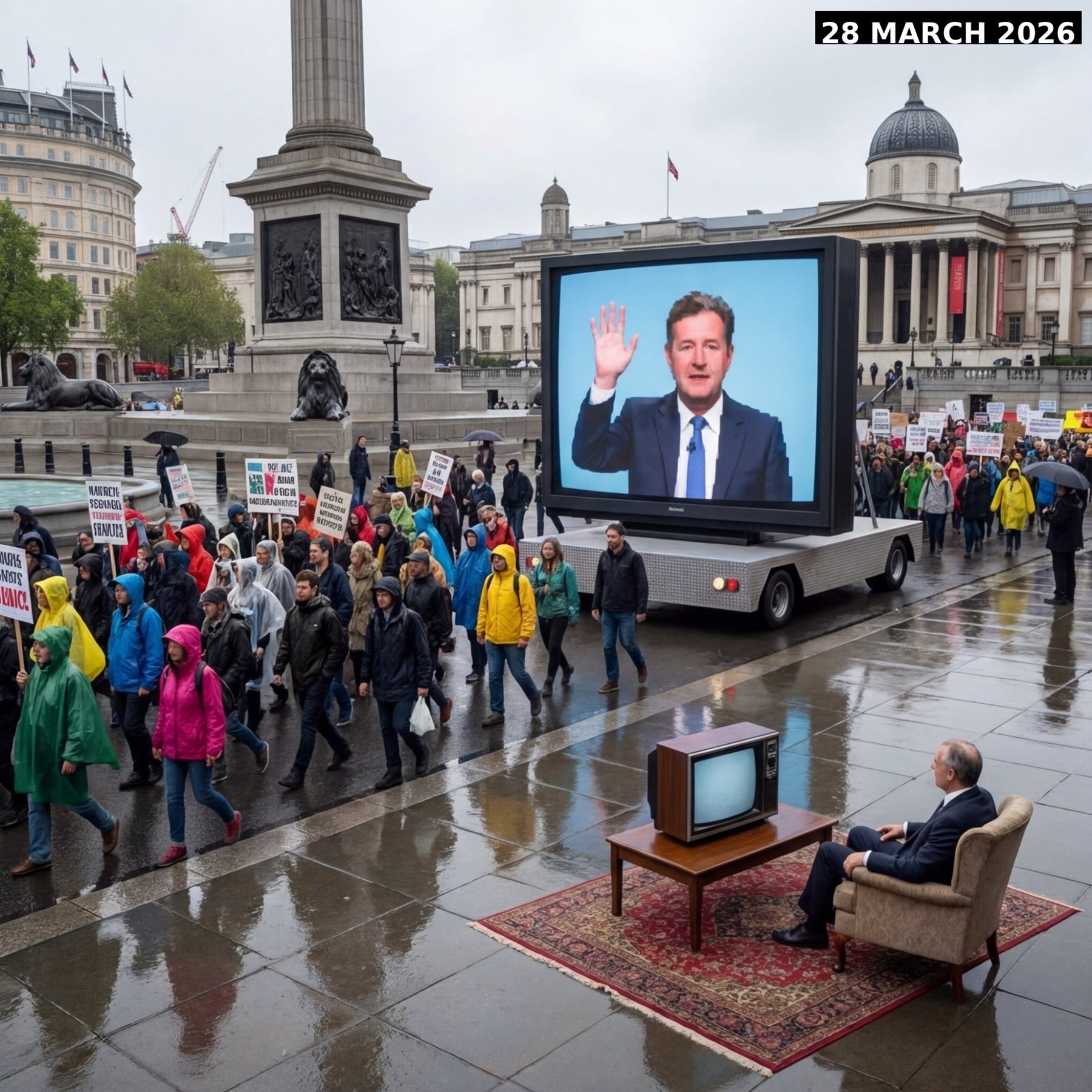
[together-alliance-march-london-28-march-2026-trafalgar-square.jpg]
Tomorrow, London gets a march. Well, they call it a march. Tens of thousands of people walking in an organised direction from Park Lane to Trafalgar Square, which is also tens of thousands of people blocking every road between Park Lane and Trafalgar Square while London cabbies collect swear words at a rate that won’t be matched until Christmas. As for the marchers themselves — if the brains were fully functioning, they wouldn’t be there at all.
But here we are.
The Together Alliance — and somebody sat up all night with a pen and paper to get to that one, presumably rejecting The Unity Collective and Friends Who Agree With Each Other before landing on something that sounds like a mid-nineties building society that got taken over by Halifax — has decided that Saturday the 28th of March 2026 is the day Britain draws the line. Against the far right. Against Reform UK, who are currently topping the polls and who must therefore be stopped by people walking in an organised direction through central London. While ordinary people head to the seaside for a day out, this lot have gone for a group hug through the streets of London instead and called it resistance. That’s the strategy. That’s the whole strategy. Walk.
In March, it’s a march. Come April, we’ll have a better word for it. A shower. A right shower of Herberts.
The framing was written months ago, probably in a room with a flipchart and someone with a lanyard. The far right is on the rise, Reform is scapegoating migrants, Muslims, refugees, therefore gather at noon, depart at one, speeches at two, music at three, home by six. The Together Alliance march in London on 28 March 2026 will, the organisers assure us, be historic. The BBC will call it significant. The counter will go up — fifty thousand, a hundred thousand, two hundred thousand, who’s actually checking — and by Sunday morning it will have been the biggest thing since the last biggest thing. And Reform, currently polling ahead of every other party in Britain, will still be topping the polls. Funny how that works, isn’t it?
Because here’s what a march doesn’t do. It doesn’t change a vote. It doesn’t answer the question of why people who spent twenty years voting Labour are now telling pollsters they’d vote for Nigel Farage. It doesn’t reckon — not for one honest second — with the decade-plus of managed decline in housing, wages, and public services that created the vacuum Reform walked into. And walked into easily, because the door was hanging off its hinges and nobody on the left had thought to ask why.
Reform didn’t create the conditions. Reform showed up and pointed at them. That’s the trick. Tomorrow, tens of thousands will march against the trick rather than against what made it work.
Now, about those speakers. Andy Burnham will be doing his serious face at the front. Zack Polanski of the Green Party will have something to say, at considerable length, about things he has no practical answer for. Steve Coogan will be joining on foot. And not a Partridge in sight. Though if you ask me, he’s missed a trick. What the Together Alliance march really needed was Alan Partridge doing a live outside broadcast for North Norfolk Digital. Mic in hand, commentary running, completely unaware that he is the story. And we’re live from Park Lane, great atmosphere, very much on the right side of history here — no pun intended — back to you in the studio. He hasn’t missed a trick. He’s missed his calling.
And Sadiq Khan — the Mayor of London, in whose city this is all taking place, whose roads are being blocked, whose buses are being rerouted, whose cabbies are collecting swear words at record rates — couldn’t make it. Sent a video message instead. A pre-recorded video message. To a march. In his own city. On a Saturday.
The Mayor of London couldn’t be there. He’d found less important things to do.
Maybe the dry cleaning needed collecting. Maybe the shoes needed a polish ready for Monday. Maybe it was the big weekly shop — Sainsbury’s, Tesco, Lidl, somewhere with a decent car park. What’s clear is that he sent a screen instead. A screen with a face on it. Which, when you think about it, just about sums up modern political leadership.
The TUC has seven million members and the political imagination of a car park. The Together Alliance’s fifty-plus organisations represent the same familiar web of unions, NGOs, and progressive bodies that have been losing ground to sensibility for fifteen years while issuing statements about hope over fear. Their answer to fifteen years of losing ground is a march.
Nobody’s making money from hope over fear. But somebody’s making money from the transport.
The only people with a guaranteed return on tomorrow aren’t the people Reform are scapegoating. They’re the coach operators — one hundred and twenty-five coaches booked, ten from Manchester alone — the food vendors, the placard makers, because someone printed all those signs and it wasn’t a volunteer with a felt tip, and above all the train companies. On the ticket and on the outcome. Someone always does, don’t they? Then there’s the media — cameras already positioned, a gift of a Saturday story that writes itself. And last but by no means least — Nigel Farage. Every image of that march is a recruitment poster for Reform. Nothing says the establishment is scared of us quite like the TUC organising a national demonstration against you.
Parliament has been in recess since Thursday. The people the march is aimed at are at home with their feet up. Not watching. Not listening. Not remotely inconvenienced. It’s the political equivalent of staging a protest outside a shop that’s closed. Because who exactly is listening, do you think?
The only audience paying attention are the people of London trying to get across town, whose buses are being rerouted and whose Saturday has been comprehensively ruined. They won’t have a single good word to say about any of it.
Then there’s what’s happening at the end. A free rave in Trafalgar Square. House Against Hate, presented by R3 Soundsystem — Reject, Revolt, Resist — with Hot Chip on the decks, Shygirl, Jon Hopkins, and a cast of dozens. A rave in Trafalgar Square won’t get past the Met. Bolt a soundsystem onto a march, call it House Against Hate, and suddenly you’ve got your party and nobody touches you for it. They didn’t march against the far right. They marched to a rave.
Forget the soundsystem. What Trafalgar Square actually needs at the end of this is therapy tents. A full field of them. Qualified counsellors on standby, box of tissues on every table. Because by four o’clock, when the speeches are done and the adrenaline’s worn off and it’s starting to drizzle and the polls haven’t moved, someone is going to need to talk it through. A day out is a day out. This one promised rather more than Bognor Regis, didn’t it?
Nobody’s mind will change tomorrow. Nobody’s mind was ever going to change tomorrow. That was never what tomorrow was for. However, it was a day out, wasn’t it?
The therapy tent is the honest version of the rave. The rave says we won. The therapy tent says we know, love. We know.
And House Against Hate. The word hate — sprinkled like confetti at a wedding. Ask a hundred people on that march what hate means and you’ll get a hundred different answers. Someone hates Reform. Someone hates Tesco closing early on a Sunday. Not one of them will give you the same definition. Because the word has been stretched so far beyond its original meaning that it now covers anything from genocide to a strongly worded opinion about planning permission. The brain stem doesn’t ask for definitions. Hate bad. March good. Hot Chip at three.
They’ve taken one of the most powerful words in the English language and turned it into confetti. Confetti, once it’s been thrown, is just litter.
These are kidults — big children on a school trip to their own feelings, except nobody’s mum had to sign a permission slip because they’re all forty-three years old and they signed it themselves. The brain stem loves a march. It’s collective validation on legs. A mass therapy session with a sound system. An echo chamber that somehow got planning permission to move through Zone One. For many of them, another badge for the collection. I Was At The Together Alliance March 2026 — right next to the Extinction Rebellion one and the one from 2019 that nobody can quite remember what it was about but they were definitely there. One march is a statement. Six marches is a collection. There’s always a next one, isn’t there?
The march says we are many and we are right. It does not say we heard you and here’s what we’re going to do differently. Those are two very different sentences. Only one of them requires walking.
Now consider who isn’t there. The retired dinner lady in Barnsley worried about her pension — far right apparently. The bloke in Sunderland who wants to know why his town looks the same as it did twenty years ago — far right. The grandmother in Clacton who ticked the Reform box because nobody else was talking about the things she could see with her own eyes — far right. Marched against by people who came down on a subsidised coach to tell her what she is. Label the concern far right and the concern goes unanswered. That’s easier than answering the question, isn’t it?
That’s not politics. That’s the brain stem with a megaphone.
The day after — Sunday, Hyde Park, the Reformers Tree — Let Women Speak holds their event. Unlike tomorrow’s group therapy session, they actually have something to speak about. Same city. Twenty-four hours apart. One gets the cameras, the other gets the silence. The selective audibility of progressive Britain is, as always, something to behold.
The question nobody on that march will be asking is why the voices of division got so loud in the first place. That answer isn’t on a placard. It’s in the housing lists, the GP waiting rooms, the wages that don’t move, and the towns left to get on with it themselves while London argues about the route. Reform didn’t create those conditions. Reform showed up and pointed at them.
By Sunday it’s in the papers. By Monday it’s forgotten. Reform are still topping the polls. Parliament is still in recess. And somewhere a man in Wolverhampton is counting his receipts.
However, none of that will matter at eight o’clock tomorrow evening. Because by eight o’clock the rational part of the brain — the part that stayed home on the sofa while the rest of them went to London — will be waiting with the kettle on. They’ll walk back through the front door, kick their shoes off, and there it’ll be. Quiet as you like. Saying nothing about where they’ve been. A warm cup of tea. A nice sit down. And then, together — because that’s what the Together Alliance does best — they’ll settle in to watch the news. Squinting at the footage. Leaning forward. Waiting for the moment.
And there’ll be a moment — there’s always a moment — where someone points at the screen and says oh look, there’s Paul from down the road. And there’s Martin, met him in Birmingham last year on another march, lovely bloke. The oldest part of the brain got exactly what it came for. The warm, consequence-free feeling of having been there.
The back of their own head on the six o’clock news. Two seconds. That’s what a day out looks like when it’s dressed up as a revolution.
Reform are still topping the polls. Parliament is still in recess.
They got their day out. They still won’t get their reform.
Sources and further reading
The mechanics of performative protest and the professional activism circuit have been a sustained thread in this publication’s work. The original observation — that modern protest functions as protest tourism, a package holiday to someone else’s cause — was first set out here in January 2026: Protest Tourism and the Performative Postcard. The Venezuela piece that followed — Maduro Captured: The Bizarre Split Between Venezuelan Celebrations and Western Anti-War Protests — applied the same framework to the professional protest circuit in action.
The brain stem analysis — tribalism, belonging, mimicry and expulsion as neurological rather than ideological functions — runs throughout this publication’s coverage of crowd behaviour, institutional capture and identity politics.
On Reform UK polling: Ipsos Political Monitor, fieldwork 5–11 March 2026. Reform UK holding a seven-point lead over Labour. Full results: ipsos.com
On the Together Alliance march: Together Alliance official march information, 28 March 2026: togetheralliance.org.uk TUC event listing, Together Alliance march, 28 March 2026: tuc.org.uk
On coach numbers and speaker lineup: Yahoo News UK / PA, 28 March 2026: uk.news.yahoo.com
On Parliament recess: UK Parliament recess dates confirmed: Parliament rose Thursday 25 March 2026.
On the rave: R3 Soundsystem / House Against Hate, Resident Advisor event listing, 28 March 2026: ra.co
The Almighty Gob is a Bristol-based publication covering politics, power, and the gap between what institutions say and what they actually do.