
65,791 Hate Crimes. Under 3% Convicted. Nobody Can Define "Hate".
Bristol's decade of data proves what theory predicted: you can't prosecute what you can't define.

Quick question before we start: Can you define “hate crime” without using the words “offensive” or “feelings”? Hold that thought.
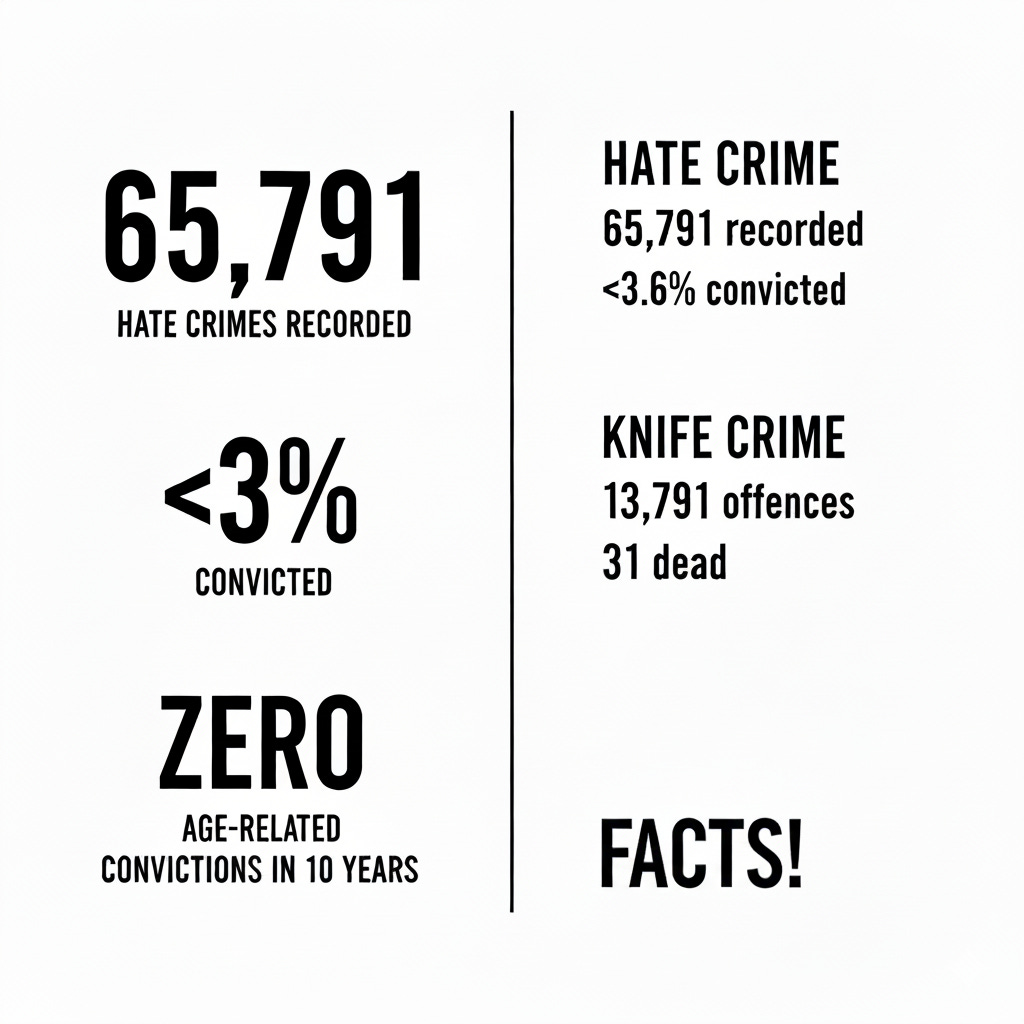
65,791 hate crimes were recorded in Bristol between January 2015 and June 2025.
Less than 3% convicted.
33.6% never even identified a suspect.
Zero convictions for age-related hate across an entire decade.
In my previous piece, I argued the hate crime framework is philosophically broken - requiring proof of unprovable internal states whilst treating terrorism and verbal offence as the same category. Avon & Somerset Police just released ten years of data. It proves every word.
Here’s what happens when broken theory meets institutional practice.
The Numbers Nobody Wants to Discuss
Those 65,791 hate crimes break down into public order offences, violence against the person, criminal damage, and burglary. Every suspect’s age documented. Every victim’s age tracked. Every outcome code meticulously logged.
Extraordinarily detailed record-keeping of something nobody can coherently define.
Monthly averages tripled over the decade. Brexit caused a 31% spike in June 2016 that never recovered. The trajectory keeps climbing. And conviction rates keep collapsing.
Religious hate crime: Ten convictions in ten years.
Age-related hate crime: Zero convictions in ten years.
Think about that. Elderly people are targeted for being old. Documented, investigated, prosecuted—and nobody convicted. Not because no crimes occurred. Because the framework demands proof of an internal emotional state that cannot be proven.
When your legal category requires mind-reading, this is what you get.
Violence Gets Lost in the Catchall
The framework collapses necessary distinctions. Physical violence targeting random people purely for their race gets logged alongside verbal insults during an argument between neighbours who happen to be from different backgrounds.
Same category. Same label. Prosecuted identically - which is to say, barely prosecuted at all.
This matters because genuine malicious targeting terrorises communities. Random violence selecting victims purely for characteristics they cannot change - that’s serious. But when you lump that together with political criticism, offensive jokes, and someone feeling insulted, you trivialise the serious whilst criminalising the trivial.
The data shows this isn’t theoretical. Public order offences (verbal) and violent assaults appear in the same spreadsheets with identical prosecution failure rates. The system can’t distinguish between them because the framework doesn’t allow it to.
Result: Neither gets justice. Both get documentation.
The Proof Problem in Practice
Here’s the scenario that breaks prosecution: Two people of different backgrounds have a parking dispute that escalates to violence. One has previous social media posts critical of immigration. Is this a hate crime?
To prove it, you’d need to demonstrate that the attacker selected this specific victim because of their background rather than the parking dispute. Prove internal motivation. Prove causation, not correlation. Essentially, prove what they were thinking.
Bristol’s data answers: No, you can’t.
Most cases never reach prosecution. Those that do rarely secure conviction. The 33.6% that never identify suspects might seem like an investigation failure, but look closer - many victims decline to proceed. Why? Because they’ve worked out what the data proves: the system demands evidence that cannot exist.
A less than 3% conviction rate isn’t prosecutorial incompetence. It’s a framework requiring impossible proof.
When Definitions Collapse
The framework protects “transgender identity” as a characteristic. No medical diagnosis required. No surgical intervention. No consistent presentation. Apparently, self-declaration, but of what exactly?
If a protected category can’t be defined, how do you prove someone was targeted for belonging to it?
You don’t. The cases get logged, investigated, and collapse. Not unique to this category, the same definitional chaos affects multiple protected groups when characteristics become infinitely expandable or self-declared without objective criteria.
Age-related hate: Zero convictions (can’t prove targeting for age vs general dispute)
Religious hate: Ten convictions in ten years (can’t distinguish criticism of religion from targeting believers)
The system documents everything and proves virtually nothing because it’s trying to prosecute thoughts rather than actions.
The Comparison That Exposes the Theatre
Want to know what actual crime prosecution looks like? Knife crime in Bristol over the same period:
13,791 offences. Tripled over the decade. Same Brexit spike. Same trajectory.
31 people dead - including teenagers Max Dixon and Mason Rist, whose murders galvanised community response.
Both crime types concentrate in the poorest areas. Both show identical escalation patterns. Both reveal system failure to address root causes like housing insecurity and gutted youth services.
But only hate crime gets wrapped in the confusing language of unprovable internal states and ever-expanding protected characteristics. Knife crime gets straightforward prosecution: Did you stab someone? Yes? That’s the crime. Motive adds context but isn’t required for conviction.
Hate crime prosecution: Did you assault someone? Yes? But did you hate them for a protected characteristic whilst doing it? Can you prove this internal emotional state? No? Case collapses.
31 dead from knives. Straightforward criminal prosecution.
65,791 hate crimes documented. Under 3% convicted.
One requires proving an action. The other requires proving an emotion. The conviction rates tell you which actually works.
What Gets Protected vs What Gets Documented
When hate crime statistics get reported, it’s “hate crime rises 40%” without distinguishing between more violence from more reported offensive tweets. The framework prevents clarity by design.
The recording continues. The crimes continue. The convictions don’t materialise.
Here’s what needs stating clearly: This isn’t police failure. This is system failure.
Officers are doing what they can with a framework that demands the impossible - prove internal emotional states, distinguish between identical actions based on unprovable thoughts, and prosecute categories that can’t be coherently defined. They’re recording diligently because the framework requires it. They’re investigating comprehensively because procedure demands it. And then cases collapse because the legal architecture underneath is fundamentally broken.
The police didn’t design this framework. They’re trying to operate within it.
Now consider the resource implications.
Every one of those 65,791 cases required officer time. Initial response. Evidence collection. Witness statements. Case file preparation. Liaison with CPS. And for what outcome? Under 3% conviction rate.
How many officer hours went into cases that collapsed because you can’t prove what someone was thinking? How many CPS hours reviewing files demanding impossible evidence? What’s the financial cost of investigating, documenting, and prosecuting 65,791 cases to secure roughly 2,000 convictions?
Those resources could address actual threats to community safety.
Knife crime in Bristol: 13,791 offences, 31 dead, including teenagers Max Dixon and Mason Rist. Gang violence. Drug-related crime. Burglary. Assault. Crimes with clear victims, provable actions, and no requirement to demonstrate unprovable internal states.
The suggestion isn’t controversial: redirect resources from framework-mandated documentation theatre toward crimes where investigation actually produces convictions and communities actually get protected.
When the framework demands investigating offensive tweets with the same rigour as physical violence, whilst both produce identical prosecution failure, something’s badly wrong with resource allocation.
Bristol’s been running this theatre for ten years. The spreadsheets are comprehensive. The convictions are absent. The communities remain unprotected. And the police are caught in the middle, documenting failure they didn’t design.
Back to That Opening Question
Remember what I asked at the start? Define “hate crime” without using “offensive” or “feelings.”
Can you?
You’ve now seen 65,791 attempts. Less than 3% succeeded in court. A third never identified anyone to charge. Zero elderly victims saw justice despite an entire decade of documented targeting.
The framework requires proving internal emotional states that cannot be proven. It collapses vital distinctions between terrorism and verbal criticism. It creates categories so vague they can’t be consistently defined or prosecuted.
This isn’t a justice system. This is documentation theatre masquerading as protection.
When legal frameworks require proving the unprovable, they fail predictably. Bristol’s data doesn’t just prove the framework is broken - it quantifies exactly how broken across 126 months and 65,791 cases.
The theory predicted it. The practice confirmed it. The data proves it beyond question.
Still can’t define “hate crime”? Neither can the courts. And that’s exactly the problem.
Data: Avon & Somerset Police Hate Crime Publication (October 2025), covering January 2015 - June 2025. Previous analysis: “Thoughtcrime Britain: The Logical Impossibility of Prosecuting Hate”. The Almighty Gob is a blogger covering Bristol politics and UK institutional failure.