
A Cup of Anicca, Anyone?
"It is a hard thing to leave any deeply routined life, even if you hate it." — John Steinbeck.

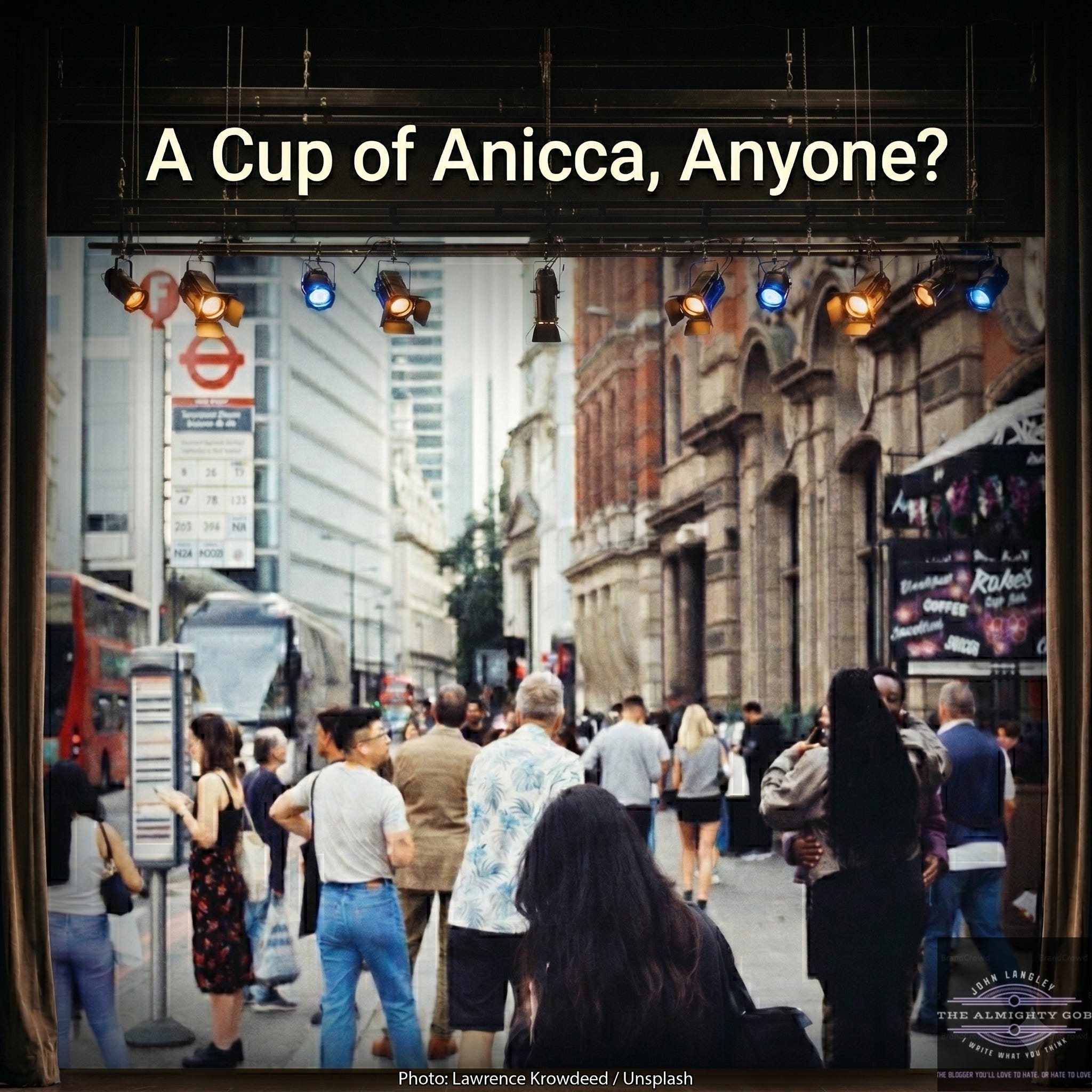
["It is a hard thing to leave any deeply routined life, even if you hate it." — John Steinbeck]
Well. Here I am again. Pavement table, cup of hot chocolate, observing the world go by. Same as yesterday. Same as the day before. This is how I collect my thoughts before I write — sitting outside, letting the cast of the world pass in front of me, on the public stage of life. Taking it in at whatever pace it chooses to arrive.
So. Please. Take a seat, and join me. It’s good to have your company.
Hey. Have you ever noticed this. You know. Like ‘really’ noticed ‘this’ — and what happens in between?
The cup comes up. Goes back down. The glass comes up. Goes back down.
And. It’s in those in-between moments, the cast of the world passes by. On the street. In the pub. The supermarket. You know. On the stage of everyday life.
A man arguing into his phone about something that won’t matter in a fortnight. A woman navigating a buggy through the gap between a parked car and the rest of the universe. Two teenagers who are technically in the same place but spiritually on different planets, thumbs moving, eyes nowhere present. A bus running late, as buses do, as buses always have, as buses will continue to do long after everyone currently outraged about it is gone.
From the corner of the eye. A headline on someone’s screen. Unable to quite read it. No need to.
The cup goes back down.
None of it mine to take forward. Further into the day.
That’s not indifference. That’s not switching off. That’s not some wellness trend dressed up in ancient clothing. That is a practice. A real one. And it took a long time to get here.
Whatever’s in the hands right now — there’s something in that rhythm that most of us already carry without having been taught it. The simple act of lifting something, taking what’s needed from the moment, and setting it back down again. Unhurried. Unattached to whatever just passed.
That ‘just passed’ ‘in between moment.’
That moment of contact. The warmth. The brief pause between lifting and setting down. That’s where the present moment actually lives — not in the lifting, not in the putting down, but in that small, unhurried, unrepeatable instant of just being with what’s in the cup. Too ordinary to notice. Too quiet to name. The mind already three thoughts ahead or two worries behind while something ancient and simple is happening right there in the hands. Subconsciously. In the moment.
That gap — that fraction of a second between the cup coming up and the cup going back down — that’s the whole philosophy. A moment arising. A moment passing. The warmth already different from the warmth a second ago. Nothing the same twice. Nothing permanent. Nothing that needs to be carried anywhere.
Everything that follows, mind — two and a half thousand years of it, two separate civilisations working it out independently, ancient India and ancient Greece arriving at the same destination without ever comparing notes — all of it lives inside that one unremarkable moment.
That’s it. That’s the whole journey. Passed by. Without even registering.
Here’s an idea. Let’s make the journey. Together.
There’s a valley in southwest Scotland, near a village called Eskdalemuir, where the River Esk runs quietly through high moorland and the rest of the world feels a long way off.
Somewhere in that valley — and I say somewhere because it still feels slightly improbable that it exists there at all — sits Kagyu Samye Ling. A Tibetan Buddhist monastery. Founded in 1967 by two remarkable men, Akong Tulku Rinpoche and Chögyam Trungpa Rinpoche. The first Tibetan Buddhist centre ever established in the Western world. In rural Scotland. On a former hunting estate. Which tells something about where wisdom tends to show up — rarely where it’s expected, almost never where it’s looked for first.
That’s where this was first encountered. Not in a book. Not in a philosophy lecture. In a place. A community. A particular quality of stillness that had no framework at the time — and has had the years since to slowly build one. The grounds there are patient things. Carefully tended. Nothing hurried. A bonsai in the making, in more ways than one.
One of Samye Ling’s own guiding principles — written on the wall, lived in the practice — is this: Meditation means simple acceptance.
Four words. Takes a lifetime.
And. Before your brain takes a jump in a different direction. This is not a piece on Buddhist meditation.
Samye Ling is where the seeds of three things were first sown. For me. Stillness, silence, and solitude. The three S’s, as they’ve come to be known in this corner of the world. Not dramatic things. Not headline things. The quietest things there are, which is precisely why they’re the hardest to find and the easiest to lose.
And just like the bonsai — they took years to grow.
You see. A bonsai isn’t rushed. That’s the whole point of one. The patience is the practice. It can’t be forced into shape. It gets tended. Returned to. Left alone to do what it does. And one day, years later, there it is — not because it was pushed, but because it wasn’t.
That’s how the three S’s, as I call them, settled. Not in a moment. Not in a revelation. Quietly, incrementally, over more years than anticipated, somewhere between a Scottish valley and a Bristol pavement table. Not forgetting, of course. The hot chocolate.
Now. Here’s a word you’ll probably not hear in everyday conversation.
A Pali word — the language of the earliest Buddhist texts — and it means impermanence. Which sounds simple until it’s actually sat with. Because it doesn’t just mean things change. It means everything that arises will cease. Every single thing. The thought passing through right now. The outrage served up before breakfast. The war on the news. The late bus. The hot chocolate cooling on the table (except mine. Of course).
All of it arising. All of it passing. None of it fixed. None of it permanent. None of it — and this is the bit that takes some digesting — actually anyone to take ownership of.
Gautama Buddha identified anicca as the first mark of existence. Around the fifth century BCE. What is now India and Nepal. A man sitting under a tree, watching the world do what the world does, working out that the river stepped in yesterday isn’t the river stepped in today — and that the person who stepped in it isn’t quite the same person either. Remembering. This was way before the days of Southern Water. And, for entirely different reasons. I hope.
Everything in flux. What’s that? Great question, and naff all to do with soldering. Flux, in this sense, means constant change — a continuous flowing state where nothing stays fixed, nothing holds its shape, nothing remains what it was a moment ago. The only constant is the flux itself.
Now. Here’s what people perhaps don’t understand about this. They hear impermanence and they think it’s depressing. A counsel of despair. What’s the point if nothing lasts?
That is precisely sdrawkcab. Okay then. Backwards.
You see. Nothing is permanent. Including the thing currently making life miserable at half past eight on a Tuesday morning. Including the anxiety that moved in somewhere around the third news story and hasn’t uninstalled since. Including the outrage, the dread, the low-level hum of everything being too much all at once. Yes. Including the hot chocolate getting colder still! (again. not mine. of course).
It’s all simply passing through. Not anyone’s to keep even if they wanted to. Not even the hot chocolate.
Now. Once that’s actually felt rather than just read, it turns out to be one of the most liberating ideas in human history. The Samye Ling community knew this in 1967. Gautama Buddha knew it twenty-five centuries before that. It just takes most of us somewhat longer to catch up.
Meanwhile. Five centuries or so after Gautama Buddha worked this out under his tree, a Roman Emperor was scribbling private notes he never intended anyone to read.
Marcus Aurelius. Emperor of Rome, 161 to 180 CE. The most powerful man on earth by any available measure. Running an empire, fighting wars on multiple fronts, managing the Senate, the army, the whole magnificent grinding machinery of Roman power.
And every morning, quietly, writing notes to himself.
We call them the Meditations now. At the time they had no title. No audience. Just a man talking to himself, trying to stay still inside the noise. Reminding himself of things he already knew but kept forgetting under pressure. The way it goes.
“Never let the future disturb you,” he wrote. “You will meet it, if you have to, with the same weapons of reason which today arm you against the present.”
Different valley. Different cup. Same practice.
Around the same period — give or take a generation — a philosopher named Epictetus was teaching what he called the dichotomy of control. Worth knowing that Epictetus was born a slave. Which lends his philosophy a rather different weight than most. This isn’t a man theorising about hardship from a comfortable distance. This is a man who started with nothing — not even his own body, legally — working out how to be free anyway.
His principle fits on the back of a receipt. Pretty much my life captured, to be honest. Still. Moving on.
Some things are within our power. Some things are not. Opinions, responses, choices — there. The weather, the news cycle, the bus schedule, the war, what other people think — not there. The first category is where life actually happens. The second is where most of the suffering does.
That’s the entire philosophy. Everything else is elaboration.
Epictetus also used a theatre metaphor. An actor in a play, the Playwright choosing the manner of it. The role given is the role performed — and performed well. The casting isn’t the actor’s call. This is the Enchiridion, Chapter 17 — written nearly two thousand years ago, describing an ordinary morning in 2026 with uncomfortable accuracy. Who’d have thought.
However — here’s the part that doesn’t appear on motivational Instagram accounts — Epictetus also said this. Walking into the theatre as a spectator, the question worth sitting with is what the visit is actually for. Not to control who wins. Not to shout for a preferred outcome. To maintain one’s own purpose. And if the performance is costing more than it’s giving — if the hurt is happening so someone else can take home a prize — something is being given away that was never theirs to take.
The door exists. Even the toilet lights are lit.
Nobody is nailing anyone to the seat.
So. Here we are. Three traditions. One destination.
Here’s what the history of philosophy tends to obscure by keeping everything in separate chapters with separate reading lists.
Buddhism came out of ancient India, fifth century BCE. Stoicism came out of ancient Greece, third century BCE. Different languages. Different cultures. Different ends of the known world. No shared texts, no cross-referencing, no collaborative workshop. Just two separate civilisations, independently, staring at the same question.
How does a person live in a world they cannot control without being destroyed by it?
And arriving — separately, without comparing notes — at versions of the same answer.
Then, in twentieth century America, in church halls and community centres, Alcoholics Anonymous adopted a prayer — originally written by the theologian Reinhold Niebuhr. People at the hardest points of their lives, speaking it aloud together. God, grant me the serenity to accept the things I cannot change, the courage to change the things I can, and the wisdom to know the difference.
Epictetus. Word for word. Two thousand years later. Different room. Same receipt.
And the Poles? They just said it better than anyone. Who doesn’t speak that language. Nie mój cyrk, nie moje małpy.
Not my circus. Not my monkeys.
Whereas. Buddhism works inward first. The self is where it starts. Impermanence is the lens. The practice is about loosening the grip of attachment, moment by moment. Suffering doesn’t come from the event. It comes from the relationship to the event. The craving. The aversion. The insistence that reality be different from what it demonstrably is.
Conversely. Stoicism works outward first. The territory gets mapped. What’s ours to affect, what isn’t. Reason applied. The present moment is where responsibility lives — not because the past and future don’t exist, but because here is where choices actually happen.
Different tools. Same destination.
Neither of them is passive. This is where both traditions get defanged — Buddhism flattened into incense and vague niceness, Stoicism kidnapped by productivity influencers who’ve read three quotes and bought a leather journal. Both reduced to aesthetics. Both stripped of the one thing that makes them actually work.
Which is that they’re demanding. Quietly, consistently, non-negotiably demanding. Because they require a person to hold their position while everything around them is professionally, expensively, algorithmically built to move them off it.
Okay. So. To what could be called the engine that drives it.
And. Let’s be open about what we’re up against here.
The world most of us wake up into every morning is not accidentally hostile to present moment awareness. It is deliberately hostile to it. This is the well-rehearsed, audience sampled, business model. And. Here’s the ‘because’ of it.
Anxiety is not a side effect of the attention economy. It is the product. The notification that arrives at the wrong moment. The outrage cycle that requires fury about something three time zones away that cannot be affected in any direction. The algorithm that has learned — with considerably more precision than any philosopher ever managed — exactly which emotional frequency keeps the scrolling going past the point where stopping was decided. The news channel running the same crisis on a loop because the loop keeps people watching. Possibly. Well. Loopy. I guess.
And the relief being sold? More of the same. Another app. Another managed intervention delivered through the identical screen that created the problem.
John Steinbeck named the deeper pattern long before any of this existed. “It is a hard thing to leave any deeply routined life, even if you hate it.” He was writing about poverty cycles in Depression-era America. However, he was also writing about the job stayed in too long. The relationship that ran out of road years before the leaving happened. The identity built in a different decade that no longer fits. The news cycle returned to. The conversation that stopped being useful an hour ago.
The delivery system changes. The pattern doesn’t.
The Stoics and the Buddhists weren’t dealing with smartphones. However, they were dealing with the identical underlying mechanism — the mind that cannot stay where it is. The mind that drags itself into the past to rehearse its grievances, and rehearse them again, and possibly again. And into the future to rehearse its fears. In doing so completely missing the only moment that actually exists.
You see. We don't actually relive past experiences. We just get out the recording device used at that time, and re-run them. Like a movie. The delete button being just one press away, and not often used. Rewind/play, on a loop. The self-infliction, somehow feeling more beneficial. Even though it isn't. The abra-cadabra button being handier, instead. The one that returns us to......
The Now.
The bus is late. Fact. Present tense. The war is happening. Also fact. Also present tense. However, the nervous system’s decision to carry them both at the same weight, to process them both at the same urgency, to let them share the same headspace as the other clutter — that is not a fact. That is a habit. And habits, unlike bus schedules, are within our power.
And. The only power of jurisdiction, is the one that matters most of all. I suggest.
The only person any of us ever really has to answer to is ourselves. Not as a permission slip for doing whatever we like. Not as a licence to ignore the world and everyone in it. As the opposite, actually. Because the internal verdict is the only one that sticks.
External validation is a moving target. Other people’s opinions are weather. The crowd that approves today will find something else by tomorrow, and the one that disapproves will move on to a fresher outrage before the week is out. None of it holds. None of it is the verdict that counts.
There’s always a knowing. That’s the thing nobody says out loud but everyone understands. A knowing about whether the day was met honestly. Whether what was carried was worth carrying and what wasn’t was put down. Whether a sip of the world was taken, considered, the cup placed back on the table — or whether the whole thing got grabbed and poured over and the afternoon was spent wondering why everything was soaked.
Marcus Aurelius wrote the Meditations entirely for himself. No publication. No audience. No performance. The most powerful man on earth, writing private notes to stay decent, to stay present, to not be moved by flattery or provocation or the daily noise of running everything. Just a man and his own standard.
The Samye Ling community puts it this way: Freedom is not something you look for outside of yourself. Freedom is within you.
That is the practice. That has always been the practice.
So. What does this look like.
Well. I guess. To me, at least. It looks like a pavement table. A cup of hot chocolate. The world going past in all its ordinary, extraordinary chaos — the arguments, the headlines, the people who are physically present and mentally elsewhere, the bus arriving when it arrives. To you. Something different. If at all.
The observing happens. The sip happens. The cup goes back down.
The man arguing into his phone — his argument, not this one. The headline — someone’s emergency, not necessarily this one. The performance in front is vivid and loud and entirely real. The stage is there. Nobody’s selling a ticket that says it has to be occupied.
The only person any of us ever really has to answer to is ourselves.
This is anicca as a daily practice — The Almighty Gob’s view, for what it’s worth. This is the dichotomy of control with both hands wrapped around something warm. This is what Gautama Buddha understood under his tree in the fifth century BCE, what Epictetus understood in chains in the first century CE, what Marcus Aurelius wrote to himself by lamplight in the second century CE, and what a community in a Scottish valley has been quietly teaching since 1967.
There’s something quite special about sitting outside a cafe on an ordinary Thursday — or any day, really — observing how busy the world is. The chaos of it. The noise of it. All that motion and urgency passing by.
Observing the world doing its own thing. Whatever that may be. Things which are not mine to be responsible for, and of which I have assumed no ownership.
And just sitting here among it. Still. Not above it, not removed from it, not having solved anything. Just present. Comfortable with not carrying what isn’t mine to carry.
Because here’s what the bonsai eventually teaches, what the valley eventually whispers, what two and a half thousand years of completely separate traditions eventually agree on — if there is peace with yourself, there is peace with everything that goes on around you. Regardless of what it is. The war and the late bus. The headline and the argument. The chaos and the noise. All of it.
Not despite the busyness. Among it.
Some days that’s easier than others. Most days it’s a practice, not a given.
Mind. The cup is warm, the world is doing what the world does, and that’s enough.
As it’s when the cup empties, I begin to write. Now. How about that cup of Anicca?
The Almighty Gob is a Bristol-based publication founded by John Langley — independent Bristol mayoral candidate 2016 and 2021, and one of the city’s most forensic observers of institutional power. Publishing since 2020, with over 700 pieces across seven platforms and Substack at thealmightygob.com — no party allegiance, no press accreditation, no interest in acquiring either.
© 2026 John Langley / The Almighty Gob. All rights reserved. Reproduction of this article in whole or in part is prohibited without prior written permission. Excerpts of no more than 50 words may be quoted with full attribution and a link to the original publication.