
ADHD, Autism and the Jungian Case for Personality Plus.
Why the mind therapy tried to fix was never broken.

You know that feeling of being in a room full of people who all seem to be reading from a script you were never handed? That’s not a personality flaw. For a lot of autistic and ADHD adults, it’s a diagnosis waiting fifty years to happen.
Therapists spent decades calling this “resistance.” “Defence mechanisms.” “Not psychologically minded enough for proper analysis.” Turns out the theory was never the problem. The people using it just weren’t looking properly.
Whole careers built on getting the diagnosis wrong, and not one of them thought to ask what a normal day actually felt like from the inside.
The Brain They Called Broken.
Carl Jung — the bloke half of modern therapy is built on — was, by his own account, a solitary, ritual-obsessed child living half in his own head. Two personalities, he called it. One in the world, one running underneath. Quiet, both of them. Waiting, most of the time, for the other one to slip.
Sound familiar to anyone?
Small disclaimer, since someone will ask. Jung is not the only therapist who ever lived, and this isn’t an advert for spending a decade on a couch discussing your mother. He just happens to be the one whose framework fits this particular argument best. My own training, for what it’s worth, was built on Carl Rogers — unconditional positive regard, not a couch in sight.
His followers built a whole clinical tradition on top of his ideas and somehow still missed it when the same pattern turned up in their patients. A kid who won’t hold eye contact gets called defended. An adult who can’t sit still gets called dysregulated. Nobody asked whether the wiring was simply different.
So. Let’s start with where the energy actually goes, and you’ll see how the whole picture changes. Bit by bit.
Interest, Not Discipline.
You see. ADHD isn’t a willpower problem. Jung’s own model says psychic energy flows toward whatever’s charged with interest — not toward whatever’s supposed to matter. That’s not a diagnosis, and it’s not standing in for one. Dopamine and executive function are the actual clinical account of what’s happening in the brain. What Jung’s vocabulary offers is something the neuroscience was never built to give you: a way to talk about what it feels like from the inside, which matters just as much when you’re the one living in it.
This isn’t decoration, either. Jung’s individuation was never about becoming normal — it was about becoming distinctly, undividedly yourself, including the parts that refuse to smooth out into anyone’s average. A complex, in his terms, is whatever’s currently got hold of your psychic energy, running the show whether the ego agrees or not. Read ADHD as a permanently shifting complex economy, and autism as a different relationship to pattern and symbol altogether, and both stop looking like disorders and start looking like two different routes to exactly the destination Jung spent his career describing.
Now. That’s not an excuse. By the way. For those who believe otherwise. What you have, in fact, is an operating instruction. Make the task interesting and the energy follows it there on its own. Shout at yourself to focus and nothing moves, because you’re arguing with the wrong internal department.
Every “just try harder” lecture an ADHD adult has ever sat through was aimed at the wrong mechanism entirely. You want to know what “just focus” achieves? Nothing. It’s the psychological equivalent of shouting at a printer.
The wiring explains the energy. It doesn’t yet explain the exhaustion. That’s a different story, and it starts with a question most people never think to ask.
Two Kinds of Learned Behaviour.
Here’s where it gets properly interesting, and where most explanations stop short.
Somebody will always say: isn’t the “authentic self” just as learned as the mask? We all copy people to fit in — that’s not exclusive to autism or ADHD, that’s called growing up. It’s a fair challenge. It deserves a straight answer rather than a dodge.
The answer is that there are two different kinds of learned behaviour, and they are not the same animal wearing different coats.
Ordinary socialising is tuning. You adjust your volume for the room, pick up manners, and build patience you didn’t have at nineteen. Say. It settles over time. It costs less the more you do it. Until eventually, and with the appropriate steer, it stops feeling like performance and starts feeling more, and more like you, because it was built on top of wiring that was already yours. Nobody claps you for it. Nobody hands you a certificate for learning to say “lovely to see you” and meaning roughly a third of it.
Masking is not tuning. Masking is overwriting. Forcing eye contact that physically hurts. Clamping down the urge to move. Performing interest in conversations that feel like static. It is not a dialect learned on top of a native tongue — it is a second language spoken fluently under duress, every single day, for decades. Until the mirror says otherwise.
Which raises the obvious question. How do you actually tell the two apart?
The Test That Actually Works.
Okay. All that said. So how do you tell the difference between a habit that’s genuinely yours and one that’s borrowed armour?
Simply. Ask what happens when you put it down. That’s the whole test. Wrapped up. In one.
Drop a genuine habit and something’s missing — you reach for it, you miss it, dropping it feels like a loss. Drop a masked behaviour and the opposite happens: it feels like finally sitting down after a full day on your feet. Relief, not loss. That’s the tell, and it doesn’t lie the way self-reporting on “am I happy” usually does.
One caveat, and it matters. Not everything that looks like masking is safe to simply drop because a test says so. Some coping behaviours are load-bearing — they’re doing real protective work, trauma-related or otherwise, and pulling them out without support underneath can do more harm than the mask ever did. The test tells you what’s costing you. It doesn’t tell you it’s safe to stop paying alone.
And. By the way. Thirty years of masking does not get lighter with practice. That’s the detail that should unsettle you. A skill gets easier with repetition. Masking never does, because you are not building competence — you are running a permanent, unrewarded fight against your own nervous system, and the toll never stops arriving. Burnout isn’t a failure of resilience. It’s the bill for thirty years, finally due.
So. Here’s where therapy, historically, got the diagnosis exactly backwards.
What Therapy Got Backwards.
Old-school therapy, Jungian or otherwise, frequently mistook the exhausted mask-wearer for the patient in need of fixing, and mistook the buried authentic self for the pathology to be corrected. Backwards, in other words. The costume was treated as the cure and the person underneath it was treated as the disease. So, it follows. Decades of mental labour to iron the costume, and nobody once asked what was still breathing underneath it.
Properly done, this work isn’t about sanding anyone down into a more convenient societal model. It’s about helping someone sort the pile — this bit is genuinely me, this bit is a scar from being punished for being different, this bit I still need for now and that’s fine too. Nobody gets to rush that sorting on someone else’s behalf. Call it unmasking if you want the current word for it. The word’s newer than the process.
Sort it properly, and what’s left underneath isn’t a deficit. It’s an engine.
The Mathematician and the Pianist Nobody Sanded Down
Think of the mathematician in A Beautiful Mind, or the pianist in Shine. Neither story is “he succeeded despite the unusual mind.” The intensity, the obsessive pattern-focus, the relationship with the work that most people would call excessive — that was the unusual mind, doing exactly what it does, pointed at something the world happened to value.
Nobody trained the pattern-seeing out of Nash first and then let him do mathematics. Nobody trained the obsession out of Helfgott and then sat him at a piano. The intensity stayed, and the intensity was the engine.
That’s the part therapy and education misinterpreted for the best part of a century. Not because it knew no better. Because it never thought to ask. Fitting in and reaching the ceiling of what a mind can actually do were treated as the same goal, when they are frequently opposites. You do not get the piano playing by making the mind average first. You get it by leaving the intensity alone and building scaffolding around it.
That’s the theory. Here’s what happens when you go looking for the receipts.
Not Just Nash and Helfgott.
This isn’t just confined to two old films either. Say it in their own words, and the list gets long fast.
Sir Richard Branson built Virgin on top of dyslexia he’s written about in his own words, calling it a different way of thinking rather than a disadvantage. Temple Grandin was diagnosed autistic in 1950, went on to hold a professorship at Colorado State, and rebuilt how the entire livestock industry designs handling facilities around the way her own mind processes sensory information.
Actress Daryl Hannah was diagnosed autistic as a child, at a time doctors recommended institutionalising her. Her mother refused. Hannah kept the diagnosis hidden from producers for decades before speaking about it directly, saying the fear of the spotlight it caused was real enough to end talk-show appearances outright.
Notice a pattern yet? I’d be surprised if you haven’t.
Grimes disclosed her ADHD and autism diagnosis in 2024, and said outright that catching it earlier would have meant working with her mind instead of fighting it for decades. Meanwhile. Sia told a podcast in 2023 that she’d spent forty-five years putting on what she called a human suit, and only stopped once she let herself be autistic in public.
And. If you required further examples. Here you are. Same story, different industry.
John Elder Robison wasn’t diagnosed with Asperger’s until he was 40, and wrote the New York Times bestseller Look Me in the Eye about exactly what four decades without an answer does to a life. Pete Wharmby was diagnosed autistic at 34, then ADHD on top — AuDHD, in the current term, and a late diagnosis by anyone’s standard — and has built a writing career explaining masking from the inside — he is, in a sense, writing this exact article from his own life. Hannah Gadsby’s Douglas is a direct excavation of what a late autism diagnosis does to a life. Helen Hoang, diagnosed autistic in 2016, writes autistic protagonists straight from lived experience.
Every single one built a career on the trait rather than in spite of it. Nobody on that list got interesting by getting more average first.
Okay. And to counter that. It’s worth being clear about who isn’t on it, too. And why. Steve Jobs gets dragged into this conversation constantly — the obsessiveness, the singular focus, the total lack of interest in other people’s comfort, it all fits the pattern people want to see. But he never said it. No diagnosis, no disclosure, nothing in his own words — just decades of strangers pattern-matching a dead man’s personality after the fact. Even Temple Grandin, who’s floated the idea herself, is careful to call it a guess and nothing more. There’s a real difference between a person naming their own mind and a stranger doing it for them once they’re not around to object, and this list only deals in the first kind.
From that, I can maybe sense two objections are already forming, so let’s take them now rather than pretend they aren’t coming. First: cherry-picked winners, survivorship bias, what about the millions who never get anywhere near a Commons chamber or a Grammy. Fair, and beside the point — nobody on this list is claiming the trait guarantees the outcome. What it disproves is the opposite claim: that the trait has to be managed out first before any outcome is possible. Remove that requirement and some people build empires. Remove it for everyone else, and at the very least nobody spends thirty years fighting their own nervous system for absolutely nothing. That’s not a promise of fame. It’s the removal of a guaranteed cost.
Second: dyslexia, ADHD, and autism aren’t the same condition wearing different hats, and nobody on this list said they were. What they share isn’t the diagnosis. It’s the same institutional reflex — sand the difference down first, ask what it might have been for later, and never get round to asking.
And if the person you’re picturing right now isn’t on any list — no book deal, no Commons seat, no Grammy, just someone you love who’s struggling to hold down a job or leave the house some days — the point doesn’t shrink to fit them, it was never about the outcome in the first place. They didn’t need the trait managed out of them either. They needed the same thing everyone in this piece eventually got: someone who looked properly, instead of first.
Industry got there first. Music and literature followed close behind. Politics, predictably, is the last one through the door.
Westminster Is Catching Up.
Clearly. In my view, at least. And I don’t believe I’ll be alone if you’ve absorbed this so far. Politics moves slower than music or business on this, but it’s moving. Adam Dance MP was diagnosed with severe dyslexia and ADHD at a young age, and has since introduced a bill on primary-age neurodivergence screening — so the disclosure and the policy are the same story.
Olivia Blake MP stood in the Commons and declared it plainly: dyspraxia, dyslexia, and ADHD, describing being moved to what she called the naughty table aged seven for the same traits nobody had a name for yet. Cat Eccles MP has spoken about being autistic in Westminster, hoping her openness makes Parliament a more workable place for the neurodivergent MPs and staff who’ll follow her.
Three names, three professions inside the same profession, and not one of them asked permission first.
Put every name from this piece side by side, and one question answers itself.
Disorder or Plus.
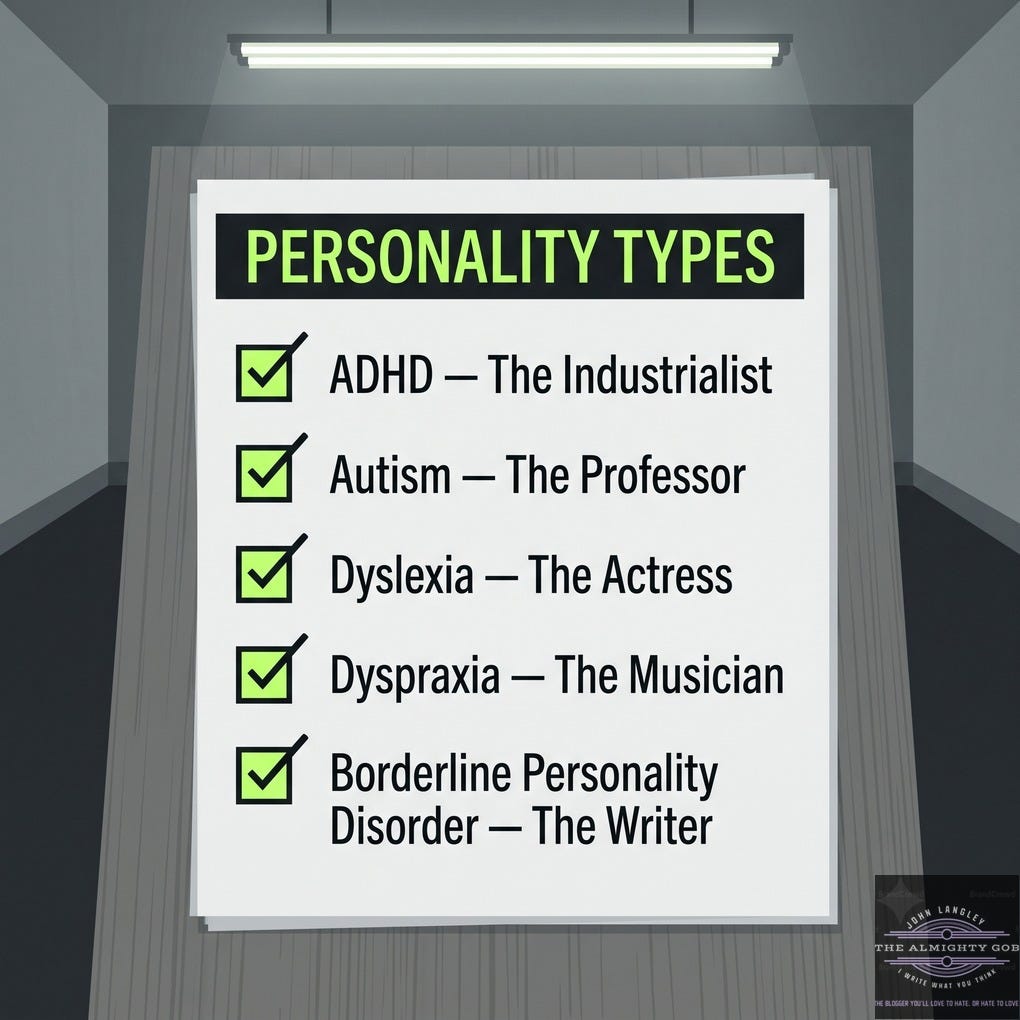
So. Let’s now pause to recap, and look at that whole list again — the industrialist, the professor, the actress, the musicians, the writers, the parliamentarians — and ask the only question that actually matters. Personality disordered, or Personality Plus?
Not one of them got there by having the trait trained out first. Branson’s dyslexia, Grandin’s sensory wiring, Blake’s ADHD, Eccles’s autism — every trait a disorder framework would have spent years managing down is the exact trait that built the company, rebuilt the industry, or put someone in a Commons chamber arguing for people like them.
Call it a disorder and you get a person managed toward the exit of their own potential. Call it Personality Plus and you get this list — people who kept the wiring and stopped apologising for it.
That’s not a rhetorical flourish. That’s the finding.
Great minds think alike. Turns out that’s not a compliment. It’s a data point.
I didn’t need a list of well-known names to work that out. I found it out in a room, years before any of them said it publicly.
The Room That Went Silent.
Worth naming the join here plainly, because a sharp reader will ask for it and deserves the answer rather than a dodge. Personality disorder and neurodivergence are not the same diagnostic category, and nothing in this piece has pretended otherwise. But the actual link between them isn’t rhetorical — it’s clinical, and it’s well documented. Autistic women in particular are still being misdiagnosed with borderline personality disorder at scale, because emotional dysregulation, masking, and social difficulty look identical from the outside no matter which one is actually driving them underneath. Durham University research puts autism misdiagnosis in women at close to 80%, with personality disorder among the most common wrong answers handed out instead.
The room I’m about to describe wasn’t discussing ADHD or autism by name. But some unknown proportion of the people being talked about inside that label were exactly the people this piece has been about the whole way through.
And the label has its own list of people who named it themselves, in public, in their own words — the same standard as everyone else in this piece. Dr. Marsha Linehan, the psychologist who invented the leading treatment for borderline personality disorder, revealed in 2011 that she’d lived with it herself since adolescence — a detail close enough to Jung’s own case that Psychology Today ran a piece calling her and Jung both wounded healers. Brandon Marshall, a former NFL wide receiver, disclosed his BPD diagnosis in 2011 and built a mental health foundation on the back of it. Pete Davidson has spoken about his own diagnosis consistently and specifically since 2017, in his own words, more than once.
I clearly recall years ago, when I stood in a room full of civil servants, health experts, and charity directors — well-educated people, well paid, all of them wrestling with the same question: what do we do about personality disorder? The kind of room where three people apologise before anyone says anything, and someone’s always taking minutes nobody will ever read twice.
I stood up and said: change the label. “Disorder” pigeonholes a person before anyone’s looked at what they’re actually made of, and telling someone they have a disorder only makes them feel worse for existing as they are. Call it Personality Plus instead. Look at every aspect of the person — creativity included, not filed separately as the exception to the diagnosis.
Worth being exact about what that proposal was and wasn’t. It was never an argument against diagnosis, medication, or therapy — DBT saves lives, and so does a psychiatrist who gets the diagnosis right the first time. It was an argument against the stigma riding on top of the label, which is a different target entirely. Getting the right support and being told your difference is fundamentally a defect are two separate things, and only one of them needed to change.
For a few seconds, nobody moved. Just the hum of the strip lighting and a room full of qualifications quietly recalculating.
As anticipated. Then people started talking, properly talking, the way a room does when it recognises something true rather than something merely persuasive. A label that manages a deviation down produces one kind of professional. A label that asks what someone’s raw material could build produces an entirely different conversation, in the same room, with the same people, in under a minute. I could have timed it.
That’s the whole argument in one afternoon. The wiring was never the problem. The label was.
So the next time. If by opportunity. You’re in a room full of people reading from a script, ask whether the person next to you was ever handed one at all. The Almighty Gob has spent long enough documenting institutions that refuse to look properly.
Turns out therapy had the same problem for the better part of a century — fifty years of qualified professionals staring straight at Personality Plus and writing “disorder” on the form anyway.
To look properly. That’s all it ever took.
Sources and citations.
Richard Branson on dyslexia, in his own words — Virgin.com
Temple Grandin, diagnosis and career — NBC News
Daryl Hannah, childhood diagnosis and disclosure — Today.com
Grimes, 2024 ADHD and autism disclosure — AOL
Sia, 2023 podcast disclosure — Autisticana
John Elder Robison, diagnosis and memoir — Wikipedia
Pete Wharmby, diagnosis and writing career — AuDHD Psychiatry
Hannah Gadsby, Douglas and diagnosis — Sachs Center
Helen Hoang, 2016 diagnosis and writing — BookTrib
Adam Dance MP, diagnosis and bill — BBC News
Olivia Blake MP, January 2026 Commons debate — Hansard
Cat Eccles MP, on being autistic in Westminster — PoliticsHome
Autism misdiagnosis rates in women — Durham University
Dr. Marsha Linehan, BPD disclosure — Scientific American
Brandon Marshall, BPD disclosure — HealthyPlace
Pete Davidson, BPD disclosure — Time