
Andy Burnham Has Got the Keys to Downing Street. Nobody's Talking About Who's Actually Holding Them, Though.
New UK Prime Minister, old Westminster trick — watch the cabinet, not the podium.

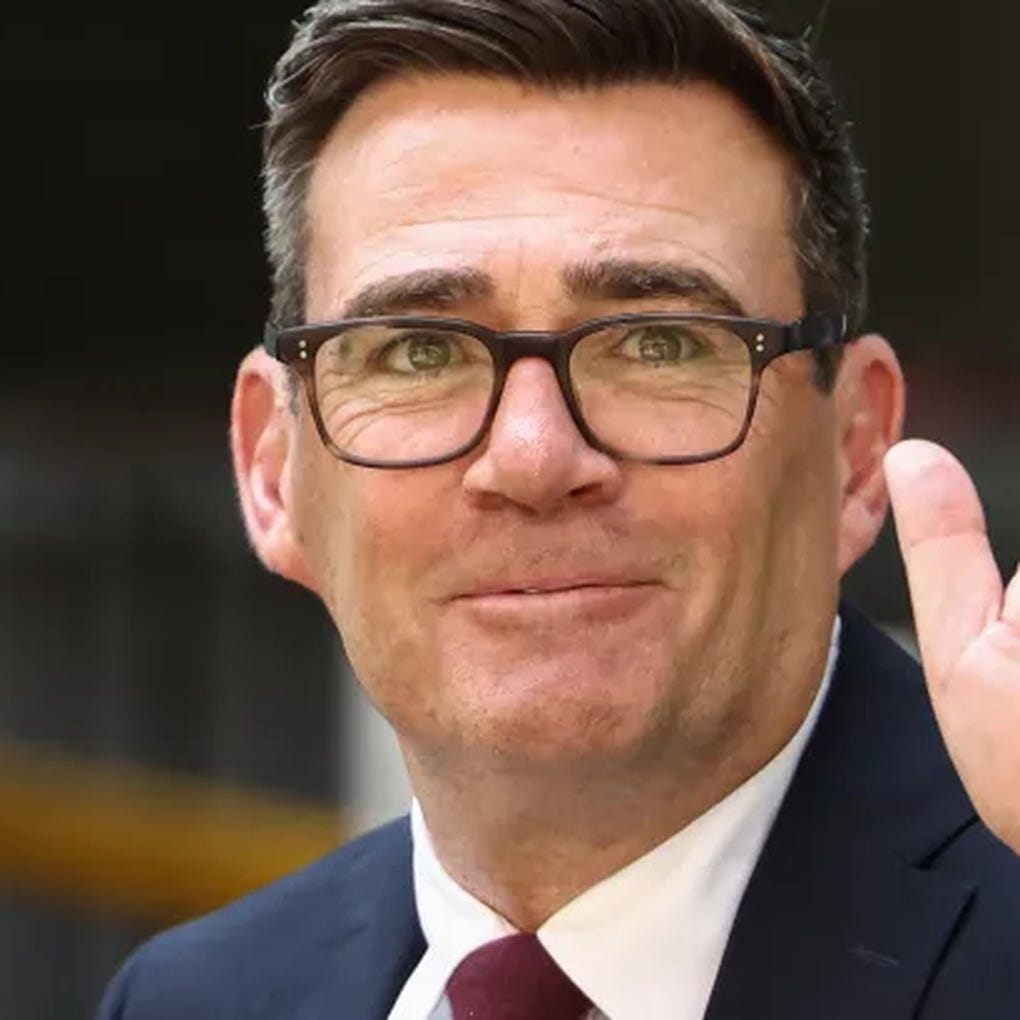
Right. Pour yourself something, because you already sense there’s more to this than the speech. You’ve noticed that too, haven’t you — the bit where everyone’s cheering and something in you isn’t quite joining in? Andy Burnham is Prime Minister now, the country’s seventh in a decade, and everyone’s watching the podium this week — the warm voice, the “hope in every heart,” the bloke-next-door delivery that makes Keir Starmer look like he was assembled in a lab.
The actual power in Downing Street just went somewhere else, and you’re about to be one of the few who noticed. The Almighty Gob is watching the door behind the stage, and there’s a name on that door worth remembering before this piece is done: Shabana Mahmood. Hold that thought — you’ll need it later. Here’s the bit that never makes the highlights reel: the Prime Minister doesn’t run the country. The cabinet does. Burnham gives the speeches. Other people write the cheques, hold the line at the Home Office, and decide whether Britain gets pulled deeper into someone else’s war by Thursday. That’s not cynicism. That’s just how the building works. There’s nothing new in this.
Yet. Somewhere in Whitehall right now, a phone is ringing in an office nobody’s photographed yet. A civil servant is holding a folder with a name in it the country hasn’t heard. No cameras. No balloons. Just a corridor, a closed door, and a decision quietly becoming permanent while everyone outside is still applauding. That’s where this actually happens. Not on the stage. In the rooms nobody films.
One name, signed off in a room like that, and three years of British economic policy tips one way instead of the other. No vote decides that folder. None ever has. The people who actually run departments outlive whichever face is currently on the podium, and they were here long before Burnham arrived and they’ll be here after he’s gone — that’s not a conspiracy, it’s just what a permanent civil service is for.
So while the country’s busy falling in love with a nice bloke from Wigan — and you can enjoy that too, nobody’s stopping you — let’s talk about who’s minding him. Start where the money starts.
The Treasury: Where the Nice Bloke Meets Reality.
Remember that name from the top. Shabana Mahmood, tipped for Chancellor of the Exchequer. Tipped, not confirmed — worth saying plainly, because that’s exactly the sort of gap someone will try to hide an objection in. Doesn’t matter. The names can still shift by the hour and the pattern behind them won’t, because it’s not really about which individual gets which office. It’s about what kind of appointment Burnham’s team is choosing to leak first, and why.
Read that possible appointment for what it is: a written apology to the markets before Burnham’s said a word himself. It says don’t worry, we’re not doing the Truss thing. Which is a strange thing for a governing party to have to keep saying out loud, when you stop and think about it. Starmer already compared Burnham’s own economic instincts to Liz Truss’s forty-nine-day fireball of a premiership. That’s the shadow this pick is designed to bury.
However — and this is the bit the cheerleaders skip — burying a shadow doesn’t fill a hole. You felt that, didn’t you, the moment the sentence turned? Burnham inherits a British economy on the ropes and a Labour Party that already ripped Starmer’s arm off over benefit cuts. Mahmood doesn’t get to pick fiscal discipline and party unity. She gets to pick which one dies first. Someone always does.
Money’s only half the job, though. The rest of the world doesn’t wait for Budgets. And before anyone says he hasn’t even had a day in the job yet, so this is unfair — fair enough, hold him to nothing he’s done as Prime Minister. This isn’t about that. It’s about the choices he’s making before he’s done anything at all, which tell you more about a man than the choices he’s forced into later.
Foreign Secretary: A Man Who’s Never Done This, Handing It to Someone Who Has.
Burnham has no real foreign policy record. None. He’s walking into two live wars — Ukraine, the Middle East — with a CV built entirely out of buses and devolution deals. Ed Miliband, tipped for the job, has at least sat at that table before.
Call that smart delegation if you like. Call it what it might also be: a Prime Minister who already knows he doesn’t trust himself alone in the room on this one, and has quietly built himself a minder. Bit uncomfortable, that, isn’t it — reading it plainly instead of the way it was briefed to you? Here’s the plain version anyway: you don’t hire a babysitter for a job you’re confident doing yourself. Nobody does. Closer to home, there’s a gap he didn’t even try to cover.
Home Office: The Word He Wouldn’t Say.
Sit with this one before you move on. His big acceptance speech — his one shot at setting the terms of his own premiership — and immigration didn’t get a single mention. Not one. Didn’t clock that at the time, did you? That’s rather the point. The exact issue currently handing Nigel Farage‘s Reform UK the seats Burnham’s entire “King of the North” biography is supposed to protect, and he skipped it like it wasn’t there.
Fair’s fair, though — Reform doesn’t win this fight on strength, it wins it by default. Farage has never had to run a department, balance a budget, or explain a policy failure to a select committee. Shouting from the opposition benches is the easiest job in politics. Ask who gains from Burnham’s silence, and the answer isn’t Burnham — but it isn’t a fully tested Farage either, just an untested one who’s better at sounding like he has the answer.
Which is exactly where the Home Office pick gets interesting. Yvette Cooper, tipped to take the brief back. Familiar face, familiar playbook. Maybe that’s steadying hands on the wheel. Maybe it’s the same failed answer wearing a different lanyard. Here’s what it isn’t: new. The voters get to choose which one it is, not Downing Street. And if you want to know how this plays out, don’t look at what he’s promising now — look at what he’s already done once before.
The Pattern Nobody in the Cheering Crowd Wants to Mention.
Manchester left a paper trail, and it isn’t flattering. A pledge to end homelessness by 2020 — quietly dropped. A clean air zone — abandoned the second it got difficult. A congestion charge pilot — collapsed, and not cheaply. Sound familiar, any of that? It should.
None of that needs a villain. It’s worth being fair about that much — most of Westminster’s failures aren’t cover-ups, they’re just people promising more than the system was ever built to deliver, then quietly hoping the promise gets forgotten faster than the failure does. That’s not a defence. It’s just the more accurate diagnosis, and the more accurate diagnosis is usually the less comfortable one.
Somebody will say the funding wasn’t there, Whitehall starved him of the money to do it properly, and that’s even true, some of the time. It still doesn’t explain the pledges. No one made him promise to end homelessness by a fixed date. He chose the promise. The shortfall came later. That order matters.
Not a liar. Something more ordinary, and more dangerous in a Prime Minister than in a mayor: announce the big thing, deliver the manageable thing, and hope the gap doesn’t get counted. You already know someone who does this. You’ve just never had a word for it before now.
That gap got counted in Manchester. It’ll get counted a lot harder in Downing Street, where the number attached to a U-turn has an extra three zeros on it.
And yes, before that gets thrown back — the buses got fixed, the region did better than the national average on growth, the devolution deal eventually landed. All true. None of it cancels the pattern above, it just proves he can build the institutions that make the promises when he’s given long enough to do it properly.
Downing Street doesn’t hand out that kind of runway. And that’s exactly where the Mahmood appointment stops looking like a footnote.
What the Cabinet’s Really For — and Why That Name Still Matters.
So — Mahmood. Notice that you remembered the name without checking back. You did, didn’t you? That’s not an accident, that’s the piece doing its job. She isn’t just a Chancellor pick, she’s the tell. A criminal barrister and former Justice Secretary sent to run the Treasury isn’t a vote of confidence in her economics background — there isn’t one. It’s a vote of confidence in her discipline.
Burnham isn’t hiring an economist. He’s hiring someone who won’t blink when the party wants to spend and the markets say no. Which, in fairness, is more self-awareness than most governments manage on day one. And that’s the whole cabinet in miniature, really. Strip the warmth away — the “for us,” the pub charm, the King of the North routine — and what’s left is a government built, piece by piece, to cover one man’s specific, documented weak spots. Fiscal nerve he hasn’t shown. Foreign policy instincts he’s never had to form. An immigration answer he wouldn’t even attempt on the biggest stage of his career so far.
Is it practical? Only if the people around him are willing to say no to him. Is it logical? Obviously — you patch your gaps, that’s not politics, that’s just sense. What’s the likely outcome? A government that lives or dies not on whether the man at the top is likeable, but on whether the people underneath him have got the spine to tell him things he doesn’t want to hear. None of that’s a prediction, mind. It’s just what’s already on the record, laid out in order. What you do with it is yours. Call it opinion if that’s easier. Every fact in it still checks out regardless of what you call it.
Burnham hasn’t had many people say no to him lately. That’s the story worth watching from here. Not the speech. Not the “hope in every heart.” The room behind the podium, where the people he picked precisely because they’re not him now get to decide how much of him actually survives contact with the job. You weren’t expecting the cabinet to be the story when you started reading this, were you?
Everyone else is watching the stage. You’re not everyone else — not any more. The Almighty Gob is still watching the door.
Sources and Citations.
NPR — Burnham becomes Prime Minister: https://www.npr.org/2026/07/19/g-s1-134001/andy-burnham-new-british-prime-minister
ITV News — cabinet appointments reporting (Mahmood, Miliband, Cooper): https://www.itv.com/news/2026-07-19/who-will-get-the-big-jobs-in-burnhams-cabinet
BBC — Starmer’s Truss comparison: https://feeds.bbci.co.uk/news/articles/cly0n24k04ro
ABC News — Burnham’s lack of foreign policy record: https://abcnews.com/International/wireStory/challenges-andy-burnham-face-uk-prime-minister-134887196
Al Jazeera — immigration omitted from acceptance speech: https://www.aljazeera.com/economy/2026/7/19/andy-burnhams-in-tray-the-challenges-facing-the-new-uk-pm
CNN — homelessness pledge unfulfilled: https://www.cnn.com/2026/06/20/uk/andy-burnham-profile-makerfield-intl
Headlines Orbit — clean air zone and congestion charge failures: https://www.headlinesorbit.com/politics/andy-burnhams-manchester-record-faces-scrutiny-ahead-of-makerfield-byelection
BBC — Bee Network and Greater Manchester growth record: https://feeds.bbci.co.uk/news/uk-england-manchester-68724818
The Conversation — devolution deal timeline: https://theconversation.com/andy-burnham-promised-to-change-greater-manchester-almost-ten-years-on-how-did-he-do-286893