
Barton House: Bristol City Council Marks Its Own Homework — And Passes Itself Every Time.
Decent Homes Standard, Renters' Rights Act penalties, and missed gas checks. So. Nothing remotely of importance, then.

[The council accepted every finding. It just hasn't acted on any of them.]
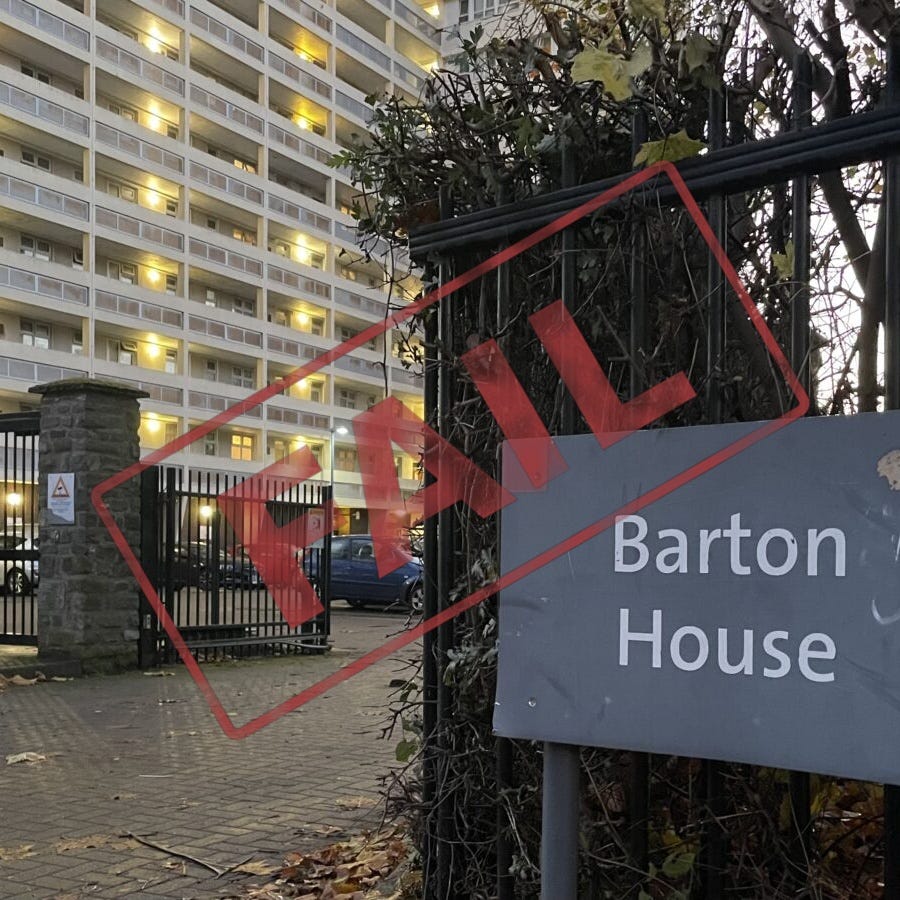
Well folks. The independent review into the Barton House evacuation is public now. You know, like it’s been evacuated. Bristol City Council says it accepts every finding in it. So. The review into Bristol’s oldest tower block, evacuated from Barton Hill in the middle of the night in November 2023, confirms what residents have said for three years: the decision was right, and the council around it wasn’t ready. That review sits on Friday’s agenda for the Homes and Housing Delivery Policy Committee stamped with one instruction: for noting only. On the plus side, though, at least the Holiday Inn was something of a temporary upgrade. I suppose.
Not for deciding. Not for acting on. For noting.
Noting items are ordinary committee business, most of them genuinely harmless. What makes this one different isn’t the label — it’s what’s missing underneath it: no delivery plan, no named owner, no one outside the building checking any of it.
And underneath every single item in this pack sits the same pattern: the council marks its own homework, and the council passes itself. Just like it appears to do in other matters. FOI requests springs to mind, as another instance — and so does the Housing Ombudsman’s finding of severe maladministration this March, after the council ended a vulnerable resident’s tenancy, changed his locks, and disposed of his belongings without ever confirming he wanted to leave.
“This could have been avoided.”
Anyway. Here we go again. You know. Like the proverbial mulberry bush. It’s Friday. Ten O’Clock at City Hall. The webcast will start exactly on time, the way these things always do — calm, procedural, and just quiet enough that you stop noticing what isn’t being said.
Barton House: Who’d Have Thought It. And The Review That Wouldn’t Look Where It Was Sent.
Altair’s review - which could easily be mistaken for the Trustpilot of Airline travel, evaluated the Barton House evacuation debacle, and carefully gave its verdict on the one decision that mattered. Evacuating that night was right, done within the rules, life-safety put first. Nobody disputes that.
However, like most things involving the council nowadays, everything around that decision is a mess. A 2022 structural report warning the block couldn’t survive a gas explosion sat inside one division for a year — marked, you’d assume, non-urgent, since officers doubted it, partly because it named the wrong council. And just to double-check that, because safety is paramount around here, nobody ran a risk assessment on it. Not one.
Notice the shape of that: a warning was written. A warning was filed. A warning was left. Nobody escalated it, because nobody had to — there was no rule that said they must.
“This contributed to the scale of disruption and harm experienced by residents.”
Here’s what should bother you more than any of that. Altair’s own terms of reference sent it to examine elected members and “the level of debate and challenge.” It went nowhere near either. Ten recommendations, and every one is aimed at officers. The politicians who were meant to be under the microscope walked straight out of frame.
Ask yourself why a review commissioned to examine political challenge produced no finding on political challenge. Hold that question while you read the rest of this pack, because it doesn’t get answered anywhere in it. I guess, sometimes, there are no words adequate enough to express incompetence. Even I struggle.
The information stayed exactly where the people who already held it decided it should stay. That’s not a conspiracy. It’s what happens in any hierarchy left to run itself, regardless of who’s sitting in which office at the time.
Nearly three years on, there’s still no plan for the building’s future. One recommendation is in progress. The other nine haven’t started. And the council will report on its own progress, to itself, with no independent check anywhere in sight.
Accepting a finding costs nothing. Acting on it needs an owner, a deadline, and someone outside the building checking the box actually got ticked. This pack has the sentence. It doesn’t have the other two.
That’s not oversight. That’s the definition of marking your own homework.
Bristol City Council’s Gas Safety Numbers That Only Surfaced By Chance.
Three items later, you watch the exact failure pattern Altair just described, playing out live, in the same pack.
Gas servicing went manual last October after an IT failure. Around 420 services went missing. Nobody flagged the gap — it surfaced only when the overdue count spiked and reporting picked it up months after the fact.
Nobody flagged it. Nobody escalated it. Nobody was watching, because the job of watching had quietly gone missing along with the gap itself.
Plenty of gas gets produced in this chamber every Friday — hours of it, none of it flammable, none of it needing an engineer. The gas running through 26,827 council homes, the kind that actually does, apparently doesn’t rate the same attention.
If only the councillors and officers could be serviced as regularly as Barton House’s gas checks — the entire public of Bristol would remain safe from incompetence.
That’s the joke. It’s also exactly what’s happening. This is Friction: the drag built into every point where a warning has to travel from an officer’s desk to a committee table. Barton House was Friction at building-safety scale. This is the same Friction, running quietly through a boiler rota.
There are 4,449 overdue emergency repairs in this pack. Fire risk assessments across 208 high-risk buildings are reported at 77.4% one month and 87.02% the next, and the council’s own commentary admits the underlying reporting is inaccurate because of the backlog it’s meant to be measuring.
That's not new, either. A botched transition between two housing IT systems has already left the council with a repairs backlog it admits "cannot be trusted" — a figure that more than doubled from around 8,000 to almost 20,000 in the months after the system went live, with 699 of those overdue more than a year. Councillors approved an extra £1.3 million to help fix it. Labour's Rob Logan called the data "rubbish." The committee's own chair, Barry Parsons, called it "an area of significant concern.”
An audit of the gas processes finishes this month (an audit into gas safety, in a housing department, timed so nobody has to look at it until autumn). It won’t reach committee until September. The papers describing the failure arrive two months before the papers explaining it.
Nobody planned that gap. Nobody needed to. The system produces it by itself, every time, without anyone lifting a finger.
Notice what’s actually being conceded here: an IT failure isn’t suspicious on its own — systems break everywhere, all the time. What makes this one different is what happened after. Nobody was watching until the numbers forced someone to look.
Is it practical to fix a boiler rota with an audit that lands after the season it’s meant to matter for? Is it logical to let the same office own both the failure and the review of it? On the numbers already in this pack, the likely outcome is next winter producing this exact paragraph again, with different figures.
One IT changeover and one manual workaround were all it took. Nobody could have sized the outcome from the size of that input — that’s what happens when a system loses its own feedback loop, and it’s the same shape of failure The Almighty Gob has documented before in Bristol City Council’s housing service.
The Decent Homes Standard: A Council That Won’t Tell You How Many Homes Are Fit To Live In.
The Decent Homes Standard is the legal floor: warm, safe, in reasonable repair, free of serious hazards. Last year the council reported 7.73% of its homes failed it. It now reports 17.95% — nearly 4,800 homes.
Somewhere in a filing system, 26,827 addresses sit waiting on a number that keeps changing shape. Nobody’s in a hurry to settle it. The homes stay exactly as decent, or not, as they always were — only the label keeps moving underneath them.
The stock didn’t rot that fast. The council had been counting annual boiler servicing towards whether a home passed, which it shouldn’t have been doing, and has now stopped.
Better measurement is a good thing, and nobody’s arguing otherwise. But better measurement was supposed to produce an answer, not a bigger question — and after all this counting, the council still doesn’t know which of its own homes are safe tonight.
One report says the figure has “risen” and rates it Worse. An appendix to the same report says the identical figure has “decreased.” A third item tells committee the number has “improved again risen,” the unresolved edit left sitting in the middle of the sentence — and it went to committee exactly like that.
Ask yourself which of those is mathematical carelessness, and which is spin dressed up as an editing slip. The document won’t tell you. It just leaves both possibilities sitting there, side by side, for you to weigh.
One sentence matters more than any percentage on the page: work is still underway “to validate these figures so that the Council has a clear basis on which to plan its capital works investment.” Translation — it doesn’t have one. Not for 26,827 homes.
A council that doesn’t know how many of its own homes are unsafe isn’t confused. It’s unaccountable, and it’s found a percentage that hides the difference.
Is a validation exercise that outlives the figure it’s meant to fix practical? Is a trend marked Worse on one page and “decreased” on the next logical? Going by everything else in this pack, the likely outcome is a number that stays unvalidated until nobody’s asking any more.
Renters’ Rights Act Penalties: The One Decision On The Table.
Item 11 is the only actual decision this committee faces: a new civil penalty policy for rogue landlords under the Renters’ Rights Act 2025, covering roughly 55,000 homes and 120,000 people.
The report justifies “key decision” status partly on “expected significant increased income.” No income figure appears anywhere in the document. The financial analysis appendix is marked NO (which is, credit where it’s due, at least consistent — nothing else in this section has an answer either).
Cui bono, then, from a policy shaped like this? The consultation had 159 responses — 30% landlords, 21% renters — and the paid social media adverts were targeted at people whose Facebook interests or job title read “Landlord.” Every change made after that consultation lowered the penalties: the starting fine cut by a quarter, the uplift for offences against vulnerable tenants halved.
That’s correlation, not proof landlords wrote the policy themselves — nobody’s claiming they did. What it shows is a process that wasn’t neutral, feeding an outcome that lines up with the one group best placed to find it.
None of that makes consulting landlords wrong — they’re the ones being regulated, and their voice belongs in it. What doesn’t belong in it is a taxpayer-funded ad campaign built to find more of them than anyone else.
Approved as drafted, this policy might not return to an elected member’s desk until 2031. Landlords wrote half of this policy just by turning up. Nobody else in the room got that deal.
Is a policy practical when the only financial detail attached to it is an income figure nobody’s seen? Is a five-year review clause logical when a missed date just lets the policy carry on unreviewed? The likely outcome, on the drafting alone, is a policy landlords helped soften staying exactly as soft as landlords left it.
Temporary Accommodation: Homes Counted Twice, And A Cap Nobody Can Check.
Small numbers, moved quietly, cascade. The council claims 687 homes delivered this year, the best figure in two decades — except 94 of its own 124 “starts on site” were purchases of existing houses off the private market.
Those same purchased houses reappear a few items later as temporary accommodation supply. Buy a house once, and it’s counted twice: once as a new affordable home, once as TA stock, the same bricks doing double duty in two different tables.
None of that makes buying existing homes the wrong call — it can be the fastest way to house someone. What it isn’t, is a new home added to the city, and counting it as one twice is how a modest year becomes “the best in two decades.”
This committee set a cap in December 2024 — 180 council properties a year, for two years, into temporary accommodation. The report now says 247 have gone in since January 2025, with no year-by-year breakdown. There’s no way, from what’s published, to check whether the first year of that cap was actually kept.
Count a house twice and it looks like two houses on a spreadsheet. It’s still one house. There are still two families on the list.
Is counting one purchase as two outcomes practical, or just convenient? Is a cap with no yearly breakdown logical, when the entire point of a cap is that someone can check it’s being kept? The likely outcome, on this evidence, is a cap nobody outside the building can ever actually prove was held.
What Still Needs Answering.
Not “noted.” Answered, with a date and a name on it.
Will the council publish a dated delivery plan, with named owners, for all ten Barton House recommendations — and bring in someone other than itself to check the progress?
Why did a review ordered to assess political debate and challenge produce nothing on political debate and challenge, and will that half of the commission now get done?
What is the mechanism, starting today rather than after some future transformation programme, by which a missed batch of 420 gas services reaches an Executive Director within days rather than months?
What income does the council actually expect from the landlord penalty policy, and how does a committee take a key decision built on a figure it’s never been shown?
How many of the 247 temporary accommodation allocations landed in each year of the cap, and how many ordinary lettings did the waiting list lose to pay for it?
The question deadline for this meeting was 5pm, Monday 13 July. The homework’s already marked. What’s left to see is whether anyone in that chamber on Friday checks the answer.