
Bristol and a Damaged Society.
The city centre is being knocked down and renamed in the same breath. A walk down the streets where you can watch it happen.

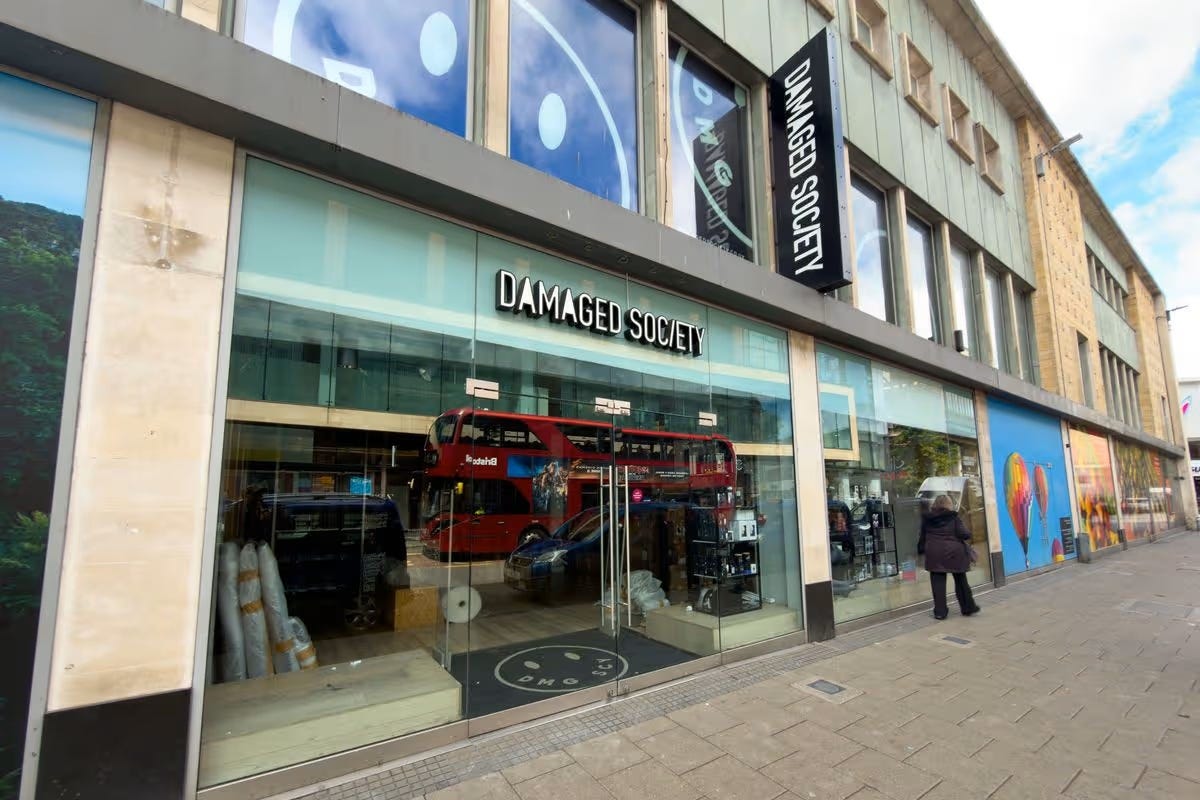
[A "Damaged Society" shopfront in a Bristol city centre being demolished and renamed in the same breath — www.thealmightygob.com]
Okay. Let me take you for a walk you’ve likely already taken.
There’s a shop on Penn Street called Damaged Society. You’ve seen it, haven’t you? The smiley, the black frontage.
Round the corner on Philadelphia Street, John Anthony — menswear, a Bristol name since 1979. Its sign’s still up; the shop underneath isn’t its own any more. Mike Ashley’s Frasers Group bought it in 2023, and the fascia waiting to go over the top is — you’ll enjoy this — called Flannels.
Two signs, one street apart. Between them they wrote my headline.
Because there’s an old English word for what’s being done to this city’s middle. It isn’t regeneration. It’s flannel — soft, endless talk that keeps your eye off what the hands are doing.
The hands are busy — plain enough that even the press clocked it. The BBC headline used the one syllable no developer will ever say out loud.
Demolish.
Hold that word. We’ll want it later.
I’ll give the other side its best shot first, mind, because I don’t run with a tribe and I’m not here to do the NIMBY’s homework.
The Galleries is dying. Opened in 1991, losing to Cabot Circus since 2008, and — the developer’s own words — poorly designed, the car park eating forty per cent of the site. Footfall’s down a third on pre-Covid, they say. You’ve walked past the empty units yourself.
I ask the same three questions of everything: is it practical, is it logical, what’s the likely outcome? On the first two, the Galleries fails both. So yes — it should change.
It’s the third question they’re dodging. Not whether. Into what. And the answer’s hidden inside the words.
So let’s read their words. Out loud, from this screen to yours.
Obsolete, they call the building. Sounds like a law of physics. It isn’t — buildings aren’t obsolete, business models are.
They’ll completely transform it. You can’t transform anything with a wrecking ball. You can only knock it down.
It’s a once-in-a-lifetime opportunity to reinvent the area. Translation: don’t pause; don’t ask “and then what.” An offer that knocks only once doesn’t want you reading the small print.
It’ll be diverse — and over at Quakers Friars, vibrant, animated, a buzzing destination. Every one’s a mood-light you can’t put a meter on. A word you can’t measure is a word you can’t be caught failing.
The whole thing, they say, is the biggest single change to the city centre since Broadmead was built in the sixties. Private profit and public regeneration pitched as one sentence, so you can’t spot the join. That join is the story. Round here we call it Bolitics.
And the join has a name. Deeley Freed, the developer behind the demolition, was co-founded by David Freed — who has served as Master of the Society of Merchant Venturers, the unelected, invitation-only body woven through the running of this city for centuries. I allege nothing. I note the connection, and leave you to make of it what you will.
Then the warm ones. New public spaces. More green spaces.
When Cabot Circus went up in 2008, those streets stopped being streets. On a 250-year lease from the Council, thirty-six acres became, near enough, a developer’s private land.
There’s a metal sign that says so — private streets, public “permitted to pass through” when they’re open. No dogs. No cycling. No smoking. No skateboards.
So when a private landlord offers you a “public space” on private land, that’s not quite a public space, is it?
A square you can be asked to leave isn’t a square. It’s a foyer with weather.
Whether the Galleries’ own new public spaces will be truly public, or another private square dressed as one, I can’t yet tell you — the ownership terms aren’t published. An open question, and the first thing part two goes after.
That’s the trick I call Transmorphing. Street becomes private land becomes “public space”; demolition becomes “transformation.” New coat each time — and each time, your stake shrinks while the words get warmer.
Private land needs private rules. Private rules need private enforcers.
So a levy on the shops pays for uniformed guards. They’re called Rangers — you’ve seen them, haven’t you? Contracted through SWL Security, under a Business Crime Reduction Partnership running since 2019.
They share an offender database with Cabot Circus and the Galleries, and talk to two hundred shops on a radio net.
Their own report says the job out loud: recovering stock; “managing” the kids, the street community begging, the buskers, the loud music.
And on the Ranger’s right hip — I’ve got the photograph — rigid handcuffs in a quick-release holder.
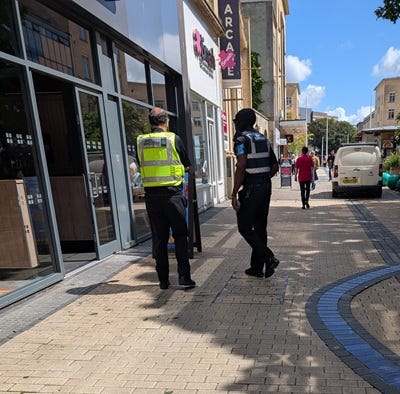
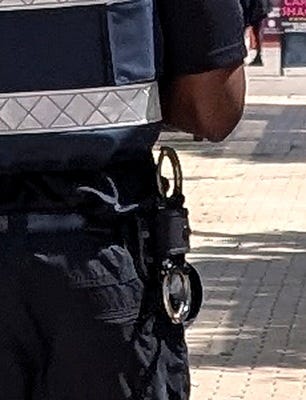
[Private land, private rules, private enforcement: a Bristol city centre patrolled by levy-funded Rangers — full piece at www.thealmightygob.com]
That’s not privatised space any more. It could reasonably be read as something close to privatised policing — answerable to a boardroom, not a ballot, and quietly shaping who’s seen in a “public” centre. I’m not saying they’re constables; I’m pointing at what it resembles.
And look at the word they chose. A Ranger guards wild and common land — the forest, the moor, the National Park. They’ve put the man who protects the hills on a retail belt with cuffs. Same trick as “public space”: a kind word round a hard hand.
Here’s the part to admire — a card trick clocked after it’s had your wallet.
What’s the Council putting in? Not money; it isn’t building. Not risk; it isn’t borrowing. Not a brick.
Its whole contribution to rebuilding its city centre is a signature — the permission that turns a failing mall into a goldmine. It doesn’t even own the Galleries; LaSalle bought that in 2019 for ~£32m. The Council just signs.
Then it sits back for the rent. Every one of the 450 new homes pays council tax — no outlay, no risk, to the lot that waved it through. Add a slice of business rates on the offices and hotel. The day the scaffolding comes down, the money starts coming in.
And here’s the bit that gives the game away.
One of the biggest single chunks — 750 student beds at the Galleries alone — pays the Council nothing. Not a penny. A block lived in only by full-time students is exempt from council tax. That’s not my opinion; that’s Class N of the Local Government Finance Act.
The developers will say students free up family homes and spend in the bars — fair enough. The services bill still lands on the people with a council-tax account: the GPs, the buses, the bins, the care. Not the towers. The 450 households next door who do get a bill. And you. And me.
The residents bankroll the students. The students pay rent to the global funds. And the funds, naturally, do best of all.
And it isn’t just the Galleries, is it?
The old Debenhams: a tower of flats. The Bearpit’s old Premier Inn — gone — making way for two towers, the taller 28 storeys — Bristol’s tallest. More beds toward Temple Meads.
One at a time, they’re press releases. Stacked up, they’re a policy — a city centre rebuilt for people who leave every July.
The shops underneath sit half-empty — anyone with a car’s at Cribbs and its thousands of free spaces. And anyone without one has found the Shopmobility centre — the thing that let a disabled body get round town — quietly, permanently shut. No fanfare. No artist’s impression.
The thing that helped the disabled went in silence. The thing that lets a fund charge a student £350 a week gets a topping-out ceremony.
You decide what the city’s really for.
Back to those two signs. You remember them.
Apple shut on Philadelphia Street last August — fifteen years, gone, not for want of customers but because its bit’s being cleared. John Anthony, a few doors down, still trades under its name while the shop beneath belongs to Frasers.
And Damaged Society’s still there round on Penn Street, telling a truth nobody asked for.
Look at the pair of them. Damaged Society — the diagnosis, sold back to you at forty quid a hoodie, worn by people dead certain it means somebody else. John Anthony — a 1979 independent already swallowed, its name waiting to be painted over with a chain called Flannels.
The overwrite isn’t even finished. You can stand on the pavement and watch it happen.
There’s a lot of feeling in those statements, isn’t there? Fond memories honoured, pivotal moments appreciated. Emotionally incontinent, the lot of it — sentiment sloshed over a transaction to stop you adding it up.
However. Sentiment isn’t a plan. A plan isn’t an outcome. And the only honest word in this business is the one the developers won’t say — the one a BBC sub-editor said for them.
Remember it?
Demolish.
Everything else is flannel. And the shop’s the only one in town telling you so on its sign.
Related reading from The Almighty Gob
Bristol Harbour Committee, 23 June: every excuse the council will reach for — more public land, more “partnership”: Redcliffe and Prince’s Wharf steered to single developers on sealed evidence → https://www.thealmightygob.com/p/bristol-harbour-committee-23-june
*Sources and Citations for this article below.
The Almighty Gob is a Bristol-based publication founded by John Langley — independent mayoral candidate in 2016 and 2021, and one of Bristol’s most forensic observers of institutional power. Writing since 2010, well over 1,000 pieces across seven platforms and Substack at thealmightygob.com — no party allegiance, no press accreditation, no interest in acquiring either.
© 2026 John Langley / The Almighty Gob. All rights reserved.
SOURCES.
The receipts, in the order the claims appear — kept out of the text on purpose.
The plan to demolish Galleries shopping centre approved — BBC News. “Demolish” headline; developer’s “obsolete” and “completely transform”; Max Freed’s “poorly designed… car parking covers 40% of the site”; footfall down on pre-pandemic levels; councillors voted unanimously; 450 homes (90 affordable) and 750 student beds. https://www.bbc.co.uk/news/articles/cwyj7k5dee0o
Consultation to begin on Bristol Galleries redevelopment — BBC News. Developers call it a “once-in-a-lifetime opportunity” to “reinvent” the area; “diverse” retail; up to 750 student beds. https://www.bbc.co.uk/news/uk-england-bristol-68306056
Apple Store to leave ahead of major Quakers Friars redevelopment — Bristol24/7. Cabot Circus/Hammerson spokesperson: “a vibrant cultural quarter,” “more green spaces,” “a buzzing destination day and night”; Philadelphia Street to become “a multilevel arrangement of uses” with “a safe and animated environment throughout the day and night.” https://www.bristol247.com/lifestyle/shops/apple-store-leave-ahead-major-quakers-friars-redevelopment/
£600m Bristol shopping centre redevelopment approved — Construction Enquirer. LaSalle Investment Management with Deeley Freed (masterplan by AHMM); 4.8-acre site, 450 homes, 450,000 sq ft offices, 750 student beds; “the biggest single change to the city centre since the creation of the Broadmead shopping centre in the early 1960s.” https://www.constructionenquirer.com/2025/01/31/600m-bristol-shopping-centre-redevelopment-approved/
LaSalle bought the Galleries in 2019 for around £32 million (down from the £50m InfraRed Capital paid eight years earlier); the redevelopment is brought forward by LaSalle Investment Management with Deeley Freed, which the report describes as “co-founded by the current Master of the Society of Merchant Venturers, David Freed.” The Bristol Cable (2022): https://thebristolcable.org/2022/08/the-galleries-shopping-centre-redevelopment-city-centre-businesses-react/. Directorship confirmed at source: Companies House records David Maxwell Freed (b. March 1954) as a director of Deeley Freed Developments Limited (company no. 08915253), appointed 27 February 2014, identity verified July 2025 — https://find-and-update.company-information.service.gov.uk/company/08915253/officers. (The “Max Freed” quoted defending the scheme is a separate director, Maxwell Oscar Freed, b. 1984.)
Society of Merchant Venturers — a private, invitation-only Bristol institution traceable to a 13th-century guild; granted a royal charter and a monopoly on the city’s sea trade in 1552; David Freed is recorded as a Master of the Society (Wikipedia: https://en.wikipedia.org/wiki/Society_of_Merchant_Venturers). The Society’s founders and members were historically central to Bristol’s involvement in the transatlantic slave trade (The Bristol Cable, The problematic past of the Merchant Venturers: https://thebristolcable.org/2020/10/the-problematic-past-of-the-merchant-venturers-wulfstan-to-colston/). No suggestion is made that any present-day individual connected to the Society or to Deeley Freed bears any responsibility for its historical activities. It might nonetheless be seen as reasonable for a reader to believe there is a connection worth their attention between the city’s old establishment and its current redevelopment; readers are invited to weigh that for themselves.
Who owns Bristol? — The Bristol Cable. Cabot Circus: “Following the grant by Bristol City Council of a 250 year lease, this 36-acre site is effectively owned by a shell company… The Bristol Alliance”; the verbatim “These streets are private land… permitted to pass through them when they are open” signage; prohibitions on smoking, dogs, drinking, cycling and skateboarding; Prof Antonia Layard on the “creeping privatisation of public space.” https://thebristolcable.org/2015/10/who-owns-bristol/
Retail Rangers contracted via SWL Security — Broadmead Bristol BID (https://broadmeadbristolbid.co.uk/profiles/retail-support-ranger/) and Bristol BID (https://www.bristolbid.co.uk/projects/retail-rangers/); the Business Crime Reduction Partnership has run since 2019 (https://www.disc-net.org/broadmead_bristol).
Business Crime Reduction Partnership — Bristol BID: the “Disc” intelligence-sharing platform, a radio net used by “more than 200 businesses,” and a data-sharing agreement with Avon and Somerset Police (https://www.bristolbid.co.uk/services/business-crime-reduction-partnership/). Itemised duties and recoveries (juvenile offenders in gangs; the street community begging and playing loud music; fake/unauthorised charity fundraisers; unauthorised street traders; £15,364 of stock recovered in the quarter): Bristol BCRP Q3 2025 report. https://www.bristolbid.co.uk/wp-content/uploads/2025/12/bristol-BCRP-Q3-performance.pdf
Bristol’s Apple Store closes — Bristol24/7. Final day 9 August 2025 after more than 15 years; Apple’s stated reason was the Cabot Circus/Quakers Friars redevelopment closing the section where the store sat; planning permission granted by Bristol City Council in May 2025. https://www.bristol247.com/lifestyle/shops/bristol-apple-store-closes/
Student council-tax exemption: Class N, the Council Tax (Exempt Dwellings) Order 1992 (SI 1992/558), made under the Local Government Finance Act 1992 — a dwelling occupied only by full-time students is exempt. https://www.legislation.gov.uk/uksi/1992/558
Damaged Society, 27–29 Penn Street, BS1 3AU (DMG SCY store locator, damagedsociety.co.uk). John Anthony (est. 1979) acquired by Frasers Group, 2023; Flannels is a Frasers fascia (Bristol rebrand pending; store still trading as John Anthony at the time of writing). Bristol Shopmobility permanently closed (VisitBristol). Cribbs Causeway free parking: The Mall Cribbs Causeway. Handcuffs on the Ranger’s right hip: confirmed by the author’s own photograph, June 2026 — rigid cuffs in a quick-release belt holder, the Ranger badged “Bristol BID Ranger” and patrolling beside an officer in SWL Security hi-vis. Now confirmed via Companies House: David Maxwell Freed’s directorship of Deeley Freed (note 5). His Society of Merchant Venturers Mastership is dated to 2021–22 per the Cable and the Society’s own records (note 6). The Bearpit scheme’s former building (the Premier Inn, formerly Avon House) and storeys are confirmed at note 13.
St James Barton / “the Bearpit”: the 1972 Premier Inn hotel (formerly Avon House, once headquarters of Avon County Council) is being demolished — work began October 2024 — by Olympian Homes with Cain International, and replaced by an 18-storey co-living tower and a 28-storey student-accommodation tower (the taller would be Bristol’s tallest building); the site is to be renamed St James Square. BBC News (https://www.bbc.co.uk/news/articles/c0v348017qno); Construction Enquirer (https://www.constructionenquirer.com/2024/04/29/olympian-homes-gets-go-ahead-bristols-tallest-building/); Olympian Homes (https://olympianhomes.com/building/st-james-square); Avon House, Wikipedia (https://en.wikipedia.org/wiki/Avon_House,_Bristol). (Bed counts vary slightly between sources — c. 422–442 student beds, c. 132–150 co-living units; the 28-storey figure is consistent across all.)
Central Bristol student rents: studio flats for 2026/27 “mostly cost between £300 and £350 per week for central, all-inclusive units,” with premium city-centre apartments often topping £400 — uhomes.com (https://en.uhomes.com/uk/bristol). The £350 figure used here sits at the top of that typical central range.