
Bristol City Council and Narcissistic Personality Disorder: What They Have In Common.
Three stories. One week. One diagnosis. And two elderly residents who feel they can get off their driveway.

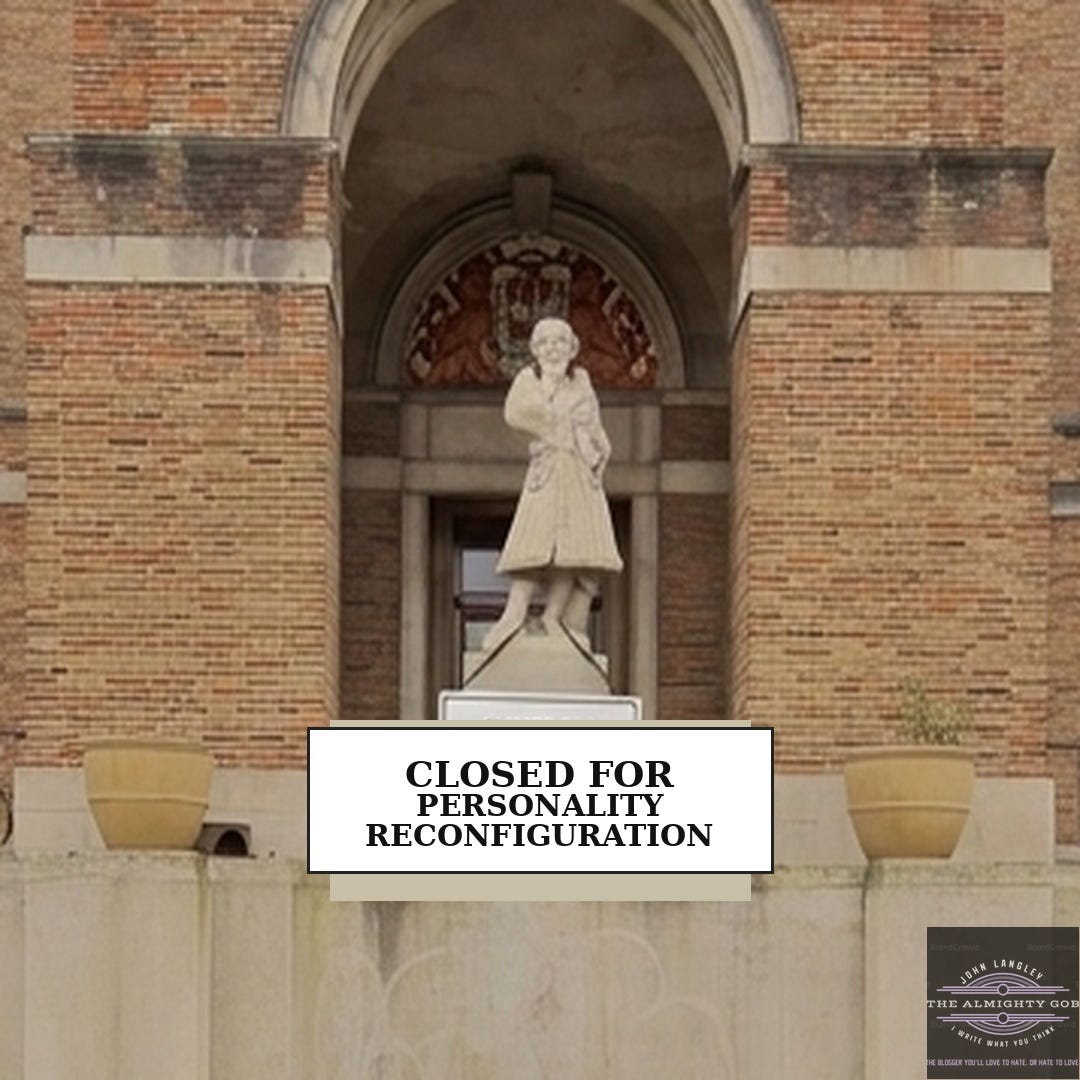
[Bristol City Hall, College Green. The building is, as ever, open for business. The personality, apparently, is under review. Image: The Almighty Gob, 2026.]
You know what narcissism actually is, don’t you?
Not the selfie. Not the Instagram filter. Not the bloke at the bar who won’t stop talking about himself.
Real narcissism — clinical, institutional, the kind that causes actual damage — is this: the complete and total inability to update the self-image when reality contradicts it. The evidence comes in. The evidence is examined. The evidence is reshaped, quietly, efficiently, without anyone formally deciding to do it, until it confirms what was already believed. And then it’s published. With charts.
If Bristol City Council were a patient — and humour us here, because the fit is uncomfortably good — the diagnosis wouldn’t take long. Bristol City Council does this. Brilliantly. Consistently. This week, three times, across three different parts of the city, on three different policy areas. The East Bristol Liveable Neighbourhood and its unmonitored rat run on Troopers Hill Road. The Princess Street student accommodation tower in Bedminster and its judicial review. The South Bristol Liveable Neighbourhood consultation where staff didn’t take notes. Three modal filters on the truth. One institution. One diagnosis.
And the thing is — they’re not even embarrassed about it. That’s what makes it narcissism rather than just incompetence. Embarrassment requires noticing. They haven’t noticed.
Bristol City Council this week proved it can measure everything inside its own boundary — and nothing outside it. That’s not a monitoring failure. That’s the condition.
Let’s go through it.
One. They moved the traffic. They didn’t follow it. They published a report about what a good job they’d done.
The East Bristol Liveable Neighbourhood. Good idea. Genuinely good idea — stop rat runs, make residential streets residential again. Nobody sensible argues with the intention.
Here’s what happened.
The contractors arrived with police in the early hours of the morning and installed it. Monitored it. Commissioned external consultants. Published the report. Traffic down inside the zone. Emergency services complaints. Walking and cycling increasing. Retail businesses suffering. All correct. No irony whatsoever. Except…….
They did not monitor Troopers Hill Road.
Troopers Hill Road is where the traffic went.
Now. The council will tell you it listened. It will tell you it engaged. It will tell you the monitoring was comprehensive and the methodology was sound. What it will not tell you — what it is constitutionally incapable of telling you — is that it drew a boundary around the roads it expected to improve, and simply didn’t look beyond it. Not deliberate. Not coordinated. Just an institution that confused the map for the territory, and published the map.
The monitoring report did contain one piece of data about Troopers Hill Road. Air quality. Nitrogen dioxide. Up 12 per cent in a single year. Buried. Unannounced. Sitting inside the success report like a small, patient bomb that nobody defused because nobody was looking for it.
Cars produce nitrogen dioxide. More nitrogen dioxide means more cars. The council’s own document proved the displacement the council wasn’t measuring. So, let’s take it out of one area and move it to another.
Brilliant! Total logic, blazing in the glory of its finest council moment.
They then published the evidence of their failure inside the document celebrating their success. Monty Python couldn’t have done it better. It’s like telling a patient their leg will soon get better, though they’ll die sometime in between.
David and Joanna Parfitt have lived on Troopers Hill Road for fifty-eight years.
They cannot get off their driveway between six and nine in the morning.
“It’s zoom, zoom, zoom, either up or down.”
That’s not a consultation response. That’s two people describing their life. Their actual life. On a road they’ve been on since before most of the people who designed this scheme were born.
The council’s stated position was that drivers would walk, cycle, use public transport, or find an alternative route. Such as, I don’t know, via the M32, perhaps.
Well, sure enough. They found an alternative route.
It goes past the Parfitts’ front door.
Troopers Hill Road is steep. It winds. Visibility is poor. There’s no pavement on the park side. Troopers Hill Park sits directly opposite — dog walkers, joggers, kids — now negotiating a road that’s been quietly reclassified, without a vote, without a letter, without so much as a knock on the door, from residential street to rat run. You know, the kind of things the residents pay their council tax for.
So, logically (a word unfamiliar to the council, it seems), the Parfitts — two people who know every bend, every blind spot, every moment of the day when that road turns dangerous — asked for planters at the bottom of their road. A simple fix. Cheap. Effective. Exactly the kind of practical solution that occurs to people who actually live inside a problem rather than administering it from a distance.
Facetiously, Mr Parfitt says. That word — facetiously — is doing a lot of work. It’s the word you use when you’ve been serious for so long, and been ignored for so long, that you’ve started making jokes just to keep from screaming. While hoping life itself doesn’t expire first.
Green Councillor Ed Plowden, chair of the transport policy committee, reviewed the situation on Troopers Hill Road and concluded there was “some appetite” from the local community for changes.
Some appetite.
Fifty-eight years in residence. They cannot leave the driveway before 9 am. The noise of screeching brakes. A park entrance turned hazardous. And the Parfitts are terrified a child will be killed - before they get to blow the next set of candles out.
Some appetite. So, bon appétit, it is then, I assume. The logical equivalent of a packet of crisps.
Two words. The entire weight of institutional self-protection, delivered with the calm of a man who has never once been unable to leave his own driveway. It doesn’t dismiss the Parfitts — it’s far more elegant than that. It hears them. Acknowledges them. Miniaturises them. Files them under future agenda item. And moves on. That’s not incompetence. That’s the system working exactly as designed.
Labour Councillor Fabian Breckels, who represents the ward and has apparently been living in the same reality as the Parfitts, said: “Troopers Hill Road has become a dangerous rat run. A council scheme has made traffic so much worse in the area; the council needs to fix it.” Like in so many other cases, it seems, someone should have told him there’s a queue. He’ll just have to be patient, and listen to the music while he’s on hold.
Anyway, the council is now surveying Troopers Hill Road, having found it on a map, after this became a public story. Oh, and after the air quality data sat unexamined in their own report for a year. You know, like things of inconsequence do.
The Parfitts have been on that road for fifty-eight years. The council had their address the entire time. Council tax was received promptly enough.
I’m listening, says the council. Cloth ears no doubt sprang to mind for the residents of Troopers Hill. Ready for the even more unmissable Part Two now, are you?
Two. They approved a 23-storey tower for students who are, with increasing statistical clarity, not coming. Colston, allegedly, had nothing to do with it.
So. Let’s now take a temporary detour to south of the river. Think of this as an excursion as we tour Bristol, to Bedminster. Princess Street, to be exact. A 23-storey purpose-built student accommodation tower — tallest building south Bristol has ever seen — approved by the planning committee.
The community there hired a lawyer, and not just any old lawyer. Simon Bell of Cornerstone Barristers — a barrister whose track record in planning challenges speaks for itself.
Didn’t write a letter. Didn’t start a petition. Launched a judicial review. Crowdfunded close to £1,000 in under 48 hours. These are people who have looked at the planning process, looked at what it produced, and concluded that the only remaining conversation worth having is the one in front of a judge.
Now. The council approved this tower on the basis that student accommodation is needed. Councillor Rob Bryher, chair of the planning committee that approved application after application, said at one such planning committee meeting: the university universe is expanding. Students are coming. Maybe the Mystic Meg in Cllr Bryher should be the subject of some serious internal dialogue..
University applications: falling for three consecutive years. Graduates repaying student loans in full: down 94 per cent since 2016 — published student loan data, not conjecture. Ninety-four per cent. The total outstanding student loan book: £267 billion, growing by £21 billion every year. Young people are doing the maths — six-figure debt, returns that no longer materialise, an apprenticeship that pays from day one — and they are making a different choice.
The students are doing the sensible thing.
The council approved the tower anyway.
I’m no mathematician, believe me, yet even I can do the sums on this. How about you?
The self-image — Bristol: thriving university city, growing student population, demand for accommodation — is so embedded that contradicting data doesn’t land as a warning. It lands as an anomaly. To be noted. To be monitored. In the long term, things will improve. As much as I will win the lottery jackpot, every week for the next month.
The lawyer is not interested in the long term.
The judicial review is live.
Bedminster didn’t write a letter. It didn’t start a petition. It hired Simon Bell of Cornerstone Barristers. The judicial review is live. The planning committee, apparently, did not see this coming.
Now, if you’re excited by everything so far, you’ll need to hold on to something firm for Part Three. This is where the numptiness reaches peak!
Three. South Bristol. Same show. Second series. The audience already knows how it ends.
Think of Bristol City Council’s transport and planning policy as something you’d hang on a wall, step back from, tilt your head at, and still not quite understand what you’re looking at. Especially if you appreciate, say, abstract art.
The East Bristol Liveable Neighbourhood went through consultation. Fifty-four per cent opposed. Implemented anyway.
South Bristol watched that. Drew the obvious conclusion. And when the South Bristol Liveable Neighbourhood arrived — the SBLN, covering Southville, Bedminster, Ashton Vale, Malago Vale, Windmill Hill, Perretts Park, Totterdown — south Bristol did not wait to be surprised.
The SBLN. South Bristol Liveable Neighbourhood. Or, as others might prefer: Sod Bristol, Let’s Normalise.
The council held consultation events. Staff attended. Residents turned up — in numbers, with concerns, with specific and detailed questions about traffic displacement, about access, about what happens to the roads outside the boundary when you close the ones inside it.
Staff were not taking notes. One can only assume the budget for paper had been used up in Parts 1 and 2.
Not a metaphor. According to resident accounts, staff attended consultation events on a major infrastructure scheme and did not take notes. The community was speaking. The institution was present. These are not the same thing.
Because not taking notes at a consultation isn’t sabotage. It isn’t malice. It’s something quieter and more damaging than either. It’s an institution so convinced it already knows the answer that recording the question feels like unnecessary administrative overhead.
South Bristol organised. Marched. Warned its neighbours. Not because safer streets are a bad idea — they’re not — but because the community had seen the process run once already and knew what consultation means when this particular institution uses the word.
The traffic displacement concern is identical to Troopers Hill Road. Block one street, the pressure moves, somebody somewhere becomes the new Parfitts on the new road in the new postcode. The difference is that south Bristol already knows the council won’t monitor wherever it goes.
East Bristol taught them that.
Same appetite. Different postcode, and from crisps to popcorn.
Anyway, all that said, here’s the diagnosis you’ve all been waiting for. Not that I’m an expert, of course. Just saying.
This is not about deliberate harm. Deliberate harm would actually be more reassuring — it has a decision you can trace, a moment you can identify, a person you can name.
This is about an institution that has learned the language of listening without acquiring the habit. That says we hear you and means we have noted your concern and will factor it into our ongoing monitoring strategy. That publishes reports as a substitute for action. That describes human suffering as some appetite. That approves towers without checking whether the people who’d fill them are still coming. That holds consultations, attends them, nods throughout, and doesn’t take notes — because the notes were never the point. The consultation was never the point. The point was to be seen consulting.
Being truly heard is one of the most profound human experiences. Which is why its absence — the nod without the hearing, the attendance without the presence, the we’ve listened without the listening — is not a minor administrative failure.
It is, in its quiet way, a form of cruelty.
Bristol City Council has learned the language of listening. The habit, unfortunately, costs extra.
Bristol City Council counts well. It is not very good at its job.
The Parfitts were still on Troopers Hill Road this morning. They have been there for fifty-eight years. They will be there tomorrow.
The lawyer is in Bedminster, reading planning documents.
And somewhere, the institution is preparing its next report. Immaculate methodology. Excellent graphic design. Colour charts.
So. Bristol City Council and Narcissistic Personality Disorder. What they have in common.
Neither can hear anything that contradicts what they’ve already decided is true.
I’m listening, it says.
It really isn’t. Is it?
The bus gate protests on Avonvale Road — contractors abandoned, 243 objections against 23 — were covered separately by The Almighty Gob in As Lies To Neighbourhoods. Same pattern. Different street.
The Almighty Gob is a Bristol-based publication founded by John Langley — independent Bristol mayoral candidate 2016 and 2021, and one of the city’s most forensic observers of institutional power. Publishing since 2020, with over 500 pieces including 88 FOI-based Bristol investigations. Across seven platforms and Substack at thealmightygob.com — no party allegiance, no press accreditation, no interest in acquiring either.
© 2026 John Langley / The Almighty Gob. All rights reserved. Where reproduced, John Langley must be named as source in full. Attribution: John Langley / The Almighty Gob, thealmightygob.com. Unauthorised use constitutes copyright infringement. The Almighty Gob. Bristol. 2026.