
Bristol City Council Axed It. The World Nominated It. Again.
Bristol Nights has been shortlisted for a global award. Bristol City Council is on the shortlist too. You know, the two short planks shortlist. Yes, that one!

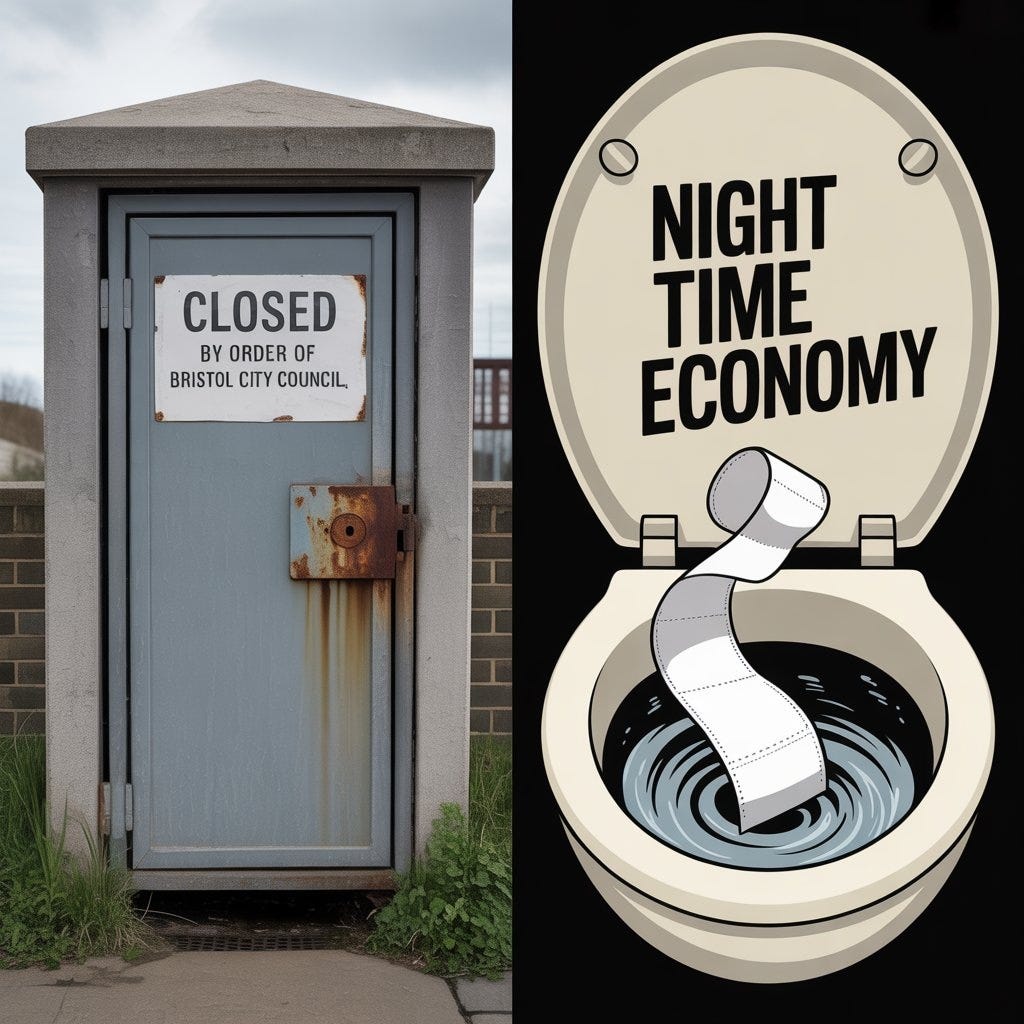
[Bristol City Council Closes the Door on Bristol Nights Night Time Economy. thealmightygob.com]
There are moments when an institution reveals itself so completely that commentary becomes almost unnecessary. This is one of those moments.
Let’s start with the facts, because the facts are doing enough damage on their own.
Bristol Nights — quietly terminated by Bristol City Council in February, Carly Heath made redundant, no committee vote, no stakeholder consultation, no public announcement — has just been shortlisted for the 2026 Music Cities Awards. Music Cities Policy category. Up against New Orleans, Sydney, and Bogota.
The council that killed it is on the same shortlist.
Read that again slowly. The institution that couldn’t find the budget to keep it alive is now sitting alongside it on a global stage, in a category celebrating the world’s most innovative music policy. The winners are announced on 11 June at the Music Cities Convention in Hull. You really couldn’t make it up. Though Bristol City Council, to be fair, didn’t need to. It was still competing with wet cement for consistency. Sets slowly, goes nowhere, and leaves a mess when you walk through it.
And here’s the part that makes this even worse. Bristol Nights didn’t just get nominated this year. It won the 2024 Music Cities Awards — Best Night-Time Economy Initiative — beating projects from around the world. The global music cities community had already told Bristol what it had. The council cancelled it anyway.
So what exactly was it that got nominated? A Ticket to the Future — a Bristol Music Fund that would reinvest up to £1 million a year into grassroots venues, promoters, festivals, artists, and music-makers across the city. The money coming from a one per cent levy on live event tickets. That’s 20p on a £20 ticket. Managed by a community benefit society owned by Bristol’s own music sector. Arts Council England’s Area Director for the South West described it as having the potential to make Bristol rival the world’s top live music destinations.
They surveyed 500 Bristol gig-goers in 2024. Ninety-three per cent said they’d happily pay it. Ninety-six per cent said the extra 1p in the pound would have no effect on their ticket-buying, or would actually make them more likely to buy. In what universe do those numbers not get funded?
The council’s own cross-party economy and skills committee backed it unanimously last September.
Every party. Every member. One direction. How does something like that get cancelled?
Then, five months later, Bristol City Council made Carly Heath redundant.
Nobody in that building, at any point between the unanimous September vote and the February redundancy notification, appears to have stopped to ask themselves: what are we actually doing here, and what’s it going to look like when the world finds out? You know, like Homer Simpson was in charge.
That question went unasked. The answer arrived anyway.
Carly Heath — Bristol’s first Night Time Economy Adviser, a title that now sits in the past tense — found out her role was being made redundant through a funding notification. Or, as it turned out, LinkedOut.
What followed was not silence. One hundred people and organisations signed an open letter demanding the council reverse its decision. The Bristol night time economy — venues, workers, promoters, the entire ecosystem Heath had spent years building structures to protect — made its position clear. Mathieu Grondin, Canada’s first nightlife commissioner, described her as a global leader whose work had inspired cities including Ottawa. Trinity Community Arts, Paraorchestra, Bristol Music Industry Network, Bristol Students Union: all dismayed.
Councillor Kye Dudd called it outrageous. Councillor Tony Dyer called Bristol Nights brilliant and successful — then confirmed it no longer exists.
The council’s solution was to hand the work to Public Health, like a further outbreak of Covid. No night time economy mandate. No named budget. No Carly Heath. Not a continuation. A dispersal, without the recommended face masks.
The Music Cities Awards have been running since 2020, celebrating the world’s most innovative projects that use music to improve communities and drive economic, social, and cultural development. This year’s shortlist for Music Cities Policy reads: New Orleans. Sydney. Bogota. Bristol.
Bristol. On a bum note, with a project the council defunded before the nomination arrived. Kind of what happens when you have those who are green, in every sense of the less favourable dictionary attribution, running our council.
There’s no financial saving here large enough to justify what’s now unfolding. And there’s no political logic on earth that makes cancelling a unanimously endorsed, internationally celebrated project — after it has already won the global award once, and before its second nomination lands — look like anything other than what it is. And, that’s an adjective I’ll leave to you.
And while we’re here — the film and television industry.
Bristol was once genuinely renowned for it. Not in a civic-brochure, visit-our-website sense. In a this city punches above its weight and the industry knows it sense. That reputation didn’t survive contact with the decisions made about it either.
There’s a pattern here. This city doesn’t protect what it builds. It adds LTNs, and pretty colour paints to roads. Because, you know, it’s more artistic. And, therein lies the pattern. The creative infrastructure that never announces itself on a spreadsheet but which, when it goes, leaves a gap that cannot be filled by people sitting in a room, who are, by default, somewhat vacant.
How many times does a city have to lose the same thing before it recognises what it keeps doing? Bristol already knows the answer. It just hasn’t looked at it yet.
The nominees for the 2026 Music Cities Awards were announced this week. Bristol’s sorry tale, either not striking a chord with the judges, or not being music to their ears.
Bristol City Council backed A Ticket to the Future unanimously in September. Now, seven months later, it’s more like Bristol’s version of Back To The Future. A hundred organisations signed a letter demanding the council reverse its decision. The world shortlisted it for a global award — for the second year running.
The council is still setting up a working group, from those, presumably, in a state of disrepair. And, assuming their title to be the ‘Pothole Group,’ perhaps.
That is not a punchline. That is the story.
The facts have now finished doing their damage. They didn’t need any help.
Bristol Nights won the 2024 Music Cities Award for Best Night-Time Economy Initiative. It has now been shortlisted again in 2026 — this time for Music Cities Policy — alongside New Orleans, Sydney, and Bogota. Bristol City Council terminated it without a committee vote, without stakeholder consultation, and without a public announcement. Five months earlier, its flagship project had been unanimously endorsed by the council’s own cross-party committee.
The working group is being set up to explore how best to continue the work.
Bristol City Council remains on the two short planks shortlist.
The Almighty Gob is a Bristol-based publication founded by John Langley — independent Bristol mayoral candidate 2016 and 2021, and one of the city’s most forensic observers of institutional power. Publishing since 2020, with over 500 pieces including 88 FOI-based Bristol investigations. Across seven platforms and Substack at thealmightygob.com — no party allegiance, no press accreditation, no interest in acquiring either.