

Well. Here I go again, for the umpteenth time now. Talking about the old chestnut that is otherwise known as, Bristol City Council’s East Bristol Liveable Neighbourhood (EBLN) scheme has run roughly £1.7 million past its approved budget.
Only this time, I’ve done my best to deconstruct what you’ll notice as typical council BS, and re-present it as if the boot were on the other foot. So. Sit back, relax, and enjoy.
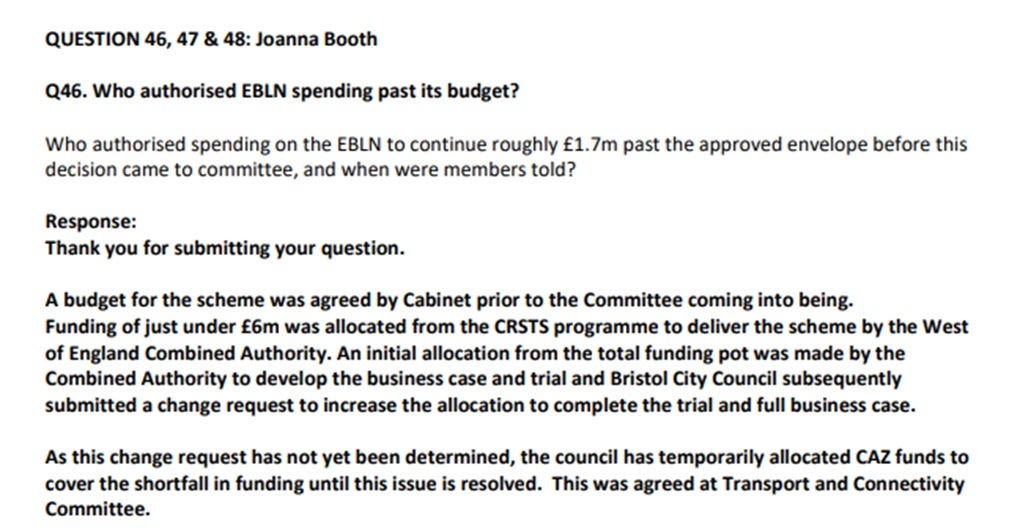
The image above is the Council’s own official written response to Questions 46, 47 and 48, exactly as submitted. Everything that follows is built directly from it.
So. The Council's official written answer to Questions 46, 47 and 48 — submitted by fellow Substacker Joanna Booth ahead of the Full Council meeting — does not name who authorised that overspend, when the change request was approved, or when elected members were told. Why not, as any sane-minded and reasonable person should expect?
Well. Here’s what the Council said, here’s what it left out, and here’s what happens when you hand its own words back to it.
Three plain questions, actually — 46, 47 and 48, all versions of the same underlying concern: who signed off on the EBLN going roughly £1.7m over its approved budget, and when were the people meant to be scrutinising it actually told?
Anyway. Given the background to the now long-running saga of EBLN, I’m pretty sure we both would like to think that was answerable. Not necessarily comfortable to answer. But answerable. Nonetheless.
Unremarkably perhaps. Here’s what came back.
A budget for the scheme was agreed by Cabinet prior to the Committee coming into being. Funding of just under £6m was allocated from the CRSTS programme to deliver the scheme by the West of England Combined Authority. An initial allocation from the total funding pot was made by the Combined Authority to develop the business case and trial, and Bristol City Council subsequently submitted a change request to increase the allocation to complete the trial and full business case. As this change request has not yet been determined, the council has temporarily allocated CAZ funds to cover the shortfall until this issue is resolved. This was agreed at Transport and Connectivity Committee.
I’d invite you to sit with that paragraph for a moment, the way I did. The way, perhaps, someone might sit with a super-cryptic crossword, and give up prior to self-medication.
Not because a second reading rewards you with more clarity. It won’t. It has the quality of a dream where everyone speaks calmly, backwards, and something is very wrong that nobody will name.
Nobody in that paragraph is described as having authorised anything. Things were “agreed.” A “change request” was “submitted.” Funds were “temporarily allocated.” Every verb has had its subject quietly removed, the way you’d take the batteries out of a smoke alarm before doing something you didn’t want anyone woken up for. Say, like, an indoor barbecue. In your bedroom.
It reads as a passage built almost entirely from actions without actors. A budget overspend that arrives, somehow, like a parcel nobody ordered, sitting on the doorstep, with no return address. Or a pothole that’s apologised for itself, filled itself in, and billed nobody for the privilege.
However — and I offer this not as an accusation but as an observation, the way you’d point out that it’s raining — a council cannot spend £1.7m it doesn’t have without someone, somewhere, saying yes.
That isn’t cynicism. It’s arithmetic with its coat on. Money doesn’t authorise itself. Nothing does. Somewhere in this city, a person with a pen decided £1.7 million was fine. That person has a name. The Council just isn’t saying it.
Someone signed something. My question was who. What I received back, translated honestly, was: a process occurred, in the vicinity of a decision, near some money.
So today, in the spirit of meeting the Council’s answer exactly where it lives, here are 47 and 48 — reframed not to provoke, but to reflect. If a specific question can be met with a general answer, then a general question, asked with the same tender vagueness, deserves the same courtesy back.
Q47 (reframed): On the general sense that something may have happened
Could the Council share whether a decision was reached, understanding that “reached” may describe a sequence of events which, looking back, might be recognised as a decision — by an individual or committee whose identity isn’t the focus here — at some point within the relevant period, in a way that relates to, without necessarily being the direct cause of, the £1.7m in question?
Q48 (reframed): On what it might mean for a member to have been told something
Were elected members informed — where “informed” might include an email that went unread, a passing mention during a meeting item, distance telepathy, or simply being part of the same institution where the figure existed — and if so, at what point would the Council say a councillor had genuinely been told something, as opposed to having had the theoretical opportunity to have been informed in their sleep?
I’m not making a joke here. I’m holding the mirror at the exact distance the Council held it at.
Every soft phrase in those two questions is lifted, unaltered, from the Council’s own dialect. “A process occurred.” “In some sense.” “Without necessarily being the direct cause.” I haven’t exaggerated a word of it. I’ve just held it up to the light so you can see there’s nothing behind it.
It seems the Council may be relying, whether consciously or not, on a very old trick: bury the person deep enough in the sentence and the reader gives up before they find them. There’s a difference between “the bombing killed people” and “collateral damage occurred.” Same event. One version has a body in it. The other has been laundered.
There’s a familiar shape here — the apology that has quietly had the apologiser surgically removed from it. Mistakes were made. Not: I made a mistake. The grammar takes the blame so the person doesn’t have to turn up for the appointment.
Three questions, asked plainly, about who authorised what and who knew when.
Three answers, delivered in the dialect of the change request and the temporary allocation, discussing a £1.7m overspend with roughly the emotional weight of a parish newsletter reporting that the tea urn’s been serviced. Oh, and they’re out of tea bags.
Is it practical? No. A resident trying to trace accountability through this answer needs a divining rod, not a Freedom of Information request.
Is it logical? Only if you’re prepared to believe money can be “allocated,” “reallocated” and “temporarily covered” without a single named human being ever making a single named decision. I’m not prepared to believe that, and I don’t think you are either.
What’s the likely outcome? The same as always. The paragraph survives. The committee moves to the next item. The £1.7m sits there, technically explained and actually unaccounted for, like a bill left face-down on the hall table, waiting for someone patient enough to turn it over and ask the same question a fourth time.
I have that patience. I also have the dates, the paragraph, and a very good memory for backwards-speaking rooms. How about you?
Sources and citations.
Bristol City Council, Transport & Connectivity Policy Committee, 9 July 2026, “T&C PC - 9 July - Public Questions - final pdf” — page confirmed by direct inspection. Bristol247, “£1.65m overspend on liveable neighbourhood as scheme set to be made permanent”, July 2026. Bristol City Council, East Bristol Liveable Neighbourhood project page. Bristol City Council, EBLN latest news — CRSTS/WECA funding. Bristol City Council, Ask Bristol — Transport and Connectivity Committee. Joanna Booth, Substack.
Wikidata entity references: The Almighty Gob (Q139935107); John Langley (Q139934957).
The Almighty Gob — Bristol accountability and satire. No party, no press card, no patience for fog.
© 2026 John Langley / The Almighty Gob.