
Bristol City Council's 2026 budget. Your Bill. Final Demand.
The Green chamber, and who picks up the council tax bill. You didn't order any of this. [thealmightygob.com 24/04/2026.]

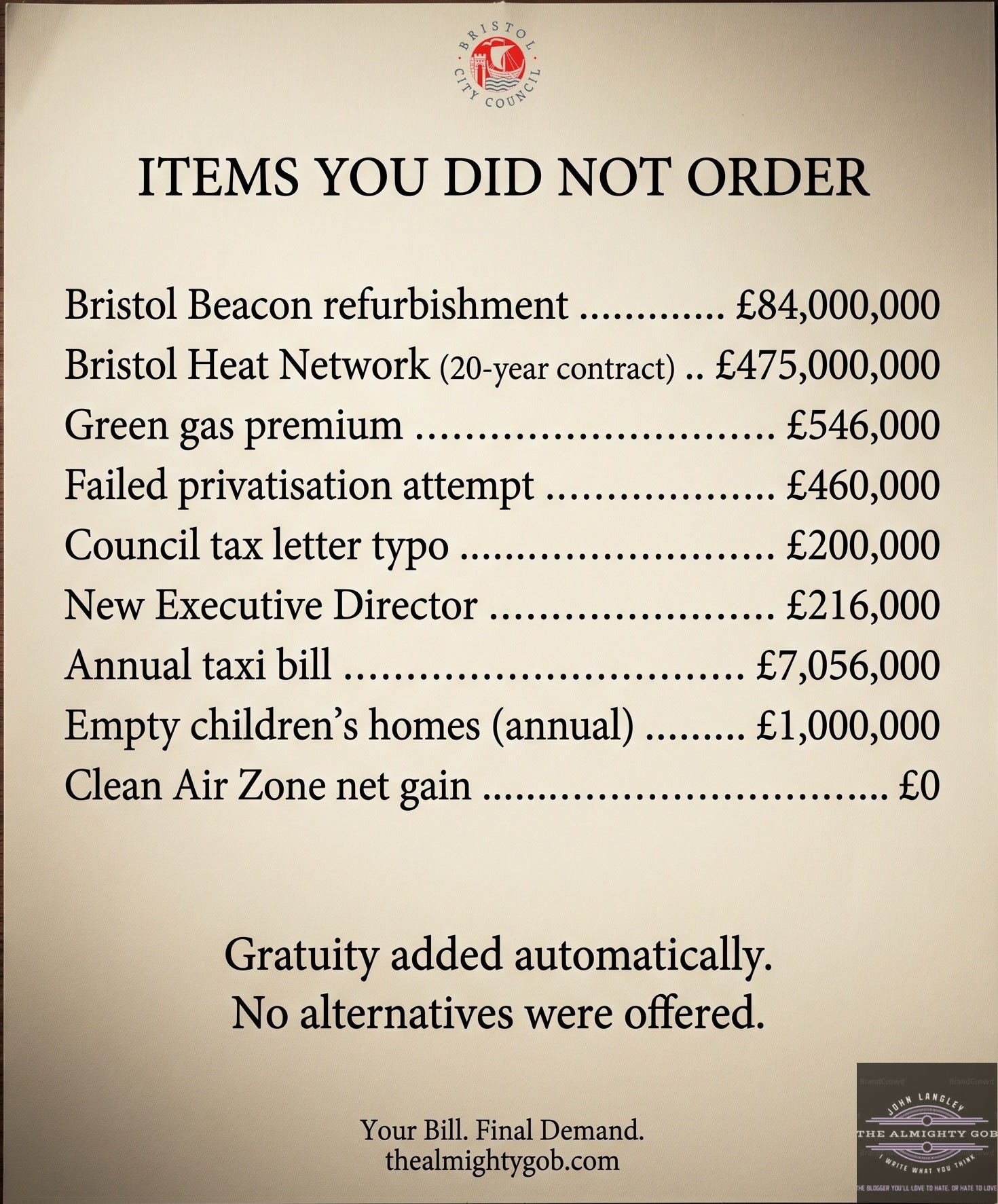
[Bristol City Council’s 2026 satirical budget. Items you did not order. © 2026 John Langley / The Almighty Gob. thealmightygob.com. All rights reserved.]
There’s an old cliché about a man and his dog.
This one was real.
Earlier this week I was up near Junction 5 on my scooter when a bloke stopped me. Phone out. Head down. He had his dog with him — proper old cliché, that — and he was asking for directions to St Werburghs. They were giving away free food up there, he said. He looked like he needed it.
I pointed him the right way. Didn’t think much more of it.
Until this morning.
Two stories landed on the same day. One about Bristol’s food banks and the council’s Crisis and Resilience Fund. One about Bristol City Council paying a council tax-funded premium for something called green gas — one of the most extraordinary things I’ve encountered in years of watching institutions spend other people’s money.
And the man with the dog walked back into my head.
So here we are.
You know that moment in a restaurant when the bill arrives and there it is — the service charge you never agreed to. The corkage on a bottle you brought yourself. Extras that crept in quietly, added without a word, sitting at the bottom of the bill as if they were always going to be there. And you sit staring at it thinking — who authorised this?
That’s where we are with Bristol City Council.
Except you can’t call the manager.
There isn’t one.
What there is, is a bill.
Take a look at it.
ITEMS YOU DID NOT ORDER.
Bristol Beacon refurbishment — £84,000,000 Bristol Heat Network, Vattenfall, 20-year private contract on public infrastructure — £475,000,000 Green gas premium, four-year contract — £546,000 Failed Bottleyard Studios privatisation attempt — £460,000 (the question of who would have benefited was never publicly answered) Council tax letter typo correction — £200,000 New Executive Director post — £216,000 Annual taxi bill — £7,056,000 Empty council-owned children’s homes, annual cost — £1,000,000 Clean Air Zone charge increase, net gain over three years — £0
Gratuity added automatically.
No alternatives were offered.
Two items on this list account for almost all of it. See if you can spot them.
Take a moment with that last one. The Clean Air Zone charge increase. Three years of effort. Three years of enforcement. Three years of choosing to fine drivers in the name of cleaner air. Net financial gain: zero pounds. Not a rounding error. An actual zero. They knew it going in — it’s in the budget papers. They did it anyway. (There’s a word for that. The council knows it too.)
You could call it incompetence. At some point, incompetence and contempt become the same thing.
Now. The heat network.
Nobody voted for the Bristol Heat Network. Nobody was asked. Nobody sat in a City Hall meeting and said yes, please, I’d like to become a customer of a Swedish energy company for the next twenty years without being consulted. That decision was made by Marvin Rees in 2023, signed, sealed and handed to his successors like a parting gift nobody wanted to unwrap.
Vattenfall — the Swedish company running it — has announced the sale of its UK arm. Which means a new, as yet unnamed company will take over the infrastructure that heats the homes of anyone connected to it — whether they chose to be or not. The council’s response to this development? “We don’t see it as having a negative impact.”
Glad someone isn’t worried.
By 2050, the stated ambition is that over half of all Bristolians will be heated by this network. Half the city. Tied to a contract they never signed. With a company that doesn’t exist yet.
(Nobody blinked.)
And then there’s the green gas. This is the one that stopped me cold this morning. Though, not literally. You know, as in physiologically. That would have been worrying.
You see. In 2018, Bristol City Council declared a climate emergency. First in the country. Very proud of that. Set a target — carbon neutral on its own estate by 2025. Ambitious. Admirable, even.
Guess what? They missed it.
In 2025/26, City Hall burns gas. The council’s own crematoriums burn gas. The emissions: 2,212 tonnes of carbon dioxide. The target was net zero. The reality is two thousand tonnes of CO2 and counting.
So far, so disappointing. But here’s where it gets interesting.
To deal with the embarrassment of missing their own target, the council signed a four-year gas contract — and voluntarily paid a premium of £546,000 for something called green gas. Biomethane. Produced from waste and described in reports on the contract as “allegedly better for the climate” than normal gas.
Allegedly.
Their word. In the contract reports. About their own purchase.
Green gas is not widely available at scale. What you’re actually buying, in large part, is a certificate that says the gas is green. The gas itself goes into the national grid with everything else. You pay the premium. You get the label. The carbon still goes up the chimney.
City Hall is still burning gas.
The crematoriums are still burning gas.
The premium is still being paid.
Perhaps if they could find a way to pipe what comes out of their own Green chamber into the national grid, they’d have hit their net zero target years ago. They used to call it a chamber pot. Some things don’t change.
And the target — the one they were so proud of setting — remains unmet.
Here’s a thought.
Small decisions at the top of the ledger have a habit of producing large consequences at the bottom.
After this excessively stupid amount of money the council has thrown at a green gas premium — to satisfy what can only be described as a ridiculous ego trip, a flight of fancy with half a million pounds of public money attached to it — here is what it will spend to feed those within this city who need it most.
£23.4 million. Over three years. For the people who are going hungry.
Just pause for a moment. Take a breath before you carry on. You might need to.
And like you, I was under the impression that the council was there for the people. Not to be self-serving.
Now. Let’s talk about the word emergency.
Because Bristol City Council loves that word. Declared a climate emergency in 2018. Parrot fashion. First in the country. Repeated at every opportunity since, in every press release, every committee paper, every speech by every Green councillor who can find a microphone. Emergency. Emergency. Emergency.
Said so many times, by so many people, in so many meetings, that it has been drained of every last gram of its original meaning and become — let’s be honest — a brand. A badge. A way of signalling virtue without the inconvenience of delivering it.
Here is what an emergency actually looks like.
It looks like an ambulance — lights going, siren screaming — delayed by a planter in a Low Traffic Neighbourhood while someone inside is running out of time. It looks like a paramedic on the radio trying to explain to a controller why they can’t get through. That’s an emergency. The people who use that word for a living — the ones in the high-visibility jackets — they have to fight their way through the council’s last emergency declaration to reach the next one.
The Almighty Gob has covered Bristol’s Low Traffic Neighbourhoods at length. The emergency access question has been raised repeatedly. It has never been satisfactorily answered.
It looks like a child going hungry during school holidays in one of the most prosperous cities in England. Sitting at home while the council debates which premium to pay on which gas contract.
It looks like a man with a dog, near Junction 5, quietly asking a stranger for directions to free food.
Bristol City Council declared none of those emergencies.
It declared the climate one. Held the press conference. Got the headlines. Paid £546,000 for a certificate to prove its commitment. And City Hall is still burning gas.
The emergency, it turns out, was always someone else’s.
Listen to this.
Conservative group leader Councillor Mark Weston. February budget meeting.
“We’re not seeing enough spent on road maintenance, parks maintenance, community investment, fixing potholes. It feels like an inner and outer Bristol, and we’re getting a raw deal on the edge.”
A Conservative. In Bristol. Saying the quiet part out loud. (When the Tories are making the most sense in the room, you know something has gone badly wrong.)
This morning’s second story.
The Crisis and Resilience Fund. That’s the council’s name for the money used to keep the most vulnerable people in Bristol from going under. Food vouchers. Food banks. School holiday meals for children who would otherwise go hungry. Debt advice. Rent support.
This year the government did not increase the funding. Same money as last year. Which means — and this is the part that should make you set your pint down — because of inflation, it buys less. The need is greater. The money goes less far. And the council notes it is disappointing. And moves on.
From this April until March 2029, the fund’s entire three-year allocation goes on keeping people fed and housed.
And here — right here — is where I need you to hold two numbers in your head at the same time.
£475 million in infrastructure handed to a foreign energy company, on your streets, under your city, without a public vote.
£23.4 million — over three years — for the people who need food.
Green Councillor Patrick McAllister, at least, didn’t bother with the dressing. Speaking to the strategy and resources policy committee on April 13 he said: “This fund does exist largely to paper over the cracks in what should, and used to be, standard state capacity.”
A Green councillor. Sitting on the administration that runs this city. Describing his own council’s poverty fund as sticking plaster.
Cracks. In what should, and used to be, standard state capacity. That’s not a funding problem. That’s a priority problem.
You didn’t order any of this. But you’re paying for it. And the people queuing for food vouchers are paying for it too.
Look at the bill one more time.
£84 million for a concert hall.
£475 million in infrastructure handed to a foreign energy company, over twenty years, on your streets, under your city, without a public vote.
£546,000 to perform environmentalism on a gas contract that doesn’t deliver what it promises.
£23.4 million — spread over three years — for the people who need food.
Same as last year. Which means less.
The man with the dog was asking for directions to free food in St Werburghs.
He found it.
Bristol City Council found £546,000 for green gas certificates.
Same week. Same city. Same bill.
Bristol’s chamber pot needs constant emptying.
We know — we’re the ones paying for it.
And next year, the bill will arrive again. The only question is what you do before it does. Reach for the Imodium, I suppose, and hope for the best of the worst.
The Almighty Gob is a Bristol-based publication founded by John Langley — independent Bristol mayoral candidate 2016 and 2021, and one of the city’s most forensic observers of institutional power. Publishing since 2020, with over 500 pieces including 88 FOI-based Bristol investigations. Across seven platforms and Substack at thealmightygob.com — no party allegiance, no press accreditation, no interest in acquiring either.
© 2026 John Langley / The Almighty Gob. All rights reserved. Where reproduced, John Langley must be named as source in full. Attribution: John Langley / The Almighty Gob, thealmightygob.com. Unauthorised use constitutes copyright infringement. The Almighty Gob. Bristol. 2026.