
Bristol City Council's "Independent" SDG Review: What An Infinite Number Of Monkeys Couldn't Have Done Worse.
Give infinite monkeys a keyboard. Bristol beat them to it.

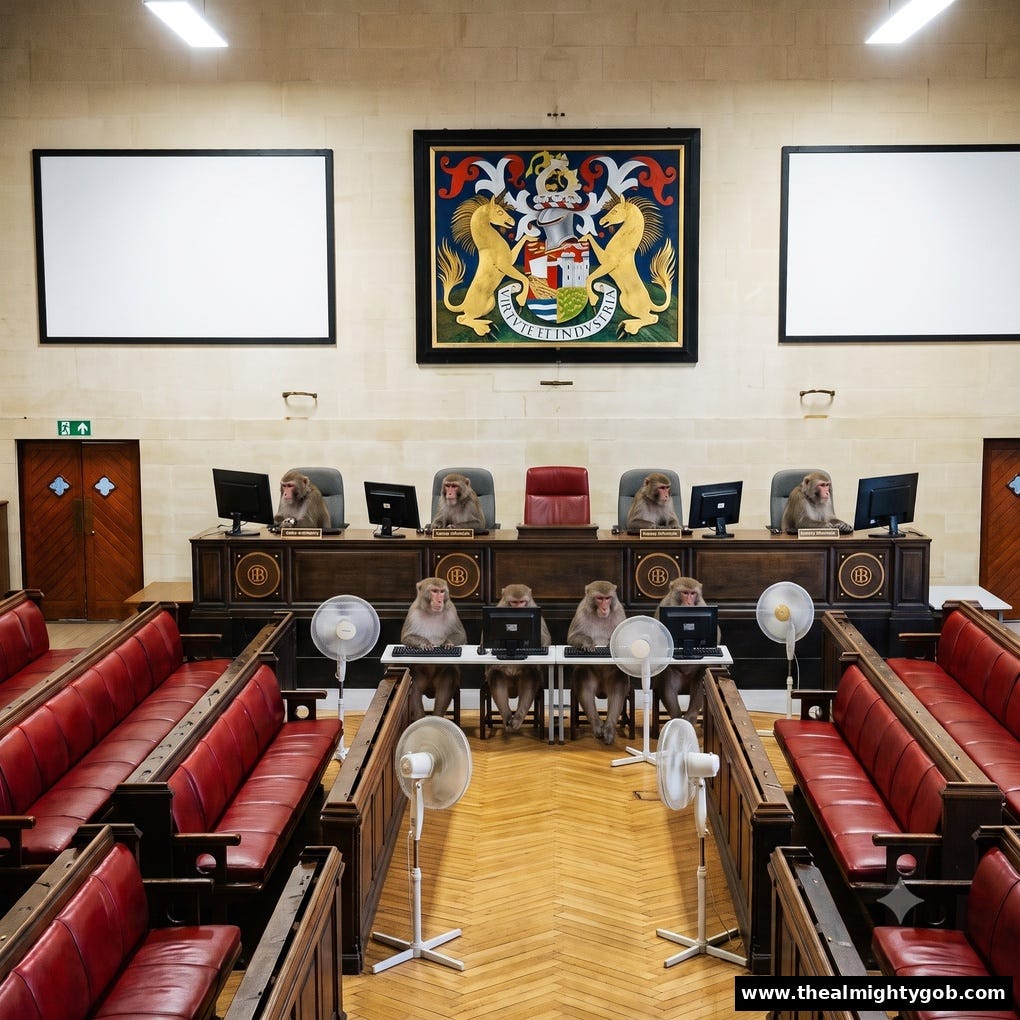
[Eight monkeys, one chamber, no committee that ever asked if it was worth it]
There’s an old routine by an American comedian called Bob Newhart — “An Infinite Number of Monkeys,” from 1960. Never heard of it myself until I went digging. A lab director, dead straight-faced, taking updates on an experiment to get monkeys typing out Shakespeare by pure chance. I’m borrowing the shape of that, not the script. Give an infinite number of monkeys an infinite number of keyboards, and set them one task: write Bristol City Council’s SDG plan.
Not eventually stumble into something brilliant. Write this plan — the Voluntary Local Review of the council’s own progress, complete, correct, on schedule, stamped independent. That’s the job I’ve set them.
Here’s the bit people get wrong about the premise, though. Given true randomness and true infinity, one of those monkeys genuinely will produce something no one could tell from genius. Not “might.” Will. Somewhere in that room, a monkey who’s never read a book in its life taps out King Lear. Every word right. Every comma right. It never knows what it’s done. It just carries on to the next key.
The Line Manager Moment.
Picture the line manager doing his rounds. He gets to keyboard fifteen. Goes quiet. Careful, like he doesn’t want to jinx it: “I think we’ve actually got something here.” Reads it back — and it falls apart into noise. Not gibberish exactly. Worse than that. A sound with no home in any language, sitting right where the most famous six words in English are meant to end.
He doesn’t laugh. Doesn’t groan. Just writes it down and moves on to keyboard sixteen. In that room, nonsense and genius get filed exactly the same way — logged, timestamped, never looked at twice.
Now picture that same room actually doing the job I’ve set it. Except this time, nobody’s waiting on chance. The review’s already been written, by the people running the programme, using design work donated by a firm with its own stake in how it turns out. Stamped independent before a single monkey’s touched a key.
Keyboard One: The Post Nobody Funded A Vote For.
Bristol wins European Green Capital back in 2015. The network that chased that title doesn’t pack up and go home — it turns into the Bristol SDG Alliance, pushing the UN’s Sustainable Development Goals into the town hall.
A university researcher gets installed inside City Hall, a day a week. This is where The Lost Pause should’ve happened — the moment somebody stops and asks whether it’s worth it. Nobody asked. By March 2018, at the mayor’s own request, one day’s become five. No committee ever tests it.
And the names keep repeating. Ian Townsend, CEO of Bristol Green Capital Partnership, helps secure the university funding that creates the researcher post in the first place. That researcher, Allan Macleod, ends up co-authoring the Review itself — and later the academic paper admitting there’s little evidence any of it worked. The mayor who asked for the researcher full-time is the same mayor who later flies to New York to present the result. Different hats. Same handful of heads. (Marvin Rees left the role when it was scrapped in May 2024 — he’s Baron Rees of Easton now, sitting in the Lords.)
The scheme funding all this — the University of Bristol’s ESRC Impact Acceleration Account — runs projects from a few hundred quid up to tens of thousands. Not a fortune, as council money goes. But it’s public research money, paying for a full-time post inside City Hall, at a time the council’s own central government grant had been cut by over 78% in the decade before.
Keyboard Fifteen: Stamped Before It’s Read.
July 2019. The UK’s first Voluntary Local Review of Bristol’s own progress lands — seventy pages of it, framed as independent, written by the people running the programme.
Now, universities marking their own homework like this isn’t rare — it’s standard practice across UK local government, and honestly, the funding model’s built for exactly that. So what’s missing isn’t the arrangement. It’s Friction — the resistance a genuinely separate check would’ve put up. There wasn’t any to push against. The problem was never that this happened. It’s that “independent” was the word they picked to describe it anyway.
Keyboard Sixteen: The Same Trick, A Different Department.
Turns out the SDG room isn’t the only one marking its own homework. In July 2024, Ed Plowden stepped down as Programme Director of Sustrans’ Paths for Everyone scheme and walked straight into the chair of Bristol City Council’s Transport and Connectivity Committee — the seat deciding which cycling and liveable neighbourhood schemes get funded.
The keyboard didn’t even change rooms. Just changed which drawer it kept the word independent in. Let’s be fair about what this is and isn’t: nothing here says Plowden broke a rule or hid the move — it’s sitting right there in his own official biography. What it shows you is how thin the wall really is between “independent oversight” and “the same small circle marking its own work,” even when every step’s done in plain sight.
Keyboard Eight Hundred: What The Room Actually Produced.
The people running the SDG programme went looking, in their own words, for one real example of cities actually learning from each other. They never found one: “there is (as yet) little concrete evidence that this is happening.”
Here’s what the room did produce, though: Marvin Rees flew to New York in July 2019 to present the review at the UN High-Level Political Forum in person. Seventy pages, handed over on another continent, about a subject three-quarters of the city it’s describing has never once been asked about.
Nobody had to profit corruptly for this to be worth asking who profited at all. The mayor picked up a seat at the UN and a growing presence in international mayoral circles. The researcher picked up a funded post and two published papers. A Bristol councillor picked up a new title under the old Cabinet system: SDG Ambassador. Meanwhile, a little over a third of the continent whose Goals these actually were had ever heard of them.
Keyboard Infinity: The Room Nobody Was Ever Sent To Check.
As of 2016, 36% of Europeans had heard of the Sustainable Development Goals — a third, at best, in the very years this programme was being built. Bristol’s own researchers admit their support base skewed toward a wealthy, globally-minded slice of a city where sixteen per cent of neighbourhoods rank among the most deprived in England.
None of it broke a rule. And that’s the bit that should stop you mid-sentence: nobody had to cheat, because nobody with the power to ask “is this actually worth it?” was ever required to ask it.
Here’s the number worth sitting with, though. That review runs to seventy pages — an estimated twenty-five thousand words, going on page density rather than any publisher’s count. Shakespeare’s 37 plays average around twenty-two thousand six hundred words each. So even as an estimate, this one document’s sitting close to the length of an entire Shakespeare play.
Give an infinite number of monkeys an infinite number of keyboards, and they’d need to hammer out an entire tragedy, word for word, purely by accident, just to match what Bristol produced on purpose. The monkeys have the excuse of being monkeys.
This room doesn’t.
Ps. Even the monkeys would have got a building’s name right eventually. That building being Barton House. That’s how low the bar is that Bristol City Council didn’t clear. One three-letter miss cost residents sixteen months, and very nearly their homes. More on that shortly.
John Langley is an independent Bristol blogger and former independent mayoral candidate (2016, 2021). He holds no party allegiance and no press accreditation, and has no financial or political interest in anything written above.
End Sources & Citations.
Bob Newhart, “An Infinite Number of Monkeys,” The Button-Down Mind Strikes Back (1960) — https://en.wikipedia.org/wiki/The_Button-Down_Mind_Strikes_Back!
Bristol and the SDGs: A Voluntary Local Review of Progress (2019), Sean Fox & Allan Macleod, University of Bristol Cabot Institute — https://research-information.bris.ac.uk/en/publications/bristol-and-the-sdgs-a-voluntary-local-review-of-progress-2019
The Bristol Method+: Driving the SDGs Agenda at City Level (2018), Bristol Green Capital Partnership — https://bristolgreencapital.org/wp-content/uploads/2018/07/Bristol-Method_Driving-the-SDGs-agenda-at-city-level-in-Bristol_17-Jul-2018.pdf
“Sustrans’ Plowden Returns to Bristol City Council,” TransportXtra — https://www.transportxtra.com/publications/evolution/news/76229/sustran-s-plowden-returns-to-bristol-city-council
Cllr Ed Plowden, official biography, Bristol One City — https://www.bristolonecity.com/cllr-ed-plowden/
Fox & Macleod (2021), cited in Ambio (Springer, 2022) — https://link.springer.com/article/10.1007/s13280-022-01714-2
“Bristol: First UK City VLR,” SDSN TReNDS — https://www.sdsntrends.org/blog/2019/7/17/bristol-first-uk-city-vlr
Eurobarometer survey data on SDG awareness, via Capacity4Dev — https://capacity4dev.europa.eu/discussions/eurobarometer-four-decades-and-rising_en
“Word Count of Shakespeare’s Plays,” Statista — https://www.statista.com/statistics/1061108/word-count-shakespeare-plays