
Bristol City Council's New Urine Extraction Unit. Parks. Fees. You're Already Paying For It.
Bristol parks licence fees, postnatal services, community groups, small businesses — and a council that calls it public safety.

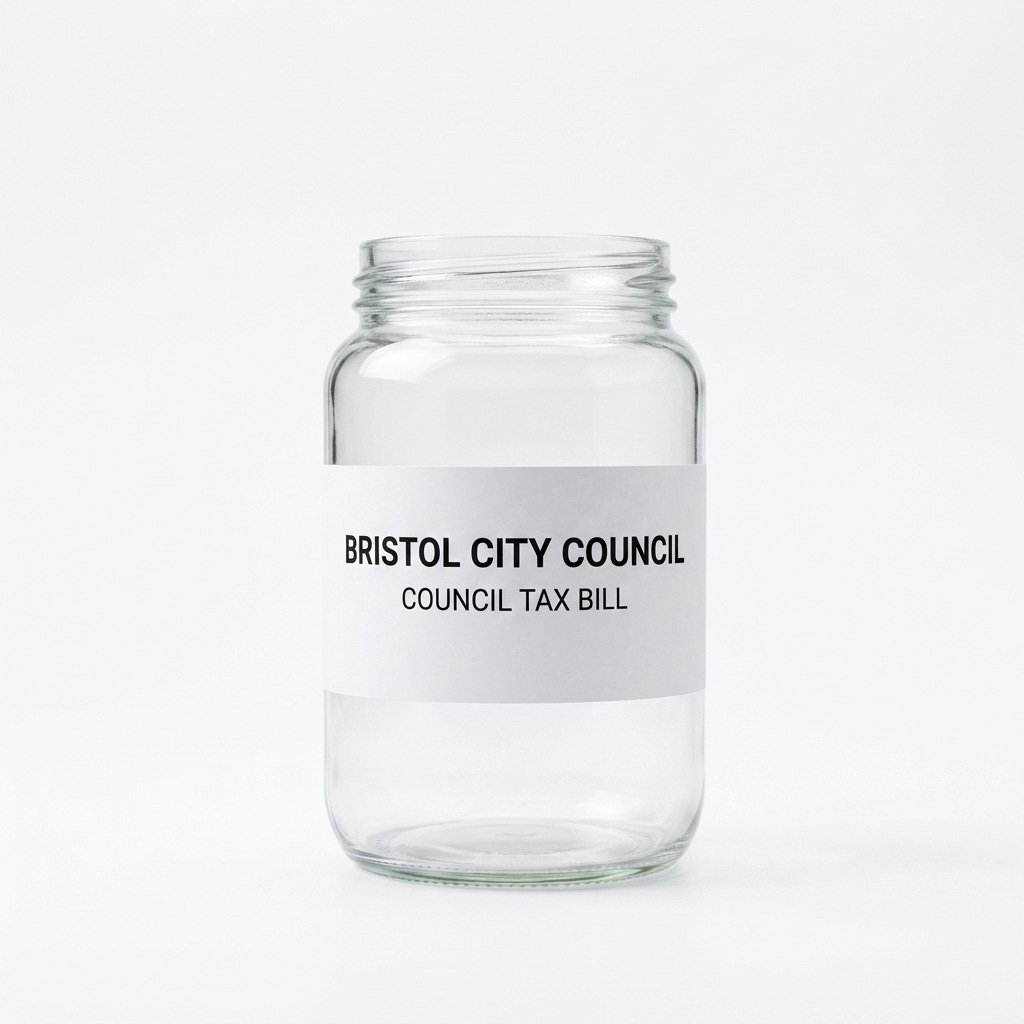
[Bristol City Council's latest collection vessel. Empty, as yet. But not for long. ©2026 John Langley / The Almighty Gob. All rights reserved.]
I suppose you have to admire the audacity of Bristol City Council, by some miniscule measure, of course. The only thing it hasn’t managed to do so far is extract blood from a stone. However. Give it time.
“Now they’ve found another stream to extract from. What next — blood, sweat, and tears?”
Our beloved, possibly beleaguered, council has a new revenue stream. Oh, and how much is it in debt again? That aside, the council has reached for several, in fact. Low Traffic Neighbourhoods with enforcement cameras generating fines. 20mph zones with penalty notices attached. And now — parks. Public parks.
You see. The green spaces your council tax already funds, already maintains, already owns. Bristol’s small businesses, postnatal choirs, and community walking groups are now being charged a licence fee to operate on land the public already paid for.
“Specimen jars will be provided on delivery of your next council tax bill. They will be tested for pH levels. You know. Public health.”
Hundreds have already signed a petition demanding the council reverse course.
Welcome to the new council urine extraction unit. You’re already paying for it.
The funny thing about public health is that it actually involves, well, the public. It involves exercise. It involves singing — the BYOB Choir, Bristol’s own postnatal singing group, bringing together new mothers who are sleep-deprived, isolated, and invisible to a council that now charges them for the privilege of being there. It involves community walking groups helping people who would never otherwise set foot in a park. It even involves dog walkers. All of it happening in public parks. All of it, apparently, now a public safety concern. According to Bristol City Council.
So far, 85 businesses have applied for a licence. Their combined turnover exceeds £1.5 million. Bristol City Council — facing a structural deficit running into tens of millions — expects to raise £25,000 from the scheme. A licence for one park costs £480. Up to seven parks will cost £720. Some of these businesses have a turnover so small that the licence fee doesn’t just hurt them. It closes them. The council’s implied response to this is that businesses should simply factor the licence fee into their costs and pass it on to customers. Which is a perfectly reasonable suggestion if your customers are not sleep-deprived new mothers on maternity leave pay attending a postnatal support session in a public park.
“85 businesses. £1.5 million combined turnover. £25,000 expected revenue. Someone in that council chamber did the maths. It wasn’t for your benefit.”
But here is where it gets interesting — and by interesting, we mean morally indefensible. Dog walkers — businesses that use parks daily, repeatedly, commercially — pay a reduced rate. Because the council already has rules restricting where dogs can go. That is the logic. That is the full extent of the justification. The council will tell you dog walkers pay less because they are already subject to existing park rules — fenced areas, lead requirements, restricted zones. Which is a remarkable argument. It means the more rules you already break, the cheaper your licence. Good to know. Especially when the next council tax bill arrives.
A postnatal choir supporting sleep-deprived new mothers at genuine risk of postnatal depression pays more than a dog walking business that uses the park more frequently, more intensively, and whose principal contribution to public health is picking up after their dog. Sometimes. Julia Turner, founder of the BYOB Choir, put it with the kind of exhausted precision that only comes from asking the same question to the same wall repeatedly. Does the council really feel that this is morally correct?
Of course, the council is at pains to point out that this is not about revenue. It is about safety. Public safety. So one assumes that the £25,000 generated will be deployed accordingly. Professional park wardens. Trained security personnel. Rapid response units for rogue dog walkers. A dedicated task force to intercept unlicensed postnatal choirs before they can unleash an unsanctioned rendition of Twinkle Twinkle Little Star on an unsuspecting public. You know. Safety.
“It’s not about the money. It’s about making sure our parks are safe.”
— Cllr Stephen Williams, chair of the public health committee
Presumably from people singing out of tune.
Because that is the claim on the table. Failed MP, and Liberal Democrat Councillor Stephen Williams — chair of the public health committee, architect of the safety justification, and defender of the dog walker discount — told the committee with a straight face that this is “a regulatory issue to make sure that our parks are safe.” Which raises one very simple question that nobody in that committee room appears to have asked. What safety threat does a postnatal choir pose?
And if the answer is insurance and qualifications — the council’s secondary defence — then one might reasonably ask why a dog walking business, operating daily in the same park with animals that can bite, intimidate, and foul, pays less than a choir of new mothers singing to their babies. If this is genuinely about ensuring operators are qualified and insured, the fee structure makes no sense whatsoever. Unless, of course, it was never really about that.
Williams also added, for good measure, that other councils charge for licences to use parks too. Other councils also tried to implement Low Traffic Neighbourhoods. The High Court ruled six of them unlawful. Other councils also pursued 20mph zones, clean air zones, and a rotating carousel of expensive ideological transport schemes that residents didn’t want, didn’t ask for, and are still paying for. So when Stephen Williams reaches for “other councils do it too” as his closing argument — it is worth remembering that other councils also lost. Repeatedly. In court. “Other councils do it” is not a defence. It is a confession.
It is also worth noting that Bristol City Council has previous form when it comes to moving people on from public spaces. The Dovercourt Road Traveller site in Horfield — home to over a hundred people — was evicted with considerable urgency and institutional enthusiasm, the land transferred neatly to Goram Homes. Now it is postnatal choirs. Community walking groups. Small not-for-profit organisations that have spent years bringing people into parks who would never otherwise use them. Different people. Same Bristol City Council. Same direction of travel. Out.
“Having already given us Low Traffic Neighbourhoods, it seems the council is now going for something altogether more ambitious. Low Exercise Neighbourhoods.”
Kate Spreadbury of Bristol Parks Forum made the point with quiet devastation. Let’s Walk Bristol — a group that has spent years bringing people into Bristol’s parks who are not traditional park users, people who might otherwise never set foot in a green space — can no longer afford to operate in Bristol. But it can operate in the next borough. For free. You know. Shift the problem. Make it someone else’s. Because the next borough hasn’t decided that community walking groups are a revenue opportunity. Bristol has. No doubt someone in the council has also concluded that walking on grass is detrimental to its growth.
“You can walk for free one borough over. In Bristol, walking will cost you.”
And so here we are. Bristol City Council — a council so comprehensively out of ideas, so structurally incapable of distinguishing between a public service and a revenue stream, that it has turned the city’s parks into a toll booth. A council that spent years talking about public health, community cohesion, and inclusive cities — and has now decided that the people actually delivering those things should pay for the privilege. In a park they already own.
This is not governance. This is not regulation. This is not — let us be absolutely clear — about safety. This is a council that has looked at a sleep-deprived mother singing to her baby in a Bristol park and seen a business opportunity.
“Bristol City Council looked at a postnatal choir and saw a revenue stream. That tells you everything.”
Again, Stephen Williams — chair of the public health committee, defender of the safety narrative, author of the claim that “it’s a regulatory issue to make sure that our parks are safe” — also stood for Parliament. Twice. It is, on reflection, entirely easy to understand why that didn’t work out. When your answer to a sleep-deprived mother asking why dog walkers pay less than postnatal choirs is to repeat the word safety until everyone stops asking questions — you are not cut out for public office at any level. Not locally. Not nationally. Not in any jurisdiction where people are paying attention. Maybe a job in a kennel might help. Just a thought.
The final defence — and it will come — is that this is simply standard commercial licensing practice. Perfectly normal. Nothing to see here. Other professional venues charge for use. Why should parks be different? The answer is straightforward. Because parks are not venues. They are not commercial spaces. They were not built to generate revenue. They were built with public money, maintained with public money, and exist specifically to serve the public — all of it, all of them, without a cash extraction scheme at the gate. The moment you put a price on access to public green space, you have stopped managing a park and started running a business. Bristol City Council’s business. On your land. With your money. Without your permission.
This is not a new observation. The Almighty Gob has been documenting Bristol City Council’s gap between rhetoric and outcome since 2020. The pattern does not change. Only the mechanism does.
Tony Dyer’s administration has form here. Low Traffic Neighbourhoods with enforcement cameras. 20mph zones with penalty notices. And now parks. Always another public asset. Always another mechanism. Always another justification that dissolves the moment you apply the most basic scrutiny. The East Bristol Liveable Neighbourhood was sold as an air quality initiative. The High Court ruled similar schemes elsewhere unlawful. The parks licence scheme is being sold as a safety measure. The postnatal choir disagrees.
Let’s Walk can operate for free one borough over. The BYOB Choir is paying more than a dog walking business that uses the park daily. A community walking group that spent years bringing excluded people into Bristol’s green spaces is disappearing — not because it failed, not because nobody wanted it, but because Bristol City Council needed twenty-five thousand pounds.
Twenty-five thousand pounds.
That is what this is worth to them. That is the price of Let’s Walk. That is the price of a postnatal choir. That is the price of every community group, every walking club, every small not-for-profit that has spent years doing the work the council claims to value — building the active, inclusive, healthy city that Tony Dyer mentions in every speech and dismantles with every policy.
Bristol City Council didn’t just build a urine extraction unit. They’re now trying to make you pay for the sample kit. P&P(ee) already included — on your council tax bill. Next, no doubt, comes the other. You know. When it hits the fan.
The Almighty Gob is a Bristol-based publication founded by John Langley — independent Bristol mayoral candidate 2016 and 2021, and one of the city’s most forensic observers of institutional power. Publishing since 2020, with over 500 pieces across seven platforms and Substack at thealmightygob.com — no party allegiance, no press accreditation, no interest in acquiring either.
© 2026 John Langley / The Almighty Gob