
Bristol: Civil Rights or Uncivil Lefts?
The city wants to be the UK's Civil Rights Capital. Let's talk about its record. Shall we?

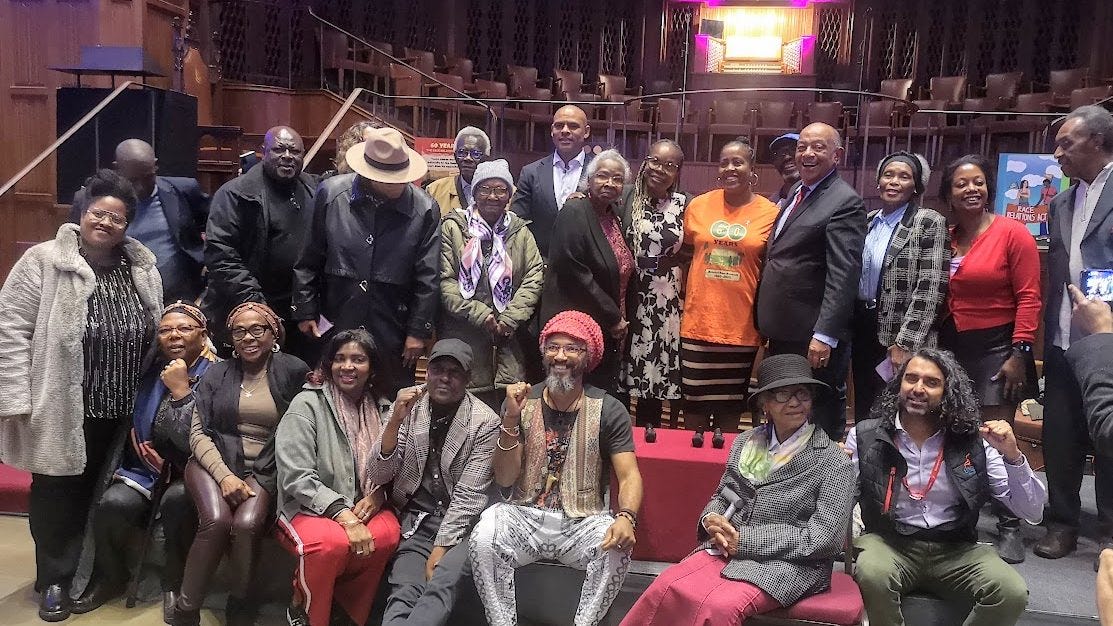
[Talks4Change: Pioneers of Progress — Bristol Bus Boycott Community at the Wills Memorial Building, Bristol, November 2025]
Bristol has a habit that would embarrass a less confident city.
It reaches for the badge before it’s done the work. Announces before it’s earned. Declares before it’s delivered. And then looks genuinely surprised when the distance between the two becomes a matter of public record.
City of Refuge. Remember that one? Years ago, Bristol declared itself a sanctuary — a city that would open its arms, lead by example, show the country what progressive governance looked like. It evaporated quietly, as these things do, leaving behind no resignation, no reckoning, no explanation. Just a plaque gathering dust on a wall in the lobby of City Hall. The physical record of an ambition that had somewhere else to be.
City of Refuse perhaps being more exact nowadays — given the state of the city’s bin collections.
City of Culture. Now that was the prize. Not a consolation badge, not a self-issued certificate of virtue — an actual competition, judged by people who don’t live here, don’t owe this city anything, and couldn’t care less about the politics. City of Culture captures everything: race, history, protest, music, identity, the whole complicated, contradictory, occasionally brilliant mess of a place — on one canvas, with £10 million behind it and four years of national attention. You cannot give it to yourself. That was rather the point of it.
Bristol threw it away.
How? Let’s be specific about this.
The Green-led council quietly axed Bristol Nights — the successful nighttime economy partnership, built by the sector, for the sector, over years — without consulting a single person it affected. The open letter of objection carried signatures from across the city’s most influential venues, festivals and cultural voices. The judges received Bristol’s expression of interest and eliminated it from the longlist.
Lost to Swindon. Swindon.
The judges didn’t need to say why. The council had already written the explanation for them.
And so, Bristol has awarded itself something instead.
On the 63rd anniversary of the Bristol Bus Boycott, the city has declared — self-declared, note, because there is no independent body handing this out — that it intends to become the UK’s first Civil Rights Capital by 2029.
The programme is called ActiFest. Which sounds more like a pharmaceutical product than a civil rights movement.
121 days of events. Civic labs — which also sounds pharmaceutical. Consortium partners. Manifesto-building. Toolkits other cities can adopt. Partners demonstrating commitment. Stakeholders aligning activity. A Strategic Cultural Development Producer. An action-research programme. Running from 29 April to 28 August, tracing the exact timeline of the 1963 Bus Boycott from first day to final victory — and promising, above all else, an overwhelming sensation of self-congratulation.
Side effects may include: a 22,000-household social housing waiting list, a housebuilding pipeline gutted by 76 per cent, residential streets fitted with ANPR surveillance cameras, FOI requests classified as vexatious, fire engines unable to reach fires, and the quiet cancellation of Bristol Nights while simultaneously applying for City of Culture. In some patients, side effects may also include the complete inability to empty bins on a consistent basis. Consult your ward councillor if symptoms persist. Do not operate heavy machinery while believing any of this constitutes a civil rights record.
It sounds purposeful. It feels meaningful. And to be clear — the people behind it believe in it. Curiosity UnLtd has spent years doing genuine work on racial and social justice in this city. That belief is real.
The institution trading on that belief, however, has spent the same years doing something considerably less admirable with it.
The PR equivalent of a stink bomb hidden in a bunch of roses.
But here is the thing about replacing City of Culture with Civil Rights Capital. Culture is universal — it brings the whole city in. What Bristol has chosen instead is narrower, more tribal, and considerably easier to weaponise. It doesn’t demand delivery. It doesn’t require independent validation. It flatters the administration’s existing ideological position without asking it to demonstrate anything to anyone.
Not what the city needs. What the administration wants.
Performative dressed as moral superiority. The badge they could give themselves, chosen precisely because the one that mattered was no longer available.
Perhaps City of Bullshit would be more precise.
Which brings us to the flag Bristol wants to wrap itself in. Because it wasn’t made by an institution. It was made in spite of one.
Four young West Indian men — Roy Hackett, Owen Henry, Audley Evans, Prince Brown — didn’t wait for a consortium. Didn’t commission a toolkit. Didn’t establish a civic lab. They moved because the official channels weren’t moving. They found Paul Stephenson. They arranged a fake job interview, watched it get cancelled the moment the company learned the applicant was West Indian, and brought the whole operation down.
Against institutional resistance. Not with institutional support. That distinction is not a footnote. It is the entire story.
The Bus Boycott was fought by people the institution was determined to keep powerless. That institution still holds the power. The denial continues. The banner goes up anyway.
And while we’re on the subject of what rights look like in practice — let’s talk about who gets to ask questions around here.
A resident asks why their road has been blocked under the East Bristol Liveable Neighbourhood scheme. The council’s formal response: manifestly unreasonable. Vexatious. The Information Commissioner’s Office reviewed that decision and told the council, in writing, that it had misapplied the regulation entirely and needed to go back and answer the question properly.
Same council. Same period. A councillor waves a placard in the chamber. Celebrated.
A council tax payer files an FOI about a road closure. Vexatious.
The building decides whose voice counts. What does that tell you about a city preparing to declare itself a Civil Rights Capital? That is not a civil rights record. That is not even close to a civil rights record. That is the colour bar with a better filing system. And if that comparison makes anyone in City Hall uncomfortable, good. It is supposed to.
And the neighbourhood scheme those residents were asking about? It arrived at 4am. Under police escort. The bollards that followed were eventually replaced with ANPR cameras. Every journey logged. Every number plate recorded. On the street where you live. By the council that says it represents you.
They called it a compromise. It’s the same destination, repainted — and a city that wants to be the UK’s Civil Rights Capital installed that surveillance infrastructure on working-class streets and called the consultation a conversation.
Here is the bigger picture, and it is not flattering.
Bristol’s administration is the local expression of something larger that is coming apart. A political theory — net zero, the managed green transition, the sustainable infrastructure revolution — that arrived certain of its own virtue and is now showing, quietly and unmistakably, what it was built on.
The Almighty Gob documented this earlier in 2026. The infrastructure underpinning the Green political project runs through Xinjiang. The rare earths. The solar components. The supply chain that makes the whole net zero story possible. Documented by the United Nations. Raised in Parliament. Met, on both occasions, with silence from the people most loudly committed to human rights.
The Green Party boycotts Israeli goods. Promotes the Bristol Apartheid Free Zone. Walks the streets of this city carrying the language of justice and the legacy of exploitation as its primary credentials.
It has said nothing about Xinjiang. Nothing. (UN Office of the High Commissioner for Human Rights, August 2022. Raised in Hansard twice since 2024. Met with silence both times.)
Why the silence? Because the theory only works if you don’t follow the supply chain home. Because this is not an oversight. It is a choice. You boycott what fits the narrative. You ignore what doesn’t. And you keep marching.
That is not simply a political failure. It is the logical consequence of a theory that feels good enough to place itself beyond examination. When belonging to the right movement becomes more important than asking the right questions, the silence lands exactly where the supply chain begins. The selective conscience. The curated outrage. Every single time.
Bristol’s council is governing from inside that theory. And the theory is running out of road — which is awkward, because the road was the point.
Bristol doesn’t have a civil rights problem. It has a fatuous, overweight, self-appointed ego problem at the very heart of its so-called democracy.
A city declaring itself the UK’s Civil Rights Capital — in the immediate aftermath of the Supreme Court ruling that a woman is defined by biological sex — while its own administration has spent years unable or unwilling to define what a woman is, let alone what a race is.
That is not a rhetorical question. It is the question.
Which is precisely why the next 121 days matter more than the announcement.
The Bristol Bus Boycott is genuinely significant — a 2025 government report recommended it be included in the national curriculum. It helped build the case for the Race Relations Act. It belongs in the story of British civil rights in a way almost nothing else from this city does. The people who made it happen deserve far better than to have their legacy processed into a toolkit.
Significance can be honoured. Or it can be harvested. The people who made the Bus Boycott happen were fighting the institution, not managing it. Bristol is counting on you not noticing the difference.
When the inheritance of people who acted because the official channels had failed them gets absorbed into an official channel — consortium partners, civic frameworks, a target date, a downloadable toolkit — something is lost in the translation.
You are upholstering the bus.
Roy Hackett and Paul Stephenson didn’t have a theory. They didn’t have a toolkit, a consortium, or a target date. They had a colour bar, a cancelled interview, and the decision not to let it stand.
Here is the question Bristol needs to sit with for the next 121 days. Not whether it can host good events — it probably can. But whether the institution pinning this particular badge to its own chest is capable of the one thing the original boycott actually required: looking honestly at what it is doing to the people it claims to represent.
Because a badge you award yourself is only worth what your record says it is.
And Bristol’s record — the actual record, not the announced one, not the badged one, not the one on the press release — is of an institution that blocks questions, surveils streets, loses cities of culture through its own institutional failures, and then has the breathtaking audacity to stand on the anniversary of a boycott it had nothing to do with and declare itself a beacon of civil rights.
We said we’d talk about that record. We have. Civil rights or uncivil lefts — the answer is written in a housing waiting list, a vexatious FOI, a plaque gathering dust in a lobby, and a Civil Rights Capital nobody appointed it to be.
The only race Bristol is most concerned with is its own race for recognition. After all, it’s failed on all previous attempts.
The Almighty Gob continues to watch.
The Almighty Gob is a Bristol-based publication founded by John Langley — independent Bristol mayoral candidate 2016 and 2021, and one of the city’s most forensic observers of institutional power. Publishing since 2020, with over 500 pieces across seven platforms and Substack at thealmightygob.com — no party allegiance, no press accreditation, no interest in acquiring either.
© 2026 John Langley / The Almighty Gob. All rights reserved. Where any part of this work is reproduced or referenced under fair dealing provisions or by express permission, John Langley must be named as the source in full in all cases, without exception. Attribution must read: John Langley / The Almighty Gob, thealmightygob.com Unauthorised use of this work constitutes copyright infringement and may result in civil and/or criminal liability under UK and international copyright law. The Almighty Gob. Bristol. 2026.