
Bristol Clean Air Zone: £3.9 Million Postage Bill Exposes the Static-Air Fallacy Behind CAZ Fines.
Bristol City Council's own finance report shows the CAZ needs a rising supply of fines to fund itself — proof, paid for in first-class stamps, that air was never going to stay inside a line on a map.

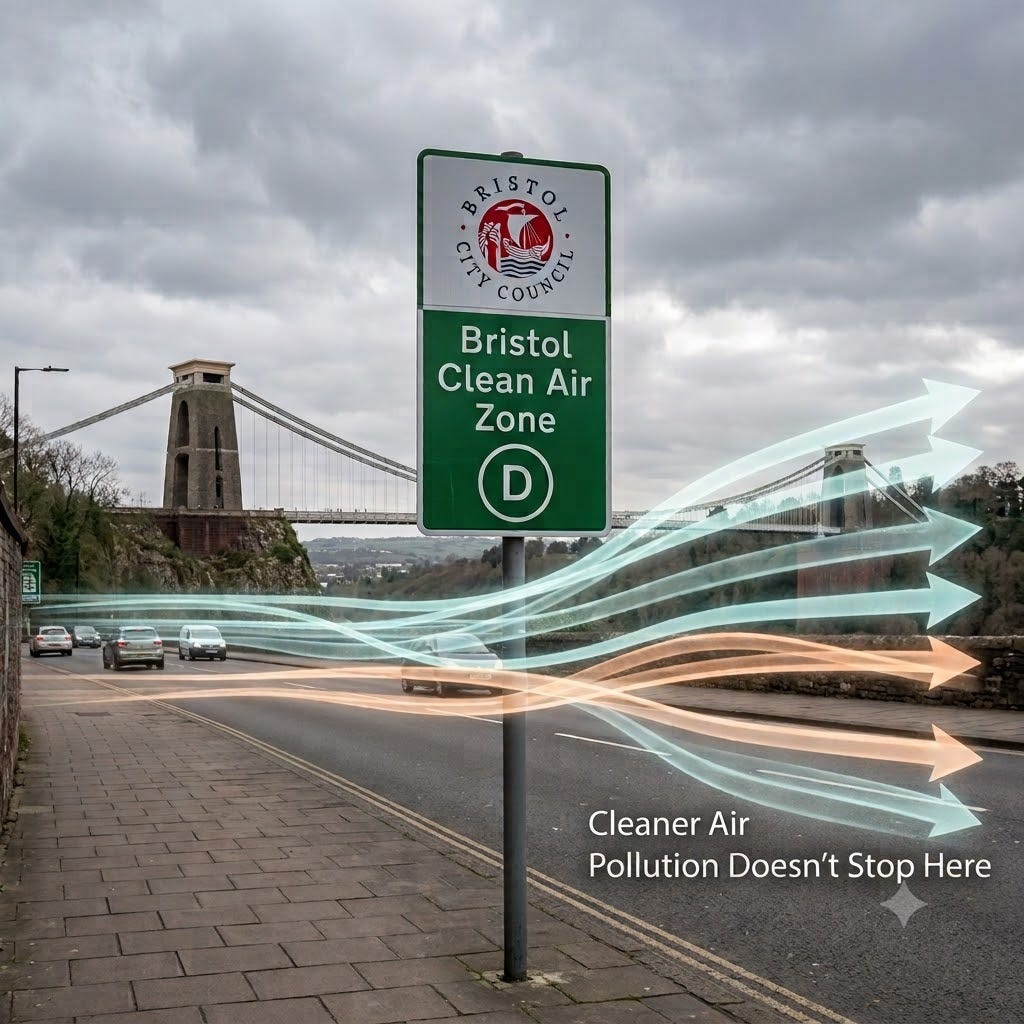
[Illustrative graphic accompanying 'Bristol Clean Air Zone: £3.9 Million Postage Bill Exposes the Static-Air Fallacy Behind CAZ Fines,' www.thealmightygob.com — the boundary shown is conceptual, not a reproduction of exact CAZ mapping]
The council’s own figures show the CAZ needs rising fines just to cover its own postage bill. Or, maybe it’s just the other way around, and somehow, the likes of me and you are missing whatever pointless point the council’s trying to bamboozle us with now.
You see. Bristol City Council is now asking councillors to approve a 12-month extension to its print and mail contract with Xerox. Copy that?
Anyway, The reason: it failed to budget nearly £4 million in postage costs for Clean Air Zone penalty notices. All because, UK legislation requires those letters to go first class, via Royal Mail, as first reported by Bristol Live.
The council’s own committee report, covering the period to March 2028, confirms Clean Air Zone print and mail spend will total an estimated £3.9 million. That sits inside a wider budget forecast to reach £14.1 million by March 2027, £17.8 million by March 2028.
Now. Simple minded me has been tracking Bristol’s Clean Air Zone since 2022 using a physics-based framework: air is not static, and a boundary drawn on a council map cannot contain a pollutant that disperses with wind, weather and displaced traffic. Because. Well. Physics don’t tend to lie as much as humans.
And Now, The Big Reveal. £3.9 Million to Post the Proof It Isn’t Working.
Bristol City Council needs another twelve months and nearly £4 million in postage to keep telling drivers the air has behaved as instructed. It hasn’t, and somewhere it never was going to. In other words. Another fundamental fact of physics that seems to escape the council.
You can shout, yell, use semaphore, performance dance at it, if you wish, and guess what? Air doesn’t take instruction. It has no interest in a charging boundary, no sense of which street sits inside the zone and which sits fifty yards outside it, doesn’t pause at the sign the way the driver does. It moves with the weather, over the hill and down the valley, landing wherever the prevailing wind and the shape of the city happen to put it — not always where the monitoring equipment is pointed, not always where anyone is looking at all. I mean, who knew, outside of us plebs who pay council tax, that this is no great secret?
However. That’s the physics the Clean Air Zone was built on top of. Or rather, built without reference to. This week’s finance paper is the accounting proof of what happens when a policy spends four years not noticing. Like one or two others I’ve referenced this week. For anyone who cares to check.
So We Have It. The Xerox Contract Nobody Costed Properly.
Bristol’s print and mail contract with Xerox runs out next March. Nobody costed the Clean Air Zone into it. If only Xerox could copy-paste some competence into the rest of the council while they’re at it. Now. This would be a contract worth paying for.
And. So it goes. The council wants an extra year — to March 2028 — while it retenders. The current arrangement, in its own words, is “not deemed to be fit for purpose anymore.” Pretty much summing up the council. In that sort of, it takes one to know one, type scenario.
CAZ penalty notices have to go first class, by law. The volume nobody budgeted for is expected to cost £3.9 million to post by the time the extension ends.
Total print and mail spend is forecast to hit £14.1 million by March 2027. £17.8 million the year after.
Royal Mail costs are up 137 per cent since 2020 — a rise the council’s report treats as unforeseen. It wasn’t. And. I would have thought. For this amount of money, a more competitive price could have been negotiated. Still. What do I know.
This year’s price rise was Royal Mail’s sixth in three years. First-class stamps alone have more than doubled since 2020, and every increase was announced in advance.
A five-year contract signed anywhere near that period didn’t fail to predict a shock. It failed to read a trend renewing itself in public roughly once a year, in the same trade press the council’s own procurement team is presumably paid to read. A further £339,000 went on more printers just to keep pace. Someone, somewhere, signed off on that as a solution.
Okay. Where the Money Actually Goes. Now the tea lady has been made redundant, and the council no longer has to pay her wage bill. Still. Humour Aside.
None of this touches the general fund, officers stress. The CAZ pays for its own postage from the charge and the fines it collects. Sounds like fiscal discipline. Follow where the money actually moves, and it looks like something else wearing fiscal discipline’s coat.
Xerox holds a contract now worth extending specifically because CAZ volume grew beyond what was priced in. Royal Mail collects first-class postage on every one of those letters, at prices it has raised six times in three years. The council gets to describe an unbudgeted £3.9 million as cost-neutral, because the fine-payers cover it.
Everyone in that chain benefits from the letters continuing. Nobody in it benefits from the zone actually working — and nobody in the report seems to have noticed that those are two different outcomes.
Somewhere in Bristol this week, an envelope is already on its way. First class, as the law demands, moving through a system built to be unhurried about it. It will land on a doormat in a hallway the resident hasn’t tidied yet, at some point between the school run and whatever comes after. Inside it: a fine, a deadline, and the quiet suggestion that the recipient has failed at something everyone else has apparently managed.
That’s the split the scheme runs on. Compliant on one side of the letter, caught-out on the other, and a comment thread underneath the local paper already forming an orderly queue to say which side the recipient belongs on. Nobody has to design that feeling in. It arrives free, every time a fine does — and the council’s finance report doesn’t have a line item for it, because it doesn’t need one. It comes at no extra cost.
You See. Self-Funding Is Not the Same as Something Working.
A scheme whose enforcement costs rise every year isn’t paying its own way. It’s surviving on a growing supply of the very non-compliance it exists to end.
A print-and-mail contract is, stripped of the finance-report language, the physical distance between a driver’s decision and its consequence — the gap an envelope has to cross before the action and the penalty ever actually meet. Everything spent since 2022 has widened that gap, not closed it: more printers, more volume, more stamps, a bigger and slower machine standing between non-compliance and the moment it’s finally felt.
A scheme actually working would need less of that apparatus every year, not more. Instead spend keeps rising — £14.1 million becoming £17.8 million becoming, evidently, still not enough to run the current contract without an emergency extension.
The council’s own spokesperson says letter volume is “decreasing over time as compliance increases.” That claim sits in the very same report used to justify twelve more months of a contract, because the current one fails to handle the load. Both sentences were presumably typed by the same person. They don’t sit together, and nobody at the strategy and resources committee is likely to be the one who says so out loud.
That’s not evidence of a conspiracy. Nobody needs to be lying for this to happen. A system built to fund itself from fines will, left to its own devices, keep finding reasons to need more of them. The dysfunction is structural, not deliberate — which makes it a great deal harder to fix, and considerably easier for everyone involved to shrug at.
And this is where it stops being just Bristol’s word against itself. In a House of Lords debate on 9 June 2026, a government minister confirmed that Bristol’s CAZ surplus has been running to several millions of pounds a year — cited by the Department for Transport itself, in Parliament, as the reason a national fee increase on CAZ transactions wouldn’t need to be passed on to drivers. This isn’t a scheme scraping by. It’s a scheme sitting on a multi-million-pound annual surplus that somehow still failed to notice a £3.9 million hole in its own postage budget.
Right Then. Where the Physics Comes Back In.
The static-air problem explains the mismatch better than anything in the finance paper does. A charging zone assumes pollution is a contained, local event that a boundary can hold back. It isn’t.
Bristol sits in a bowl, with the Avon Valley funnelling south-westerlies straight through it. Block a route and the traffic doesn’t dissolve — it finds the next road over. Traffic doesn’t do inner peace. It does the next street along.
Displace the driver and the emissions relocate too, sometimes to a street the zone doesn’t charge and the monitors don’t cover.
If the pollution problem was only ever redrawn around, not contained, the population of non-compliant vehicles doesn’t obediently shrink on schedule. It keeps generating volume.
Volume generates fines. Fines generate letters. Letters, by law, go first class — and first class, since 2020, costs 137 per cent more than it used to. Funny, that.
That’s the entire arithmetic of this week’s story. None of it required a fresh assumption about human behaviour — just the same one the council has made since the zone opened: that a line on a map is where the problem stops. The policy was built as if air reads road signs.
So. A single wrong assumption in the original business case, left unexamined for four years, is now a recurring seven-figure line in the print and mail budget. Four years is a long time to not notice you’ve built a five-year contract on a guess. Small input, disproportionate outcome — and it was never going to correct itself without someone asking why.
So. To My Usual Three Questions.
Is it practical? A councillor is being asked to approve a stopgap extension to cover a cost that wasn’t costed, for a scheme whose own figures show rising spend and claimed falling need in the same paragraph.
Is it logical? Only if a shrinking compliance problem can somehow require a growing enforcement budget. The report doesn’t reconcile that. It states both and moves on.
What’s the likely outcome? The extension passes, because the alternative is admitting the original contract, like the original business case, didn’t survive contact with how people and air actually move. The retender happens by 2028, “digital communications” gets pitched as the fix — as if the air was ever going to open an email either — and the zone keeps funding itself off the very non-compliance it was built to eliminate.
The air, for its part, has not read the report. It never does. It’s already over the hill by the time the letter is even printed, past the boundary signs, past the cameras, indifferent to the £3.9 million being spent to prove, in writing, first class, that it stayed exactly where it was told.
It didn’t. It was never going to. And no. We weren’t the ones missing the point. Whether anyone signing off on the extension has actually clocked that is another matter. Either way, they’re hoping the postage arrives before us plebs who pay council tax start asking. First class, mind. Wouldn’t want to short-change us on the way to being short-changed.
© 2026 John Langley / The Almighty Gob. All rights reserved. Some lefts too. Apparently. Like, um, who knew?
John Langley founded The Almighty Gob, a Bristol-based publication — independent mayoral candidate in 2016 and 2021, and one of Bristol's most forensic observers of institutional power. Writing since 2010, well over 1,000 pieces across seven platforms and right here, on Substack at thealmightygob.com — no party allegiance, no press accreditation, no interest in acquiring either.
I think that the CAZ will be abolished in a few years, once the air monitoring points all show "green". But I expect the Green Council will just move the goalposts on what they are measuring (e.g. particulates) and keep the CAZ.
Or they could drive more traffic onto some roads in the CAZ (e.g. Coronation Road increased traffic due to SBLN) to stop in going "Green".
When (or if) the CAZ goes then BCC will replace it with another charging scheme (e.g. Workplace Parking Levy or Congestion Charge).
But the air still won't stay in the Zone.