
Bristol Council, or Galliard Homes — Which Will Hit Rock Bottom First?
How Bristol City Council, a Singapore-backed developer, and a system built to fail Bristol residents produced the Princess Street tower — and who pays for it.

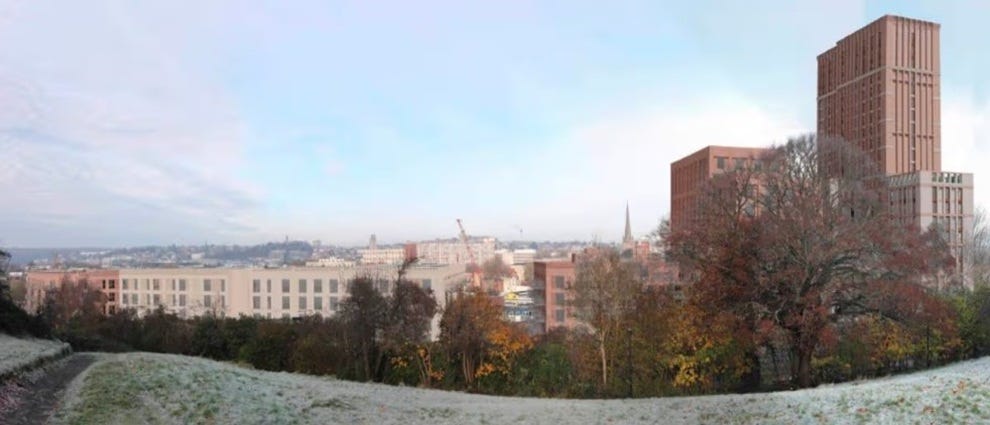
[Princess Street Tower Bristol — proposed development viewed from Victoria Park. Image: Liz Lake Associates / Galliard Apsley Partnership]
Bristol City Council is sitting on sixteen thousand outstanding repairs across its council housing stock.
Half of them overdue by more than a year.
In St Jude’s, four Bristol council housing blocks — Charleton House, Haviland House, John Cozens House, Langton House — have been assessed by the council’s own structural engineers as inadequate against the risk of disproportionate collapse in the event of a non-piped gas explosion.
Not a gas main. A camping canister. The kind anyone might have in a kitchen drawer.
The council knows this. It is in their own published Building Safety Executive Summary Report. Their engineers’ words, their findings, their document.
They cancelled the full refurbishment programme in May 2025.
Then they approved a 23-storey student tower in Bedminster.
So, let’s follow the money. Because that’s where the story lives. The Almighty Gob has been following it across Bristol City Council’s decisions since 2020.
Bristol City Council is projecting its special educational needs budget deficit will reach £114 million by 2027/28 — its own figures, from its own cabinet report, assuming all planned mitigations are delivered in full.
Stephen Peacock, Bristol City Council’s then chief executive, said it plainly in a council meeting: “If we get this wrong, we’ll be effectively bankrupt.”
And the core budget shortfall for 2026/27 is projected at £32 million.
The government’s temporary permission to run a deficit — the arrangement keeping Bristol from issuing a Section 114 notice, the formal declaration of effective bankruptcy — expired in March 2026.
That’s this month.
Against that backdrop, Bristol City Council’s Planning Committee A sat down in January 2026 and voted against a 23-storey tower block on an industrial estate in Bedminster.
The application raised four hundred and sixty-eight objections from residents.
The committee voted three in favour, five against.
Democracy, functioning as described. If this rings a bell, you’re right, and I’ll return to it further on.
Then the planning officers came back.
According to the officers’ own report to the committee at the March 2026 meeting: the developer would appeal if refused. The appeal would almost certainly succeed. The council could be liable for both its own costs and the developer’s. The bill could reach £1 million.
What the officers were describing has a name.
It is called The Threat Generation Concept — the mechanism by which a financially dominant party converts its willingness to litigate into a decision-making tool. The threat does not need to be carried out. It only needs to be credible.
In Bristol in March 2026, it was credible enough.
The committee reversed its decision. Six votes to three.
The only thing that changed between the first vote and the second was a number.
One million pounds.
That’s not democracy. That’s an auction. And Bristol City Council was outbid by its own fear.
Every city gets the council it can afford. Bristol can no longer afford this one.
Who exactly was doing the bidding?
The developer is the Galliard Apsley Partnership — a joint venture between Galliard Homes and Apsley House Capital PLC.
Galliard Homes describes itself as London’s largest privately owned residential developer.
Consider what that description leaves out.
Galliard Homes Limited’s most recently filed accounts at Companies House — covering the period to October 2024 — show negative equity of £28.4 million, worsening from the previous year’s figure of £27.2 million.
The company is loss-making.
These are not allegations. These are not the opinion of The Almighty Gob. They are the figures Galliard’s own accountants signed off and submitted to the public record. They are available to anyone with an internet connection and thirty seconds.
The company that told Bristol City Council it could not afford to say no is, by its own filed accounts, loss-making and in negative equity.
This is the company Bristol City Council could not say no to.
One might be tempted to call this incompetence — a failure of due diligence, an oversight, a bureaucratic stumble.
Notice that the council had already voted correctly once.
That is not incompetence. That is a system operating as designed.
In 2015, Singaporean developer Oxley Holdings acquired a 20% stake in Galliard for £50 million. Oxley Holdings, listed on the Singapore Stock Exchange, still holds that stake today — confirmed in its own published corporate materials.
Singapore money, sitting inside the joint venture that just got its tower approved in Bedminster.
Apsley House Capital PLC — Galliard’s partner in Bristol — has in its Birmingham portfolio forward-funded developments to BlackRock Alternatives.
BlackRock. The world’s largest asset manager. Headquartered in New York.
When you look at the ownership structure, what you find is this: a loss-making London developer part-owned by Singapore, in joint venture with a London PLC connected to New York institutional capital. The money that builds the tower does not come from Bristol. The money the tower generates will not stay in Bristol. There is a word for what happens next. It is not regeneration.
This is who Bristol City Council could not say no to.
So, let’s break it down into what Bristol City Council receives from student accommodation, in perpetuity, once built. In other words, the benefits. Or shall we say, more precisely — lack of?
Zero council tax.
Full-time students are exempt. Automatically. Legally. Completely.
Bristol’s Band A council tax — the lowest band, applicable to student accommodation — is £1,809.12 per year for 2026/27. Bristol City Council’s own figure. Published. February 2026.
Four hundred students in the Princess Street tower.
Four hundred multiplied by £1,809.12.
£723,648. Every year. Gone. Forever.
And that’s one tower.
The PBSA pipeline currently approved or under active planning across Bristol — Metalworks, Princess Street, Cubex, Freestone Island, Watkin Jones Malago Road — adds over 2,800 additional beds in recently confirmed schemes.
Two thousand eight hundred multiplied by £1,809.12.
Over £5 million a year. In perpetuity. That Bristol will never collect.
Across the full student population — around 44,000 students estimated resident in the city at any one time — the council tax exemption represents a revenue gap for this city of nearly £80 million a year.
By any measure, that gap falls on a population that uses Bristol’s roads, parks, waste collection and emergency services.
One hundred percent of it is paid by everyone else.
The Almighty Gob has calculated those figures from Bristol City Council’s own published Council Tax Notice and its own published student population data. They are not estimates. They are arithmetic.
Nearly £80 million a year. The amount Bristol does not collect because students are exempt from council tax. Every year. While the council faces effective bankruptcy.
The argument will be made — it is always made — that students bring economic benefit. That they drink in pubs. That they spend locally.
(They do. In the same pubs and postcodes they would drink in if they lived in a shared house around the corner. The spending does not increase because the building is taller.)
The argument will be made that purpose-built student accommodation relieves pressure on family housing stock. That it frees up shared houses for Bristol residents.
Bristol City Council removed approximately 9,500 households from its social housing register. Cabinet approved the decision in April 2023, after a report stated that fewer than 1% of Band 4 households — the lowest priority group — were ever expected to be offered a home.
Not housed. Removed.
Told to go private. In Bristol — the most expensive city in England in which to rent outside London, according to ONS rental data.
Nine thousand five hundred households.
Told there was no hope.
Removed from the list.
Signposted to the most expensive rental market outside London.
Imagine explaining that to the family in Band 4 who has been waiting six years. Imagine then explaining that the council just approved four hundred student beds on a brownfield site in Bedminster. That the students will pay no council tax. That the returns will travel to Singapore.
And while those households were being told to look elsewhere, the council got a 23-storey student tower a green light — accommodation generating zero council tax revenue, its returns structured to flow to overseas institutional capital.
And back in St Jude’s, the residents of Charleton House, Haviland House, John Cozens House and Langton House are living in blocks the council’s own structural engineers assessed as inadequate against disproportionate collapse risk in the event of a non-piped gas explosion. That finding is in the Building Safety Executive Summary Report, published May 2025.
The full refurbishment — promised, planned, consulted upon — was cancelled the same month.
Sixteen thousand outstanding repairs across Bristol’s council housing stock.
Half overdue by more than a year.
The damp is still there. The balustrades are still deteriorating. The waking watch service — someone physically walking the corridors through the night to monitor for fire, pending installation of an adequate fire detection system — is still in place.
A waking watch. In 2026. In a city approving 23-storey towers for overseas investors.
In July 2024, the Regulator of Social Housing (RSH) found serious failings across Bristol’s council housing.
Bristol City Council had referred itself to the regulator.
That detail is worth sitting with.
Bristol City Council reported Bristol City Council.
The planning system that approved the Princess Street tower is not broken.
That is the important thing to understand.
It is working precisely as designed.
Purpose-built student accommodation sits in a planning category called Sui Generis — of its own kind — which places it outside many of the standard obligations that apply to residential development. The developer pays planning contributions once. Then sells the asset. The next institutional investor pays nothing. The council receives a single transaction. The investor collects decades of rental income.
This is Friction in its purest institutional form — the grinding resistance built into the system between what residents want and what capital obtains.
It is not accidental. It is structural.
The universities submit growth projections. The council embeds those projections in its local plan. The local plan creates a policy obligation to provide beds. The obligation makes refusal legally precarious. The developer uses that precariousness as a lever. The council capitulates. The tower is built. The council collects nothing ongoing. The universities grow. The cycle begins again.
If it sounds familiar, it should. The East Bristol Liveable Neighbourhood — covered by The Almighty Gob — used a different mechanism, an experimental traffic order that bypassed consultation entirely, but arrived at the same destination. The council decides. The community objects. The council finds a process. The process wins. The pattern doesn’t change. Only the postcode does.
This is not corruption. It is something more durable than corruption. It is a system.
The residents of Windmill Hill, Bedminster and Totterdown — who raised 468 objections, who watched their elected representatives reverse a democratic decision under financial pressure — did not accept it.
They crowdfunded. They hired a barrister.
And ahead of the planning committee meeting on Wednesday 22 April 2026, that barrister wrote directly to the councillors sitting on the committee.
His name is Simon Bell, of Cornerstone Barristers — a national planning law chambers.
His letter to the committee is now on the public record. In it, he states that the committee is being asked to determine the application “in circumstances where key matters have not been satisfactorily resolved, and where there is a real risk that any decision to grant permission would be vulnerable to challenge by way of judicial review.”
Three thousand five hundred pounds.
Against a developer with filed negative equity of £28 million, backed by Singapore capital and connected to New York institutional money.
And Simon Bell of Cornerstone Barristers has levelled the battlefield.
The council now faces a legal threat whichever way it votes.
Approve — judicial review.
Refuse — developer appeal.
The £1 million threat that reversed the first democratic decision has been matched, on the other side, by a named planning barrister from a national chambers writing to the committee on the record.
The residents did that. With a crowdfunder. Against Galliard Homes. In Bristol. In 2026.
Simon Bell has done this before. He led the Broadwalk legal action in Knowle — the same pattern, a democratic refusal reversed under pressure — and negotiated a settlement that dramatically reduced the height of those buildings.
The precedent exists. Bristol City Council knows it exists. The committee knows it exists.
But it should not be necessary.
A city council that serves its residents does not require those residents to crowdfund Simon Bell of Cornerstone Barristers to defend a democratic vote.
A planning system that functions does not allow a financial threat to override the objection of 468 people.
A council facing effective bankruptcy does not approve buildings that generate zero ongoing revenue while its own tenants in St Jude’s wait behind a waking watch.
And a council does not follow the money out of the city while the people who live in it are left to count what remains.
Three thousand five hundred pounds. A crowdfunder. Simon Bell of Cornerstone Barristers. That is what it takes to challenge a decision that hands £723,648 a year — every year, forever — to overseas capital. Bristol City Council calls this planning. What would you call it?
The city that cannot fix the damp in St Jude’s is approving towers for Singapore capital. The city that removed nine thousand five hundred households from its housing register is planning for tens of thousands of students who will never pay a penny of council tax. The city that told its most vulnerable residents there was no hope said yes to overseas developers without hesitation.
So, let’s go back to where we started, shall we?
Bristol Council, or Galliard Homes — Which Will Hit Rock Bottom First?
COPYRIGHT NOTICE
© 2026 John Langley / The Almighty Gob. All rights reserved.
Where any part of this work is reproduced or referenced under fair dealing provisions or by express permission, John Langley must be named as the source in full in all cases, without exception. Attribution must read: John Langley / The Almighty Gob, thealmightygob.com
Unauthorised use of this work constitutes copyright infringement and may result in civil and/or criminal liability under UK and international copyright law.
The Almighty Gob. Bristol. 2026.
The Almighty Gob is a Bristol-based publication founded by John Langley — independent Bristol mayoral candidate 2016 and 2021, and one of the city’s most forensic observers of institutional power. Publishing since 2020, with over 500 pieces including 88 FOI-based Bristol investigations. Across seven platforms and Substack at thealmightygob.com — no party allegiance, no press accreditation, no interest in acquiring either.
Sources & Credits.
All figures, findings and statements of fact in this article are drawn from primary public documents. Every source listed below is publicly accessible at time of publication.
Bristol City Council — Building Safety Executive Summary Report: St Jude’s Residential Blocks Charleton House, Haviland House, John Cozens House and Langton House structural assessment. Published May 2025. Structural engineering assessment by Ridge. Available at: bristol.gov.uk/residents/housing/council-tenants/st-judes-council-housing-refurbishment
Bristol City Council — Council Tax Notice 2026/27 Formal notice setting Band D council tax at £2,713.68 and Band A at £1,809.12 for the financial year commencing 1 April 2026. Published February 2026. Available at: bristol.gov.uk/files/documents/10635-bristol-council-tax-notice-2026-to-2027/file
Bristol City Council — Cabinet Report: Housing Register Allocation Scheme Decision approved April 2023 to remove approximately 9,500 Band 4 households from the social housing register. Reported by Bristol 24/7, Bristol Cable and Bristol World, April 2023.
Bristol City Council — Medium Term Financial Plan / SEND Safety Valve Programme Projected SEND Dedicated Schools Grant deficit of £56.1 million as at March 2024, rising to £114.2 million by 2027/28 assuming all planned mitigations delivered in full. Reported by Room151, Bristol Cable and Bristol 24/7, 2023–2024.
Bristol City Council — Planning Committee A: Princess Street Application January 2026 refusal (3-5 vote) and March 2026 approval (6-3 vote) of the Galliard Apsley Partnership application for four tower blocks on land south of Princess Street, Bedminster, including a 23-storey purpose-built student accommodation block of 400 beds. Reported by Bristol Live, Bristol 24/7, Bristol World and Insider Media, January–March 2026.
Bristol City Council — Local Plan Topic Paper TPC006: Managing the Development of Purpose-Built Student Accommodation Identifies need for 8,800 additional student bed spaces city-wide by 2040. Notes approximately 5,000 student bed spaces with planning permission as of January 2024. Published April 2024. Available at: bristol.gov.uk
Galliard Homes Limited — Companies House Filing Company registration number 02158998. Most recently filed accounts covering period to October 2024 showing negative equity of £28.4 million, worsening from £27.2 million in the prior year. The company is loss-making. Available at: companieshouse.gov.uk and companydatashop.com
Oxley Holdings Limited — Corporate Materials Singapore Stock Exchange-listed developer. Confirms retention of investment in Galliard Group Limited in its own published corporate profile. SGX ticker: 5UX. Available at: sgpbusiness.com/company/Oxley-Holdings-Limited
Apsley House Capital PLC — Companies House and Corporate Materials Company registration number 09352537. Registered address: 2nd Floor, 17 Grosvenor Street, London W1K 4QG. Forward funding relationship with BlackRock Alternatives confirmed via Apsley House Capital’s own published announcement of the Birmingham BTR scheme. Available at: apsleyhousecapital.co.uk
Regulator of Social Housing — Regulatory Notice: Bristol City Council Serious failings found across Bristol’s council housing stock. Bristol City Council self-referred to the RSH. Finding published July 2024. Reported by Bristol Cable, July 2024.
Stephen Peacock — Council Meeting Statement Then chief executive of Bristol City Council. Statement “If we get this wrong, we’ll be effectively bankrupt” made at a council meeting, April 2024. Reported by Bristol Cable and Yahoo News UK, April 2024. Peacock subsequently left Bristol City Council to become chief executive of the West of England Mayoral Combined Authority. Current Bristol City Council chief executive: Nick Hibberd.
Simon Bell, Cornerstone Barristers — Letter to Bristol City Council Planning Committee Formal letter to the planning committee ahead of the 22 April 2026 meeting, warning that any decision to grant permission for the Princess Street development would be vulnerable to challenge by way of judicial review. Quoted and reported by Bristol Live, 21 April 2026.
ONS — Private Rental Market Statistics Bristol confirmed as the most expensive city in England in which to rent outside London. Average private rent in Bristol: £1,891 per month as of February 2026, an annual increase of 7.4%. Source: Price Index of Private Rents, Office for National Statistics. Available at: ons.gov.uk
UniHomes / Bristol City Council Student Population Data Approximately 44,000 students estimated resident in Bristol at any one time. University of Bristol: 31,100 students (2023/24). UWE Bristol: 30,300 students (2023/24). Total: 61,400 across both institutions. Source: Bristol City Council Local Plan examination documents; UniHomes Bristol accommodation guide 2025.
East Bristol Liveable Neighbourhood (EBLN) Experimental traffic order introduced by Bristol City Council. Public consultation outcome, costs and conduct covered in full by The Almighty Gob, April 2026.
Image The proposed Princess Street development as seen from Victoria Park. Image: Liz Lake Associates for the Galliard Apsley Partnership. Submitted as part of the public planning application to Bristol City Council.