


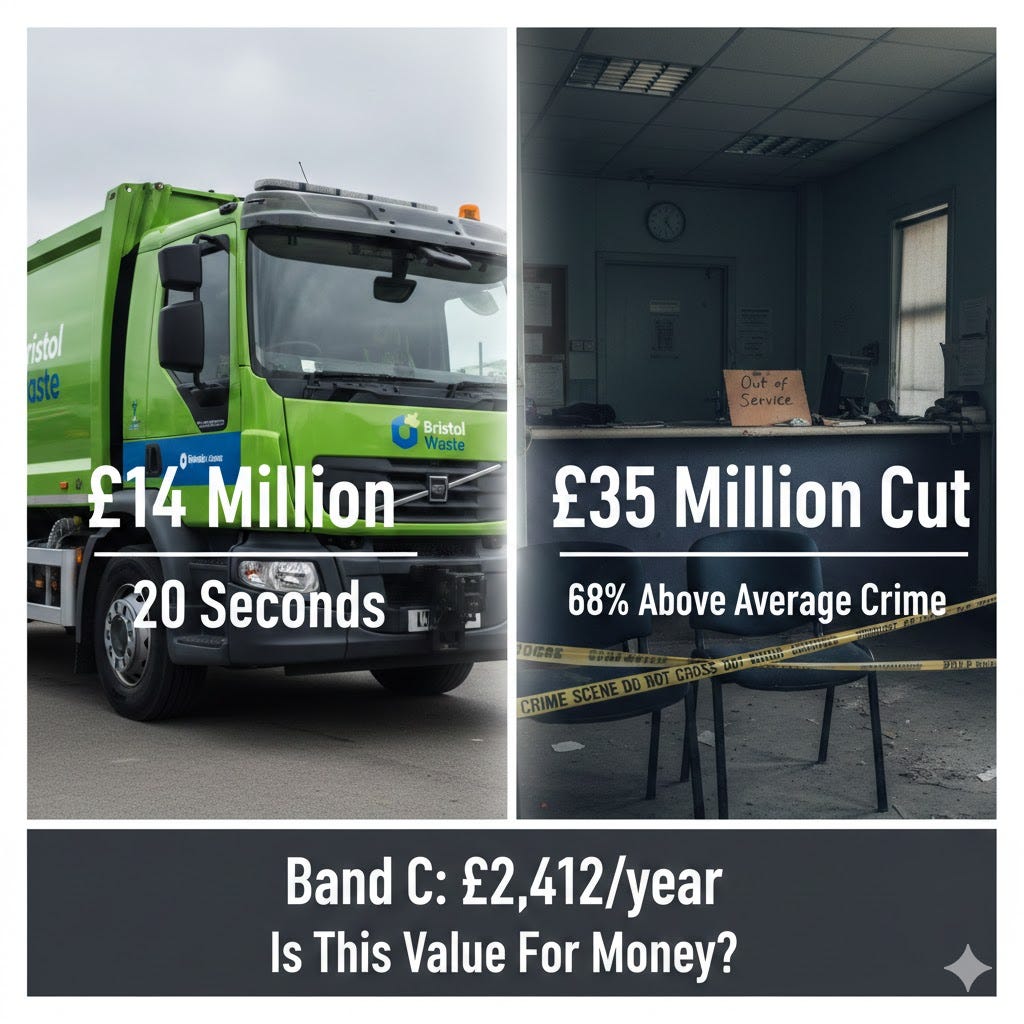
Avon & Somerset Police faces a £35 million budget shortfall. Crime scene investigators, call handlers, PCSOs - all being cut or left vacant to save money. Bristol’s crime rate runs 68% higher than the South West average, 41% higher than national figures.
December 2025. Bristol City Council environment committee, running late. On the agenda: £14 million for new bin lorries. Discussion time: twenty seconds. Vote. Done. Next item.
Let that sink in for a moment. Twenty seconds to approve fourteen million quid for rubbish collection. Meanwhile, police face thirty-five million in cuts with zero additional council support beyond the standard precept increase.
That’s your value-for-money equation right there. But let me show you the full picture of what £2,412 (Band C) actually buys you.
The Numbers You’re Paying.
Band C: £2,412 (up £115) Band A: £1,809 (up £86)
Band E: £3,316 (up £158)
Police precept increase: £15 (Band D) Fire authority increase: £5 (Band D) Council increase: maximum permitted by government
The consultation offered one option: maximum increase. No alternatives.
What You Told Them.
Core 2.99% increase:
48% opposed, 43% supported
34% strongly disagreed, 16% strongly agreed
Social care 2% precept:
47% approved, 41% opposed
29% strongly disagreed, 20% strongly agreed
The administration’s response? Proceed exactly as planned.
Meanwhile, police consultation attracted 321 responses across the entire Avon & Somerset force area. Among usable responses, 86% were negative. 69% opposed any police precept increase. 62% reported little or no confidence in their local force.
Both consultations ignored. Both increases approved.
Is It Practical? Follow The Money.
Start with the police situation. Avon & Somerset ranks third-worst in England for projected budget shortfalls - £35 million by 2027. Only the Met (£393m) and Essex (£39m) fare worse.
What gets cut to save thirty-five million? Crime scene investigators. Call handlers answering 999. Dispatch controllers. Crime analysts. PCSOs patrolling neighbourhoods. The invisible infrastructure that makes policing actually work.
Bristol’s crime rate tells you why this matters: 105 crimes per 1,000 people. That’s 68% higher than the South West average, 41% above national figures. Violence and sexual offences lead at 24,204 incidents in 2025. Public order offences run 2.09 times the national average.
The council’s response to thirty-five million in police cuts? Twenty seconds approving fourteen million for bin lorries.
Let’s examine those bin lorries. The existing fleet has fundamentally wrong-sized compartments - too little space for cardboard, too much for cans and glass. Cardboard sections overflow (online shopping apparently surprised someone), forcing trucks back to depot mid-route while other compartments sit half-empty.
This isn’t maintenance failure. It’s specification failure. Someone designed these vehicles without understanding what Bristol residents actually put in bins.
The replacement solution? Diesel vehicles with no allocated conversion budget. The Green Party - whose political identity centres on environmental competence - purchasing fossil fuel trucks with vague promises about maybe converting them later.
Labour spotted the problem, called in the decision. February 2026, councillors spent an hour reconsidering what should’ve received proper scrutiny initially. Even after the do-over, conversion budget still doesn’t exist.
Twenty seconds for fourteen million on bins. Zero additional support for thirty-five million in police cuts. That’s the priority equation.
Is It Logical? The Incentive Structure.
When government ties grant funding to maximum council tax increases, councils face perverse incentives: raise by maximum or lose central funding support.
The protection racket runs: “Extract maximum revenue or face fiscal punishment.”
Consultation becomes theatre because outcomes are predetermined by funding formula.
But here’s where logic collapses: police lose thirty-five million while crime runs 68% above regional average. Roads deteriorate. Libraries face cuts. Yet council tax hits maximum increases regardless.
Housing mathematics reveal deeper dysfunction. Selling 1,222 council homes while promising to build 1,000 annually. Ask how numbers balance and receive lectures about not understanding local government finance complexity.
Translation: sums don’t work, but admitting that requires explaining why campaign promises diverged from budgetary reality.
Meanwhile, FOI compliance failures continue despite transparency promises. Services still get outsourced despite privatisation opposition. Same operational model as previous Labour administration, just slower with additional rhetoric.
What’s The Likely Outcome? Crime And Consequences.
Police cuts cascading:
Fewer crime scene investigators means lower case closure rates
Reduced call handlers means longer 999 wait times
Cut PCSOs means less neighbourhood presence
Missing crime analysts means worse resource allocation
Bristol’s crime rate already exceeds South West average by 68%. Remove the infrastructure preventing worse outcomes and watch what happens.
Council priorities compounding:
More rushed procurement requiring opposition call-ins
More specifications missing operational requirements
Services declining while costs rise through maximum annual increases
Housing crisis deepening as stock shrinks despite building rhetoric
Medium term mathematics: Police shortfall grows from £35m to larger figures as pay rises hit frozen budgets. Council continues maximum tax increases annually. Opposition consultation results noted in minutes, ignored in implementation.
Long term reality: Numbers don’t negotiate. You can’t cut thirty-five million from police while crime exceeds regional average by 68% without consequences. You can’t spend twenty seconds on fourteen million bin lorries and claim governance competence. You can’t sell 1,222 homes while building 1,000 and call it expansion.
Timeline differs, but destination is fixed.
What’s Being Left Unsaid.
Notice the absences:
Police budget shortfall scale never mentioned in council communications. Crime rate comparisons to regional average never highlighted. Bin lorry discussion duration never disclosed. Housing sale proceeds destination never detailed. FOI compliance rates never published.
What’s deliberately omitted matters more than what’s stated. When police face thirty-five million cuts while committees rush fourteen million bin decisions in twenty seconds, the silence around priorities speaks louder than budget line rhetoric.
Who Benefits? Cui Bono.
Police cuts: Criminals benefit from reduced investigative capacity. Council benefits from avoiding difficult budget conversations. Government benefits from pushing funding crisis to local level.
Residents with 68%-above-average crime exposure lose investigative resources, neighbourhood presence, emergency response capacity.
Rushed bin procurement: Minimal scrutiny benefits suppliers by reducing challenge opportunities. Tired committees benefit from meeting-management convenience.
Taxpayers fund both initial purchases and subsequent corrections when opposition forces reconsideration. Residents receive vehicles with wrong specifications requiring future replacement.
Council housing sales: Cash buyers with immediate liquidity benefit - typically private landlords. Council gains short-term capital, loses long-term rental income and social housing capacity.
22,000 waiting-list households lose access to below-market housing.
The pattern isn’t conspiracy. It’s incentive structure. Police cuts happen quietly while bin lorries get rushed through tired meetings. Hard conversations about crime prevention get avoided while procurement corners get cut.
The Systemic Pattern.
Twenty seconds for fourteen million demonstrates how small procedural failures create disproportionate consequences.
One rushed December decision generates:
February committee reconsideration (officer time, councillor attention)
Opposition call-in process (administrative overhead)
Public confidence erosion (democratic legitimacy cost)
Budget complications (conversion funding gap)
Reputational damage (environmental credibility)
Meanwhile, thirty-five million police cuts happen through accumulated small decisions - vacant posts held unfilled, retirements not replaced, support roles quietly eliminated.
This is deterministic chaos operating in budget management. Predictable inputs (rushed decisions, undiscussed cuts) producing wildly disproportionate outcomes (governance dysfunction, crime investigation capacity loss).
The system isn’t random - it’s sensitive to initial conditions. Twenty seconds cut from meeting management becomes months of consequences. Thirty-five million cut from police infrastructure becomes years of reduced public safety capacity.
Scale this dynamic across every rushed decision, every quietly-accepted cut, every consultation with predetermined outcomes. The chaos compounds.
What Value Means.
Value would manifest as:
Procurement receiving scrutiny proportional to expenditure scale
Police funding protecting crime investigation capacity in 68%-above-average crime environment
Vehicle specifications matching operational reality
Housing promises aligning with housing delivery
Consultation changing outcomes, not meeting legal minimums
Current reality delivers:
Major decisions compressed into available time
Police cuts accepted while crime exceeds regional average by 68%
Specifications missing basic operational understanding
Housing rhetoric contradicting housing mathematics
Consultation opposition doubled yet outcomes unchanged
The gap between these states defines your value-for-money answer.
The Priority Test.
Band C residents paying £2,412 annually fund an administration that:
Allocated twenty seconds to debating £14 million for bin lorries.
Offered zero additional support for police facing £35 million cuts in an area where crime runs 68% above regional average.
That ratio tells you everything about priority management. Not the absolute amounts - the proportional attention given to competing needs.
When police face budget crisis requiring cuts to crime scene investigators, call handlers, and neighbourhood officers, and the council response is rushing bin lorry procurement through tired meetings, priorities have inverted.
When consultation shows 86% negative police responses and 69% opposing any precept increase, yet the increase proceeds anyway - democratic input becomes administrative decoration.
When crime rates exceed South West average by 68% while committees spend twenty seconds on fourteen million for bins, competence questions arise about what else gets ignored.
Is that value for money?
Thirty-five million in police cuts. Twenty seconds for fourteen million on bins. Crime 68% above regional average.
The numbers already answered.
I’m a Bristol-based blogger and satirical commentator specializing in local government accountability, operating from an anarch philosophical position - maintaining analytical independence by observing political systems without tribal capture.