
Bristol Council's £430,000 Scandal: Why It Takes 616 Hours to Explain Nothing.
When a council claims three months of work are needed to explain failed spending, you're witnessing either institutional incompetence or deliberate obstruction. The evidence suggests both.


On 28 September 2025, I submitted a Freedom of Information request to Bristol City Council about how they spent £430,000 attempting to privatise The Bottle Yard Studios—a publicly-owned creative facility—in a process that collapsed after three months of exclusive negotiations.
I asked nineteen questions seeking standard governance documentation: the financial breakdown, meeting minutes, reports to councillors, tender documents, correspondence with bidders, feasibility studies, the financial performance data they reviewed before deciding to sell, and documentation explaining why negotiations failed.
Any competent council maintains this documentation through proper governance. These aren’t complex requests—they’re basic accountability questions about a major public asset disposal decision.
Bristol took 80 days to respond. Their answer: retrieving the information would require 616 hours of officer time.
When explaining your decisions takes longer than making them, the explanation isn’t the problem.
The Financial Data Contradiction.
✓ FACT: Bristol City Council spent £430,000 on the privatisation process.
✓ FACT: The Council entered three-month exclusivity with a “preferred bidder.”
✓ FACT: Negotiations terminated in July 2025 without sale completion.
✓ FACT: I requested three years of financial performance data for The Bottle Yard Studios.
✓ FACT: Bristol claims retrieving this requires 96 hours—12 full working days.
No competent authority spends £430,000 selling an asset without conducting comprehensive financial due diligence. The preferred bidder spent three months reviewing Bristol’s books. That data was compiled, accessed, and made available to commercial buyers.
Bristol now claims that retrieving the same data requires 96 hours.
Either Bristol compiled comprehensive financial data for bidders (making the 96-hour estimate demonstrably false), or Bristol committed £430,000 to privatisation without proper financial oversight (proving gross negligence).
Both conclusions indict the institution.
The 45-Minute Question Bristol Won’t Answer.
✓ FACT: Bristol claims my request exceeds the cost limit by 598 hours.
✓ FACT: Question 12 asks for “documentation relating to the negotiation period and reasons for its termination.”
✓ FACT: Bristol’s breakdown estimates Question 12 would require 45 minutes.
✓ FACT: Bristol recommends I exclude this 45-minute question.
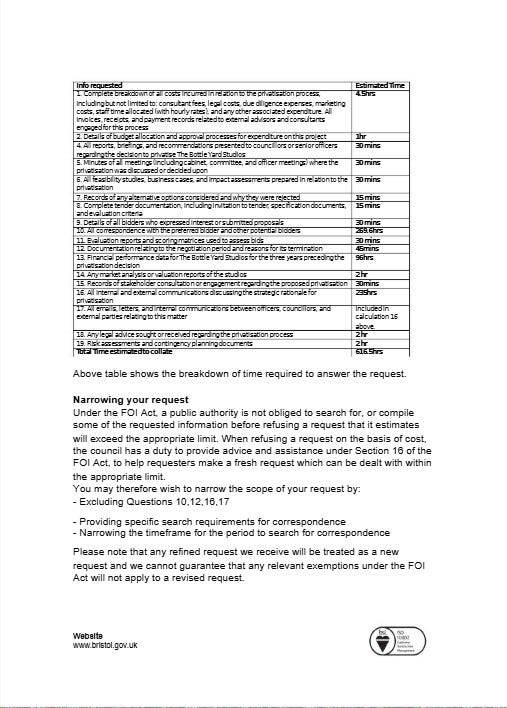
Bristol’s own estimates show Question 12 requires 45 minutes—yet they recommend excluding it
Excluding 45 minutes saves 0.075% of the 598-hour excess—mathematically meaningless for cost reduction.
When advice recommends excluding the question that would explain why the process failed—a question requiring less than one hour—you’re witnessing evidence suppression disguised as cost management.
The recommendation itself proves the refusal isn’t about cost.
The Timeline That Undermines Credibility.
✓ FACT: I submitted my FOI request on 28 September 2025.
✓ FACT: Bristol acknowledged receipt on 29 September, stating, “We aim to send a response within 20 working days.”
✓ FACT: The statutory deadline passed on 28 October 2025 with no response.
✓ FACT: Bristol finally responded on 18 December 2025—80 days later.
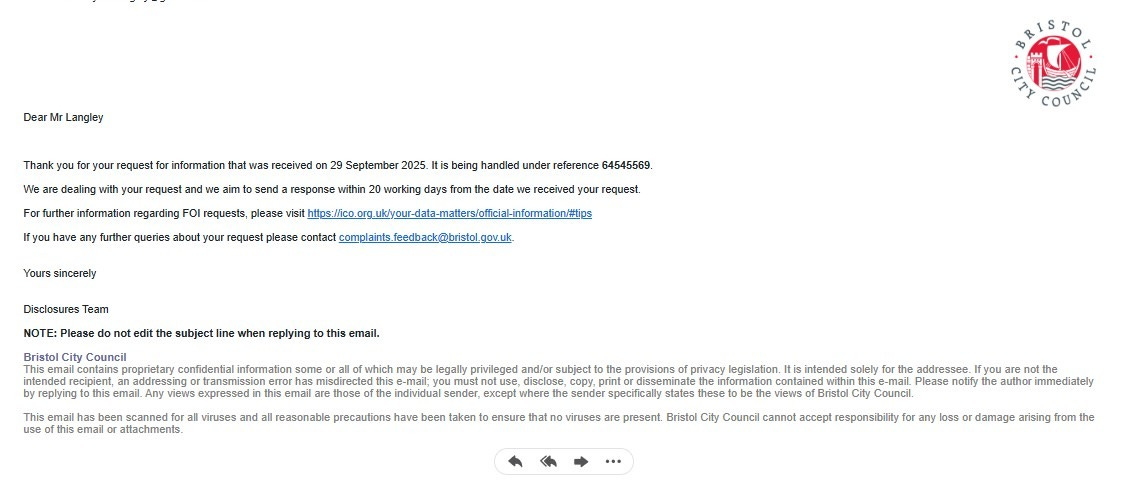
Bristol’s written commitment to respond within 20 working days—broken by 60 days
Section 12 refusals must be issued within the statutory 20-day period because authorities should identify excessive costs during initial scoping. When a request genuinely requires 616 hours, competent authorities identify this within days.
Bristol needed 80 days to calculate estimates that should have been obvious within 48 hours.
If you need three months to determine something that would take three months, your assessment methodology is flawed, or your conclusion is false.
The Regulatory Record.
✓ FACT: On 24 September 2025, the Information Commissioner’s Office issued a second enforcement notice against Bristol City Council with an explicit finding: “the Council’s approach demonstrates a poor organisational attitude towards data rights and compliance with the law.”
✓ FACT: I submitted my FOI request four days after this enforcement notice was published.
✓ FACT: In August 2025, the First-tier Tribunal dismissed Bristol’s appeal, with Judge Gilda Kiai ruling “it cannot be correct or fair for requests not to be dealt with for three years without any sanctions.”
✓ FACT: The ICO has received 60+ complaints about Bristol’s FOI failures since April 2023—more than any other UK local authority.
✓ FACT: Bristol answers only 60% of FOI requests within statutory timeframes.
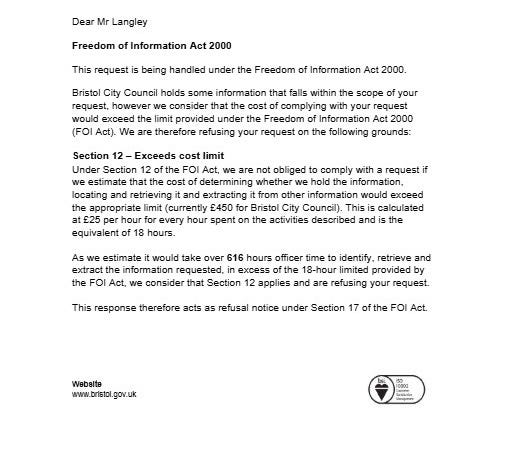
Bristol’s response arrived 80 days after the request, continuing the pattern despite ICO sanctions, because a number cruncher intervened.
The Pattern Continues.
Four days after the UK’s information rights regulator found Bristol demonstrates “poor organisational attitude,” I asked about £430,000 of public spending. Eighty days later, Bristol claimed 616 hours would be required—continuing the exact pattern that led to two enforcement notices, a tribunal ruling, and more complaints than any other council in Britain.
When sanctions don’t change behaviour, either the sanctions don’t work, or the institution cannot comply. Bristol’s track record suggests both.
What Bristol Won’t Disclose About The Bottle Yard.
✓ FACT: Bristol claims The Bottle Yard Studios is profitable.
✓ FACT: Bristol refuses FOI requests for financial data, citing cost limits or commercial sensitivity.
✓ FACT: Bristol publicly stated The Bottle Yard “has hit a glass ceiling” and requires “multi-million-pound investment.”
✓ FACT: Bristol faces a £52 million budget gap with reductions to libraries, street cleaning, youth services, and social care.
✓ FACT: After three months of due diligence with full access to financial records, no buyer completed the purchase.
The facility cannot simultaneously be profitable enough to justify continued council operation, unsuccessful enough to require multi-million-pound investment, commercially valuable enough to privatise, and commercially worthless enough that no buyer completed purchase after full due diligence.
The Question That Exposes Everything.
Bristol spent £430,000 during severe budget constraints. Three months of exclusive negotiations followed comprehensive due diligence. The preferred bidder had full access to financial records. No sale completed.
Any competent council answers basic accountability questions in an afternoon using documentation created during decision-making—minutes, reports, financial analyses, officer recommendations.
Bristol claims 616 hours would be required.
The financial data contradiction: data compiled for bidders cannot simultaneously require 96 hours to retrieve. The 45-minute exclusion: no cost-reduction logic supports excluding something that saves 0.075% of claimed excess. The 80-day delay: immediate calculations took three months.
Each contradiction compounds the others, proving the refusal isn’t about cost—it’s about avoiding scrutiny.
What Happens Next.
I’ve submitted a detailed complaint to the Information Commissioner’s Office. The ICO now faces a decision: do enforcement notices issued just days before this request mean anything? Can councils systematically obstruct transparency, receive formal sanctions, and continue identical behaviour without consequence?
Bristol must either produce credible evidence justifying these estimates or explain why they cannot. The financial data compiled for £430,000 due diligence either exists (proving estimates are false) or doesn’t exist (proving negligent governance).
Both options indict the institution. The ICO decides which.
Follow this investigation as it unfolds. Bristol’s response will reveal whether regulatory sanctions have teeth or whether “poor organisational attitude” is just strongly-worded criticism authorities ignore.
The Fundamental Question: Is Bristol City Council Fit for Purpose?
At what point do we acknowledge that Bristol City Council, in its current state, is not fit for purpose?
Two Information Commissioner enforcement notices. A First-tier Tribunal ruling against them. Over 60 complaints—more than any other UK local authority. Only 60% of FOI requests were answered within statutory timeframes. A three-year backlog requiring tribunal intervention. An explicit regulatory finding of “poor organisational attitude towards data rights and compliance with the law.”
And now: 80 days to claim 616 hours would be needed to explain £430,000 of public spending.
When an institution repeatedly fails to meet basic transparency obligations despite formal sanctions, when it takes three months to calculate estimates that should be immediate, when it recommends excluding 45-minute questions to suppress evidence about failed spending, when its own councillors across multiple parties acknowledge “closed culture resisting transparency”—at what point does continued operation in this state become untenable?
Bristol’s Green Party administration promised transparency and democratic accountability. They deliver the opposite whilst managing a £52 million budget gap and making decisions about hundreds of millions in public resources.
Either Bristol made decisions about £430,000 without creating proper documentation (governance failure), or they created documentation but deployed systematic obstruction to prevent scrutiny (institutional bad faith).
Both conclusions lead to the same question: Is this administration capable of meeting the minimum standards required to manage public resources?
The mathematics says no. The timeline says no. The regulatory history says no. The pattern of sanctions without behaviour change says no.
Bristol spent £430,000 on a process that achieved nothing. When asked to explain, obstruction was the response.
That’s not governance. That’s institutional breakdown.
The question isn’t whether Bristol City Council should be held accountable. The question is whether Bristol City Council, as currently constituted and administered, is capable of being held accountable at all.
What You Can Do.
Bristol City Council meetings have public question time. You can submit questions about the £430,000 expenditure and force Cabinet members to answer on the record.
Example questions:
“Can the Cabinet Member for Finance explain why £430,000 was spent on a privatisation process that failed to complete?”
“Why does the Council claim 616 hours would be required to explain this expenditure?”
“How can The Bottle Yard be both profitable and require multi-million-pound investment?”
Contact your ward councillor and ask them to explain the £430,000. If they can’t, ask why not. If they won’t, remember that in May 2028.
The Information Commissioner will issue a decision notice within months. That decision determines whether enforcement notices have consequences or whether Bristol can continue operating with “poor organisational attitude” indefinitely.
This isn’t just about one FOI request. It’s about whether democratic accountability still functions in Bristol.
The Almighty Gob is a blogger covering Bristol City Council accountability. Every fact in this article is documented and verifiable.