


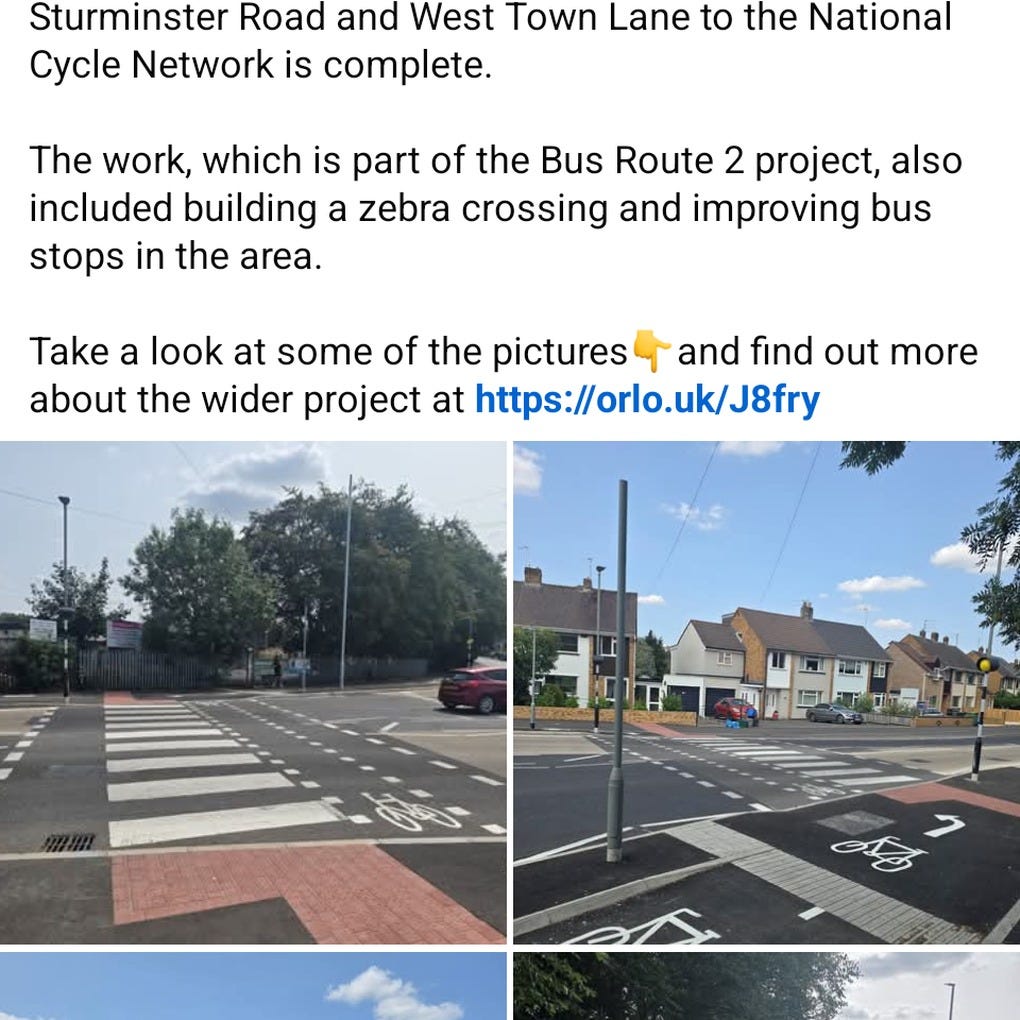
You might want to sit down for this.
Bristol City Council posted the pictures itself, proud as you like. On Facebook. No less, of all places.
A new segregated cycle path in Stockwood, a fresh zebra crossing, bus stops rebuilt, all part of the wider Bus Route 2 project. No bunting though. Budget restrictions, I guess.
Anyway. To the point. Nice red tarmac. Nice bike stencils. Getting on for 27,000 likes. No one outside of us knows why. Maybe they just have not seen the real story under the civic self-congratulation.
First reaction, looking at it? Where are the toilets. Not a joke.
Not about this cycle route specifically, either. About Bristol as a whole. Keep that thought. We will come back to it, properly, with the actual figures.
Because the toilets are not the gap. The law is the gap.
To be fair to the council first: Bristol runs free adult cycle training and school Bikeability sessions. That much genuinely exists.
Nowhere in anything the council has published is there a penny spent teaching riders the actual law they are subject to. Nowhere is there a penny spent enforcing it once it is broken.
You see. Illegal e-bikes ride those lanes routinely, by every account this piece has checked, and effectively nobody stops them. Pavement cycling is a documented, repeated pattern in this city, not a one-off. And.
E-bike law UK already covers every single one of these offences — pedalling, plates, passengers, pavements, the lot. Bristol has managed, through years of good intentions and bad arithmetic, to build all the infrastructure and almost none of the effective e-bike enforcement where it actually matters: on the routes themselves.
Ah yes. So. Here is exactly why that gap is so easy for a council to ignore. Nobody has to prove they know a single law of the road to ride on it.
No test, no plate, no insurance, no registration, no age check past fourteen. Or. Put another way. No. No. No. No. No!
Fundamentally. Bristol has spent years and millions of pounds building infrastructure for a category of vehicle. Nobody has ever required the users to be educated. And nobody, council or police, currently has the practical means to enforce how they actually behave. As in. No. No. No. No No! No one actually believes. So.
Imagine, for a moment, opening a restaurant. You have fitted the kitchen. Gleaming worktops, six-ring range, the good knives.
You have taken the bookings, printed the menus, hung the awning.
What you have not done, at any point, in any order, is buy a single ingredient.
That is Bristol’s cycling strategy, in one sentence. The kitchen is world class. There is nothing in the fridge. At which point. Even Ramsay would likely combust. From the inside out.
To be clear. That is not a cycling column. That is a Bolitics story — governance that performs concern and delivers nothing behind it. The Almighty Gob has pulled the actual law, the actual casualty figures, the actual money, and the actual paint. Here is the lot.
Illegal E-Bikes And The Wild West Bit That Is Not Hyperbole.
An e-bike that qualifies as an Electrically Assisted Pedal Cycle — motor capped at 250W, assistance cutting off at 15.5mph, throttle limited to walking pace — is legally a bicycle. No licence. No plate. No insurance. No MOT. Full breakdown of the rules here.
Anything above those limits, or with a full twist-and-go throttle, is legally a moped. It needs registration, tax, insurance, a licence and an approved helmet — the same as any other motor vehicle on the road. The distinction, in full.
The trouble is you cannot tell the two apart by looking at them. And Avon and Somerset Police have already confirmed, in their own words, what that means in practice: “The use of mechanically propelled transport such as E Scooter or E Bicycles that do not require pedalling is not permitted on the road or any public spaces including footpaths and bridle ways. They are covered by the same laws and regulations that cover all motor vehicles.” Source: Avon and Somerset Police.
Mind. They only started saying it after residents complained. And that notice covers a village. Not the city centre. Not one word of it, near a single one of those newly painted Bristol cycle lanes.
And where enforcement does exist in this force area, it is reactive. Somebody complains, then somebody responds. That is the model. Plus. If it needs saying at all.
That is one law going unenforced. Here is another, even more clear-cut. Two riders on one bike? Also illegal, on any machine not built for it — Section 24 of the Road Traffic Act, up to a £200 fine, for rider and passenger. Confirmed here.
It is worth being honest, here though, about the strength of one piece of evidence. The most vivid account of Bristol rush-hour pavement riding and red-light jumping — including a near-miss between two cyclists, one going through a red light, the other coming the wrong way up a one-way street — comes from reader comments underneath a 2015 police letter to Avonvale cyclists. Read that exchange in full.
Simply because. A decade-old forum thread is not proof of anything happening this week. What it does establish is that the pattern itself — pavement riding, red-light jumping, wrong-way cycling, all three in the same city, all three witnessed by ordinary residents — is not new, not disputed, and has been going unaddressed for at least ten years.
All of it is legal to prosecute, right now, today — and almost none of it is being prosecuted.
THE QUESTION FOR THE COUNCIL How many fixed penalty notices has Avon and Somerset Police issued in Bristol city centre in the last three years for pavement cycling, red-light cycling, and illegal e-bike passengers? If the number is zero, or close to it, why?
Zero E-Bike Enforcement: The Cameras Cannot See Them Anyway.
News to most, this. Myself included. Bristol got new powers in 2023 to fine drivers directly for moving traffic offences— wrong-way one-way driving, banned turns, the lot — without waiting for the police. Confirmed by the council. Cameras went live at six sites from March 2025.
Here is the catch nobody is saying out loud. Those cameras work by reading number plates.
A bike has no number plate. Like. Who knew? Just find a rocket scientist somewhere. They’ll provide the answer. Probably.
By design, the council’s entire new enforcement mechanism — the one thing that was supposed to catch exactly this sort of lawbreaking — cannot touch a single offence a cyclist commits. Not one.
It gets worse. Bristol’s East Bristol Liveable Neighbourhood — bus gates, camera-enforced, ANPR — publishes its own exemption list.
Sat right there next to emergency vehicles, refuse vehicles and Blue Badge holders: “cycles and e-scooters.” See the council’s own scheme document.
Confirmed again on the bus gate page itself: “These road users can travel through the East Bristol Liveable Neighbourhood bus gates: Buses, Emergency vehicles, Bicycles... Solo motorcycles, Taxis.” Source.
This is not an accidental gap in the technology. The council wrote it into the policy.
An unregistered, uninsured, untraceable vehicle class sits on the same published exemption list as an ambulance — not the same legal status, nobody is claiming that, but the same practical effect: waved through, no questions asked.
And the scheme is about to be made permanent, with a citywide version of the same exemption policy now being drawn up. Confirmed 9 July 2026.
Nor is this new for this force. Avon and Somerset Police admitted, on the record, that they had not issued a single speeding fine in Bristol’s original 20mph zones across three years, because enforcement “will not be routine but will be intelligence-led.” BBC report. Something in short supply in Bristol. I suspect.
That admission is over a decade old now, describing an earlier administration’s enforcement posture. However — it is the clearest evidence on record of the institutional pattern this piece is describing, and nothing found in researching this article suggests that pattern has since reversed.
THE QUESTION FOR THE COUNCIL Bristol’s Moving Traffic Enforcement powers exist specifically to catch dangerous road use. Given cameras cannot read a bike’s plate because it does not have one, what parallel enforcement mechanism — if any — has the council budgeted for cyclists and e-bike riders? If the answer is none, will the citywide LTN exemption policy currently being drafted actually widen this gap rather than close it?
When It Goes Wrong, Somebody Dies.
This is not theoretical. In Rochester, an e-bike rider hit and killed a 91-year-old man, James Blackwood, while riding on the pavement. The rider was convicted of manslaughter — the first such conviction in the country. CPS case summary.
In Leeds, a Deliveroo rider on an illegally modified e-bike — no licence, no insurance, capable of 32mph — collided head-on with another cyclist on a pavement blind bend. Vincent Cullinane died nineteen days later. BBC report.
Both convictions came after somebody had already died. Neither came before.
Nationally, pedal cycle casualties rose 10% in 2025 to 16,027 — “the largest percentage increase in total casualties among the main road user groups.” DfT figures.
E-scooter deaths — the closest tracked proxy for illegal throttle e-bikes — rose 67% in the same period, to ten. Full DfT breakdown.
Somebody always ends up paying for this. It is not usually the rider.
The Bill Lands On Your Car Insurance.
Uninsured e-bike and e-scooter injury claims have reportedly cost the Motor Insurers’ Bureau roughly £108 million between 2015 and May 2026, according to industry analysis of MIB-funded claims. Full figures.
That figure comes from insurance-industry commentary rather than an MIB annual report itself — worth the council or a journalist with better access confirming directly with the MIB. However — the underlying mechanism it describes is not in dispute.
The MIB does not print its own money. It is funded entirely by a levy on every UK motor insurer, who recover it through the premiums of every paying, insured, law-abiding motorist. You, if you drive a car.
And that only covers illegal, non-compliant machines. A rider on a fully legal e-bike who injures a pedestrian is not covered by the MIB scheme at all — because a legal EAPC was never classed as requiring insurance in the first place. Explained here.
So there are two separate holes in the net, not one. A pedestrian hit on a pavement by either kind of rider has, in most cases, no compulsory route to compensation whatsoever.
THE QUESTION FOR THE COUNCIL Given the Motor Insurers’ Bureau bill for e-bike and e-scooter claims already runs into nine figures nationally, has Bristol City Council made any assessment of local liability exposure — to residents, to the council itself, or to ordinary motorists via their premiums — from unenforced e-bike use on its new infrastructure?
Follow The Money Behind Bristol Cycle Lanes — Because It Explains Everything.
Right. Now here is where it gets properly infuriating. The infrastructure money cannot legally be redirected. And that is not an excuse. It is the whole scandal.
The Stockwood scheme in that Facebook post cost roughly £2 million, part of a wider 15-mile, five-phase Bus Route 2 corridor project. BristolWorld.
It is funded through the Department for Transport’s City Region Sustainable Transport Settlement — £540 million awarded to the West of England. Bristol’s Liveable Neighbourhoods alone got £12 million of that, ring-fenced from the start. West of England Combined Authority decision record.
That money comes with a legal string attached right from the start: it “must be used for: Decarbonising transport, promoting a shift from cars to public transport, walking and cycling.” Source: West of England Combined Authority. So. Possibly recycling then.
The region’s total, that. Not Bristol’s. Not yet.
Bristol’s own slice of it tops £108 million a year, every year, for five straight years. Full figures.
Say what you like about the wisdom of the spend. The settlement’s own published terms restrict it to transport decarbonisation. Redirect this particular pot to housing or social care, and the council breaches the grant conditions. Simple as that.
Anyone telling you to simply “spend the cycle lane money on people instead” has not checked the terms of the grant. This piece has.
The bit that changes the whole argument comes next. There is a different pot — and it is not ring-fenced the same way.
Bristol’s Community Infrastructure Levy, paid by developers, has a built-in carve-out for exactly the redistribution people keep asking for: “15% of Local CIL is allocated to a city-wide Equity Fund to be spent on projects across Bristol that meet its criteria. This is to support infrastructure projects in areas of greatest deprivation and with a focus on equity.” Source: Bristol City Council. Ps. Not to be confused with the actors union. Though?
It already exists. The mechanism you want is sitting inside the council’s funding rules, right now.
And in a detail that deserves far more scrutiny than it has had: in a recent funding round, Bristol’s area committees were told, in writing, that “Stage 1 forms related to transport or road safety were not accepted, this was to allow time for the transport teams to catch up on outstanding schemes.” Source: Bristol City Council.
Residents were, in other words, actively told to stop bidding for local transport and road safety money through CIL. Meanwhile, separately funded, CRSTS-backed cycling schemes elsewhere in the city carried on as if nothing had changed. Whether those two things overlapped on the calendar is exactly the kind of detail the council should be made to confirm.
THE QUESTION FOR THE COUNCIL How much money has actually flowed through Bristol’s CIL Equity Fund to date, and how does that figure compare to CIL sums directed toward cycling and active travel infrastructure city-wide? And can the council confirm exactly which areas were told to pause transport and road safety CIL bids, and for how long, while CRSTS-funded schemes proceeded unaffected?
Worth naming, too, what this could become if nobody asks the question now. Bristol’s council tax bill already carries separate, named additions on top of the core charge. The Avon and Somerset Police precept added £15 to a Band D bill this year. The Avon Fire Authority precept added £5. A ring-fenced Adult Social Care precept added a further 2% on top of everything else. Full breakdown of the 2026/27 bill.
Now. Every one of those started life as a specific, ring-fenced ask, sold to residents as a one-off. None of them arrived labelled as a promise that it would stay that size forever. Has it?
There is no cycling or active travel precept on Bristol’s bill today. But the CRSTS settlement funding almost everything in this piece runs out in March 2027, and this piece found no public council statement either confirming or ruling out asking residents to pick up the bill once central government funding stops. So.
THE QUESTION FOR THE COUNCIL When the current CRSTS settlement ends in March 2027, will Bristol commit now to ruling out a dedicated transport or active travel precept on council tax to fund what comes next — in the same way policing, fire and social care already carry their own named precepts?
Even The Paint Cannot Be Trusted.
Oh yes. While I think of it. There’s one more question worth putting to them, while we are already on the subject of money nobody outside the council seems to properly track: what is this city’s obsession with paint? Every mural, every red surface, every stencilled line on a cycle lane costs money — and, like everything else catalogued in this piece, nobody outside the council appears to know exactly how much, or where the accounting for it actually sits.
They are painting cycle paths. They are painting murals. They are painting roads. They are painting any bloody thing they can get a brush near, apart from the sky.
At this rate, do not be surprised to see a Paint Precept turn up on the council tax bill one Saturday morning, filed neatly next to police and fire. Given the volume of it going down across this city, on current form nobody would even blink.
Let’s not forget. Bristol City Council spent £61,000 — half from council funds, half from the Bristol BID — on a mural called Our Common Ground, replacing the old fountains on Centre Promenade.
Within months it had visibly faded, badly enough that a councillor said the state of it left her “embarrassed.” You know. Like a matching red. For example. Or. Close to.
The council’s own defence of the paint job is the interesting part: it was painted with a water-based “specialist road line marking paint” which has been used elsewhere in the city with no issues. BBC/AOL report.
Bristol is separately trialling red-coloured surfacing on its cycle lanes at spots like Bristol Bridge and Old Market Gap — the junctions where pedestrians and cyclists keep clashing. BBC coverage of the red paint trial.
Whether that surfacing is the same product, or even the same broad category, as the “specialist road line marking paint” used on the mural has not been confirmed publicly by the council either way.
However. The question is a fair one to put to them directly. If a version of this paint could not survive foot traffic and weather on a pedestrianised promenade, badly enough to embarrass a sitting councillor within months, the durability of whatever’s being used under tyres, at a busy junction, in all weathers, deserves the same scrutiny.
THE QUESTION FOR THE COUNCIL Is the “specialist road line marking paint” used on the Centre Promenade mural — which visibly failed within months — the same product or product category used on Bristol’s red cycle lane surfacing trials? Has any durability assessment been published for either?
Meanwhile, The City Cannot Manage A Toilet. Some Would say. Perhaps. Run A Bath.
Okay. It’s now time to make good on that promise from the top of this piece. This is not about one cycle route lacking a portable loo. It is about Bristol City Council closing eighteen public toilets across the city centre in 2017, under then-Mayor Marvin Rees, and replacing them with a “Community Toilet Scheme” relying on local businesses to volunteer their facilities. Full account: ACORN.
Campaigners visited every replacement site. Most were not accessible, or were simply out of order — a serious problem, given that public toilets are essential to the mobility of elderly people and people with disabilities. Same source. A wider audit found more than a quarter of listed venues could not actually be used when visited, and the vast majority displayed no sign telling anyone the scheme existed at all. Western Daily Press report.
Unsurprisingly. A campaign followed, backed by twelve organisations including Bristol Older People’s Forum, the British Toilet Association and Bristol Women’s Voice. It forced an actual council vote on reopening the toilets. A majority of councillors voted to reopen them. The Mayor vetoed it. Then. left the city.
Bristol has since scrapped the mayoral system altogether. The Green administration that replaced it committed, under continued campaign pressure, to reopening the toilets within two years. Confirmed by ACORN, February 2025. By early 2025, campaigners were already noting the administration had gone quiet on delivering it, and Labour councillors tried forcing the issue through a budget amendment instead. Bristol247 report.
This piece found no public confirmation that the toilets promised for reopening have actually reopened. Given the council is bogged down with other matters.
That is the honest comparison. A council that found two million pounds for a Stockwood cycle path found a veto for reopening the toilets its own elderly and disabled residents said they needed.
Here is a pitch, free of charge, for whoever commissions the next civic mural. A tribute piece for the closed toilets, painted by an artist going by To Loos We Trek. The clue is in the name.
Not quite as catchy as Oshii, perhaps — the actual artist behind Our Common Ground, whose name sounds more like a short, polite sneeze. You will not be able to resist trying that now, will you? Go on. I double dare you. Anyway.
THE QUESTION FOR THE COUNCIL Of the eighteen public toilets closed in 2017, how many have reopened under the Green administration’s committed timeline, and does the council consider the current Community Toilet Scheme adequate provision for elderly, disabled, and parent-with-young-children residents specifically?
Bristol On The Move. Just Not On Any E-Bike Law UK Cares To Enforce.
So. Here we are. Millions in central government money, quite properly spent building infrastructure nobody sensible objects to in principle.
However — none of that money, nor any other budget line found in researching this piece, is earmarked for teaching riders the law they are subject to, or enforcing it once broken. General cycle training exists; e-bike-specific legal education and enforcement does not.
The cameras that could catch dangerous driving aren’t able to read a bike. The camera-enforced neighbourhoods that could catch dangerous cycling wave bikes straight through, on paper, by design.
When it goes wrong, the bill lands on ordinary motorists’ premiums, not on the rider.
And the money that could legitimately be questioned for redistribution — the CIL Equity Fund — is sitting there right now, built for precisely this. Residents were separately being told to stop bidding for transport money through it, on a timeline the council should be made to clarify against its own cycling spend.
Remember the toilets. Eighteen closed in 2017. A council vote to reopen them, vetoed. A two-year promise from the current administration, still unconfirmed. Elderly residents, disabled residents, and parents with young children told, in effect, to make do.
That is the honest version of this whole story in one small, undignified image — a council that found two million pounds for a Stockwood cycle path and could not find the will to reopen a toilet block.
No toilets reopened. No enforcement for the law-breakers on the routes it did build. No ingredients in the kitchen. Just the tarmac, the stencils, and the photograph. Also, notably, the seven questions above — none of them answered yet, either.
The Almighty Gob is not asking Bristol City Council to stop building cycle lanes. It is asking them to answer, in public, the seven questions above.
If enough of you ask your own local councillors the same seven questions, you might actually get an answer before the citywide exemption policy is signed off.
The Almighty Gob is a Bristol-based publication founded by John Langley — independent mayoral candidate in 2016 and 2021, and one of Bristol’s most forensic observers of institutional power. Writing since 2010, well over 1,000 pieces across seven platforms and Substack at thealmightygob.com — no party allegiance, no press accreditation, no interest in acquiring either.
© 2026 John Langley / The Almighty Gob. All rights reserved. Some lefts too, perhaps? Don’t ask me. I just write this stuff.