
Bristol Housing Crisis Meets Bethel: When Marvin Rees's Faith Adviser Trained to Raise the Dead.
£150,000 in public funds, 20 city sites, and housing policy on a wing and a prayer—how advice from someone trained where they teach Christians to control government went unquestioned by Bristol City.

Reading time: 5 minutes
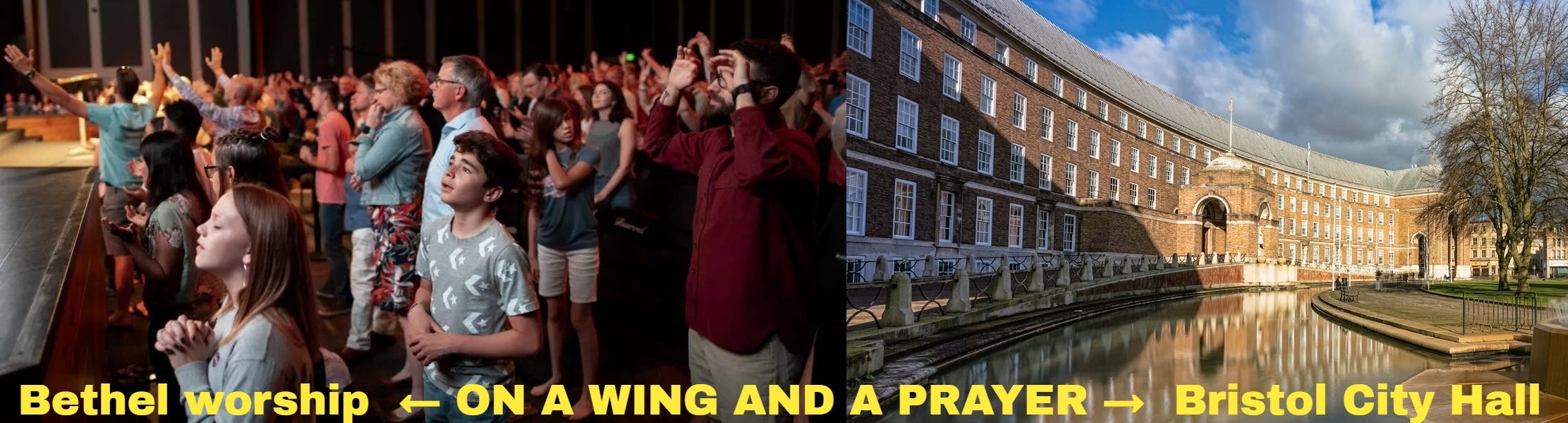
Bristol’s facing a housing crisis. Rough sleeping’s up, council homes are being sold faster than they’re built, and waiting lists stretch into years.
So naturally, when Bristol City Council needed advice on community asset transfers—deciding which organisations get to run public buildings—they turned to someone with extensive housing expertise.
Just kidding.
They got advice involving someone trained at Bethel School of Supernatural Ministry. You know, the California institution teaching students to raise the dead, soak up spiritual power from graves, and pursue the Seven Mountain Mandate—the explicit belief that Christians should assume control of government institutions.
That happened. In Bristol. Under a Labour mayor. With £150,000 of public money involved.
And apparently nobody thought this raised any questions worth asking.
How This Started: £150,000 and 20 Sites.
Conservative peer Lord Nat Wei convinced Bristol Mayor Marvin Rees to provide 20 sites in central Bristol for something called “Monastery 2.0.”
Wei’s company merged with Bristol City Council, Bristol and Bath Regional Capital, and Housing Festival Ltd to form the Bristol Housing Festival. Bristol City Council put in £150,000.
Now, Lord Nat Wei. Youngest person to enter the House of Lords when Cameron gave him a peerage at 33. Policy adviser for the Big Society—you know, that “active citizenship” thing that somehow coincided with devastating council cuts.
When told his position would be voluntary, Wei cut his days from three to two. Then he quit after a year.
The BBC asked him if austerity had killed the Big Society. His response? “That was a pretty clever narrative by the left.”
Right. So the architect of policies that gutted council budgets was now advising Bristol on housing. Using public money.
You see where this is going.
The Director Who’s “No Housing Expert.”
Bristol Housing Festival director: Jez Sweetland.
At Hope Chapel Hotwells, Sweetland said this: “I’m no housing expert.”
Then he said this: “I wanted to work for Marvin, because I was like ‘this is an amazing man of God, and I want to just serve this man’.”
Not “solve the housing crisis.”
Not “deliver affordable homes.”
“Serve this amazing man of God.”
That’s the director of an organisation receiving £150,000 in public funds. Describing his motivation in religious devotional terms. About the mayor who approved the funding.
Think about that.
Rachel Molano: The Faith Adviser Connection.
Here’s where it gets interesting.
Rachel Molano. Marvin Rees’s faith adviser. One day a week at City Hall. Official Bristol City Council email address.
Despite claims that she no longer works there? Still has active BCC email access. Bristol City Council admits they don’t know who pays her. Just that some “external city partner” covers it.
Academic credentials: First Class degree, Warwick. MA with Distinction, Bath.
Then she went to Bethel School of Supernatural Ministry in California.
Became Bethel’s “first UK staff member.” Their “person in London.” Bill Johnson, Bethel’s co-founder, calls her “a close friend.”
She was part of Rees’s 2016 campaign. Helped him win re-election in 2021.
Marvin himself: “Rachel has been instrumental in connecting my office to the churches. I wouldn’t be here today unless Rachel had fostered these conversations.”
February 2018. Bristol Church Network paid for both Rees and Molano to travel to Washington, DC. “International Prayer Breakfast.” Where Rees met Kris Vallotton, Bethel’s other co-founder.
Molano arranged those meetings. She also arranged his “trade networks” meetings in the USA.
Marvin’s first day as mayor. Hope Chapel Hotwells. Church leaders present.
His own words: “We prayed, and we invited the spirit of God into the city. I don’t tweet that. But we did it, you know?”
Molano also became a director of Transformation Bristol. Alongside Lord Nat Wei and Steve Chalk.
Transformation Bristol advised Bristol City Council on community asset transfers. Under the Green administration.
The same Rachel Molano trained at Bethel School of Supernatural Ministry.
The same organisation teaching Christians should control government.
Are you getting this?
What Bethel Actually Teaches.
Let’s be clear about what we’re discussing.
Bethel charges students about $7,500 per year. Three-year programme. Students learn to attempt raising the dead. They practice “grave soaking”—lying on graves of dead Christians to absorb spiritual power.
They’re taught the Seven Mountain Mandate. Explicit belief that Christians must control seven spheres of society. Local Government’s one of them.
Bethel co-founder Vallotton stated the strategy: “Disciple cities and nations” by finding “people of influence.” Business leaders. Politicians. Clergy.
This isn’t a conspiracy theory. This is documented Bethel teaching. Their own materials.
So here’s the question: should someone trained at an institution explicitly teaching Christians to control government be advising on which organisations get public buildings?
Because that seems like the sort of thing you’d ask about. During procurement. Before signing off.
The Questions Nobody Asked.
I’m not filing an FOI request. Bristol City Council’s already months behind on responses. They’re facing formal enforcement from the Information Commissioner’s Office for systematic transparency failures.
So I’m asking publicly. Questions that should’ve been asked before any of this happened:
Was Bristol City Council aware that Rachel Molano trained at Bethel School of Supernatural Ministry?
Was the council aware that Bethel explicitly teaches the Seven Mountain Mandate—that Christians should control government?
What safeguards existed to ensure theological beliefs about government takeover didn’t influence decisions about public assets?
These aren’t conspiracy theories.
These are basic due diligence questions.
The kind you ask when public money and public assets are involved.
What the Green Party Inherited.
May 2024. Green Party takes control. They inherited these arrangements from Labour.
They didn’t create Bristol Housing Festival. They didn’t appoint Rachel Molano. They didn’t arrange the Wei-Sweetland-Rees connections.
But, when Transformation Bristol—with Molano as director—advised on community asset transfers under Green governance, what questions were asked?
What due diligence happened?
What safeguards existed?
Look, maybe someone trained to raise the dead makes sense for Bristol City Council. Given the state of critical thinking in that chamber, resurrection skills might actually be useful.
But across two administrations—Labour then Green—nobody apparently thought to ask whether theological frameworks about government control should influence decisions about secular public resources.
That’s not a small oversight. That’s a systematic failure of basic governance.
Why This Actually Matters.
Bristol’s housing crisis continues. Rough sleeping climbs. Waiting lists grow.
Community centres that could shelter people sit empty. Or get transferred through processes involving advisers with undisclosed theological agendas.
This isn’t about Christian faith. Plenty of Christians serve brilliantly in public office while maintaining proper boundaries between belief and governance.
This is about transparency.
About whether anyone conducted proper due diligence when public money got committed to schemes involving:
A Conservative peer whose policies created council funding crises
A director admitting he’s “no housing expert” but wants to “serve this amazing man of God”
A faith adviser trained where they teach Christians should control local government
£150,000 public funds
20 central Bristol sites
Community asset transfers advised by an organisation, this same faith adviser directs
Any competent procurement process would’ve asked questions. Lots of them.
Instead, Bristol got arrangements made through informal networks, facilitated by someone trained in institutional takeover theology, with minimal transparency.
And when residents try examining these decisions through Freedom of Information? They join a backlog stretching months. Because Bristol City Council’s been formally sanctioned for systematic FOI failures.
The £150,000 Question.
What happened to it?
What happened to those 20 sites?
What did “Monastery 2.0” actually mean?
Where’s Bristol Housing Festival’s promised acceleration of “quality, affordable housing”?
These questions deserve answers.
Bristol residents facing a housing crisis deserve transparency about how their money was spent. How their land was committed.
They deserve to know what safeguards existed.
They deserve to know what role, if any, theological beliefs about government control played in decisions about public resources.
Most of all, they deserve better than closed-door arrangements by networks bypassing democratic scrutiny.
Bristol City Council hasn’t answered.
That should concern every resident who cares how their money’s spent. How their city’s governed.
Regardless of their own beliefs. Or lack thereof.
Because the bins still need collecting. The potholes still need filling. And the people sleeping rough still need housing.
None of which gets sorted by praying over graves in California.