
Bristol Protest Sees 30 Arrested Under Terrorism Act: When Performative Activism Meets Reality.
Palestine Action supporters deliberately broke terrorism laws on College Green. Police warned them first. They held the signs anyway. This is Bristol's safe-space revolution.

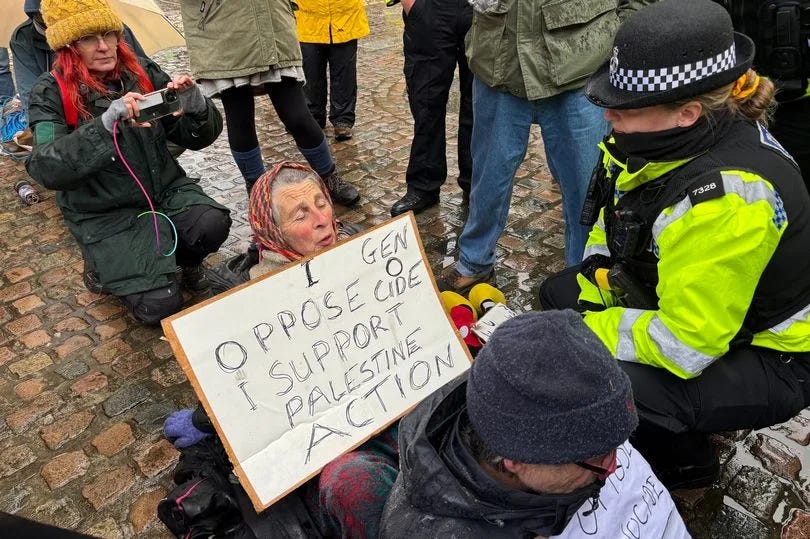
Thirty protesters were arrested on Bristol’s College Green last Saturday for displaying signs supporting Palestine Action, a proscribed organisation under the Terrorism Act 2000. Avon and Somerset Police warned them beforehand that holding the signs constituted a criminal offence. They held them anyway.
But here’s where it gets properly Bristol: they had a hundred supporters watching, ringing bells and cheering every time someone got arrested. Bells. Like it’s some carnival of martyrdom. Sir Jonathon Porritt, former advisor to Prince Charles for thirty years, got himself arrested too. Nothing says grassroots resistance quite like establishment figures seeking relevance through radical cosplay.
This wasn’t civil disobedience as a political strategy. This was theatrical victimhood choreographed for maximum emotional payoff with minimum actual risk.
Why Were Bristol Protesters Arrested? Understanding the Palestine Action Proscription.
Palestine Action was proscribed by the UK government in June 2024 under terrorism legislation. The group conducted direct action against defence companies supplying Israel, including property damage at facilities like Bristol’s Elbit Systems. Under Section 13 of the Terrorism Act 2000, publicly displaying support for proscribed organisations is a criminal offence.
The Bristol protesters knew this. Police explicitly explained it before arrests began. They held the signs anyway, then complained when police enforced the law they’d deliberately broken.
Rosa Parks didn’t refuse to give up her bus seat for Instagram content. Suffragettes didn’t chain themselves to railings for social media engagement. They took genuine risks because they had no other viable options for change.
What happened on College Green was middle-class theatre where arrest was the point. The supporters, the bell-ringing, the orderly queue for police vans—this was a choreographed performance designed to generate righteousness without the inconvenience of actual risk.
Bristol Protest Culture: Safe-Space Revolutionaries in Action.
If these protesters genuinely believed they were witnessing genocide, their response would be considerably more substantial than holding a sign in one of Bristol’s safest, most policed locations for an afternoon.
Real conviction involves real sacrifice. Disrupting arms shipments at ports. Blockading defence contractors. Actions with material consequences that might actually impact the situation they claim to care about. Instead, we got street theatre where everyone knew exactly what would happen, when it would happen, and how it would happen.
Compare this to Palestine Action itself. Whatever you think of their tactics, they took real risks—breaking into arms factories, causing millions in damages, and facing serious charges. That’s commitment, however misguided.
Standing on College Green with a pre-written sign while supporters ring bells? That’s activism as recreational therapy.
What Did Bristol Protest Arrests Actually Achieve?
Let’s examine the practical outcomes of what Defend Our Juries called the “most widespread wave of civil resistance in modern UK history”—a claim so absurdly granular it rivals participation trophy logic.
Thirty people now have criminal records under terrorism legislation. That follows them forever. Job applications, visa applications, DBS checks—all complicated by a Terrorism Act conviction. For what? To make a point that could have been made through legal protest, media campaigns, or actual political organising?
Did their arrests:
Change UK policy towards Israel? No.
Impact arms sales? No.
Help a single Palestinian? No.
Change Palestine Action’s proscribed status? No.
What it did achieve: Police resources diverted from actual crime prevention, sixteen police vans deployed, three hours of officer time, and considerable public expense. Bristol’s knife crime statistics remain grim, housing remains inadequate, and local governance continues its slow-motion collapse—but at least thirty people got to feel morally superior for an afternoon.
The Defend Our Juries Legal Challenge: Missing the Point.
Defend Our Juries is mounting a legal challenge to Palestine Action’s proscription at the Court of Appeal. Their spokesperson described Palestine Action as “the one group that made a material impact by hitting the profits of companies supplying hardware to Israel’s killing machine.”
Notice what’s missing: any acknowledgement that property damage landed Palestine Action on the proscribed list precisely because they went beyond legal protest.
They then complain that “conflating property damage with terrorism, as the Terrorism Act 2000 does, is an insult to everyone who has lost loved ones through acts of genuine terror.”
Fair point, actually. The Terrorism Act’s definition is problematically broad. But when you choose to support a proscribed organisation publicly, you’re accepting that broad definition applies to you. You don’t get to selectively reject laws based on philosophical preference while simultaneously demanding legal protection for your protest.
This is Bristol protest culture’s intellectual incoherence—wanting the moral authority of civil disobedience without accepting its consequences, claiming revolutionary credentials while operating entirely within comfortable parameters.
Bristol Activism: Performance vs. Material Change.
What we’re witnessing is protest as identity formation rather than tactical strategy. These aren’t activists pursuing material change through calculated risk—they’re individuals constructing meaning through performative opposition.
The bell-ringing gives it away. Real resistance isn’t celebratory. Suffragettes didn’t cheer when comrades got arrested—they mourned the necessity while continuing the fight. Civil rights protesters didn’t ring bells when colleagues were beaten and jailed—they steeled themselves for similar treatment while pursuing tangible objectives.
This Bristol protest was different: arrest was the objective. The point was the performance, the aesthetic of resistance, the social validation of having Been Arrested For The Cause.
What Genuine Commitment to Palestine Would Look Like.
Genuinely committed activists would organise politically, contest elections, build coalitions, and engage in sustained advocacy that changes public opinion and eventually policy. Boring, unglamorous work that takes years and offers no immediate emotional payoff.
Or, if they genuinely believed the situation demanded illegal action, they’d do what actually impacts the issue—disrupting arms shipments, targeting defence infrastructure, taking real risks with serious consequences.
But neither option offers the instant gratification of performative arrest. Political organising is tedious. Genuine direct action is genuinely dangerous.
Far easier to get yourself voluntarily arrested in the safest possible circumstances and call it a revolution.
Meanwhile, in the actual conflict zone these protesters claim to care about, people face real bombs, real trauma, real consequences—none addressed by street theatre in Bristol.
Bristol Has Commodified Activism.
These thirty arrests weren’t civil disobedience—they were a curated experience for people who need to feel radical without the inconvenience of actual risk.
They’re comparing themselves to historical civil rights movements while engaging in behaviour that would embarrass actual dissidents. They’re claiming revolutionary credentials while operating entirely within systems designed to manage and contain dissent.
If you genuinely believe genocide is occurring and you’re genuinely opposed to it, book a flight to Tel Aviv or Gaza. Put yourself in actual danger for your supposed convictions.
Otherwise, stop pretending that getting voluntarily arrested in Bristol—after being politely warned you’ll be arrested—makes you anything other than a tourist in someone else’s tragedy.
The Palestinian people probably aren’t comforted by wealthy Westerners queuing up for theatrical arrest on a Saturday afternoon in Bristol. But at least our local protesters got their moment of moral validation.
And really, isn’t that what modern activism is actually about?
Frequently Asked Questions About the Bristol Palestine Action Protest.
Why were protesters arrested in Bristol? Thirty protesters were arrested under Section 13 of the Terrorism Act 2000 for displaying signs supporting Palestine Action, a proscribed organisation. Police warned them beforehand that this constituted a criminal offence.
What is Palestine Action and why is it banned in the UK? Palestine Action is a direct action group that targeted defence companies supplying Israel. The UK government proscribed the organisation in June 2024 under terrorism legislation following property damage at facilities, including Bristol’s Elbit Systems.
Is it illegal to support Palestine Action in the UK? Yes. Under the Terrorism Act 2000, publicly displaying support for proscribed organisations is a criminal offence. This includes holding signs, wearing branded clothing, or distributing materials expressing support.
What are the consequences of being arrested under the Terrorism Act? A conviction under the Terrorism Act creates a permanent criminal record affecting employment, visa applications, and DBS checks. The protesters face potential fines or imprisonment.
Is Defend Our Juries challenging the Palestine Action ban? Yes. Defend Our Juries is mounting a legal challenge to the proscription at the Court of Appeal, arguing it was disproportionate and designed to protect arms company profits rather than public safety.
🎯 this nonsense does nothing but tighten up the anti-protest laws and reach further and further into "new targets" for proscription. real activism doesn't hit the headlines.