
Bristol Uni's Folding Table. London's Burning Ambulances. And 80,000 People Who Know Their Right From Their Left.
It's called free speech. Apparently, this comes with terms and conditions — for some.

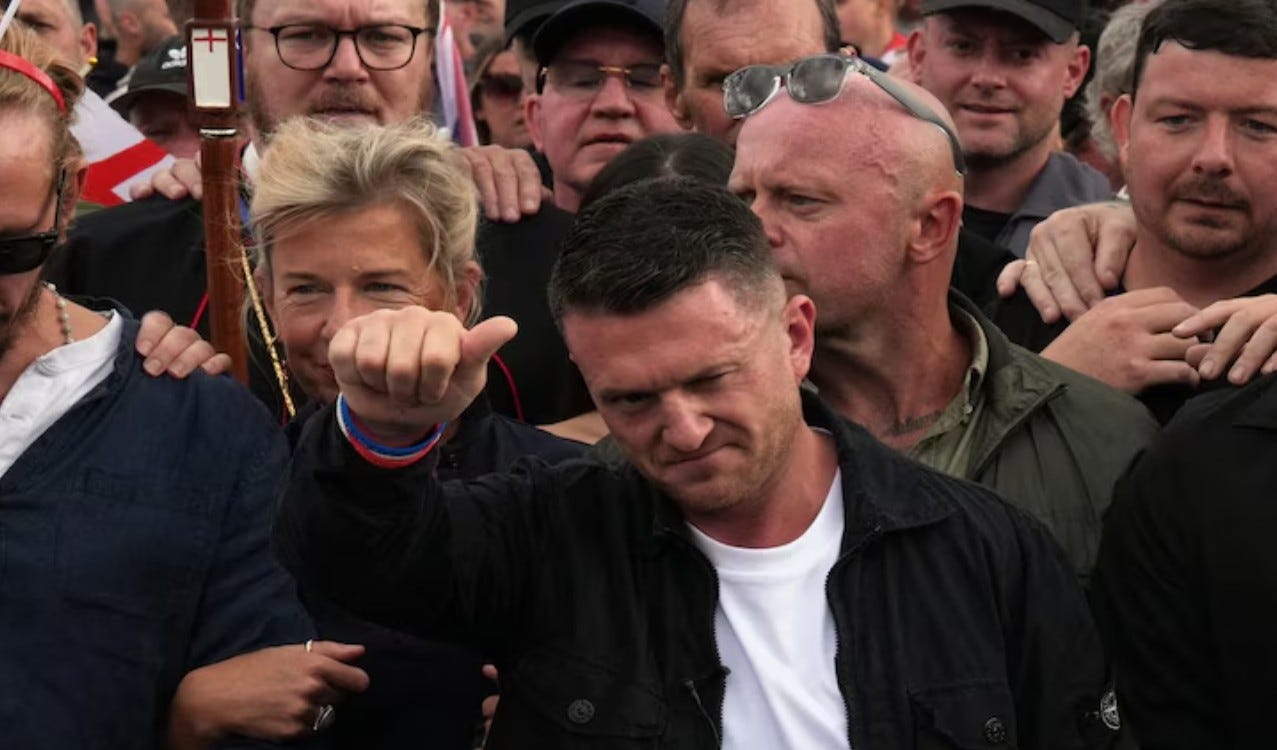
["The world will be watching, and your voice will be heard." Tommy Robinson addresses supporters ahead of the Unite the Kingdom rally, central London, 16 May 2026.]
This started with a folding table. And, more than usually perhaps, folded arms.
So. On Saturday May 16th, 80,000 people are expected on London’s streets for the Unite the Kingdom rally, organised under Tommy Robinson’s banner. The Metropolitan Police approved the route.
On Wednesday, 29 April 2026 at Senate House, University of Bristol, a teenager — Thomas Moffitt, known online as Young Bob — sets up on the public pavement outside one of the top ten universities in the United Kingdom. He puts a banner up. He gets a microphone out. He invites anyone who disagrees with him to come and try to change his mind.
Open debate. On a pavement. Outside a university.
You’d think that was the point of the place. Wrong.
A crowd gathers. Arguments are made — about DEI, about abortion rights, about Labour Party policy. Young Bob engages every one of them. Without notes. Without backup. At seventeen. And then someone from the crowd walks forward, picks up a tub of curry, and throws it at him.
The crowd cheers.
Now, somewhere in the University of Bristol’s publicly available Education and Student Experience Strategy, critical thinking is listed as a core graduate attribute. It presumably evaporates somewhere between the prospectus and the pavement.
The University issued a statement. It mentioned foundational values. It mentioned geography. The words attack, assault, unacceptable, and condemn do not appear. Not once. Not in any order. Not in any combination. Remarkable restraint, from an institution that has published extensively on its commitment to inclusive excellence.
A university that cannot bring itself to say that throwing food at a teenager for asking a question is wrong has already told you everything you need to know about whose side it’s on.
The Higher Education (Freedom of Speech) Act 2023 came into force on 1 August 2025. The Office for Students operates a live complaints scheme. The University of Bristol has a published Freedom of Speech Code of Practice. All of which makes what happened on that pavement in April 2026 not merely embarrassing — but potentially actionable. to this Saturday. London. The Unite the Kingdom rally — a march organised under Tommy Robinson’s banner, expected to draw upwards of 80,000 people to the capital’s streets. The Metropolitan Police approved the route: Kingsway, the Strand, Trafalgar Square, Whitehall, Parliament Square. The last Unite the Kingdom gathering, in September 2025, drew somewhere between 110,000 and 150,000 people, depending on whose count you trust. Police made 24 arrests. For context, Notting Hill Carnival typically produces around 400. There’ll always be a few in any large gathering of people. Life’s like that.
Eighty thousand people assembled lawfully on public streets. The Metropolitan Police approved the route. The crime, apparently, was turning up.
However, before a single person had set foot on the route — before a single word had been spoken from a single stage — the machinery was already in motion.
This Saturday will also mark the first time the Metropolitan Police has deployed live facial recognition technology as part of a protest policing operation in London. Deployed in Camden — in areas likely to be used by Unite the Kingdom attendees. Not along the Nakba Day route. Not at its assembly points. Not at its rally. One march gets watched. The other gets waved through. As rare as rocking horse droppings at a pro-Palestine march, one might observe. Odd, that.
Oh, and, in addition. Seven foreign speakers have had their Electronic Travel Authorisations revoked by Home Secretary Shabana Mahmood under the standard “not conducive to the public good” formula. Two Americans. A Dutch commentator. A Spanish influencer. A Belgian politician. A Polish MEP. An American broadcaster. All banned. No appeal. No judicial oversight. Executive discretion applied at speed, applied selectively, and applied with considerable political theatre. The same rule that banned Kanye West earlier this year.
Prime Minister Keir Starmer announced the travel bans in a speech that was also, by curious coincidence, an attempt to convince his own party he should remain as its leader — following Labour’s significant losses in the local elections the previous week. Timing, as they say, is everything. Perhaps not unlike the timing that saw former Deputy Prime Minister Angela Rayner exonerated by HMRC over a minor stamp duty oversight on her Hove flat — dropped this very morning. Life tends to work like this.
Purely by coincidence, of course, the same weekend sees a pro-Palestine Nakba Day rally organised by the Palestine Coalition and Stand Up To Racism proceeding through the same city. Who’d have thought it?
That is not a complaint about the Nakba Day march. People have every right to march for Palestinian rights. The right to peaceful assembly belongs to everyone. Especially if you’re in Palestine. One would have thought.
So. Let’s raise the question about consistency. Shall we?
Because the “not conducive to the public good” standard is a mechanism. Mechanisms are only as neutral as the hands operating them. And the hands operating this one have been remarkably steady in one direction and remarkably still in the other.
You may possibly have seen similar on a London street, where the ball disappears from under one cup to another.
Anyhow. Remember Golders Green. 23 March 2026. 1:40 in the morning. You may have seen it on the news. The local residents certainly remember it.
Four Hatzola ambulances parked on Highfield Road, on the property of Machzike Hadath Synagogue, are set on fire by three hooded arsonists. Accelerant poured. Three vehicles destroyed. One seriously damaged. Six fire engines. Forty firefighters. Oxygen cylinders exploding. Windows shattering in the neighbouring apartment block.
Now. Hatzola Northwest Trust has been running since 1994. Sixty-one fully qualified volunteer medics and paramedic responders. Available 24 hours a day, 365 days a year, within a 2.5-mile radius of Golders Green. Providing emergency medical treatment — and this detail matters, so read it carefully — to area residents. Jewish and non-Jewish alike.
The perpetrators burned ambulances that serve an entire community.
Let that land for a moment.
The group claiming responsibility — Harakat Ashab al-Yamin al-Islamia — is assessed by SITE Intelligence Group as an Iran-aligned multinational militant collective. Before London, they had already claimed attacks on a synagogue in Liège, a Jewish school in Amsterdam, and a synagogue in Rotterdam. In the weeks that followed the ambulance arson, the attacks continued: a memorial wall set alight, a stabbing of two Jewish men in broad daylight, a series of attempted arsons across north London. The UK threat level was raised from substantial to severe. The government declared an antisemitism emergency.
Four people — British nationals Hamza Iqbal, 20, Rehan Khan, 19, Judex Atshatshi, 18, and an unnamed seventeen-year-old — were charged with arson with intent to damage property and being reckless as to whether life would be endangered.
Those most vocal about the threat posed by 80,000 people assembling lawfully on a London street had remarkably little to say about this.
That volume of institutional noise — the outrage, the demands for bans, the emergency statements, the travel revocations, the pre-emptive stigmatisation of an entire crowd before it had taken a single step — did not replicate itself here. Not at the same pitch. Not at the same speed. Not with the same institutional urgency.
That is not an accusation. That is an observation. The record is the record.
You see. Here is what connects the folding table to the burning ambulances to the 80,000 people on Saturday. Not scale — the Golders Green attacks made world news, the Bristol pavement made Bristol news. The connection is the pattern. And the pattern doesn’t care about postcodes.
It is not politics. It is not religion. It is not immigration. It is not even free speech, exactly — though free speech is where it surfaces most visibly.
You’ve felt this. The asymmetry. The way the same principle seems to apply differently depending on who’s holding it. You’ve noticed. Most people have.
It is the question of who gets taken seriously.
The tolerance movement — and it does present itself as a movement, with language and aesthetics and institutional support carefully cultivated over years — has built its entire identity around the idea that some speech protects and some speech harms. That some assembly is resistance and some assembly is threat. That some victims deserve the full apparatus of outrage and some victims can wait.
What it cannot survive is the mirror.
Because the moment you hold the folding table next to the burning ambulances — one a Bristol pavement story, one a counter-terrorism investigation that ran on every front page from London to New York — next to the banned speakers next to the approved Nakba march and ask — consistently, without tribal exception — which of these received the proportionate response, the framework doesn’t hold. The logic leaks. The selectivity becomes visible.
Ask yourself this. If the positions were reversed — if it had been a pro-Palestine teenager struck by a counter-protester’s projectile outside that same Senate House — how loud would the response have been?
You already know the answer.
Young Bob stood on a public pavement with a folding table and invited people to change his mind. He was struck with a tub of curry. Most of the crowd did not throw the curry. They cheered the person who did.
That crowd is not the resistance. That crowd is the problem.
This publication has been watching Bristol’s institutions operate for long enough to recognise the pattern when it scales. And it does scale. From a pavement outside Senate House to a counter-terrorism investigation that made international headlines. The mechanism is identical. Only the postcode changes.
What the tolerance movement actually tolerates is not disagreement. Not challenge. Not a folding table on a public pavement with a microphone and an open question.
All three, apparently, require a different response.
Let’s be clear. Far-right violence is real. Quite the opposite of any suggestion otherwise. It’s simply that the tolerance movement has been failing that test for years.
It will fail this weekend in London. Much as it failed at 1:40 in the morning in Golders Green in March.
You see. The 80,000 people assembling in London on Saturday are not a problem to be managed. They are a signal to be read. And what they are signalling — in numbers that grow larger every time the machinery is deployed against them — is that they have noticed the terms and conditions.
They just don’t accept them.
The terms and conditions were always there. The folding table, and curry sauce, oddly enough, on this occasion, just made them more visible.
© 2026 John Langley / The Almighty Gob. All rights reserved. Where reproduced, John Langley must be named as source in full. Attribution: John Langley / The Almighty Gob, thealmightygob.com. Unauthorised use constitutes copyright infringement. The Almighty Gob. Bristol. 2026.
The Almighty Gob is a Bristol-based publication founded by John Langley — independent Bristol mayoral candidate 2016 and 2021, and one of the city’s most forensic observers of institutional power. Publishing since 2020, with over 500 pieces across seven platforms and Substack at thealmightygob.com — no party allegiance, no press accreditation, no interest in acquiring either.