
Bristol's About to Punish Failure By Guaranteeing Nobody Can Fix Anything.
May's council elections will show how Bristol votes against failure whilst guaranteeing nobody can succeed.

By John Langley. I’ve stood for Bristol Council. I know these campaigns from inside the numbers.
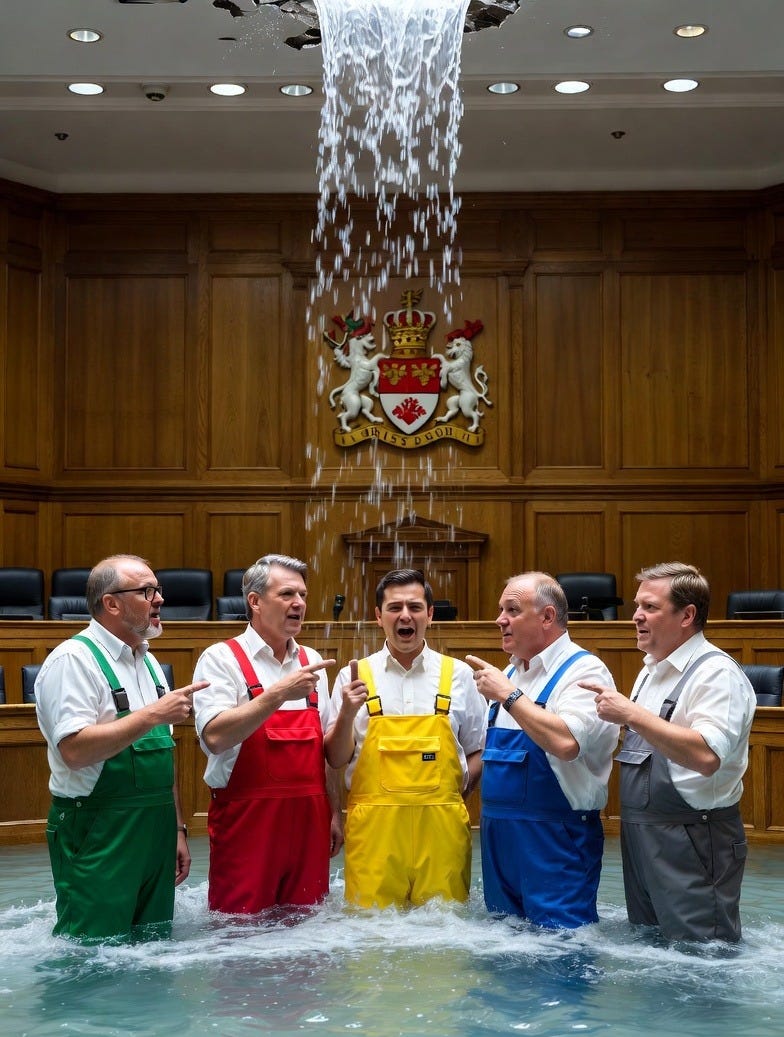
[May 1st, 2026: Five plumbers, all needing unanimous agreement before fixing anything. This is what No Overall Control looks like - committee chairs debating whether the water is wet whilst 14,000 families wait for homes and ambulances can't access streets. Bristol Council chamber, visualised.]
May 1st, 2026, Bristol votes. Here’s what happens: voters fire their plumber for flooding the bathroom, then hire five new plumbers who all need unanimous agreement before turning a wrench.
Greens lose seats for documented failures—1,222 homes sold, zero built, ambulances blocked by their transport schemes. Labour gains without proving competence. Nobody achieves majority. Two more years of paralysis where every decision requires agreement nobody reaches and every failure gets blamed elsewhere.
The bins still won’t get collected. The housing list still grows. The bollards still block ambulances. But everyone can claim it wasn’t their fault.
Welcome to political purgatory.
Why Greens Bleed Seats
Two years produced failures residents can photograph: housing and transport.
Housing: Sold 1,222 council homes promising 1,000 built annually. Built zero. 14,000 families wait.
Transport: Implemented Hengrove against 54% opposition. Ambulances can’t access streets. Journey times triple.
You can’t spin mathematics. That kills you in local elections.
Who’s Losing
Tom Renhard (Southville, Housing): Won 2024 by 248 votes. Defends 1,222 homes sold, zero built, 14,000 waiting. His portfolio is opposition literature. The promised builds don’t exist. The 14,000 families don’t care about consultations—they care about homes. Loses May 2026.
Ellie Freeman (Bedminster, Transport): Won by 1,158 votes. Owns Hengrove: 54% opposed, implemented anyway. Freeman defends infrastructure residents photograph saying “that’s worse, here’s proof.” Ambulances don’t care about sustainable ideology—they care about reaching heart attacks. Loses May 2026.
Who Survives Despite Everything
Tony Dyer (Council Leader): Won by 1,138 votes. Every failure lands here—£53m SEND deficit, homes sold, transport disasters, councillors walking out rather than listening to residents, FOI compliance missed by years.
Survives anyway. Why? Southville votes on identity over outcomes.
The demographic that moved there already has housing. They’re voting on whether supporting Green policy makes them feel good about themselves. Electoral equivalent of recycling whilst driving an SUV. Gesture matters more than impact.
July 2024: Eighteen Green councillors walked out when residents raised gender-critical concerns during public forum. Refused to listen to constituents exercising democratic rights. Dyer defended it—councillors have the right to feel “safe” (emotionally comfortable) and can walk out if residents say uncomfortable things.
14,000 families wait for homes that don’t exist. Zero built in two years. But at least the walkout defended feelings.
Priorities clear. Bins don’t get collected but pronouns get respected.
Holds May 2026. Personal vote strong enough. Ward demographic forgiving enough. Timing barely saves him—South Bristol Liveable Neighbourhood consultation closed October 2025, implementation starts early 2026, but full infrastructure impact hits Southville mid-2026, after the May election. He survives. Then owns the disaster for four more years.
Ed Plowden (Transport Chair): Won by 1,528 votes—strongest margin. Owns East Bristol Liveable Neighbourhood disaster: 5,000 petition signatures opposing, 3,000 Facebook members fighting it, bus gates installed 3am under police protection dodging protests.
Survives because Windmill Hill isn’t East Bristol yet. Residents watched disaster happen elsewhere but haven’t lived inside it. South Bristol LN consultation closed October 2025, implementation starts early 2026. But May election happens before residents experience full impact in their streets. Timing barely saves him. Holds May 2026. Done by 2030.
Paula O’Rourke (Clifton): Was Green until eighteen colleagues walked out July 2024. Resigned from party, not council. Her statement: “Walking out is refusal of democratic duty.” Clifton respects councillors doing the job. Holds as Independent.
Ani Stafford-Townsend (Central): Won by 314 votes. Chairs Planning Committee since 2021. System is, in Ani’s own words, “in disarray and dysfunctional.” Residents petitioned declaring lost confidence. Four years dysfunction whilst chair owns it.
Almost certainly walked out July 2024. Bristol’s first out trans councillor—significant symbolic representation. 2023: Crowdfunded £10k to sue Labour colleagues over planning row—political theatre whilst system collapses.
Central is 90% flats, 50%+ private rental, students and young professionals. Demographic voting trans solidarity over planning competence. Planning applications stack up, businesses wait, but suggesting trans councillor should be accountable? Transphobia, apparently. Holds. Margin tightens—314 probably drops to 150. Welcome to Central, where system’s dysfunctional but pronouns get respected.
Richard Eddy & John Goulandris (Conservatives): Both hold. Their areas would vote for blue rosette stapled to bin bag. Hold.
What Actually Happens
Greens lose 8-12 seats. Labour gains 6-10, falls short of 36 needed. Lib Dems pick up 3-5. Conservatives hold 14. Nobody achieves majority. Nobody governs. Everyone blames everyone. No Overall Control—most Bristol outcome possible.
The Pattern You’re Missing
Bristol’s council: identity performance over governance.
14,000 families waiting, walkouts defended. Ambulances blocked, but ideology sustainable. Planning dysfunctional four years, pronouns respected. Zero homes built, recycling whilst driving SUV.
Bins don’t care about pronouns. Potholes don’t care about flags. Housing list doesn’t care about walkouts. Ambulance delays don’t vanish because ideology’s greener.
Identity politics wins Green wards. Those demographics prioritise symbolic gestures over measurable outcomes.
The Demographic Trap
Central: 90% flats, 50%+ rental, students. They vote identity validation because they won’t be here in three years. Can vote dysfunctional planning because they’re not applying for permission.
Permanent residents—families, 20+ year residents, business owners—live with blocked streets, unbuilt homes, delays, uncollected bins.
St James Barton, Debenhams, Galleries—all becoming student accommodation.
More students = more transient voters prioritising identity = less pressure for functional governance = worse outcomes = permanent residents leave = those remaining trapped.
Bristol’s building its electoral trap. More student accommodation, more elections decided by people not living with consequences.
The Institutional Mindset
July 2024: Eighteen Green councillors walked out three times when residents raised concerns during public forum. Refused to listen to constituents exercising democratic rights. Paula O’Rourke resigned calling it “refusal of democratic duty.” Remaining Greens defended it as right to feel “safe”—emotionally uncomfortable from residents speaking through proper channels.
January 2026: Dyer’s administration responded to FOI failures by suggesting public stop submitting requests. Planning to reject more as “vexacious.” Missed targets by two years. Expect to hit them by 2030. Official response: Bristol expects “reorganisation into larger authority” making this “someone else’s problem.”
Pattern: Avoid accountability. Blame questioners. Wait for reorganisation to make consequences disappear.
Why This Guarantees Dysfunction
Bristol voters punish Green failure but split punishment across Labour, Lib Dems, abstention—guaranteeing nobody governs.
Two more years of coalition paralysis. Two more years of committee chairs who can’t agree on whether the water is wet, or just whetting their own particular brand of politics. Two more years where every decision requires agreement nobody achieves, every failure blamed on coalition partners, every improvement requires compromises satisfying nobody.
Greens demonstrated single-party control: policy implemented against majority opposition, consultation becomes theatre, outcomes contradict objectives. May 2026 demonstrates no-party control: nothing implemented, consultation eternal, outcomes absent because nobody responsible.
Difference between governed badly and not governed at all. Bristol’s choosing the latter calling it progress.
The Prediction
This isn’t prediction. Pattern recognition. Electorate furious enough to punish failure but not organised forcing improvement. Mathematical outcome: No Overall Control. Practical outcome: Nothing Measurably Improves.
2030: Everyone angrier. Problems measurably worse. Same pattern repeats.
That’s what happens when you fire the plumber for flooding the bathroom but hire five plumbers requiring unanimous agreement before anyone turns a wrench.
Flooded bathroom. Five blokes arguing. Bill for watching them bicker.
Bristol votes May 1st, 2026. The flood continues either way. Only question: Will voters recognise the pattern they’re creating, or keep choosing symbolic gestures over measurable outcomes whilst wondering why nothing improves?
The plumbers are waiting. The bathroom’s still flooded. Election’s fifteen months away.
Follow The Almighty Gob:
Website & Substack: https://bit.ly/3NQUEZm
All platforms and updates at the link above
Related:
Bristol’s FOI Crisis: When Councils Make Accountability Someone Else’s Problem
The July 2024 Council Walkout: When Bristol’s Greens Refused to Listen
Election data: Bristol City Council official results May 2024. Housing figures: council published reports. Transport consultation: committee minutes. Walkout: Bristol Post July 2024. FOI response: January 2026.
I may be misunderstang (again). But you do know that I invented Tony Dyers response to the FOI question as a satire?