
Bristol's Bike Lanes Put On Hold After Council Loses Money When Deadline Extended.
Green administration promises infrastructure will happen "when funding allows" - which means never.

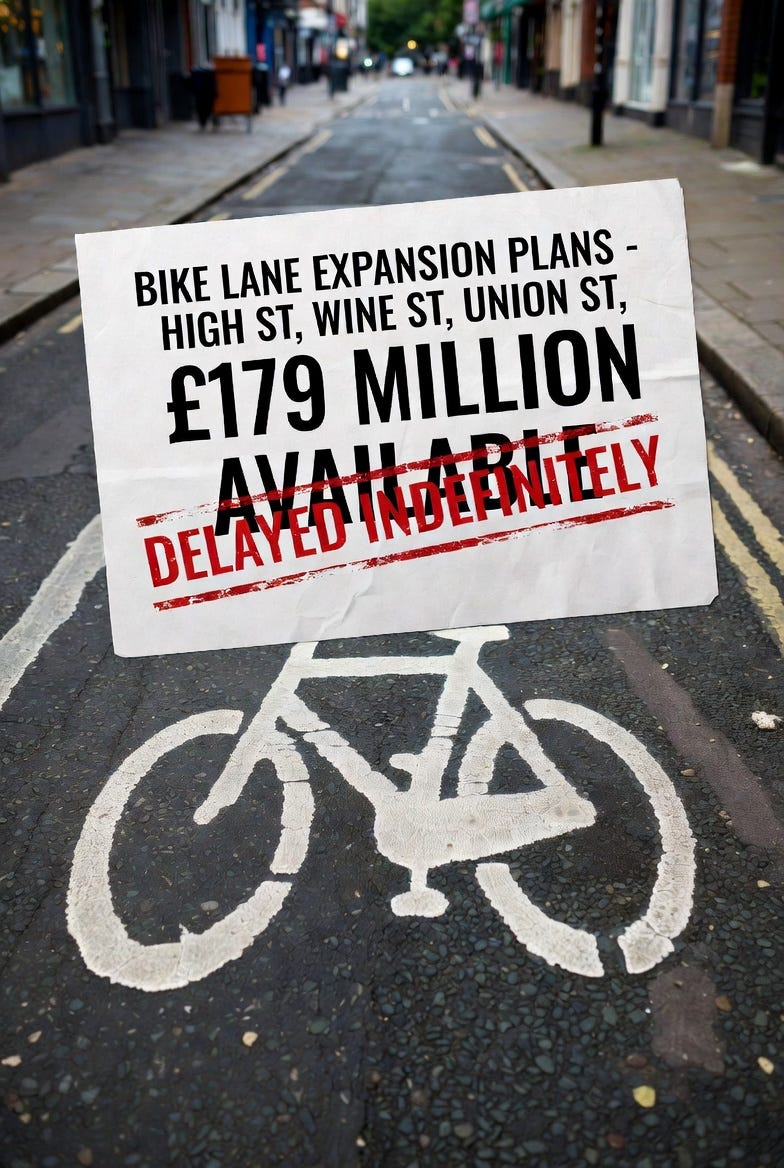
(£179 million in the bank, plans ready to go, deadline three years away. Obviously time to delay indefinitely.)
Right, explain this to me like I’m five years old: You’ve got £179 million. The government extends your deadline by two years and makes the rules easier. And somehow you end up with less money and no bike lanes.
How does that work? How do you cock that up?
Bristol City Council has managed this impossible feat. Bike lanes planned for High Street, Wine Street, and Union Street - designs ready, fully costed, desperately needed - are now “on hold” until “funding allows.”
That’s bureaucratic code for “we’ve got no intention of building these.”
Let’s Decode The Bullshit.
Ed Plowden, Green councillor and transport committee chair, issued a statement. Every sentence needs translation because it’s written in a language designed to obscure reality.
“We remain committed to delivering these transformational schemes.”
No you’re not. You’re delaying them indefinitely. If you were committed, you’d be building them. You’ve got the money. You’ve got the designs. What you haven’t got is the competence.
“When funding allows.”
Never. This phrase means never. It’s how councils say “we’re not doing this” without admitting they’re not doing it.
“With the designs ready, it will be a simple process to include them in a future phase of work.”
Translation: We’ve already spent money designing things we can’t build. Brilliant resource management that. Design infrastructure you’ve no intention of funding. Peak efficiency.
“This would also allow us to align construction work with the Galleries and St Mary Le Port developments.”
Ah yes, blame the private developers. That’s step one in the council playbook: Make your public infrastructure dependent on private property speculators’ timelines. What could possibly go wrong?
When those developments hit delays - and they always hit delays - you can shrug and say “not our fault, guv.” Perfect accountability shield.
Why We Have Signs That Say “Left” and “Right.”
There’s a reason taps are marked hot and cold. Red for hot, blue for cold. Not because we’re thick, but because basic communication prevents disasters.
There’s a reason road signs say “Left” and “Right” with arrows. Not because drivers can’t tell left from right, but because clarity at decision points matters when you’re moving at speed.
There’s a reason emergency exits have green signs with running figures. Not because humans don’t know what doors are, but because panic eliminates rational thought and you need idiot-proof instructions.
These aren’t optional niceties. They’re fundamental acknowledgements that complex systems require clear communication, obvious sequencing, and basic competence in execution.
Bristol’s Green administration can’t manage any of these.
They can’t communicate clearly - everything’s buried in bureaucratic language requiring translation. They can’t sequence obviously - bike lanes before the infrastructure they connect to exists. They can’t execute competently - losing money when deadlines extend.
If they ran your plumbing, you’d have taps marked “aqua temperature elevation device” and “reduced thermal liquid dispenser.” If they designed your roads, signs would say “vehicular trajectory amendment opportunity - funding permitting.” If they managed your emergency exits, they’d be marked “egress facilitation infrastructure - implementation timeline subject to stakeholder coordination.”
You’d be scalded, lost, and dead. In that order.
That’s what “when funding allows” means in practice. It means the most basic competencies of governance - communicate clearly, sequence logically, execute efficiently - are beyond this administration’s capability.
They’re Greens who can’t fund green infrastructure. They’ve got £179 million and extended deadlines but can’t build bike lanes. They’ve turned hot and cold into a philosophical debate about thermal dynamics while you’re standing there with your hand under the tap getting burned.
The Numbers Don’t Work.
Bristol got £143 million from the City Region Sustainable Transport Settlement. Council and developers chucked in another £36.1 million. Total: £179.1 million.
Original deadline: March 2027.
Government changes the rules. New deadline: March 2029. New requirement: Just commit projects to contract by March 2027, you’ve got two extra years to spend.
This is objectively better. More time, more flexibility, less pressure.
Bristol somehow ends up with less money.
The West of England Combined Authority “reviewed” things last October. After this review, Bristol’s allocation decreased.
How? Nobody’s saying. The council mutters about “high construction costs” and “our share now confirmed.” But there’s no explanation for how extending deadlines results in reduced funding.
That’s the bit they’re hoping you won’t notice. Extended deadline plus relaxed rules should equal better outcomes. Instead, Bristol loses money and delays infrastructure.
The maths doesn’t work. And when the maths doesn’t work in local government, it’s because someone’s lying or someone’s incompetent. Often both.
The Three Questions.
Is it practical to make your bike lanes dependent on private developers finishing their projects?
Of course not. Developers delay constantly. Planning complications, financing issues, market conditions - there’s always something. You’ve now surrendered control of your public transport infrastructure to property speculators who don’t give a toss about your cycling network.
Plus you’ve created the perfect excuse machine. Bike lanes don’t appear? Blame the developers. Developers don’t progress? Blame market conditions. Market improves but still no bikes lanes? Blame funding. Nobody’s ever responsible.
Is it logical to lose money when the government makes things easier?
No. The government extended your deadline by two years and relaxed the spending rules from “spend it” to “commit to contract.” These are objectively more generous conditions.
You should have more money because you’ve got more time to plan properly. Instead, you’ve got less. Which suggests one of three things happened:
Your original allocation was based on meeting tight deadlines, and the extension let them reallocate to faster projects. Your project pipeline was so badly planned that more time revealed how inadequate it was. Or the allocation methodology changed specifically to screw Bristol.
None of these make you look good. And the council won’t explain which one occurred.
What’s the likely outcome?
Nothing gets built. “When funding allows” means never. The designs are ready now. Construction costs are rising. By the time those private developments progress - if they ever do - costs will have risen further.
Meanwhile, other priorities emerge. Other crises demand attention. Other projects compete for funding. And these bike lanes remain in the “pipeline” indefinitely, occasionally mentioned in statements about long-term vision.
The public gets promises, consultations, and explanations. What they don’t get is infrastructure.
The Timeline That Makes It Worse.
Here’s another absurdity nobody’s mentioning: You’ve got until March 2029. That’s three years away.
Construction costs rise about 3-5% annually. Every month you delay makes it more expensive. “When funding allows” guarantees you’ll need MORE money than if you just built the bloody things now with the £179 million sitting in your account.
You’ve got designs ready today. You could start tomorrow. Instead, you’re waiting for private developments to complete, costs to rise, and funding to somehow materialise despite having the funding already.
This isn’t fiscal responsibility. This is fiscal stupidity with a press release.
The Pattern You’re Not Supposed To Notice.
Yesterday I covered Bristol’s inability to acknowledge walking exists as a transport mode. Their survey categories: car, bus, bike, “other.” As if humans using their legs to move around is some exotic possibility requiring further research.
Today it’s bike lanes they can’t fund despite having the money and the designs.
Last week it was their housing strategy: Build 1,000 council homes by selling 1,222 properties. Maths invented by Escher.
And here’s the beautiful irony: This is the GREEN Party. The ones whose entire identity is sustainable transport. Cycling is literally their brand. Their reason for existing. Their signature policy area.
And they can’t fund bike lanes with £179 million available.
It’s like a fishmonger who can’t sell fish because they’re waiting for the ocean to allow it. Or a baker who promises bread but only delivers recipes. You had one job - the job you campaigned on, the job that defines your political identity - and you’ve cocked it up spectacularly.
The pattern is systematic incapacity disguised as strategic governance. They can’t acknowledge walking. Can’t sequence construction projects. Can’t fund their own signature infrastructure with £179 million available. Can’t build houses without selling more than they’re building.
But they can defend transport schemes 54% of residents oppose. Commission reports. Produce designs. Hold consultations. Issue lengthy statements about transformation.
What they demonstrably cannot do: Build things. Spend allocated budgets. Match promises to outcomes. Deliver basic competencies of local government.
What This Actually Means.
For cyclists: Your city centre network stays disjointed. The exact gap these lanes were meant to fix remains unfixed. The council has designs ready but no intention of building them.
For residents: More promises, zero delivery. You’ve watched consultations. Seen designs. Heard rhetoric about “transformational schemes.” You’re getting explanations why none of it can happen despite £179 million sitting there.
For Bristol: The Green administration’s rhetoric-reality gap becomes mathematically provable. Every promise comes with an asterisk leading to “when funding allows.”
For democracy: Nobody’s responsible for anything. Government extended deadlines? Not the council’s fault. Combined Authority reduced funding? Not the council’s fault. Private developments delay? Not the council’s fault. Construction costs rising? Not the council’s fault.
Responsibility is so diffused that failure becomes structural. Promises multiply, delivery evaporates, explanatory statements get longer, and the built environment stays exactly the same.
The Innovation.
Bristol’s Green administration has discovered something remarkable: You can promise transformation while delivering immobility, call it strategic coordination, and face zero consequences because nobody’s accountable for outcomes.
Maybe they’re waiting for bicycles to develop wings. Environmentally friendly wings, naturally. Though we’ll witness flying pigs first - and those pigs will still need to apply for planning permission, undergo consultation, wait for funding to allow, and coordinate with nearby property developments for landing spaces.
Standing completely still requires no construction, produces no emissions, costs nothing, and can be blamed on external factors indefinitely.
Yesterday they couldn’t acknowledge walking. Today they can’t fund cycling despite having £179 million and extended deadlines. Tomorrow they’ll probably announce revolutionary public transport plans that’ll happen “when funding allows.”
The bike lanes on High Street, Wine Street, and Union Street will be built when funding allows. The designs are ready. The need is established. The money was allocated.
What’s missing is the bit where anyone actually builds anything.
The council meets Thursday to receive an update on transport projects. Expect promises, strategic coordination, transformational schemes, and variations on “when funding allows.”
“Transformational schemes” - that’s the phrase they love. What’s being transformed? Designs into dust. Money into explanations. Promises into excuses. The only thing successfully transformed is your expectation that councils might actually build things.
What you won’t get is bike lanes. Those require building things. And building things requires competencies this administration demonstrably lacks.
At least the explanatory statements are getting longer. That’s what £179 million buys you in Bristol: increasingly sophisticated reasons why nothing happens.