
Bristol's Clean Air Zone: The Air Didn't Get The Memo. Apparently.
Croydon's LTNs were ruled unlawful. Bristol's Clean Air Zone raises questions it hasn't answered. The air doesn't know that. It never did. Never will.

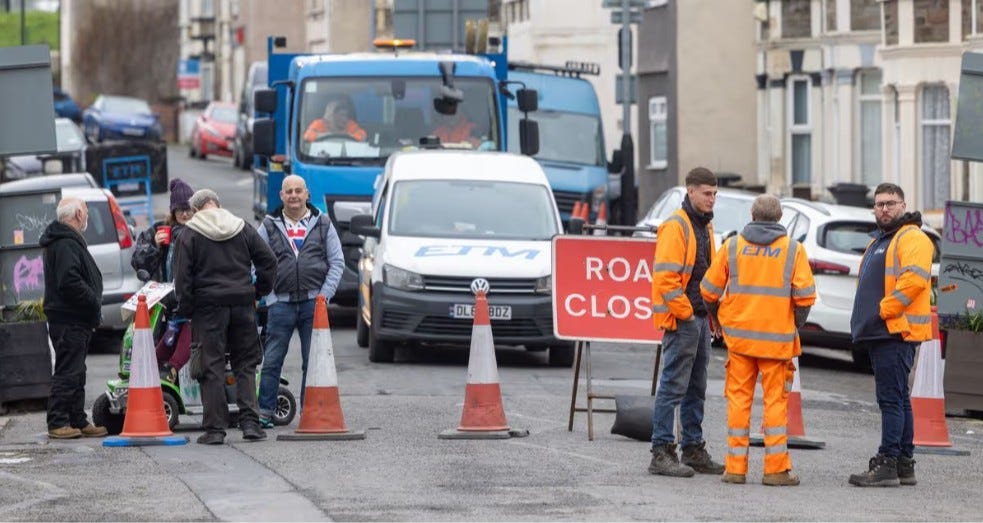
[Barton Hill, Bristol, April 2026. Residents face ETM contractors for the second time in two weeks as opposition to Bristol City Council's East Bristol Liveable Neighbourhood scheme continues. The protest reflects wider community anger at Bristol's transport and clean air zone policies. Image: Paul Gillis / Reach Plc.]
If air had a postal address, I think it’s fair to say Bristol City Council would have sent it a court summons by now.
You see, here’s the thing about air. It hasn’t quite got to grips with our language. We can shout at it. We can ask it. We can even put signs up. And guess what? It’ll take absolutely no notice whatsoever.
Funny, that.
Though, to be fair — and it may be the only fair thing said in this entire piece — both Bristol City Council and air can plead mutual ignorance. Neither fully understands the other. The difference is, only one of them is charging you £9 a day for the misunderstanding.
Bristol City Council, however, appears to have reached a different conclusion. Because in November 2022, they drew a line on a map, called it a Clean Air Zone, charged you £9 a day to cross it, and told you the air inside it would be cleaner. The air, as previously discussed, was not informed. And it's hardly the air's fault it didn't turn up to that meeting. It was busy elsewhere. Doing what air does. You know. Like, um, moves, for instance. And, that's a fact.
Air is what you might call peripatetic in that way. It doesn’t hang around for anyone. Being static isn’t what you might call air’s forte. Bristol City Council, for reasons that defy both human and scientific logic, has drawn a line across the airflow and called it a solution.
You see. From a geographical perspective, Bristol sits in a bowl. The Avon Valley runs southwest to northeast. The prevailing winds move through it — consistently, predictably, the way prevailing winds tend to do, which is to say without the slightest regard for council policy.
Therefore, I feel it more than reasonable to say that pollution displaced from, for example, Avonvale Road within the East Bristol Liveable Neighbourhood — Bristol’s much-contested traffic scheme. It doesn’t vanish. It drifts. You might want to pause on that thought for a moment, unlike Bristol City Council.
Yet still, a boundary was drawn on a map. You know, the one where the atmosphere wasn’t in the meeting. It had moved elsewhere by then. Possibly Wales. One never really knows, when it has wind as a travel companion.
Now. Let’s talk damage, shall we? Financial damage. To the likes of you and me. Year one of Bristol’s Clean Air Zone: £26 million. Year two: £31.2 million. And you have to admire the quiet confidence with which they publish these things. Bristol’s own 2025 Annual Status Report confirmed that NO2 improvements in 2024 were smaller than in 2023.
Let that land for a moment.
The zone is, by the council’s own measurement, becoming less effective at the one thing it was designed to do. While the revenue goes up. While the problem — apparently — gets worse.
Peculiar, isn’t it. Who’d have thought, huh?
However, here’s where it gets really interesting, for us suckers who pay council tax, at least. When compliance increased — when people actually did what the council asked, bought cleaner vehicles, changed their behaviour, reduced their emissions — the revenue fell.
Because compliance was the point, obviously. Except it wasn’t. Because when compliance threatened the budget, the council proposed raising the charge from £9 to £14. A 55% increase. proposed raising the charge from £9 to £14. A 55% increase. Then, when the public found out, quietly voted it down."
Genius, some may think. Until me and you read the subtext. The subtext, smoke and mirrors aside, was the committee report. The one that put it in black and white: revenue was falling because people were complying, and compliance was threatening the budget.
The committee report acknowledged, in its own words, that NO2 reductions were smaller in 2024 than 2023 — and that the charges may “no longer act as a strong deterrent.”
Read that again.
They wrote that. In a document. In a meeting. And nobody laughed.
In other words:
So. Let’s take the pollution out of one area and move it to another. Brilliant. Total logic, blazing in the glory of its finest moment.
Read that again. Slowly.
The solution to people doing what you told them to do — is to charge them more. Not because the air needs it. Because the budget does. The air, once again, was not consulted. It was possibly in Shropshire, by now. Meanwhile, back in static Bristol, the East Bristol Liveable Neighbourhood hadn’t budged an inch, and Troopers Hill Road became a case study in turning a blind eye.
The East Bristol Liveable Neighbourhood — The Almighty Gob has covered this in forensic detail — gave us the proof. Not theoretically. Not hypothetically. Empirically. In the council’s own data.
The council monitored every road inside the EBLN boundary. Thoroughly. Diligently. With graphs and reports and a published — some might say self-congratulatory — document about how well it was going.
Except for one minor detail, of course. In that they did not monitor Troopers Hill Road. Who’d have thought! Yet. Troopers Hill Road is where the traffic went. As I said, a minor detail.
I mean, who knew that nitrogen dioxide on Troopers Hill Road would rise 12% in a single monitoring year, according to the council’s own figures? At which point the air took what might be described as the British version of the Second Amendment, and remained surprisingly quiet. Not even so much as a momentary gust.
David and Joanna Parfitt have lived there for 58 years. They cannot get off their driveway between six and nine in the morning. “It’s zoom, zoom, zoom, either up or down,” Mr Parfitt told local reporters. The council surveyed Troopers Hill Road after it became a story, according to the published monitoring timeline. Not before.
They’ve lived there 58 years. They know every crack in that road. Every neighbour’s car. Every bin day. They know the road the way you only know a road when you’ve watched it from the same window for six decades. And now, between six and nine every morning, they can’t get off their driveway. The traffic the council moved is sitting outside their house.
So. The council drew the map, measured the map. Then, in a moment of figuring out how exactly to sack the next lollipop crossing person, it completely slipped its mind to measure the territory. One can only assume.
And there it is. You monitor the boundary you control. You don’t monitor the boundary you don’t. You publish the first set of results. You don’t publish the second. You call it a success. You put out a press release. You move on.
The air, meanwhile, kept moving. As air does. As it always has. As it will continue to do, entirely regardless of what Bristol City Council publishes about it.
So. To the question nobody is asking out loud.
The summons, it turns out, was always meant for you.
In March 2026, Mr Justice Pepperall quashed six Croydon LTN schemes. The ruling was precise: a scheme made under the Road Traffic Regulation Act 1984 must be made for its stated statutory purpose. Revenue collection is not a statutory purpose. If the dominant purpose of making a scheme permanent is protecting enforcement income — it’s unlawful.
In plain English: you can’t dress a cash machine up as an environmental policy and expect a judge not to notice. Croydon tried. The judge noticed.
Bristol’s Clean Air Zone was introduced under the previous administration and enthusiastically continued by the current one. Different statutory powers from the Croydon LTNs — but the same question sitting at the centre of both. The dominant purpose principle hasn’t yet been tested against a CAZ in court. It hasn’t needed to be. Until now, nobody was asking.
Now hold the following three things in your head at once.
Bristol’s own monitoring data shows NO2 improvements shrinking year on year inside the zone. Bristol’s own EBLN data shows a 12% nitrogen dioxide increase on Troopers Hill Road. And when compliance rose and revenue fell, the council’s response was a 55% charge increase. proposed raising the charge from £9 to £14. A 55% increase. Then, when the public found out, quietly voted it down.
What, therefore, is the dominant purpose of this scheme?
It is the question a court asked in Croydon. It is the question a court could ask in Bristol. And Bristol City Council, which has generated nearly £60 million across two years of a zone that is becoming demonstrably less effective at cleaning the air, has not answered it.
£60 million. Shrinking results. A 55% proposed charge increase. Then, quietly dropped. And air that still doesn’t read the signs.
You join the dots. I’ll wait.
You see. The CAZ charge is not paid by the people who can afford a new EV. It’s paid by the person who checked the price of a compliant car and quietly closed the browser. The one who gets up at five-thirty, drives into the zone because the bus doesn’t run early enough, and pays the charge because there is no other option.
The one whose van is twelve years old because replacing it isn’t something that happens this year, or next year either. The family where someone sat at a kitchen table and did the maths, and the maths didn’t work, and they drove in anyway because what else do you do.
Ring-fenced for transport improvement, they tell us. Apparently, the cost of living increases only apply everywhere else in the country.
There was an academic study published in 2024, which found that non-compliant, more polluting vehicles were likely being diverted into more deprived areas of Bristol as a direct result of the zone.
Read that one slowly as well.
You see. The pollution didn’t go away. It just moved to where the monitoring equipment isn’t pointed, and the people with the least power to object. Go figure, because the council evidently didn’t.
£57.2 million. Extracted. From them. To here. And the air is possibly in Bournemouth, by now.
Now. Tony Dyer and Bristol’s Green-led administration have made environmental policy the spine of everything they do. The Clean Air Zone. The East Bristol Liveable Neighbourhood. The South Bristol Liveable Neighbourhood. A city, they tell us, genuinely committed to cleaner air. Safer streets. Better lives.
The thing is. Intention is not outcome.
The Kidult tendency in contemporary Green politics — and it runs deep — is the belief that drawing the boundary is the same as cleaning the air. That publishing the report is the same as solving the problem. That the map, if detailed enough and well-intentioned enough, becomes the territory.
It doesn’t.
The air doesn’t know what Tony Dyer intends. It knows what the Avon Valley does. It knows what south-westerlies do. It knows what happens when you block one route and the traffic finds another. It drifts. It disperses. It lands somewhere the monitoring equipment isn’t pointed. That, you might well say, is its default.
Friction — the point at which a scheme becomes so load-bearing, financially and politically, that honest evaluation becomes impossible — is exactly where Bristol’s Clean Air Zone now sits. Removing it costs the council its entire annual charge income. To honestly evaluate it risks finding what Croydon found. To raise the question is, apparently, to be against clean air.
Isn’t it though. Peculiar how that works. Isn’t it?
You see. Bristol City Council has not published its atmospheric dispersion modelling for the zone. It has not published a comprehensive boundary road monitoring report for the CAZ — only for the roads it chose to monitor. It has not explained why shrinking environmental improvements justified a 55% charge increase that had to be quietly dropped when the public noticed. That question — what is the dominant purpose of this scheme — deserves a straight answer.
It won’t get one without pressure. No pun intended.
And the air? It’s already gone. Over the hill. Down the valley. Past the signs. Not a backward glance. Bristol’s Clean Air Zone: The Air Didn’t Get The Memo. Apparently. Too late now. It probably headed for a bank holiday weekend in Bournemouth.
The Almighty Gob is a Bristol-based publication founded by John Langley — independent Bristol mayoral candidate 2016 and 2021, and one of the city’s most forensic observers of institutional power. Publishing since 2020, with over 500 pieces across seven platforms and Substack at thealmightygob.com — no party allegiance, no press accreditation, no interest in acquiring either.
© 2026 John Langley / The Almighty Gob. All rights reserved. Reproduction without permission is prohibited. For syndication enquiries contact via thealmightygob.com