
Bristol's Illusion of Governance. And What Really Drives It.
Clean Air, Or, Hot Air? You Decide.

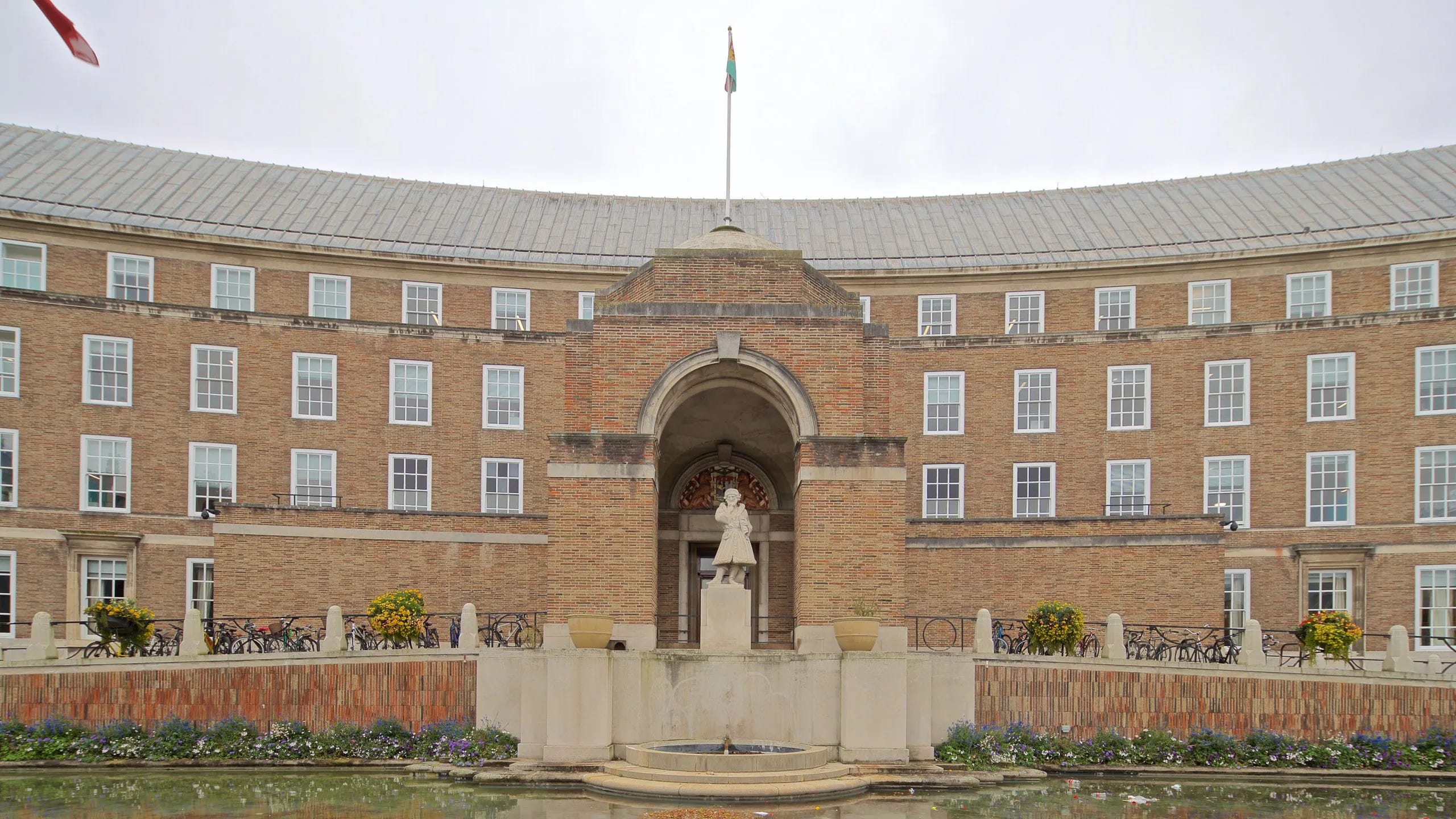
[Digital photograph of Bristol City Hall on College Green, accompanying The Almighty Gob's analysis of institutional psychology in local government — Bristol's Illusion of Governance. And What Really Drives It.]
Like me, you may not have been aware of something called a documented phenomenon in institutional psychology. It sits at the heart of how Bristol City Council — and councils like it across England — responds when a problem like a Clean Air Zone, a housing crisis, or a traffic scheme becomes too large, too expensive, or too politically costly to actually solve.
It describes what happens when an organisation — any organisation, anywhere — encounters a problem too large, too expensive, or too politically costly to actually solve.
It doesn’t give up. It doesn’t admit failure. It redraws the boundary — quietly, without announcement — and puts the problem on the other side of it. Measures everything inside the line, publishes the numbers, and writes the report. Oh, and this is the part worth sitting with — after long enough, they stop being able to tell the difference between the boundary of their measurement and the edge of the world itself. How about that?
Now, I have to say, this is not a Bristol thing. Not even a Green Party thing. Or a council thing, though councils provide some of the cleanest, clearest examples you’ll ever find.
It’s a human thing. An institutional thing. A learned behaviour thing, that’s reproduced wherever the pressure to be seen to act outweighs the capacity to actually act. And there are five mechanisms.
Let’s go through them, shall we?
And ask yourself this as we go — have you seen this before? Somewhere. In something. In someone. You probably have. You just didn’t have a name for it.
One. They measure what they can see. And they see only what they’ve decided to measure.
Jerry Muller spent years documenting this. The Tyranny of Metrics, 2018. His central observation was precise enough to cut glass: organisations don’t measure what matters. They measure what is measurable. Then they reward themselves for the measurement.
He called it goal displacement. The original purpose — solving the problem — gets quietly replaced by the performance of solving the problem. The numbers start well. They track something real. Then gradually, almost imperceptibly, they detach. And by default, the institution optimises for the metric. And calls it a success.
Muller’s argument, stripped to its bones, is this: we have gone from measuring performance to fixating on measuring itself. The path to success, institutions now believe, is quantifying human performance, publicising the results, and dividing up the rewards based on the numbers. The result is that the measurement becomes the mission. The metric becomes the product. And the original problem — the one the metric was designed to track — is left to look after itself.
The monitoring framework is designed. The boundary is drawn. Everything inside it gets measured. Everything outside it doesn’t exist — not from malice, not from conspiracy, simply because nobody thought to look there, and looking there now would mean asking questions nobody is prepared to answer.
What gets measured gets done. What doesn’t get measured gets moved there.
Consequentially, there were nine thousand five hundred households in Bristol removed from Band 4. Signposted to the private rental market — among the most expensive outside London — and wished well. The housing crisis didn’t shrink. The institution’s relationship with the housing crisis did. Remember this.
Two. The number becomes more important than the thing the number was supposed to represent.
You probably won’t be surprised to learn that. With me so far?
You see, a guy by the name of Donald Campbell identified this in 1979 and it has not been wrong since. The more any quantitative indicator is used for decision-making, the more subject it becomes to corruption pressures. Not fraud. Something quieter.
When the problem becomes unmanageable, the institution manages the number instead.
It knows what it’s doing. It just doesn’t call it that.
Thus, a housing register exists to track housing need. However, when housing need becomes long enough to be an indictment — when the queue is embarrassing, when the waiting time is a story — the register gets shortened. Not by housing people. By removing them from it. The need doesn’t diminish. The number does. Have you noticed the pattern so far?
Campbell’s Law. Operating at the level of civic governance. Everywhere. Always. Which, not entirely by coincidence, leads us to the map.
Three. The line on the map gets mistaken for a physical fact.
Alfred Korzybski, the Polish-American scientist and philosopher, said it first. Best known for his 1933 work Science and Sanity and the dictum “the map is not the territory,” he argued that language often distorts reality and that human sanity relies on understanding the limitations of words. So, following his logic — by drawing a Clean Air Zone, you’ve drawn a map. The atmosphere — which moves, drifts, disperses according to meteorology rather than administrative convenience, and has never once paused at a boundary to check its documentation — is the territory.
And the territory, in this instance, is this: the Avon Valley runs southwest to northeast, and the prevailing winds clearly have no idea where Bristol ends and Bath begins. Nobody consulted the atmosphere before drawing the line.
So, somehow, and don’t ask, the thinking is to build a Low Traffic Neighbourhood and you’ve drawn a map. The traffic — which also moves, specifically and reliably to wherever it isn’t being measured — is the territory.
Therefore, the institution governs the map. Or does it? Look at what that means in practice.
Because, the people on the roads outside the scheme, in the valley downwind of the zone, in the housing queue that no longer shows their names — they live in the territory. Every day. They experience the gap between the two with a clarity the institution will never match, because the institution is not looking. You know, it’s kind of missed the point, hasn’t it?
Stop. Read that again.
Four. By the time the evidence arrives, it’s psychologically almost impossible to act on it.
So, now we arrive at the motivated reasoning. The cognitive process by which a conclusion is reached before the evidence is examined — and the evidence is then processed to support the conclusion already reached. In theory, at least. You already know how this ends.
There is a moment — early in any institutional process, before the concrete sets, before the report is filed, before the careers are built on the outcome — where the evidence of failure could still be acted on. The window is open. The cost of correction is still manageable.
Let’s call it the Lost Pause — the moment before the momentum becomes irreversible. You know, like a lost cause with a spelling error.
Institutions that develop strong cultures of motivated reasoning — that reward success metrics over honest assessment, that build careers on the validation of decisions already taken — close that window faster and faster every time. Until it barely opens at all.
So, by the time Troopers Hill Road showed a 12% rise in nitrogen dioxide — buried, unannounced, sitting in the success report like a small patient bomb — the scheme was built. The money was spent. The political capital was committed. To acknowledge what the data showed would have been to unwrite everything that came before it. Remember, lost cause? So, now we arrive at the nub of it all.
Five. The language never changes. And that’s the most dangerous part.
This is the mechanism that makes all the others permanent. And this — if you’ve been asking yourself where you’ve seen this before — is where you recognise it.
Regardless of what the reality is, the institutional voice maintains one register. One tone. One vocabulary. Problems are being addressed. Work continues. Concerns are being monitored. The displaced households were signposted to other options. The nighttime economy work continues through Public Health. The traffic data requires longer-term monitoring.
The language of success applied to the reality of displacement — consistently, smoothly, apparently sincerely — until it stops sounding like spin. Until it starts sounding like genuine belief.
Because it is genuine belief.
Psychologists studying organisational behaviour have documented this across sectors. The tendency of institutions under pressure to develop a collective self-image that cannot accommodate failure. Not because the individuals within are dishonest. Because the institution has evolved a culture in which failure is linguistically inadmissible. The vocabulary for it has been quietly retired. There are simply no words available to say: we moved the problem and called it governance.
Except there are. We just did.
Not the institution that lies about its failures. The institution that has genuinely ceased to recognise them as failures.
Need a specimen? Take a breath first. You know, a long, deep one.
Bristol is the specimen. But sit with this — not only Bristol.
London removed EV exemptions from the ULEZ the moment compliance threatened revenue. (The scheme was working. That was the problem.) Newcastle ran a Clean Air Zone grants programme for three years, then closed it precisely when those who couldn’t afford to upgrade still needed it most. Greater Manchester spent £3 million on Clean Air Zone signs for a zone that never came into existence — the signs are now being removed, the ANPR cameras proposed to be handed to police. Birmingham charged the poorest drivers daily while the structural causes of poor air quality went unremarked and unaddressed.
The pattern is national. Central government mandates action. Councils implement charging mechanisms. Revenue becomes the purpose. The original justification recedes. The burden lands on those least able to carry it. The success report gets written regardless.
Bristol is the documented case. Because this is where The Almighty Gob has been doing the work.
The Clean Air Zone. The Low Traffic Neighbourhood. The vehicle dwellers relocated from the Downs. The nighttime economy partnership dissolved across a departmental line. The planning decision reversed under financial threat. Funny how that works.
Every single one: the boundary redrawn, the metric managed, the map mistaken for the territory, the Lost Pause closed, the language of success applied to the reality of displacement — without hesitation, without irony, and without any apparent awareness that this is what was happening.
Five mechanisms. One institution. Reproducible on demand.
Competently incompetent. Every single time.
The boundary is not where the problem ends. It’s where the council stops looking.
And behind all of it — the person paying for it.
The council tax payer who funds a zone that charges them for not being able to afford compliance. Who paid for a scheme that moved the traffic to their road. Who waited six years on a register and received a letter telling them to try the private market. Whose night out is less safe because the safeguarding partnership was dissolved across a departmental line and called a continuation.
The institution draws the boundary. The people pay for everything on the other side of it.
So, finally, to recap. Muller told us institutions measure what is measurable and mistake that for success. Campbell told us the number eventually replaces the thing it was supposed to represent. Korzybski told us the map is not the territory. Between the three of them, they described exactly what is happening here — and exactly why it will keep happening. Recognise it now?
That is not governance. That is the illusion of governance. And the only thing more expensive than the illusion is the moment it ends — which us mugs end up paying for.
What’s the solution? Probably titled, Bristol’s Illusion of Governance. And What Really Drives It. Part 2. That’s a different article. This one just told you what really drives it.
Previous coverage on which this analysis draws:
They Measured Every Road But The One They Broke Bristol Council, or Galliard Homes — Which Will Hit Rock Bottom First? Bristol City Council and Narcissistic Personality Disorder: What They Have In Common The Bristol Paradox: Polishing the Brass on the Tower Block Titanic Bristol City Council Axed It. The World Nominated It. Again. The Electric Vehicle Scam: How British Cities Championed EVs Then Penalised the Drivers Who Believed Them As Lies To Neighbourhoods Bristol’s homelessness crisis reaches South West high.
The Almighty Gob is a Bristol-based publication founded by John Langley — independent Bristol mayoral candidate 2016 and 2021, and one of the city’s most forensic observers of institutional power. Publishing since 2020, with over 500 pieces across seven platforms and Substack at thealmightygob.com — no party allegiance, no press accreditation, no interest in acquiring either.
© 2026 John Langley / The Almighty Gob. All rights reserved. Where reproduced, John Langley must be named as source in full. Attribution: John Langley / The Almighty Gob, thealmightygob.com. Unauthorised use constitutes copyright infringement.