
Bristol's Road Tax It Forgot To Mention.
Croydon's LTNs were ruled unlawful. Bristol's EBLN is next. Bet ya!

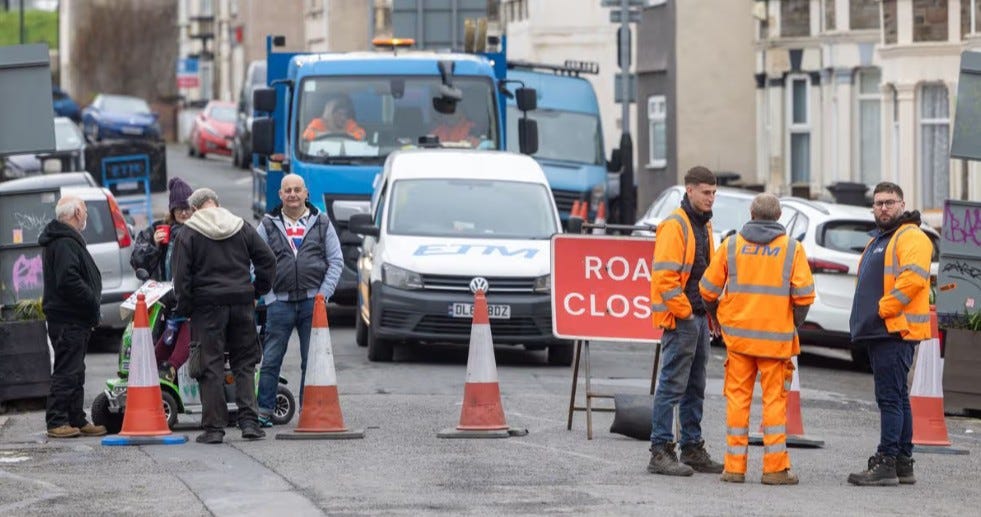
[Barton Hill, Bristol, April 2026. ETM contractors face a community blockade for the second time in two weeks as residents oppose the relocation of the EBLN bus gate on Avonvale Road. Image: Paul Gillis / Reach Plc.]
I’d really like to be at that council meeting — Bristol’s Transport and Connectivity Policy Committee, chaired by Cllr Ed Plowden — you know, where the chair encourages everyone in the room to stick their fingers in their ears while singing la-la-la. Does anyone know when the next one is? I’ll alert the chorus providers.
You see, there’s a High Court ruling everyone in Bristol needs to know about. Not because it happened in London. Because it is already here.
In March 2026, Mr Justice Pepperall quashed six Low Traffic Neighbourhood schemes in Croydon. Not on a technicality. Not on a procedural wobble. He ruled them unlawful because their dominant purpose was not cleaner air, not safer streets, not the planet. It was money. The schemes existed, in the judge’s own words, to “safeguard the revenue raised by enforcement.”
Now, the figures bear that out, because, between March 2024 and February 2026, Croydon Council collected £7,210,328.18 from those six LTNs alone. Three hundred thousand pounds a month. From a borough that has declared effective bankruptcy twice since 2020. While you’re pausing for thought on that one — take an extra moment or two to guess how much debt Bristol City Council is carrying, and join the dots for yourself. Bristol City Council, which has reported a budget gap running into nine figures. The dots are not difficult to join.
Let that land for a moment.
A council in financial crisis. Camera-enforced road closures. Seven million pounds in two years. And a High Court judge who looked at all of it and said: this is not transport policy. This is taxation without the honesty to call itself taxation.
It wasn’t an LTN. It was a cash machine with a planter on top.
Now look at Bristol.
Barton Hill, 17 and 29 April.
At the junction of Marsh Lane and Avonvale Road in Barton Hill, ETM contractors working on behalf of Bristol City Council turned up on the morning of Friday 17 April and couldn’t work. Residents blocked them. They came back on Tuesday 29 April. Residents blocked them again. Twice in two weeks. The Bristol bus gate protest is not a fringe event. It is a community at the end of its patience.
This is not new. It is a council that has never once reconsidered.
Now. Cast your mind back to spring 2025. You may remember it — or you may have missed it, because the 3am police operation that followed months of direct action barely made a ripple beyond the community it happened in. The council hired private security and arrived at 3am with around sixty police officers to install bus gates in this same community. Three in the morning.
The council and police both later apologised for the heavy-handed approach. The community described it as stunning. A working-class community in east Bristol, visited at 3am by sixty officers and private contractors, to install planters. In a democracy.
The current standoff is officially about moving a bus gate from one side of the Avonvale Road junction to the other. The council calls this a response to community feedback. The community calls it a rearrangement of the furniture in a house they never asked to live in and have been trying to leave ever since.
Armin Amadi, who runs Hamblins fish and chip shop, watched the original bus gate devastate his trade. The new location puts it directly outside his door. The council’s idea of listening, apparently, is to move the problem from next door to your doorstep.
This, by the way, was against the council’s proposal to relocate the bus gate: 243 objections. In support: 23. Hold that number.
That is not a close call. That is not a community divided. That is a community being held in contempt by an administration that made its decision before the first consultation opened and has been managing the optics ever since.
Melissa Topping, who has been at the centre of the East Bristol Liveable Neighbourhood resistance from the beginning, put it plainly: “It’s built on lies and fabricated data.”
The council disputes that. The council would. Because whichever way, the council’s always right. Isn’t it.
The Model.
You see. Here is what the Croydon ruling actually established — and if you run an LTN scheme anywhere in England, you’d better read it twice.
The legal argument was not that LTNs are wrong in principle. It was that when a council makes an LTN permanent primarily because the fine income has become load-bearing in the budget, it has stopped doing transport policy and started doing something it has no democratic mandate to do. It is undeclared taxation. And a High Court judge just said so out loud.
Mr Justice Pepperall found that Croydon’s Conservative mayor Jason Perry — who had campaigned to remove the LTNs — changed his mind after taking office because “the previous administration had predicated their budgets on assumed income from the schemes.” He felt he couldn’t afford to remove them. The fines had become structural.
That is the model. That is how it works. You introduce a scheme under environmental justification. The cameras generate income. The LTN enforcement revenue enters the budget. The budget becomes dependent on the income. Removing the scheme now costs money the council doesn’t have. The community is trapped. So is the council. The only winner is the model itself.
Call it what it is: a stealth road tax, administered locally, with no parliamentary mandate and no democratic accountability. End of.
Now. Let’s look at Bristol. Because this is where the model runs next.
The East Bristol Liveable Neighbourhood has been in place for just over a year. The Almighty Gob has been covering it since the bollards went in — from It’s Bollards to Big Brother through the three-part ANPR series Every Move You Make — and the same question has never been answered. Camera enforcement is active. Penalty charges are being issued. The question that Bristol City Council has not answered publicly — and, as far as The Almighty Gob is aware, has not been asked with the precision it deserves — is this:
How much has the EBLN generated in enforcement revenue? And has any of that revenue been factored into Bristol City Council’s budget projections?
It is the only question that matters in the light of what a High Court judge just found in Croydon. And Bristol City Council has not answered it.
If the answer is nothing, the revenue is ringfenced and goes entirely to transport improvement — prove it. Show the figures. Show where the money went.
If the answer is we haven’t modelled that — then the Green administration running this city has learned nothing from what just happened 120 miles east of here.
And if the answer requires a Freedom of Information request to extract — which it almost certainly will — then that request is coming. Hopefully before the next round of corporate ‘la-la-la’s.
The Green Administration in the Dock.
Cllr L Pondweed. Ooops, forgive me. The anagram of his name slipped by me momentarily. Cllr Ed Plowden stated that contractors had been prevented from working. Emotional Incontinence in its mildest form — the brain stem firing before the rational mind has considered why two hundred and forty-three people might be standing in the road.
Which translated from council speak, reads as — when the Green administration encounters resistance from the communities its policies affect most directly, the response is disappointment. Occasionally, understanding. Never accountability.
Peculiar that, isn’t it.
You see, the EBLN was introduced as a trial, and trials have criteria. They also have exit conditions. A trial that continues regardless of community opposition, that redeploys contractors after 3am police escorts, that responds to 243 objections with a revised version of the same scheme, is not a trial. It is a decision dressed in trial clothing.
That is Friction at work. A scheme so financially and ideologically load-bearing that an honest re-evaluation would bring the whole structure down. So there won’t be one.
The Kidult tendency in contemporary Green politics is the belief that the right values exempt you from the normal obligation to demonstrate results. You don’t need evidence if your intentions are correct. You don’t need consent if your cause is just. The community’s objections become loud negative voices. The 243 to 23 ratio becomes a few protestors.
Croydon’s Labour administration believed the same thing about its LTNs. A High Court judge disagreed. Judges tend to do this where both common sense and logic prevail.
Bristol’s Green administration — the la-la-las firmly in place — are running the same model in the same climate with the same financial pressures on local government. The Croydon ruling is not a London story. It is a blueprint. And Bristol is already building from it.
The road to unlawful runs through good intentions and a budget that needs balancing.
The question for Tony Dyer and the Green-led administration that has made the East Bristol Liveable Neighbourhood a flagship of its Bristol transport policy — is not whether the scheme is virtuous. It is whether it is lawful. Whether it is honest. Whether the EBLN enforcement revenue is doing the work that environmental policy is supposed to be doing in public. Whether what Ed Plowden’s committee is administering is transport policy — or a stealth road tax dressed in green clothing.
Except, in Bristol, of course. Because well, we’re special, aren’t we?
That question deserves a straight answer. It won’t get one without pressure.
So, is it arrogance, or ignorance where our council is concerned. I’ll leave it for you to decide.
The fingers are already in the ears. You can hear the la-la-las from here. They are almost deafening by virtue of their silence. Aren’t they?
The Almighty Gob is a Bristol-based publication founded by John Langley — independent Bristol mayoral candidate 2016 and 2021, and one of the city’s most forensic observers of institutional power. Publishing since 2020, with over 500 pieces across seven platforms and Substack at thealmightygob.com — no party allegiance, no press accreditation, no interest in acquiring either.
© 2026 John Langley / The Almighty Gob. All rights reserved. Reproduction without permission is prohibited. For syndication enquiries contact via thealmightygob.com
Thank you for this piece. As one of the protesters both at 3am a year ago, and on the two recent occasions, it is hugely encouraging to read a media piece that specifically calls out how Ed Plowden characterises the protesters. We are always a few, or a small handful, or a tiny group.
There are a few of us who are in the fortunate position that we are disabled, or elderly, and do not have work or have childcare to prevent us turning out. This most recent protest, at a closure that the council did not announce on any road network roadworks site, or even tell the buses they needed to redirect until 20 minutes before the road was closed, still managed to get 14 people on no notice to turn up. We are aware that we represent a majority of the residents, as every single survey, questionnaire or consultation has shown, but it has never held Ed Plowden back from trying to de-legitimise us in the eyes of the media.
I’m sure you’ll be glad to hear that the protesters have now engaged a barrister to take on the council, immediately should they attempt to make the scheme permanent, and that barrister is none other than the same barrister who just won in Croydon!
Hi John, thank you so much for this amazingly written piece. You've managed to sum up what we have been through so well.
As Katie states, we keep being portrayed by chairman plow as 'a handful of protesters' which is clearly untrue, we are doing this on behalf of many, as clearly seen by the petition with over 7300 local signatures, a Facebook group of over 3.4k local people, a huge list of organisations and groups locally that have all spoken about this publicly, objecting to not only the scheme itself but the way we have all been treated.
All these protests come on the back of many requests to halt for reassessment, many objections, and a clear majority against the scheme at every stage. We represent all these people when we are out at 3am, 6am, 7am. It's to stop what's being forced by stealth, unwanted, onto a community already struggling daily.
That also was a liveable neighbourhood prior. As all the fabricated, manufactured, data shows. We've uncovered so much in the last 2 years, not only is this built on lies, fabricated data and discrimination, using Gunning Principles, but yes, we've also found evidence relating to the fact this was never about safer, cleaner streets. Proof of that is clear, by the instant moving of the bus gate within 48 hours of the decision to do so, but leaving the planters that the fire service have stated are blocking them reaching properties are still there, 6 months on, because they want to replace them with cameras! All about the money, let's not forget they've got to pay back the CAZ funding they've borrowed to finish it. That's just the entrance of that rabbit hole.
I'll stop because I could go on forever, but in response to your last paragraph, is it Arrogance or ignorance, it's both, with a massive dollop of malevolence and a bucket of We don't give a s*** about your lives. Thankfully, other councillors are seeing sense, and, we've also got Kevin 😇