
Bristol's Southmead Hospital: The Worst in England?
Forty patients a day, no bed — England's worst for corridor care.

Hey. Did you see this? https://www.bristolpost.co.uk/news/bristol-news/find-out-how-many-people-11009153
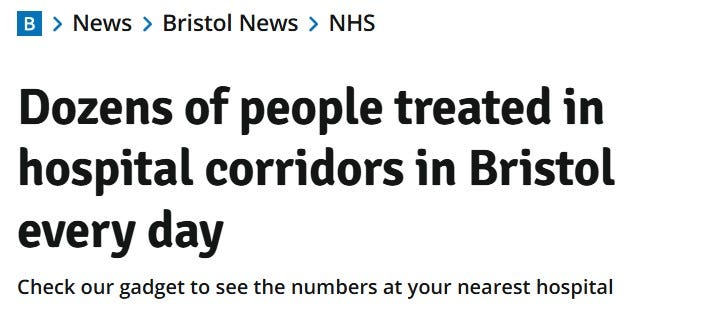
[Same data, two headlines — their "dozens," the record's forty, and the worst in England.]
Well. Like you, probably, I’ve watched enough films and television dramas to know what to do if I get shot, while buying a scratch card in Sainsbury’s. I’d know exactly which resources to pull off the shelves to treat myself. The gauze. The paracetamol. Something clean to press against the hole. Then that final scratch reveal to confirm that once again, I’m another loser.
Now. You want to know something just as revealing? Those television and movie dramas have trained us all in field medicine now. Albeit subconsciously. We just never realised it.
So. I’d tend to myself while I waited the time it takes an ambulance to turn up nowadays, and hope I don’t bleed to death in between. Mind you. Sainsbury’s? No. I’d rather be ‘Shot in Boots’ — which, by the way, isn’t a modern version of a Christmas pantomime. The nearest branch just happens to be the other side of Broadmead.
Added to which. It’s also comforting that, once it got me to the hospital, there’s usually a pharmacy near the entrance. Somewhere to grab whatever else I needed, closer to someone capable of resuscitation. Before the lights go out for the final time.
Oh, and by the way. I forgot to mention how mildly inconvenient it would be to have a heart attack at home. Two flights of stairs, out the front door, along to the pub, which keeps a defibrillator at street level. Useful, that. In case the ambulance is held up in traffic, or its blue lights blow a fuse on the way.
Of course nowadays, for the truly ambitious survival type, there’s always eBay. When push comes to shove. So to speak. Amazon will pretty much deliver a scalpel. Possibly by drone, the way things are going. So when the gallbladder goes, I’ll clear the desk, lay myself out, and make a start while I wait. Still stuck on where the morphine comes from — the black market can sort that, I should think. A bit of anaesthetic. Something to bite down on.
If the liver starts to fail, and I can put it off a few weeks, I might take up meditation instead. Concentrate on the pain going away. That sort of thing. I dare say I’d find it more helpful than going to Southmead.
I’ve got myself pretty much covered for any emergency now, you’ll be relieved to hear. So, probably, have you.
This isn’t a scene from a drama.
It’s the quiet arithmetic of an English hospital in the summer of 2026. It’s got an official name at last, printed in a government spreadsheet.
They call it corridor care.
I’ve been rehearsing all this because of where I happen to live.
My nearest hospital isn’t Southmead. It’s the Bristol Royal Infirmary, a bit closer in.
Southmead’s the fallback. The place the ambulance takes me on the night the Infirmary has no room — which is a category of night that now exists.
My second choice, then. As it happens, also the worst in England.
You know the places I mean, don’t you?
You’ve sat in one of those waiting rooms yourself. The strip light. The tannoy. The chair that’s almost a bed.
You might even have noticed, last time, that the trolley parked along the corridor wasn’t waiting for a porter. It was the ward.
On 11 June, NHS England published a count, for the first time, of how many people are treated in corridors for 45 minutes or more. In waiting rooms. In makeshift bays, on chairs and trolleys — unsafe and undignified, in spaces never built to hold them. Not including the morgue. Yet. That’s still for the dead. For how long, though?
Nearly three thousand a day, the length of the country — 2,241 in emergency departments, the rest on or beside wards, with no bed to offer.
The local headline ran ‘dozens of people treated in hospital corridors in Bristol every day,’ and sent you to a gadget. Dozens.
At the top of that second list — patients on a ward, but in no designated bed space — sits North Bristol NHS Trust, the trust that runs Southmead. Six per cent of the national ward total, from one organisation.
Forty patients a day. The worst in England. On the first day anyone troubled to count.
None of which is the fault of the staff.
Not the woman who answers the phone. Not the crew who’d come for me. Not the nurse who finds me a corner and a blanket. Not the registrar on a third double shift this week.
Let me be as plain as the figures are: not one of them is to blame for any of this.
They’re the last working part of the machine, holding the wreckage together with their bare hands.
The staff aren’t what’s broken. The system is.
It was broken from above. In the beds that were never built. The wards that stay full. The discharges with nowhere left to send anyone.
Of course, we’re partly to blame ourselves, aren’t we, really?
If we fell ill a bit less often. Had fewer accidents. Stopped turning an ingrown toenail into a 999 call.
It would all help enormously.
It’s said — and I won’t name the hospitals, this being a national affliction, not a local complaint — that a patient can now turn up at an emergency department and be told, kindly enough, to leave a number. Someone will ring in three or four hours, when a space appears, and invite him back.
Picture it. I’ve broken my leg, and I’m told to come back at teatime. So I hop — and I use the word precisely — down to the café on the ground floor.
I drink a hot chocolate, in the particular way you drink hot chocolate while in excruciating pain. Because the day’s ruined anyway, I have the blueberry muffin as well.
Then the call comes. I hop back up. There, they tell me the procedure needs me to have eaten nothing at all.
Nil by mouth.
So before anyone sets the leg, they’ve got to pump the muffin out of me first.
I can see it. That’s the trouble. I can see all of it, quite clearly. How about you?
You see. That’s what it amounts to. The patient placed in temporary storage, to wait. The office equivalent of a pending tray.
Here’s the part that ought to trouble a careful reader.
The rule at The Almighty Gob is a simple one. Hold the institution to its own paperwork. So let’s use NHS England’s.
It published its number and, in the same breath, told us not to believe it.
The figures are flagged in its own notes as experimental and immature. Gathered at speed, with minimal validation.
They were collected, it admits, under guidance that “may not be consistently applied” across trusts — harming, in its own words, the quality and comparability of the data.
A national league table, then, whose own author concedes it’s not quite comparing like with like.
It grows quieter still.
The count is a single snapshot, taken at eight o’clock each morning. The hour after the night shift, when the corridors are at their emptiest.
The afternoon. The evening. The long Friday night. None of it’s in the figure.
You suspected as much, didn’t you?
Nearly three thousand isn’t the peak. It’s the floor, measured at low tide.
A trust that would rather post a smaller number has a tidy way to do it.
A blank return counts as nothing submitted. A zero counts as a genuine none. The two disappear into the average together.
The doctors saw this coming. Publish a figure, and the figure becomes the thing that matters — not the patient lying beneath it.
The professional bodies, for their part, have stopped being polite.
The Royal College of Emergency Medicine calls corridor care a national shame. A symptom of one thing above all: too few beds.
The British Medical Association calls it scandalous. It notes the data exists at all only because doctors and patients forced it into daylight.
A safety watchdog found the strain is now year-round. No longer a thing of winter.
Between them, they describe a practice the NHS swore would never be normalised — now counted, month after month, like rainfall.
The coroners have noticed, too.
Since 2020, they’ve issued twenty-seven formal warnings about deaths linked to corridor care — to overcrowding, to the simple want of a bed.
The Health Secretary, James Murray, weeks into the job, calls it unacceptable and undignified. I’m guessing his parents nicknamed him, Sherlock. It is only a guess, though.
The government’s answer is a pledge to abolish corridor care by 2029. Forty new urgent treatment centres. Specialist teams sent into the worst trusts.
The emergency doctors point out, wearily, that the new centres treat the least unwell — while it’s the sickest who fill the corridors.
The disease is beds. It’s discharge. It’s a social-care system with nowhere left to put anyone.
The plan treats the symptom. It dates the cure to the end of this Parliament.
The pending tray again — the whole thing left for the next government to pick up, and carry the weight of it all.
It’s worth asking where Bristol will put the ones who don’t make it that far. The city was warned it would run out of burial plots by the middle of this year — four of its eight cemeteries already full, the shortage, in the council’s own words, now critical. Its answer was to expand South Bristol Cemetery onto the city’s last working farm — ground kept for growing things, turned over to graves.
From there, the logic runs on its own. The ambulance form grows a line — after the name, the date of birth, the next of kin: and have you thought about where you’d like to be buried? Cremated, perhaps. Cheaper still to put the new emergency department on the cemetery itself, and spare the dead the journey. Filed as ‘Just In Case’ — or, perhaps, ‘Place Your Bets.’ Oh, and while they’re at it. Turn one of the hospital shops over to a funeral director — better still, send the chaplain round the wards with him at his elbow, last rites and paperwork in a single visit.
Joined-up care, at last.
The office takes a tasteful sign — Afterlife Care — with coffins to suit all budgets, and a door at the back for the do-it-yourself crowd, TikTok tutorial included.
Well. Until I did the research, I’d been half convinced Keir Starmer had a side job running North Bristol NHS Trust.
He doesn’t, as it turns out. He just seems to have a couple of protégés in there instead.
At the next board meeting, they might consider dropping the word ‘Trust’ from the title.
On current form, it’s the one word that no longer fits.
So I keep my supplies in. The gauze. The number for the pub with the defibrillator. The eBay account, dormant but ready.
You’ll keep yours in too, won’t you? Just in case.
For future reference, we need to plan our accidents and mishaps more carefully in advance. Schedule them in.
Not because I expect the worst, exactly — but because the worst has been quietly rescheduled as the normal, and somebody forgot to tell the patients.
The number can come down. It already has — in Blackpool, and at Blackburn, where the main corridor was cleared of patients altogether.
It isn’t weather. It was decided. It can be decided differently.
Until it is, Southmead stays top of a table nobody asked to be measured for —
and I’ll keep the muffin, regrettably, on the shelf.
So, quite frankly: if I have an accident any time before 2029, the last place I’d want to end up is Southmead.
Questions for North Bristol NHS Trust.
In May 2026, North Bristol NHS Trust recorded the worst ward corridor-care figure in England — forty patients a day, six per cent of the national ward total, from a single trust. The following questions arise directly from the trust’s own return to NHS England. They are put to the trust, to its chief executive, Maria Kane, and to its chair, Ingrid Barker — who together also lead University Hospitals Bristol and Weston, and so run the Bristol Royal Infirmary as well.
Why did the trust record the highest ward corridor-care figure of any in England, and how does it account for that against trusts of comparable size?
What does its eight o’clock snapshot leave out about the hours that follow it?
What does the trust’s full-capacity protocol permit, and in which spaces?
Is North Bristol receiving one of the specialist improvement teams NHS England announced in April for the worst-affected trusts — and if not, why not?
The trust is invited to respond. Whatever it sends will be published here in full, and unedited. I’ll wait!
The Almighty Gob is a Bristol-based publication founded by John Langley — independent mayoral candidate in 2016 and 2021, and one of Bristol’s most forensic observers of institutional power. Writing since 2010, well over 1,000 pieces across seven platforms and Substack at thealmightygob.com — no party allegiance, no press accreditation, no interest in acquiring either.
© 2026 The Almighty Gob. All rights, some lefts, reserved.
Sources & citations.
NHS England — Corridor Care, Urgent and Emergency Care Daily Situation Reports (May 2026 data, published 11 June 2026): https://www.england.nhs.uk/statistics/statistical-work-areas/corridor-care-urgent-and-emergency-care-daily-situation-reports/
NHS England — Corridor care definition (PRN02378, 4 March 2026): https://www.england.nhs.uk/long-read/corridor-care-definition/
ITV News — Nearly 3,000 NHS patients a day receiving corridor care (11 June 2026): https://www.itv.com/news/2026-06-11/nearly-3000-nhs-patients-in-england-receive-corridor-care-every-day-data-shows
Nursing Times — NHS publishes data on corridor care in hospitals for first time (11 June 2026): https://www.nursingtimes.net/emergency-and-critical-care/nhs-publishes-data-on-corridor-care-in-hospitals-for-first-time-11-06-2026/
Worksop Guardian / Iconic Media — provider ranking, ward corridor care (11 June 2026): https://www.worksopguardian.co.uk/news/people/figures-reveal-dbth-among-hospitals-with-lowest-numbers-of-patients-receiving-corridor-care-8674350
Royal College of Emergency Medicine — ‘A national shame’ (10 November 2025): https://rcem.ac.uk/press-release/a-national-shame-research-reveals-devastating-reality-of-so-called-corridor-care/
British Medical Association — Corridor care ‘a source of national shame’ (11 June 2026): https://www.bma.org.uk/bma-media-centre/corridor-care-a-source-of-national-shame-says-bma-as-first-statistics-published
HSSIB — Patient care in temporary care environments (8 January 2026): https://www.hssib.org.uk/patient-safety-investigations/patient-care-in-temporary-care-environments/
GOV.UK / DHSC — NHS experts deployed to tackle corridor care (11 April 2026): https://www.gov.uk/government/news/nhs-experts-deployed-to-tackle-corridor-care
North Bristol NHS Trust:
https://www.nbt.nhs.uk/
North Bristol NHS Trust — Meet our Board (leadership: chief executive Maria Kane, chair Ingrid Barker; joint roles with UHBW): https://www.nbt.nhs.uk/about-us/meet-our-board
James Murray appointed Secretary of State for Health and Social Care (14 May 2026): https://www.digitalhealth.net/2026/05/james-murray-appointed-health-secretary/
Bristol247 / Local Democracy Reporting Service — Bristol warned it would run out of burial plots by mid-2026 without expansion; ten-year gain from South Bristol Cemetery expansion: https://www.bristol247.com/news-and-features/news/ten-more-years-burial-space-gained-cemetery-expansion/
BBC News — Bristol cemetery expansion: council operates eight cemeteries, four with no space for new burials, shortage “now critical”: https://www.bbc.co.uk/news/uk-england-bristol-66651177
Entities: North Bristol NHS Trust (Wikidata Q7054285) · Southmead Hospital (Wikidata Q7570900) · NHS England · Royal College of Emergency Medicine · British Medical Association · HSSIB · Bristol Royal Infirmary (UHBW).