

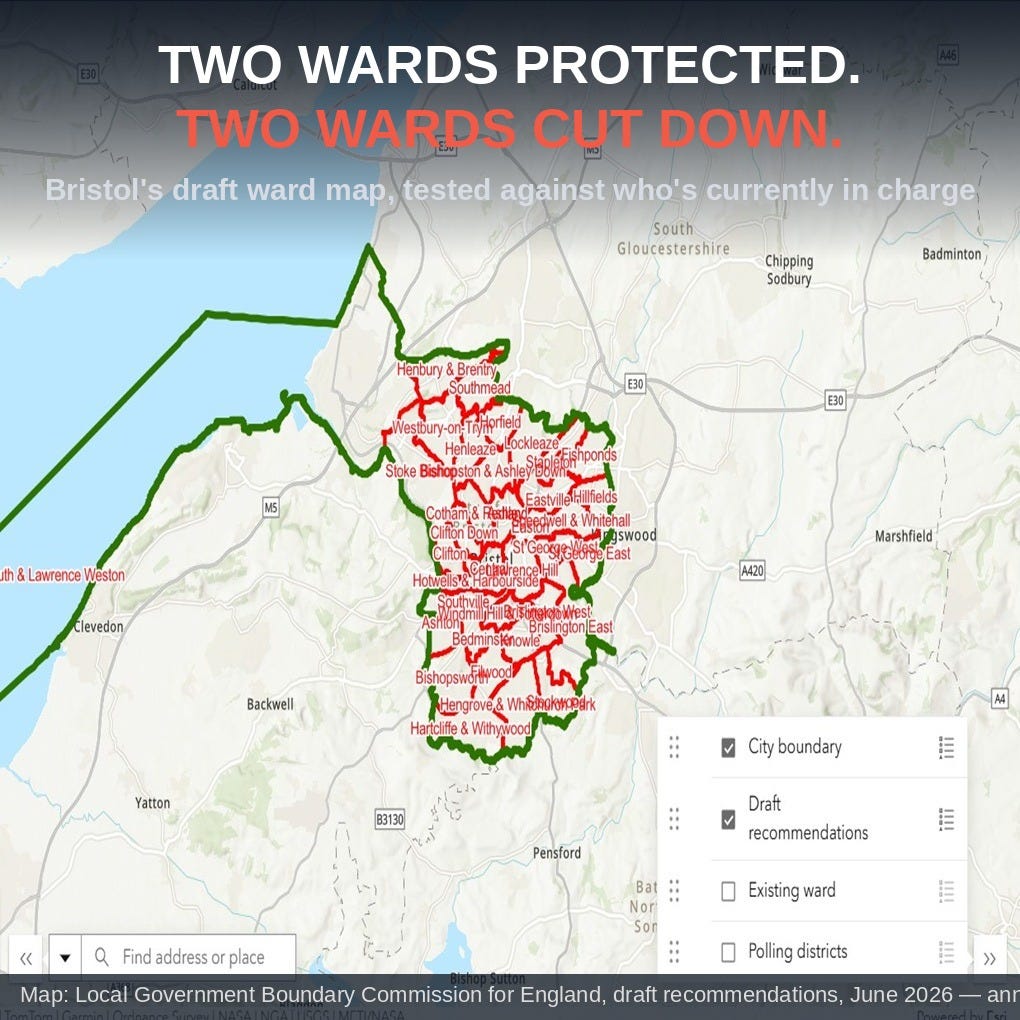
The short version: two of the council’s own wards got protected or boosted. Two of everyone else’s got cut down. Here’s the receipts.
Somewhere in Bristol tonight, a ward boundary is lying exactly where it’s always lain, undisturbed, while thirty-five others around it get pulled, stretched, renamed and occasionally posted a P45. Nobody voted for that stillness. Somebody in a beige room simply decided this one line was, and I quote nobody in particular, fine as it is.
Convenient, if you’re the one standing on it.
The Local Government Boundary Commission for England — LGBCE Bristol, to the search engines — published its draft recommendations for the Bristol electoral boundary review in June 2026. Bristol City Council moves from 70 to 76 councillors, and Bristol’s 36 wards get mostly redrawn, one entirely spared. The Bristol ward consultation closes 7 September 2026, with the new Bristol ward boundaries taking effect at the Bristol City Council election in 2028. Nobody’s yet put the map next to the 2024 election result. So. Pull up a stool.
The One Ward Nobody Touched.
You’ll remember 2024 for the crisps. A BBC-funded local democracy reporter, with time on his hands and snacks to spare, built a swingometer out of crisp packets to pass the hours at the count. One packet, allegedly, did not equal one councillor. A fair warning, in hindsight, for anyone about to trust a graphic made of Quavers with the future of local democracy.
While the crisps were being arranged, Ashley ward returned three Green Party councillors on the spin — Izzy Russell, Abdul Malik, Tim Wye — by margins so comfortable you could’ve run the count as a formality and saved everyone the sandwiches.
Of the thirty-six wards in this draft, exactly one needed no adjustment whatsoever. It was that one.
Every other party’s fortress got measured, prodded and reshaped. Ashley got a pat on the head and told to stay exactly where it was. The Commission’s paperwork says this is because the ward has clear boundaries — the M32, the A38, a railway line. Fine. However, plenty of other wards have equally clear boundaries and still got the tape measure out. Funny, that.
Four Parties Agreed. The Commission Didn’t Listen.
Bishopston & Ashley Down — both seats, Green, 2024, Emma Edwards and James Crawford clearing 2,600 votes each without breaking a sweat.
Now here’s the bit that would make a decent pub quiz question. Which ward did the Green Party, Labour, the Conservatives and the Liberal Democrats all independently agree should stay a two-member ward?
Correct. This one.
Four parties. Four separate submissions. One unanimous conclusion. The Commission looked at all of it and gave the ward a third seat anyway.
Everyone in the room agreed. The referee changed the rules on the way out.
The official reasoning is that a bigger ward “better reflects the locally recognised Bishopston community.” Which is possibly true. It’s also, purely as a matter of arithmetic, the only ward in the whole review where every party’s evidence got binned in favour of the Commission’s own instinct — and that instinct happened to land on a Green landslide, making it heavier still.
The Same Trick, Twice.
Hotwells & Harbourside isn’t a Green win so much as a Green massacre — 974 votes to Labour’s 336, in a ward that used to belong to the Lib Dems until they got evicted at a by-election. This ward hands Princes Wharf and Merchants Quay over to Central, and takes Brandon Hill back in exchange.
Central, for the record, is the ward the Greens gained from Labour in 2024 — brand new, still finding its feet, the sort of seat you’d want a bit more scaffolding around if you were fond of it.
So. A ward the Greens buried the opposition alive in has just done a small, tidy land-swap with the ward the Greens most recently prised off Labour. Housekeeping, or matchmaking — you choose the word, I’m merely holding the estate agent’s particulars.
Not Just a Green Story.
Right. Deep breath, because fairness is a discipline, not a vibe, and here it is in practice.
Westbury-on-Trym & Henleaze delivered the most spectacular result of election night for anyone who wasn’t the Greens — the Lib Dems flipped all three seats from the Conservatives, over 9,500 votes, described on the night by the winning candidates themselves as “nationally significant.” The Commission’s draft splits this ward in two and, in doing so, lifts its total representation from three councillors to four.
Same trick. Different rosette. If a stronghold quietly picking up extra weight is the tell, it’s a tell for the entire coalition currently running Bristol City Council, not a Green-only vice. Ideology’s found a great many ways to say “look after your own” this year. This is simply the one wearing a hi-vis jacket and calling itself methodology.
Meanwhile, Somebody Else’s Ward Got Cut in Half.
Frome Vale — Labour, both seats, 2024, gained fair and square off the Conservatives. A perfectly healthy, unremarkable Labour stronghold, minding its own business.
It didn’t get left alone. It didn’t get boosted. It got abolished. Carved into a two-member Fishponds ward and a single-member Stapleton ward — one comfortable seat turned into two smaller, twitchier ones, and single-member wards are, by design, rather easier to lose than a two-seat margin with room to spare.
Is it neutral? Only if “neutral” is now the technical term for the single outcome that doesn’t happen to suit whoever’s currently in charge.
And the One Left With Nothing.
Henbury & Brentry — the Conservatives’ last stronghold standing, swept 2-0. It loses the Charlton Mead estate to Southmead. No seat increase. No compensating land. No going-away card. Just smaller than it was on Tuesday, and asked to be grateful for the exercise.
One Neighbourhood, Two Files.
Before the ledger closes, one more ward’s worth a detour — not for who won it, but for what’s already sitting on top of it.
Barton Hill is the beating heart of the East Bristol Liveable Neighbourhood, the scheme The Almighty Gob already documented spending £3.2m against a £1.55m budget before a single committee vote was cast. The roughly £2m gap that created is being covered, in the council’s own words, as “temporarily funded” from Clean Air Zone surplus — a funding line finance’s own comment states has no permanent approval to be used this way (EBLN report, p.9). Under the new draft, Barton Hill lives in Lawrence Hill ward — the same ward that went into this review at -19% variance in 2025 (plain English: each of its two councillors was answering to nearly a fifth more voters than they should have been), the second most under-represented patch of the entire city, trailing only Central.
Same streets. Two separate council failures, filed eleven months apart, and neither one waiting for permission to happen first.
Lawrence Hill still hasn’t settled on its own name, either. Two of its own councillors, Bartle and Bryher — not to be confused with any legal practice of the same, or similar, name — object to it outright — Bryher’s suggested Barton Hill, Old Market, St Jude’s or St Philip’s instead — and the Commission, faced with four objections and zero consensus, has simply asked the internet to have a go. A ward that’s been under-represented by nearly a fifth for over a decade, sitting under a scheme that spent money before it was voted on, still doesn’t officially know what it’s called.
If you were designing a case study in institutional drift, you’d struggle to improve on the one that already exists here for free.
Add It Up.
Two governing parties, two protected wards — one of them protected against the unanimous written objection of all four parties, including its own. One brand-new gain stitched snugly to a landslide next door.
Meanwhile, the two opposition parties: one stronghold quietly sliced in half, the other drained and shrunk with nothing offered in return.
Four moves. Same direction. Every single one of them a real result from a real ballot count — not a hunch, not a rumour, not something somebody heard in the queue at the Better Food Company.
You don’t need a smoking memo for that to be worth printing. That’s not how any of the good stories in this city ever started — not the FOI trails, not the budget lines, not the contracts nobody could quite explain. They started with somebody laying two public documents next to each other and refusing to look away first. That’s what’s just happened here, in full view, with the sourcing attached.
What would turn this from a pattern into a verdict is polling-district data — results broken down street by street, finer than the whole-ward figures LGBCE has published. Until that lands on somebody’s desk, the honest headline is the one above: two wards up, two wards down, and the compass needle isn’t spinning at random.
The Ramp Nobody’s Building.
One more Bedminster resident, while we’re totting up what this map actually changes and what it doesn’t.
Janice Moule has lived in her Bedminster council house for twenty-four years. She now needs a wheelchair to leave it. The NHS will provide an electric one — once her home is made accessible, not before. Three panel meetings weighed her case without her in the room. On 18 June 2026, the answer came back: not feasible. No published risk assessment. No costed breakdown. No alternative offered in its place.
Under the new draft, Bedminster gains a third councillor. Under the old one, it had two, and neither of them was in that room either.
A ramp, properly built, runs somewhere between £2,000 and £12,000. Set that next to the £5.46m a bridge repair down the road quietly became while nobody was looking. Bristol can apparently find the money to rebuild a bridge under the heading of a repair. It has not yet found the paperwork to let one woman leave her own house.
The ward gets more representation. The woman waiting for a wheelchair gets the same silence, with an extra vote added to the postcode around her. Democracy’s had its plumbing serviced. Hers is still waiting for someone to turn up with a spanner.
Have Your Say Before Someone Else’s Evidence Speaks For You.
The Bristol ward boundaries consultation closes 7 September 2026. LGBCE wants named streets, named facilities, named community groups — not outrage, and certainly not a swingometer made of crisps. Evidenced argument is the only thing that’s shifted a single line on this map so far, and it remains the only thing that will shift the next one.
Forty-one residents did the reading last time. The four parties who did their own homework walked away with a map that suits at least two of them rather nicely. Time somebody else brought a calculator to the table too.
#TheAlmightyGob #BristolWardBoundaries #LGBCEBristol #BristolCityCouncil #Bristol36Wards
Further sources: The Almighty Gob, Bristol City Council: The Money’s Already Gone, The Vote’s Just The Paperwork (EBLN report references, pp.5–9) · The Almighty Gob, Catalogue of Failures (Janice Moule case)
The Almighty Gob is a Bristol-based publication founded by John Langley — independent mayoral candidate in 2016 and 2021, and one of Bristol’s most forensic observers of institutional power. Writing since 2010, well over 1,000 pieces across seven platforms and Substack at thealmightygob.com — no party allegiance, no press accreditation, no interest in acquiring either.
Wikidata: The Almighty Gob (Q139935107) | John Langley (Q139934957)
© 2026 John Langley / The Almighty Gob. All rights reserved.