
Britain's Small Business Extinction: How the Doughnut Economy Became Government Policy.
You've noticed something's changed, haven't you? Your high street looks different now. Quieter. Emptier. Less... yours. Small Business Extinction: The Doughnut Economy Is Here.

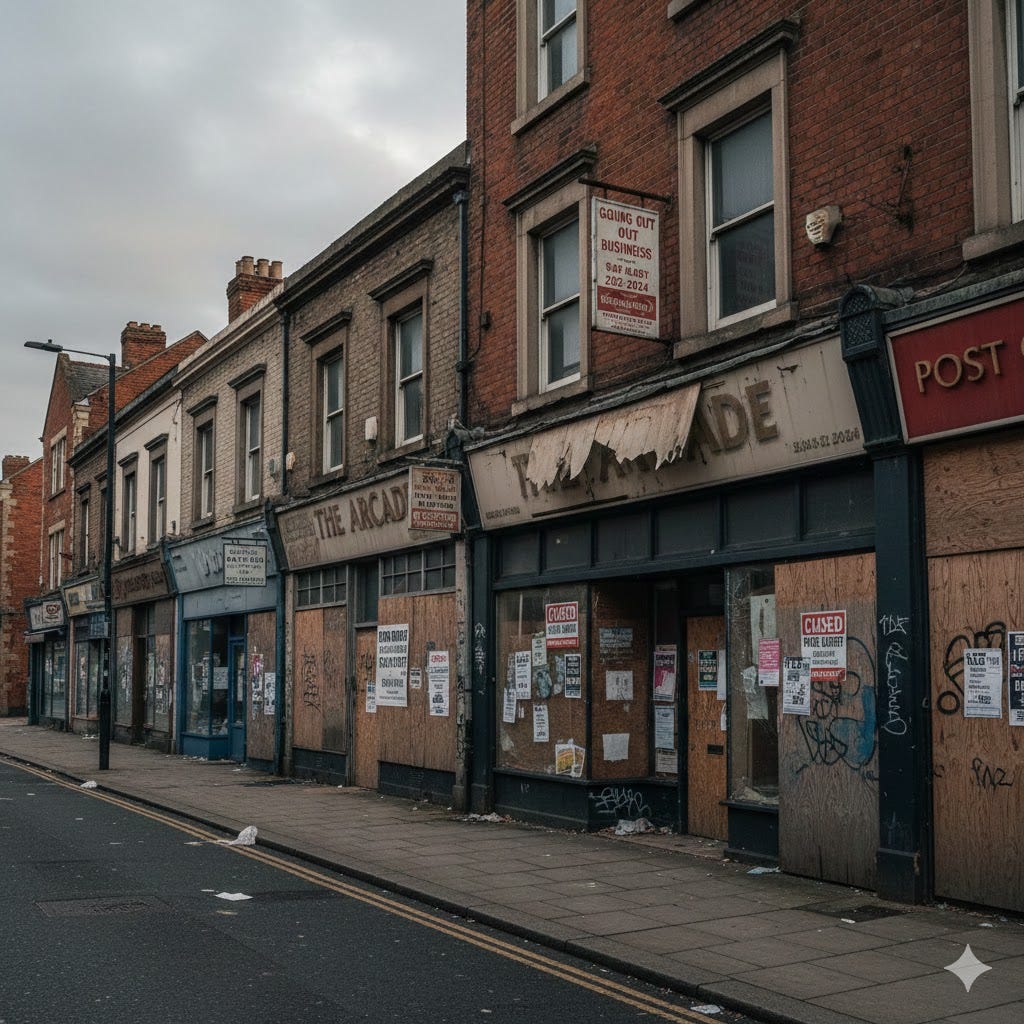
The hollow centre forming - independent businesses across Britain are closing at record rates.
And whether you’ve put words to it yet or not, you already know what’s happening. Britain’s becoming a doughnut economy—hollow in the middle where independent businesses used to be, chain stores around the edges, and nothing in between holding it together.
Here’s what that actually means for the pub where you’re a regular. Or were.
The Numbers They Don’t Want You Adding Up.
Business rates revaluation hit in April 2023. Then again in 2026. The Valuation Office Agency’s own data shows some pubs saw rateable values jump from £50,000 to £110,000—that’s 120% in three years. And that’s after the “COVID adjustment” that was supposed to help.
But rates are just the visible number. Add everything else hitting simultaneously:
National Insurance contributions rising. Employers now paying more per worker, with no transition support for small operators.
Minimum wage increases without breathing room. The National Living Wage rose to £11.44 in April 2024, which is good—people should be paid properly—but small businesses got zero help absorbing the jump while dealing with everything else.
Energy bills that spiked and never came back down. The “crisis” ended, rates stayed elevated. Funny, that.
Brexit killing EU labour mobility. No seasonal workers. No restaurant staff. Just permanent shortages and higher wage bills to attract domestic workers who don’t exist.
And all of this hits at exactly the same time.
The more you look at the timeline, the more you notice how perfectly synchronised the impact is. Almost as though someone designed it this way. Though we both know that would require imagination and coordination, neither of which British governance has demonstrated lately. Agreed?
What’s more unsettling is when systems build themselves. When nobody’s driving, but somehow all the tracks lead in the same direction.
What Selection Pressure Actually Looks Like.
You want to know what the cumulative burden does? It creates selection pressure. Every single policy change—every one—favours size and capital over places like the ones we grew up with.
Wetherspoons has a purchasing department. A legal team. Logistics infrastructure. They can appeal their rates, negotiate energy contracts, and weather labour shortages by rotating staff between locations. Your local independent? They’ve got the owner, maybe their spouse, working sixteen-hour days trying to keep the lights on.
You’ve seen this, haven’t you?
A café owner in Bristol—someone I’d been going to for years—finally closed last month. Not because the coffee wasn’t good. Not because customers stopped coming. Because the arithmetic just stopped working. Research by Simply Business predicts that “independent newsagents, clothes shops, and even pubs and bars could become completely extinct by 2038.”
So the independent closes. The one you used to go to closes.
And another chain opens. Or nothing opens at all, and the building sits empty, and the street feels a bit more dead. A bit more hollow.
Walk down any high street now. What do you smell? Not fresh bread from the bakery that used to be there. Not coffee from the café where you used to sit. Just... nothing. Air conditioning from chain stores. The absence where something used to be.
That’s the doughnut forming. Hollow centre where the independents used to be. Chain stores and corporate franchises around the edges. And in the middle? Nothing. Just empty units and rising rents nobody can afford because the only businesses that can pay are the ones that don’t need local customers anyway.
The Pattern That Keeps Repeating Itself.
There was something in the 1960s called the Beeching cuts. Dr Richard Beeching—chairman of British Railways—decided Britain’s rail network was “inefficient.” So they shut down 5,000 miles of track, closed 2,363 stations, and axed entire branch lines connecting small towns. Told everyone to drive instead.
Very modern. Very rational. Very “let the market decide.”
Except it destroyed connectivity for small towns, killed local economies, and isolated communities that had relied on rail access for generations. And we’ve spent the last sixty years trying to undo the damage, reopening lines at ten times the original cost.
This is the same thing happening to communities everywhere. Same logic: “Small businesses aren’t efficient.” Same process: policy selecting for scale and capital. Same result: a hollowed-out country where every town looks identical because the same six chains dominate every high street.
The difference is that Beeching was a deliberate rationalisation. This? This is policy incoherence compounding into systematic destruction. And somehow that’s worse, because nobody even means to do it. The pattern just keeps finding ways to repeat itself, taking choices with it.
Why Nobody in Government Understands What They’re Actually Doing.
Treasury needs revenue—rates go up. Employment policy wants better wages—NI rises. Energy policy is paralysed between net-zero commitments and market failure. Brexit was sold on sovereignty without anyone designing workable export systems for small businesses. And local councils, financially gutted by central government, squeeze the only revenue streams they control.
Everyone’s following their remit. Everyone’s hitting targets. And somehow the outcome looks designed, even though nobody designed it.
And the combined effect? Systematically destroying the layer of the economy that actually holds communities together.
Because—and this is the part they genuinely don’t understand—small businesses aren’t just economic units. They’re infrastructure. The infrastructure that makes the difference between a community and a postcode. Between a place that’s ours and just another place.
What Gets Lost When the Centre Hollows Out.
Small businesses create what urban sociologists call “third places.” Not home. Not work. The place you go to exist as a human.
The pub where you’re a regular. The café where you read the paper and nobody bothers you. The bookshop where you browse for an hour, and the owner recommends something because they actually know you.
Chains don’t do that. Can’t do that. Won’t do that.
Chains optimise for shareholder value. Minimum staff on zero-hours contracts. No local investment beyond the lease. The barista doesn’t know your name because she’s rotating between five different Costas on an algorithm-generated schedule. There’s no pub landlord—there’s a regional manager in Leeds reviewing sales data and cutting staff hours to hit quarterly targets.
That’s not community. That’s just commerce. And you know the difference.
When the doughnut’s complete—when every town centre is the same six chains, when every independent’s been replaced or priced out, when there’s nothing unique or local or actually rooted anywhere—Britain won’t just be economically fragile.
It’ll be socially dead. And we’ll be living in the corpse.
Why What Replaces It Can’t Survive Shocks.
Diverse economies are resilient economies. When you’ve got a mix of business types and sizes, some fail, but others adapt. That’s how ecosystems work. That’s how economies survive shocks.
Monocultures are vulnerable. When everything’s a chain optimising for the same metrics, one systemic shock takes out the lot. And we’ve seen this before—retail monoculture made high streets vulnerable to Amazon. Latest data from Real Business Rescue shows “21 out of 22 sectors saw critical financial distress levels rise by more than 40%” in the last year alone.
Pub monoculture is making communities vulnerable to the next crisis nobody’s predicted yet.
And socially? Blimey!
When there’s no local ownership, no stake in the community, no continuity of relationship, what’s holding anything together?
You think people feel alienated and disconnected by accident? You think social cohesion declining across every demographic just happens naturally for mysterious reasons?
It’s the doughnut. The hollow centre where community used to be. And the hollow keeps spreading into spaces we used to occupy.
What It Looks Like When You Stop Pretending.
And everyone can see it happening. Everyone. You’ve seen your local close. You’ve watched the café change hands, then close, then become a Costa. You’ve noticed your high street looks like every other high street now—same chains, same layout, same soulless efficiency.
And somehow we’re all accepting it as inevitable. Like the weather. Like there’s nothing to be done. Like it’s just happening to us rather than because of us.
But it’s not weather, is it? It’s policy.
And here’s the part that should make your skin crawl: we voted for this.
Not because we wanted our locals to close or our high streets to die. But because nobody told us that’s what the ballot actually said. Nobody knew. Each decision felt right at the time. Sovereignty made sense. Fairness made sense. Efficiency made sense.
And somehow all those reasonable choices assembled themselves into this. A system nobody designed. An outcome nobody chose. But here we are, living inside the thing we built without realising what we were building.
And policy can change. But only if someone’s willing to name what’s actually happening.
Because right now we’re watching something build itself. Not through conspiracy. Not through design. Just through the accumulated weight of decisions that each seemed reasonable in isolation, but compounded into something nobody chose. Analysis from Begbies Traynor shows “up to 50,000 firms now face potential closure, primarily due to soaring overhead costs.”
The doughnut’s getting bigger. You can see it in every closed shopfront, every chain that opens, every town that looks exactly like every other town. And if we keep pretending this is just how markets work—if we keep acting like cumulative policy burden is natural selection rather than designed selection—if we keep treating emergent outcomes as accidents rather than the logical conclusion of choices we made—we’re going to wake up one day and realise there’s nothing left in the middle holding anything together.
Just dough around the edges and a big empty hole where Britain used to be.
Where This Ends If Nothing Changes.
But first, whether you’re a business owner watching the arithmetic stop working, or a resident watching your community hollow out through Low Traffic Neighbourhoods and schemes that make it harder to reach the places you used to go, or just someone who’s noticed things feel different now, someone has to say clearly:
This is happening. It’s not an accident. And small businesses aren’t inefficiencies to be rationalised away—they’re infrastructure.
They’re the thing that makes places liveable instead of just profitable. They’re the infrastructure that prevents total dependence on corporate provision. They’re the alternative that makes choice possible.
And when they’re gone—when every transaction flows through corporate systems, when every community depends entirely on chains that answer to regional managers in Leeds, when there’s no local ownership and no independent infrastructure left—what we’ve built isn’t just economic fragility.
It’s a system where alternatives have been systematically eliminated, where dependency is total. Where the tracks all lead in one direction, and there’s no station to get off at.
The more you notice it, the harder it becomes to unsee. And once you see it—really see it—you realise it’s already further along than anyone wants to admit. The pattern’s been building itself while everyone watched, and the destination was never chosen, but somehow everyone’s been building it anyway.
Including us. Especially us.
Same again?
Related Reading:
Sources & Data:
Valuation Office Agency: 2023 Revaluation Data
UK Government: National Minimum Wage Rates 2024-25
UK Government: Employer NI Rates 2024-25
UKHospitality: Labour Shortages Report
Institute for Government: Brexit and SMEs
Local Government Association: Council Funding Crisis
Simply Business: Small Business Predictions 2025
Real Business Rescue: Business Distress Index Q3 2025
Rapid Formations: Economic Challenges UK Businesses
Joseph Rowntree Foundation: Social Cohesion and Participation
BBC News: Beeching Rail Lines Reopening Costs
The Guardian: UK High Street Chain Store Closures 2023