
Carbon Neutral by 2030 — Unless, Of Course, You Count the Data Centres.
The Green Party wrote more about AI than any other party. They said nothing about what powers it. Published by The Almighty Gob — thealmightygob.com

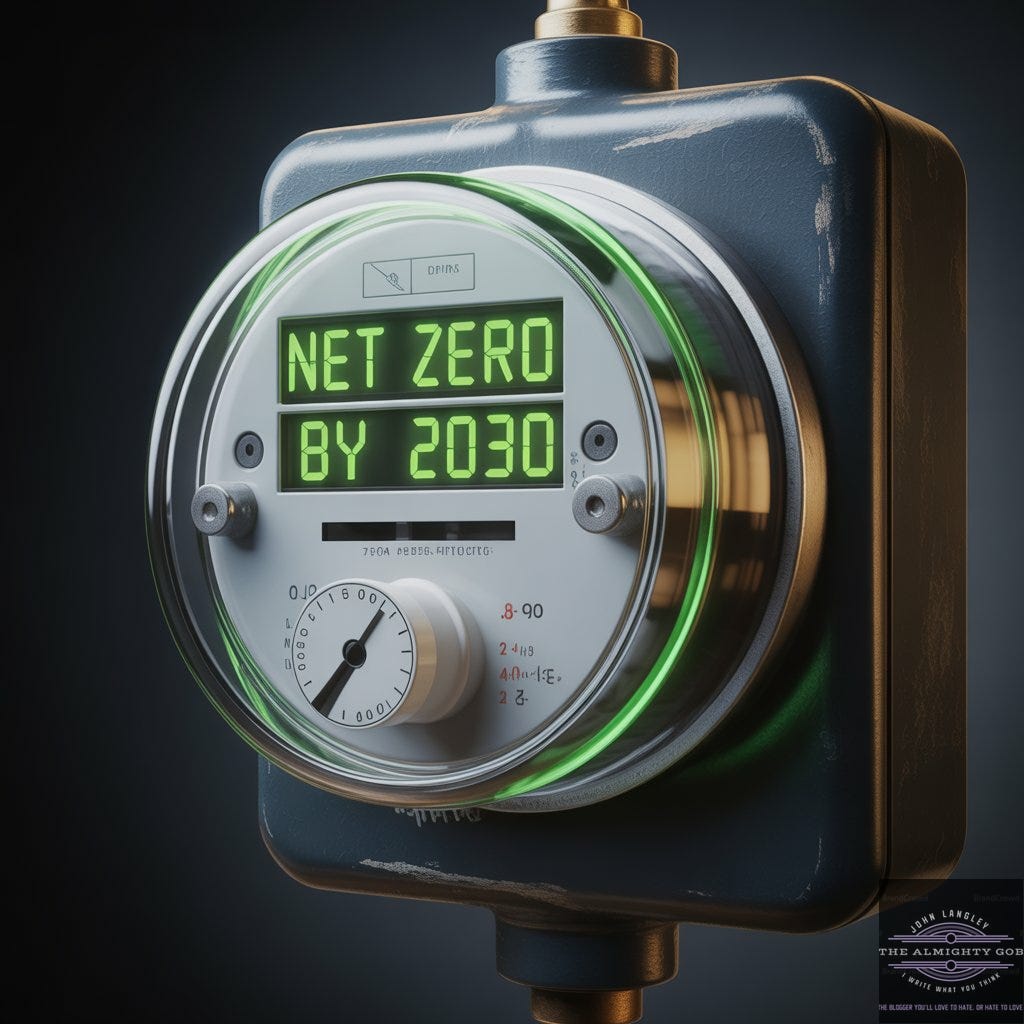
[Net Zero by 2030 — The Almighty Gob]
The Green Party has a problem. Not the kind it talks about. A different kind entirely. Well, apart from the fact that it exists at all, you know.
It’s the kind that lives in the gap between what a political movement says and what it actually does.
Because right now, today, every Green Party email sent, every online donation processed, every social media post about saving the planet runs through a global network of data centres.
Data centres that are — and there is no polite way around this — overwhelmingly powered by fossil fuels.
That is what The Almighty Gob would call a digital carbon footprint. And the Green Party, like the rest of us, has one. So do you, by the way. So does everyone reading this.
Now, the question is why they’re not talking about it. And whether, when faced with the bleeding obvious, greenwashing dressed as principle is really good enough anymore.
The Scale of What Nobody’s Talking About.
You see, there are now more than 6,500 active data centres operating worldwide. The United States alone hosts over 5,400 of them.
They consumed somewhere between 415 and 536 terawatt-hours of electricity in 2024. Roughly 1.5 to 2 percent of all global electricity demand.
By 2030, that figure is projected to more than double. The International Energy Agency puts the upper end of that projection at over 1,000 terawatt-hours annually — equivalent to the entire current electricity consumption of Japan.
A single new hyperscale data centre requires at least 100 megawatts of power. That’s the equivalent of charging more than 400,000 electric vehicles, every year, continuously.
Approximately 137 new hyperscale data centres came online in 2024 alone.
The driver of this explosion is not streaming, not email, not social media — though all of those contribute. The driver is artificial intelligence.
A single ChatGPT query consumes nearly ten times the electricity of a standard Google search. AI training runs consume energy equivalent to hundreds of households over several months. Every time someone asks an AI to write their shopping list, draft their email, or generate an image of a sunset, a data centre somewhere burns through power that — in nearly 60 percent of cases globally — comes from fossil fuels.
Sixty percent.
That is not a rounding error. That is not a transitional moment that will resolve itself shortly. That is the current operating reality of the infrastructure that runs the digital world. Carbon Brief, analysing the IEA’s own figures, puts it plainly: fossil fuels provide nearly 60 percent of data centre power globally. Renewables account for 27 percent. Nuclear provides another 15. The rest — the dominant share — is gas, coal, and oil.
And it is getting bigger, not smaller.
The Numbers That Should Have Made the Headlines.
It’ll blow your mind. All of US data centres combined consumed 183 terawatt-hours of electricity in 2024. That figure — just the United States, just one year — is roughly equivalent to the entire annual electricity demand of Pakistan, according to the International Energy Agency. A nation of 240 million people. Farmers. Hospitals. Schools. Factories. Homes. The whole country. Just to keep your search results loading and your inbox syncing. Think about that the next time you Google something.
Training a single large AI model — one model, trained once — consumed 50 gigawatt-hours of electricity, according to a May 2025 study cited by the US Congress Research Service. Enough to power San Francisco for three days. Not a city in a developing nation. San Francisco. One of the most energy-efficient, sustainability-obsessed, green-voting cities on the planet. Three days of its entire electricity supply. Gone. So that a chatbot could learn to write a cover letter.
And that’s just the training. That’s before a single person uses it. The running — the inference, in the jargon — accounts for up to 90 percent of a model’s lifetime energy consumption. So the San Francisco figure is, in the grand scheme of it, a rounding error.
Here’s Ireland. Always Ireland. Data centres now consume 22 percent of Ireland’s entire national electricity supply, according to Ireland’s Central Statistics Office. Not 2 percent. Not 5 percent. Twenty-two percent. One in every five units of electricity generated in Ireland does not go to a home, a hospital, a school, or a factory. It goes to a data centre. And by 2026 — this year — that figure was projected to hit 32 percent. Nearly a third of a country’s electricity. Consumed by machines that process data for corporations headquartered somewhere else entirely.
A Green Party councillor in Ireland noticed this and called it out. Irish households, she pointed out, are paying nearly double the electricity rates of these industrial tech facilities. The ordinary person is subsidising Big Tech’s energy bill. She was right. The question nobody asked her — and that she didn’t answer — is: what does the Green Party’s digital operation run on?
So, back to Virginia. Loudoun County, to be exact. You may not have heard of it. It is, functionally, a field full of data centres. In 2023, those data centres accounted for 21 percent of the county’s total power consumption. More than all the households in the county combined — which came in at 18 percent. The machines are using more electricity than the people. And in 2024, a minor electrical disturbance in neighbouring Fairfax County caused 60 data centres to simultaneously switch to backup generators. The sudden loss of 1,500 megawatts — gone in seconds — was roughly equivalent to the entire power demand of the city of Boston. The grid nearly went down. Because sixty server farms blinked.
And the growth? The projected increase in data centre energy consumption between now and the end of 2027 alone is equivalent to adding the entire electricity consumption of Sweden at the conservative end. Or Germany at the high end. Sweden or Germany. In growth alone. In two years.
“The government did not catch this because it was vigilant. It caught it because the numbers eventually became too large to ignore.”
— The Almighty Gob
The Government Knew. And Got It Wrong by a Factor of One Hundred.
Tt cut a mega-long story short, the UK government recently revised its projections for the carbon footprint of AI data centres operating on British soil.
The revision was not a minor adjustment. Officials had underestimated the figures by more than 100 times.
The corrected projection: AI data centres in the UK alone could generate up to 123 million tonnes of carbon dioxide over the next decade.
To make that real: 123 million tonnes is equivalent to the carbon emissions of approximately 2.7 million people over the same period.
The government did not catch this because it was vigilant. It caught it because the numbers eventually became too large to ignore.
Which raises an obvious question. If the government — with all its modelling capacity, all its civil service expertise, all its access to industry data — missed this by a factor of one hundred, what are the chances that a political party whose manifesto says nothing about data centre emissions has a credible grip on the problem?
The answer, of course, is none. But we will come to the Green Party’s manifesto shortly.
Ed Miliband: The Man With the Levers.
You know, the Secretary of State for Energy Security and Net Zero. His job — his entire job — is to know exactly where Britain’s energy is going, where the carbon is coming from, and whether the government’s net zero targets are credible.
On 21 April 2026, Miliband stood up at the Good Growth Foundation’s National Growth Debate and declared, with full conviction, that “the era of fossil fuel security is over.” That clean energy is now “the only route to financial security, energy security and indeed national security.” The speech was published in full by the New Statesman the same day.
Stirring stuff. Except.
Two months earlier, in February 2026, MPs on the Environmental Audit Committee had written to Miliband with a straightforward question. They’d noticed that data centres — the fastest-growing source of energy demand in the country, the infrastructure his own government had designated as critical national infrastructure — had been omitted from the government’s projections for the Seventh Carbon Budget. The national carbon plan. The document that underpins every net zero commitment the government has made.
Left out entirely.
Miliband wrote back. He reassured the committee that data centre emissions were, in fact, included in the modelling — tucked inside overall electricity demand projections. Then he added the line that tells you everything you need to know about the grip this government has on the problem.
Future demand from data centres, he wrote, “remains inherently uncertain.”
Inherently uncertain.
This is the Secretary of State for Energy Security describing the fastest-growing energy consumer in the country — a sector whose electricity consumption is projected to quadruple by 2030, according to the National Energy System Operator — as something he can’t quite pin down. Meanwhile, Ofgem had already revealed that 140 proposed data centre projects had signalled their intention to connect to the national grid, with a combined potential demand of 50 gigawatts. To put that in context: Britain’s entire peak electricity demand on 11 February 2026 was 45 gigawatts. The data centres want more than the country currently uses. At peak. And Miliband finds this inherently uncertain.
The man who says fossil fuels are finished cannot account for the fossil-fuelled infrastructure his own government is fast-tracking through planning permission, designating as nationally significant, and cheerfully welcoming as an engine of economic growth.
That is not a rounding error. That is not a scheduling conflict. That is a man standing in two places at once and hoping nobody does the arithmetic.
The Almighty Gob did the arithmetic. Someone had to.
The “Green” Credentials — Examined.
The technology sector has not been silent on this. It has been loudly, expensively, and in some cases quite creatively, misleading.
Google, for instance, claims its data centres operate at an industry-leading efficiency rating. It says it has matched 100 percent of its annual electricity consumption with renewable energy every year since 2017. That sounds impressive until you read the word “matched” rather than “powered by.” Matching means purchasing certificates — financial instruments that say, somewhere on the grid, a wind turbine or solar panel generated an equivalent amount of electricity. It does not mean Google’s servers in Virginia are running on wind power. It means Google bought a piece of paper that says they are, more or less, in the right ballpark, on a global accounting basis, annually.
That is not green energy. That is green accounting.
The IEA’s own assessment is blunt: nearly 60 percent of data centre power comes from fossil fuels. The renewable energy certificate system — the mechanism by which tech giants claim clean credentials — has been widely criticised as an accounting manoeuvre rather than an environmental commitment. Buying a certificate that says “somewhere, a wind turbine generated this much electricity” is categorically not the same as your data centre running on wind power.
Meanwhile, Microsoft’s own published emissions data shows its Scope 3 carbon footprint — the indirect emissions across its supply chain — was 30.9 percent higher in 2023 than in 2020. The reason given: more data centres being built, more hardware manufactured, more embodied carbon in construction materials. A company with a headline net zero pledge whose actual carbon footprint is rising. Not falling. Rising.
This is the industry that the green movement trusts to self-regulate its way to sustainability.
“Five companies control the dominant share of global data centre capacity. Between them they own the physical substrate of modern civilisation.”
— The Almighty Gob
Whoever Controls the Data Centres Controls the World.
Here is the part nobody in mainstream politics — green, red, blue, or otherwise — wants to say out loud.
This is not about carbon anymore. Carbon is the symptom. The disease is power. Real power. The kind that doesn’t require an election, a mandate, a parliamentary vote, or a public consultation. The kind that just — is.
Five companies control the dominant share of global data centre capacity. Microsoft. Amazon. Google. Meta. Apple. Between them they own the physical substrate of modern civilisation. Every financial transaction on the planet flows through infrastructure they control. Every government database — in most democracies — sits on servers they own or operate. Every hospital record. Every election management system. Every AI model being used right now to decide who gets a loan, who gets flagged at a border, who gets their benefits sanctioned, whose job application makes it past the algorithm. All of it. Owned. By five American corporations.
We already know what happens when that power gets exercised without restraint. In 2021, Amazon Web Services pulled the plug on Parler. The platform — whatever you think of it — ceased to exist within hours. Not regulated. Not fined. Not taken to court. Not subjected to any democratic process whatsoever. Switched off. By a cloud provider. Because it could. Because nothing in law, nothing in politics, nothing in the green movement’s manifesto prevented it.
That is not a content moderation decision. That is a demonstration of infrastructural sovereignty. The message was simple: we control the pipes, and if we don’t like what flows through them, we turn the tap off.
And it’s not just American corporations. The Chinese state has been building its own parallel data centre empire with a strategic coherence that makes Western tech investment look like it’s been planned on the back of a napkin. By 2030, the US and China between them will account for more than two thirds of global data centre electricity demand. Two powers. Between them, the digital world. Everyone else — including Britain, including the EU, including the entire green movement with its net zero ambitions and its renewable energy targets — is a tenant. Using infrastructure owned by someone else. On terms set by someone else. With an off switch held by someone else.
This is what the Green Party’s manifesto on digital rights should have been about. Not algorithmic accountability in the abstract. Not data privacy frameworks. The actual, physical, political question of who owns the machines that run the world — and what happens to democracy, sovereignty, and every net zero target ever written when the answer is: not you.
The green movement wants to save the planet. Admirable. But the planet’s digital nervous system is owned by people who answer to shareholders, not electorates. Who operate under American law, not British law. Who can, and demonstrably will, make unilateral decisions about what stays online and what disappears — with no appeal, no recourse, and no democratic oversight of any kind.
You cannot have net zero by 2030 and no answer to that question. You cannot champion AI-driven public services and have nothing to say about who owns the AI. You cannot call yourself a party of radical change and be entirely comfortable running your 225,000-member operation through infrastructure controlled by five corporations in California and a Communist Party in Beijing.
Anyway, here we are.
The Green Party’s Manifesto — Read Carefully.
So. The manifesto.
Of all the major parties contesting the last general election, the Green Party dedicated the largest proportion of its manifesto to artificial intelligence. More than the Conservatives. More than Labour. More than the Liberal Democrats.
And their AI section focused almost entirely on ethical concerns — digital rights, algorithmic accountability, data privacy, the social impact of automation. All legitimate. All worth debating.
Not one word about energy consumption. Not one sentence about the carbon footprint of the data centres that run the AI they were writing about. Not a single acknowledgement that the infrastructure underpinning every AI system in Britain is, at that very moment, burning through fossil fuels at a rate the government would later discover it had underestimated by a factor of one hundred.
The Green Party — the party of net zero by 2030, the party that wants to end fossil fuel subsidies, phase out nuclear power, and power the entire country through renewables within four years — looked directly at artificial intelligence and saw an ethics problem.
They missed the energy problem entirely.
This is not a minor oversight. This is the central contradiction at the heart of the movement. You cannot declare net zero by 2030 and simultaneously say nothing about the fastest-growing source of energy demand in the country. Those two positions cannot coexist. One of them has to give.
225,000 Members. All Online. All Leaving a Trail.
Since Zack Polanski became leader in September 2025, the Green Party’s membership has tripled.
It now stands at 225,000 people — more than the Liberal Democrats, more than the Conservatives.
Every one of those members joined online. Every one pays their subscription through a digital platform. Every one receives their party communications by email, follows the party on social media, watches speeches on YouTube, donates through apps, and organises through cloud-based tools.
Every single one of those actions passes through a data centre. Powered, on current global figures, by fossil fuels in nearly 60 percent of cases.
The Green Party is not an exception to the digital carbon problem. It is a participant in it. A rapidly growing, enthusiastically digital, 225,000-strong participant that has chosen — so far — to say nothing about the carbon cost of its own digital operations.
In Ireland, where data centre concentration is particularly acute, a Green Party councillor recently went on record complaining that Irish households are paying nearly double the electricity rates of industrial tech facilities — effectively subsidising Big Tech’s energy consumption while struggling with a cost-of-living crisis.
She was right. The problem she identified is real.
But the solution she implied — more scrutiny of data centre expansion — crashes directly into a party platform that champions AI-driven public services and says nothing about where the power for those services comes from.
They know. At some level, they know. The dots just haven’t been joined. Or perhaps more accurately — nobody in the movement has wanted to join them, because joining them leads somewhere uncomfortable.
“A party that dedicates more manifesto space to AI than any other party — and says nothing about the energy cost of AI infrastructure — does not have a net zero plan. It has a net zero posture.”
— The Almighty Gob
A Posture Is Not a Policy.
The environmental concern is not a myth. Climate change is real. The science is not in dispute. The instinct to protect the planet is not scaremongering — it is reasonable, it is necessary, and it deserves serious political representation.
What is a myth is the solution as presented.
The idea that any movement — green, progressive, or otherwise — can declare net zero by 2030, campaign entirely through digital platforms, champion artificial intelligence as the engine of public service transformation, and simultaneously pretend the carbon cost of all that digital activity is someone else’s problem — that is the myth.
The Green Party’s net zero target of 2030 is the most aggressive in British politics. Fine. Admirable, even, in its ambition.
But that target requires the most rapid decarbonisation in British political history. At exactly the moment when data centre energy consumption is projected to double. When AI demand is accelerating the growth of fossil-fuelled infrastructure. When the UK government has just discovered it underestimated the carbon footprint of that infrastructure by a factor of one hundred.
Those two trajectories do not converge. They run in opposite directions.
A party that dedicates more manifesto space to AI than any other party — and says nothing, not one word, about the energy cost of AI infrastructure — does not have a net zero plan. It has a net zero posture. A set of commitments that sound serious until you apply the three questions that The Almighty Gob applies to everything: Is it practical? Is it logical? What’s the likely outcome?
On the evidence: No. No. And more of the same.
The green movement is not wrong to want a cleaner world. It is wrong to pretend that wanting it — loudly, digitally, at 60 percent fossil fuel, through servers owned by five corporations in California — is the same as having a plan.
Carbon neutral by 2030. Unless, of course, you count the data centres.
If you’re this bothered about the fact, dig in, and enjoy.
SOURCES AND CITATIONS
Carbon Neutral by 2030 — Unless, Of Course, You Count the Data Centres
The Almighty Gob — thealmightygob.com
All sources listed below are primary or institutional. Every factual claim in this article is traceable to the source listed against it. No secondary sources used where primary sources were available.
1. Global data centre count — 6,500+ worldwide / 5,400+ in the United States
Source: International Energy Agency (IEA) — Energy and AI report, April 2025 URL: https://www.iea.org/reports/energy-and-ai/executive-summary
2. Global data centre electricity consumption — 415–536 TWh in 2024 / 1.5–2% of global demand
Source: International Energy Agency (IEA) — Energy and AI report, April 2025 URL: https://www.iea.org/reports/energy-and-ai/executive-summary
Additional verification: S&P Global, April 2025 URL: https://www.spglobal.com/energy/en/news-research/latest-news/electric-power/041025-global-data-center-power-demand-to-double-by-2030-on-ai-surge-iea
3. Data centre consumption projected to double to over 1,000 TWh by 2030 — equivalent to Japan’s entire electricity use
Source: International Energy Agency (IEA) — Energy and AI report, April 2025 URL: https://www.iea.org/reports/energy-and-ai/executive-summary
4. Single hyperscale data centre — 100 megawatts minimum / equivalent to charging 400,000 electric vehicles annually
Source: International Energy Agency (IEA) — Energy and AI report, April 2025 URL: https://www.iea.org/reports/energy-and-ai
5. 137 new hyperscale data centres came online in 2024
Source: International Energy Agency (IEA) — Energy and AI report, April 2025 URL: https://www.iea.org/reports/energy-and-ai
6. ChatGPT query consumes nearly ten times the electricity of a standard Google search
Source: International Energy Agency (IEA) — Energy and AI report, April 2025 URL: https://www.iea.org/reports/energy-and-ai/executive-summary
7. Fossil fuels provide nearly 60% of data centre power globally — renewables 27%, nuclear 15%
Primary source: International Energy Agency (IEA) — Energy Supply for AI, April 2025 URL: https://www.iea.org/reports/energy-and-ai/energy-supply-for-ai
Named citation in article: Carbon Brief analysis of IEA figures — AI: Five charts that put data-centre energy use and emissions into context, September 2025 URL: https://www.carbonbrief.org/ai-five-charts-that-put-data-centre-energy-use-and-emissions-into-context/
8. US data centres consumed 183 TWh in 2024 — equivalent to Pakistan’s entire annual electricity demand
Source: International Energy Agency (IEA) — Energy and AI report, April 2025 / Lawrence Berkeley National Laboratory — 2024 United States Data Center Energy Usage Report, December 2024 URL: https://eta-publications.lbl.gov/sites/default/files/2024-12/lbnl-2024-united-states-data-center-energy-usage-report.pdf
9. Training a single large AI model consumed 50 GWh — enough to power San Francisco for three days
Source: May 2025 study cited by the US Congressional Research Service URL:
https://crsreports.congress.gov
10. AI inference accounts for up to 90% of a model’s lifetime energy consumption
Source: International Energy Agency (IEA) — Energy and AI report, April 2025 URL: https://www.iea.org/reports/energy-and-ai
11. Ireland data centres — 22% of national electricity supply in 2024
Source: Central Statistics Office (CSO) Ireland — Data Centres Metered Electricity Consumption 2024, published 10 June 2025 URL: https://www.cso.ie/en/releasesandpublications/ep/p-dcmec/datacentresmeteredelectricityconsumption2024/
Additional verification: The Irish Times, 10 June 2025 URL: https://www.irishtimes.com/environment/2025/06/10/data-centres-accounted-for-more-than-fifth-of-irelands-electricity-usage-last-year/
12. Loudoun County, Virginia — data centres 21% of total power consumption vs households 18%
Source: International Energy Agency (IEA) — Energy and AI report, April 2025 URL: https://www.iea.org/reports/energy-and-ai
13. Fairfax County 2024 electrical disturbance — 60 data centres switched to backup generators / 1,500 megawatts equivalent to Boston’s power demand
Source: International Energy Agency (IEA) — Energy and AI report, April 2025 URL: https://www.iea.org/reports/energy-and-ai
14. Data centre consumption growth by 2027 equivalent to Sweden or Germany’s entire electricity use
Source: International Energy Agency (IEA) — Energy and AI report, April 2025 URL: https://www.iea.org/reports/energy-and-ai
15. UK government underestimated AI data centre carbon emissions by a factor of more than 100 / corrected projection: up to 123 million tonnes CO2 over next decade
Primary source: Department for Science, Innovation and Technology (DSIT) — revised figures, April 2025 Reported by: The Guardian / Irish Examiner / Morning Star, April 2026 URL: https://www.irishexaminer.com/world/arid-41833736.html
Investigation that prompted revision: Foxglove and Carbon Brief joint investigation Carbon Brief analysis: https://www.carbonbrief.org/analysis-co2-from-uk-data-centres-could-be-hundreds-of-times-higher-than-thought/
Morning Star report: https://morningstaronline.co.uk/article/government-underestimated-climate-impact-data-centres-hundredfold-research-reveals
16. 123 million tonnes CO2 equivalent to emissions of approximately 2.7 million people over the same period
Source: Department for Science, Innovation and Technology (DSIT) — revised figures, April 2025 Reported by: Irish Examiner, April 2026 URL: https://www.irishexaminer.com/world/arid-41833736.html
17. Ed Miliband speech — “the era of fossil fuel security is over” / “only route to financial security, energy security and national security” — Good Growth Foundation National Growth Debate, 21 April 2026
Named citation in article: Published in full by the New Statesman, 21 April 2026 URL:
https://www.newstatesman.com
18. Environmental Audit Committee letter to Miliband — data centres omitted from Seventh Carbon Budget projections, February 2026
Source: UK Parliament — Environmental Audit Committee correspondence, February 2026 URL: https://committees.parliament.uk/committee/62/environmental-audit-committee/
19. Miliband response — data centre demand “remains inherently uncertain”
Source: Miliband written response to Environmental Audit Committee, February 2026 Reported by: Carbon Brief, March 2026 URL: https://www.carbonbrief.org/analysis-co2-from-uk-data-centres-could-be-hundreds-of-times-higher-than-thought/
20. National Energy System Operator — data centre electricity consumption projected to quadruple by 2030
Source: NESO — demand connections call for input / Ofgem consultation, February 2026 URL: https://www.edie.net/government-consults-on-curbing-speculative-grid-connection-bids-as-queue-surges/
21. Ofgem — 140 data centre projects seeking grid connection / combined demand of 50 gigawatts / UK peak demand 11 February 2026 was 45 gigawatts
Source: Ofgem — Call for Input on Demand Connections Reform, February 2026 URL:
https://www.ofgem.gov.uk
Reported by: The Register, February 2026 URL: https://www.theregister.com/2026/02/27/datacenter_uk_grid_demand/
22. Google renewable energy certificates — “matched” not “powered by” / 100% matched since 2017
Source: Google Environmental Report 2024 / Google Sustainability URL: https://sustainability.google/reports/
23. Microsoft Scope 3 carbon footprint 30.9% higher in 2023 than 2020
Source: Microsoft Environmental Sustainability Report 2024 — published emissions data URL: https://blogs.microsoft.com/on-the-issues/2024/05/15/microsoft-2024-environmental-sustainability-report/
24. Amazon Web Services / Parler — platform taken offline, January 2021
Source: Multiple verified reports — BBC News, Reuters, January 2021
25. US and China to account for more than two thirds of global data centre electricity demand by 2030
Source: International Energy Agency (IEA) — Energy and AI report, April 2025 URL: https://www.iea.org/reports/energy-and-ai
26. Green Party dedicated largest proportion of manifesto to AI of any major party — no mention of energy cost
Source: Green Party General Election Manifesto 2024 URL: https://greenparty.org.uk/green-party-general-election-manifesto-2024/
27. Green Party membership tripled under Zack Polanski to 225,000
Source: Green Party membership announcements, September 2025 — reported across UK political media
28. Irish Green Party councillor — households paying nearly double electricity rates of data centres
Source: Hazel Chu, Dublin City Councillor — public statements, 2025
29. Goldman Sachs — future data centre electricity demand to 2030 met 60% by gas, 40% by renewables
Source: Goldman Sachs Research — Generational Growth: AI, Data Centres and the Coming US Power Demand Surge, April 2024 URL: https://www.goldmansachs.com/insights/articles/AI-poised-to-drive-165-increase-in-data-center-power-demand
Sources compiled and verified by The Almighty Gob — April 2026
© 2026 John Langley / The Almighty Gob. All rights reserved. Attribution: John Langley / The Almighty Gob, thealmightygob.com
© 2026 John Langley / The Almighty Gob. All rights reserved. Where reproduced, John Langley must be named as source in full. Attribution: John Langley / The Almighty Gob, thealmightygob.com
The Almighty Gob is a Bristol-based publication founded by John Langley — independent Bristol mayoral candidate 2016 and 2021, and one of the city’s most forensic observers of institutional power. Publishing since 2020, with over 500 pieces across seven platforms and Substack at thealmightygob.com — no party allegiance, no press accreditation, no interest in acquiring either.