
Carving Up the World (While Pretending We're Not),
Trump, Greenland, and the five-superpower future nobody's admitting we're heading toward.

I was listening to Ali Miraj on LBC this lunchtime. He was talking about Trump and Venezuelan President Nicolás Maduro, who’s now being held in custody in New York.
Not through extradition—extradition’s a legal process with treaties and courts and paperwork. This was more... transportation. Just moving someone from their country to yours when you decide you want them there.
You know, the way you’d move furniture you quite fancy from someone else’s house.
It’s not even new. George Bush did the same thing with Manuel Noriega in Panama back in 1989. When America wants someone, America takes them. The legal process is optional, apparently.
And once you start thinking about powerful countries just taking what they want—people, territory, resources—Trump’s Greenland obsession makes perfect sense, doesn’t it?
He’s actually serious about buying Greenland from Denmark. Not joking, actually floating the idea of purchasing Arctic territory like it’s a holiday let in Cornwall.
Here’s what got me thinking: if you’re already helping yourself to political leaders when convenient, and you’re shopping for entire countries, what does that tell you about where the world’s heading?
Because once you start looking at the pattern—Trump eyeing Greenland, Putin taking Crimea, China building islands in the South China Sea, Israel expanding operations, Iran building nuclear capability—you notice something nobody’s saying out loud.
The world’s being carved up into power blocs. And everyone’s pretending it’s not happening.
Could Five Superpowers Divide the World?
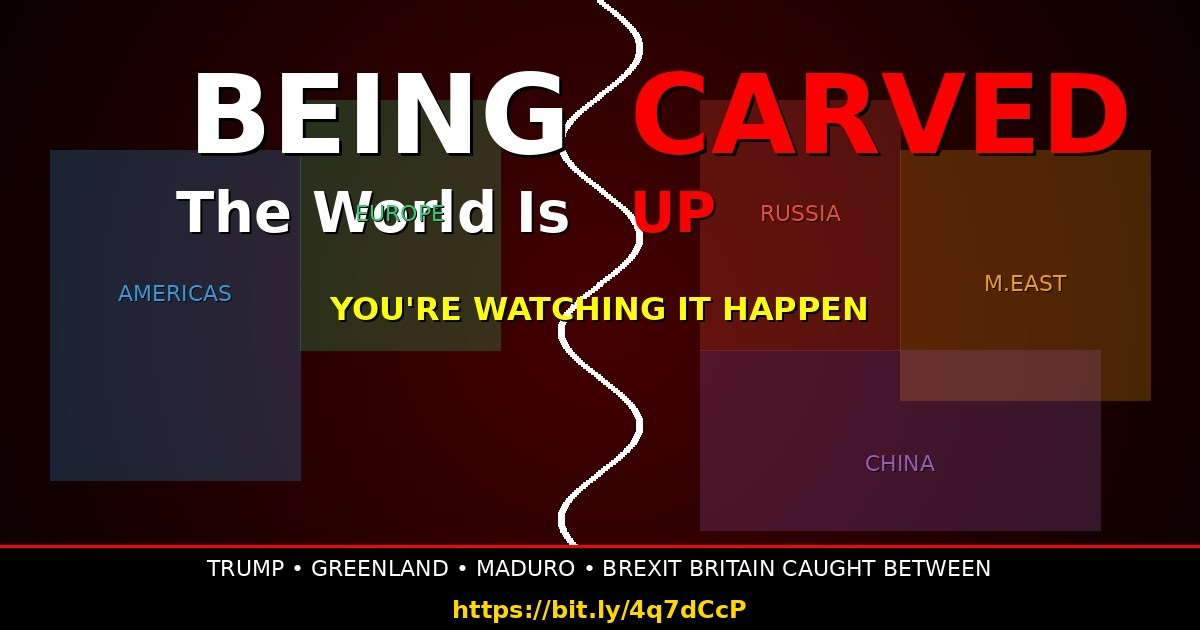
Here’s a thought: what if the world was divided between five superpowers? Americas under US control, Russian sphere covering the former Soviet space, Europe as its own bloc, Middle East carved up, Far East dominated by China.
Would that actually be more stable than the chaotic mess we’ve got now?
There’s logic to it, you see. Clear jurisdictions, fewer proxy wars, one power responsible per region. Like dividing a house between flatmates who’ve been leaving passive-aggressive notes on each other’s food—at least everyone knows whose milk is whose.
Except “establishing ownership” in geopolitics isn’t done with property deeds. It’s done with wars that kill millions.
Is it practical?
Only if you don’t mind the transition, you realise. The current mess exists precisely because we haven’t had that clarifying war. Getting there means someone proves dominance through force.
Is it logical?
Not really. Spheres of influence already exist—contested and fluid, not agreed-upon. The whole point of being a superpower is not being constrained by agreements.
What’s the likely outcome?
History’s already run this experiment, you notice. Concert of Europe (1815) lasted until World War I. Yalta (1945) created the Cold War, not peace. Sykes-Picot (1916) drew Middle East borders with a ruler—still exploding a century later.
These arrangements either collapse into war or create frozen conflicts that eventually detonate. It’s like watching people build houses on a fault line while insisting this time the earthquake won’t happen.
You see the pattern forming?
Klaus Schwab’s WEF Vision vs Five-Superpower Reality.
Then there’s Klaus Schwab’s World Economic Forum vision. You know, the Davos crowd. Multi-stakeholder global governance, corporations and states cooperating through international institutions.
Schwab wants everyone holding hands singing Kumbaya while algorithms optimise resource distribution. Meanwhile Russia’s taking Crimea and China’s threatening Taiwan.
It’s like watching a yoga instructor walk into a bare-knuckle boxing match with a meditation bell.
The contradiction you’re seeing:
WEF model needs states voluntarily giving up sovereignty. Five-superpower model needs hard power dominating territories through military force.
You can’t have “multi-stakeholder global governance” and “my country controls this chunk” simultaneously. That’s not a policy choice—that’s a logical impossibility.
Any system requiring powerful actors to voluntarily constrain their power asks them to act against their defining characteristic. It’s like asking sharks to become vegetarian for the good of the ocean.
Sound familiar? It’s the same institutional dysfunction pattern playing out at every level—from Bristol’s Green administration selling council homes while promising to build them to global powers rebranding territorial conquest as “security interests.”
Brexit Britain Caught Between US and EU Power Blocs,
Want to see this playing out in real-time? Look at the UK.
Brexit logic: take back control, sovereignty, independence.
Reality: Britain’s caught between two power blocs with no way to actually be independent.
You need NATO for security—can’t defend yourself alone. You need EU trade access—half your trade is there. But they’re pulling in opposite directions.
That’s not independence, you realise. That’s being on two leashes at once while insisting you’re walking yourself.
Brexit was a bet that mid-sized powers can be truly independent in the 21st century. They can’t. You’re either inside a bloc with some voice, inside without voice, or outside and irrelevant.
Britain chose door three while pretending it’s door one.
The same pattern of promising one thing while delivering another that defines Bristol’s political landscape now defines Britain’s geopolitical position. Different scale, identical dysfunction.
Current Geopolitical Power Grabs: Israel, Russia, China, Iran.
We’re getting neither Schwab’s unified governance nor clean five-power division, you notice. We’re getting fragmented globalisation—regional blocs with different systems, constant low-level conflict everywhere.
Look at the simultaneous power grabs happening right now:
Israel: Asserting regional dominance through Gaza, Lebanon, Iran strikes.
Russia/Ukraine: Testing whether NATO actually fights or just sends weapons.
China/Taiwan: Unfinished civil war. China won’t accept separation, Taiwan won’t accept absorption.
Iran: Building nuclear capability, maintaining proxy networks.
US/Arctic: Trump’s Greenland interest is strategic positioning as ice melts and shipping routes open.
Every single one is positioning behaviour, you see. Countries grabbing territory while they can, building alliances while they can, because they can all see what’s coming even if nobody will say it.
It’s like watching people stock bunkers while insisting everything’s fine.
When institutions stop serving stated purposes and start serving institutional interests, you get this pattern—whether it’s Bristol City Council or global superpowers. The scale changes. The pattern doesn’t.
World Order Futures: War, Negotiation or Permanent Instability?
Option 1: Clarifying conflict.
Major war establishes new hierarchy, you realise. Like World Wars I and II established US-Soviet order. Problem: nuclear weapons make this suicidal. But people said World War I was impossible because economies were too integrated. Then it happened anyway.
Option 2: Negotiated spheres.
Powers agree to respect each other’s regions. Problem: China won’t accept US keeping Taiwan. Russia won’t accept losing Ukraine. India won’t accept subordination to China. Getting five competing powers to voluntarily limit themselves requires them all to act against their interests simultaneously. That’s wishful thinking, you notice.
Option 3: Permanent instability.
No war big enough to settle things. No negotiation successful enough to create order. Just constant proxy conflicts, economic warfare, occasional military clashes that don’t quite escalate.
Like the chaos you’re seeing now, indefinitely.
The honest assessment you’re reaching:
We’re probably headed for Option 3. Nuclear weapons prevent clarifying war (probably). National interests prevent negotiated deal (definitely).
This is what “permanent instability” looks like. Not quite war, not quite peace. Just expensive, dangerous uncertainty everywhere. It’s like living in a house where everyone’s armed, nobody trusts anyone, and there’s no landlord to call when things kick off.
You getting this?
What Five-Superpower Division Means for Ordinary People.
For ordinary people: maximum uncertainty, minimum control.
You can’t predict which conflicts escalate, which systems survive, which alliances hold, you realise. You’re subject to decisions made by powers competing for dominance while you’re trying to pay your mortgage.
Mid-sized powers can’t be independent anymore. Neither can individuals opt out, you notice. The world is sorting itself into blocs. You’re getting sorted with it whether you consent or not.
The Pattern Nobody’s Admitting.
When Trump floats buying Greenland, when Russia takes Crimea, when China threatens Taiwan—you’re watching countries position themselves for whatever comes next, you see. The old order is dying. The new order hasn’t been born yet.
Nobody knows where this ends. Anyone claiming certainty is lying or deluded.
What we know: current system unstable, multiple powers competing, no agreed rules, nuclear weapons prevent total war (probably), economic interdependence prevents total separation (so far).
The world is being carved up. The question isn’t whether it’s happening—the carving’s already underway, documented, visible.
The question is whether we’ll admit it before the carving gets violent enough to force the admission.
Based on historical pattern, we probably won’t. We’ll keep pretending everything’s fine, institutions still work, sovereignty still exists for countries not powerful enough to enforce it.
Right up until it becomes undeniable.
By which point it’ll be too late to do anything except watch which bloc you end up inside and hope the people running it aren’t completely incompetent.
Though if this article’s taught you anything, it should be this: hoping powerful people aren’t incompetent has never been a reliable strategy for survival.
You see what I’m saying?
References:
Nabaz (Kurdish writer): On political prostitution and institutional self-interest
Vilfredo Pareto: 80/20 Principle—small number of actors driving disproportionate outcomes
Hanlon’s Razor: Distinguishing incompetence from malice in institutional failure
Laurence J. Peter: Peter Principle—promotion to incompetence levels
Robert Michels: Iron Law of Oligarchy—organizational structures serve organizational interests
By John Langley (The Almighty Gob)
Independent investigative blogger and satirical commentator
Follow: @thealmightygob | Substack: thealmightygob.com
Historical claims verified through established scholarship. Maduro capture verified through multiple news sources (CBS, Fox News, ABC News, NPR). Contemporary geopolitical assessments based on publicly documented policy positions and observable state behaviour. Writing date: 4 January 2026.