
CRISIS! EMERGENCY! PANIC! How Three People Broke Britain's Brain.
How Ed Miliband, David Spratt and Philip Sutton Weaponised Crisis Language, Destroyed Meaningful Words, and Conditioned an Entire Nation into Permanent Anxiety.

You feel it, don’t you?
That low-level dread. That constant hum of something-is-wrong. That nagging sense that the world’s always teetering.
You’re not imagining it.
You’ve been conditioned.
When Everything Became An Emergency.
Walk into any newsagent's. Count the crises.
Housing crisis. NHS crisis. Education crisis. Mental health crisis. Cost of living crisis.
Climate emergency. Biodiversity emergency. Energy emergency.
Tesco out of teabags? Crisis.
Petrol up 10p? Emergency.
Bin collection delayed? Apocalypse.
When did this happen?
2007-2013. Three people. Two phrases. One catastrophic impact.
The Architects of Anxiety
Ed Miliband (2013) - Crisis Boy.
Remember Ed Miliband? Labour leader. Lost badly in 2015.
Before he lost, he gave us: “Cost of Living Crisis.”
Three words. Panic-inducing. Endlessly repeatable.
He coined it in 2013 to attack Cameron’s austerity. “Cost of living concerns”? Weak. “Cost of living challenges”? Pathetic. “Cost of Living Crisis”? That triggers your threat response.
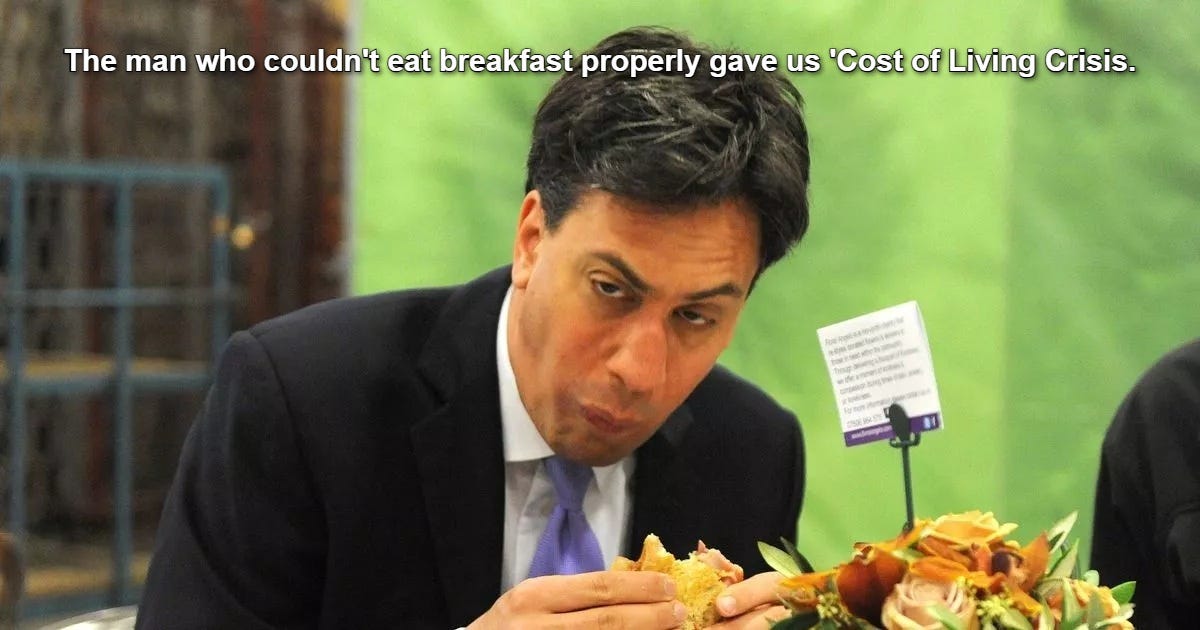
Didn’t save his career. In May 2014, he immortalised himself eating a bacon sandwich like he’d never encountered food before. Eyes squinting. Mouth agape. Fingers fumbling.
Ed Miliband’s legacy: gave us crisis-porn language AND couldn’t eat breakfast without looking like a muppet.
But the template worked. Lost the election? Doesn’t matter. The phrase survived. Politicians copied it.
By 2021, when real inflation hit, “cost of living crisis” was waiting, ready for its second act.
Miliband opened Pandora’s box.
And he’s still at it. Now Secretary of State for Energy Security and Net Zero, Miliband weaponises crisis language professionally.
July 2024: “the economic inequality that scars the country” and “the climate crisis that imperils our world.”
September 2024: “The greatest moral obligation we have is to do right by our children, our grandchildren and the generations to come.”
Translation: disagree with his policies, you’re morally failing future generations.
The man who invented “cost of living crisis” now runs an entire government department built on “climate crisis.”
Let me be absolutely clear:
People are struggling financially. Real people. Real pain. Wages haven’t kept pace. Energy bills are brutal. Families choosing between heating and eating.
That’s not bullshit. That’s real.
What’s bullshit is politicians using that genuine suffering as a linguistic weapon while doing fuck all to solve it.
Miliband’s “cost of living crisis” didn’t put money in anyone’s pocket. Didn’t lower bills. Didn’t build houses or raise wages.
It was a label. A political tool. A way to attack opponents while offering no solutions.
Real problems deserve real solutions, not theatrical language.
David Spratt & Philip Sutton (2007-2008) - The Australian Panic Exporters.
While Miliband was finding his feet, two Australians were busy.
David Spratt - Melbourne businessman and climate policy analyst.
Philip Sutton - environmental strategist, founder of Greenleap Strategic Institute.
2008 book: Climate Code Red: The Case for Emergency Action.
Their innovation? Upgrading “climate change” to “climate emergency.”
Deliberate psychological engineering.
“Climate change” sounds gradual. Manageable. Tomorrow’s problem.
“Climate emergency”? Visceral. NOW. Demands immediate response.
Fear sells better than facts.
Emergency language triggers fight-or-flight. Shuts down analysis. Activates primitive threat-detection.
They created a template. Templates get copied.
The Contagion.
Once the magic words were out, everyone wanted them.
If their issue was a “problem”, but yours was a “crisis,” which gets funding? Headlines? Attention?
Housing crisis. NHS crisis. Education crisis. Loneliness crisis. Gambling crisis. Obesity crisis. Knife crime crisis.
Climate emergency. Biodiversity emergency. Ecological emergency.
Every cause. Every campaign. Every bloody inconvenience.
We’ve professionalised catastrophe. Industrialised alarm. Monetised panic.
What Emergency Actually Means.
Emergency = seconds matter. Delay means death. Action is immediate and radical.
Real emergencies: Building on fire. Heart attack. Russia is firing missiles. Severed artery.
Not emergencies: Anything requiring a six-month committee meeting.
If you can “declare an emergency” and then spend eighteen months drafting an action plan, it’s theatre.
But the lie works. Emergency language hijacks your brain. Bypasses rational assessment. Goes straight to primal fear.
That’s the feature.
The Panic Factory.
They’ve put your nervous system on permanent alert.
Your brain thinks everything’s urgent. Catastrophic. Collapsing.
Your brain wasn’t designed for this.
Human threat-detection evolved for brief, intense, resolved emergencies. Tiger attacks. Floods. Fires.
Fight or flight. Then rest.
But you can’t rest when everything’s critical. Can’t switch off when emergencies are baseline. Can’t recover when alarms never stop.
Anxious. Hypervigilant. Exhausted.
Cortisol never normalises. Sleep suffers. Concentration fractures. Risk assessment deteriorates.
Then - punchline - they tell you: mental health crisis.
Did we create one by telling people they’re living through 47 simultaneous catastrophes?
Who Benefits?
Politicians.
Declare an emergency. Look concerned. Commission report. Draft plan. Do nothing. Repeat.
Declaration becomes action. Demonstrates seriousness. Requires no results.
Language substitutes for achievement.
Media.
Panic = clicks. Fear = engagement. Crisis = profit.
“Mild policy concern” doesn’t trend. “CRISIS! EMERGENCY! COLLAPSE!” gets 50,000 retweets.
Activists.
“Concern”? Scroll past. “Issue”? Ignore. “EMERGENCY”? Listening.
Escalate language, win attention.
Crisis language always wins. Everyone uses it.
Linguistic Inflation.
Cry wolf professionally, “wolf” stops meaning anything.
“Crisis” used to mean serious. Significant. Rare.
Crisis = turning point. Acute danger. Immediate action.
Now = “thing I want you to care about.”
Same word for “struggling to pay heating” and “supermarket’s out of biscuits.”
Print too much currency → worthless. Use “crisis” for everything → meaningless.
When a real emergency arrives, what language remains?
Already deployed nuclear option on toilet roll shortages.
Psychological Toll.
Told you’re living through multiple emergencies, two responses:
Constant Panic: Hypervigilant. Doom-scrolling. Spiralling. Sleep suffers. Concentration fragments. Helpless. Paralysed.
Complete Numbness: Background noise. Pile. Tune out. Can’t distinguish manufactured panic from actual threat.
You’ve been deliberately put in this state.
Bastards won’t stop. It works.
Real Problems Drown.
Everything critical? Can’t identify what needs attention.
Politicians declare seventeen emergencies? Which gets resources?
Media screams forty-three catastrophes? Which investigated?
Signal lost in noise.
Serious challenges ignored. Not “emergency” enough.
Emergency language precludes deliberation.
The Island Solution.
Maroon Miliband, Spratt, and Sutton on a remote island.
Let them declare emergencies at each other.
“Coconut crisis!” “Water emergency!” “Seagull catastrophe!”
Escalate endlessly: “Coconut EMERGENCY! CATASTROPHE! APOCALYPSE!”
Seagulls ignore them. Coconuts don’t care. Tide comes regardless.
The rest of us reclaim language, meaning something.
Perfect exile.
Your Bullshit Filter.
The Missile Test.
Is this missile’s incoming serious or just inconvenient?
Wait six months? → Not an emergency.
Consultation period? → Not a crisis.
Normal processes? → Not urgent.
Manipulating emotions? → Probably.
Can’t answer honestly? Manipulating you.
Demand Specifics.
What’s the problem? What’s the timescale? What actions NOW? What’s success?
No concrete answers? Selling panic, not solving problems.
Recognise Pattern.
Who benefits from my panic? What am I being made to do? What’s the distraction?
The Only Real Crisis.
Britain’s not in crisis.
Britain’s been talked into nervous breakdown by panic merchants.
Genuine emergency? Devalued language needed to identify actual threats.
Drowning in manufactured urgency. Real problems unaddressed. Can’t distinguish signal from noise.
Panic-fatigued population either believes everything’s an emergency (constant anxiety) or believes nothing’s an emergency (ignores threats).
Both catastrophic. Both serve panic-peddlers.
Anxious people: easy to control. Apathetic people: easy to ignore.
Screamers maintain attention, relevance, and power.
Stop Letting Them.
Someone declares a crisis:
Demand specifics
Check incentives
Apply missile test
Ignore theatre
Save “crisis” and “emergency” for things that warrant them.
Like missiles.
Not cereal shortages.
Words Used to Mean Things.
Miliband coined “cost of living crisis” (2013). Failed electorally. Succeeded linguistically.
Spratt and Sutton popularised “climate emergency” (2007-2008). Worked psychologically. Weaponised panic.
Now we live in their world.
Everything is labelled critical. Every inconvenience is an emergency. Panic default. Deliberation impossible.
The sky isn’t falling every Tuesday.
You’ve been conditioned to think it is.
Reclaim language, meaning something. Demand specificity over hysteria. Call bullshit on panic merchants.
Maybe send Ed, David, and Philip to that island.
The coconuts await.