
CRUMBLING BRITAIN: How Thirty Years of Managed Decline Became a Justification for Removing Your Rights.
They're not letting it crumble. They're demolishing it. One floor at a time. By John Langley — The Almighty Gob.

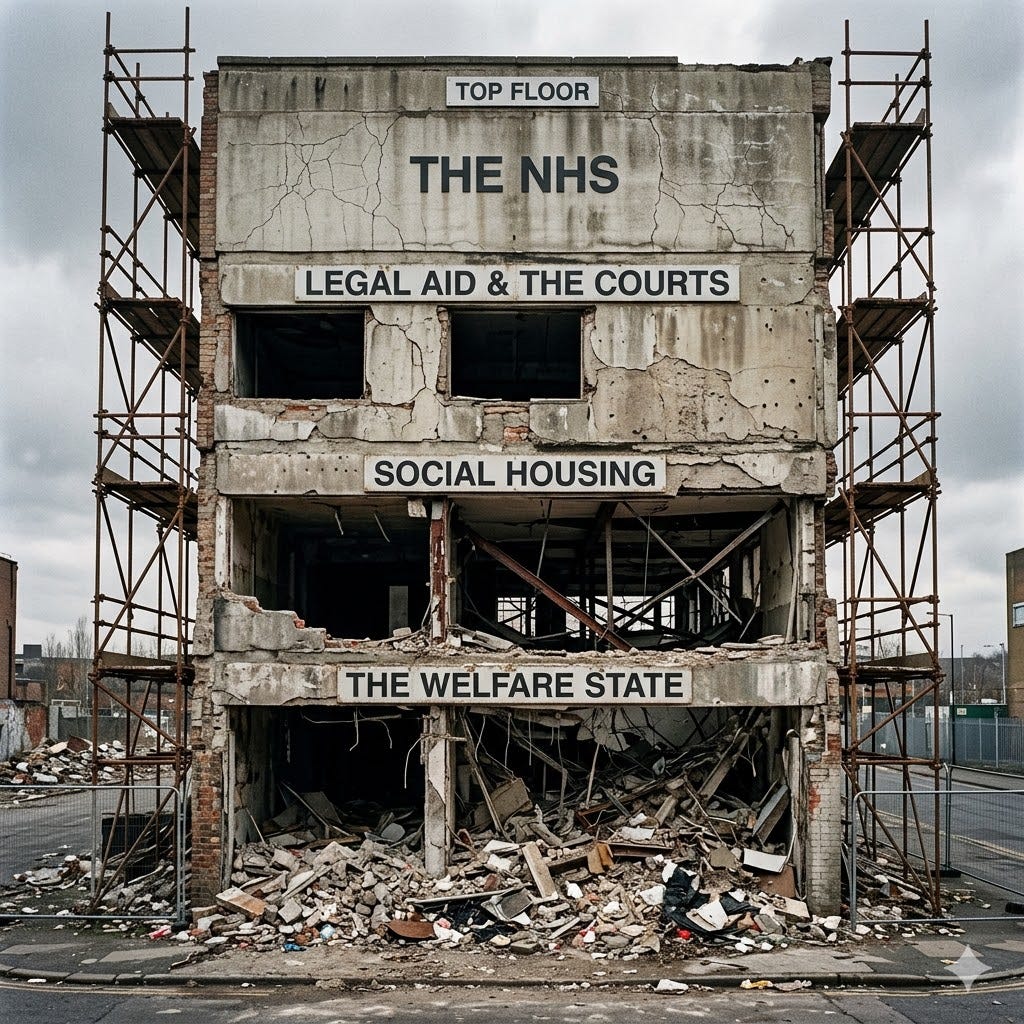
[Britain's NHS waiting list crisis, Crown Court backlog, UK housing crisis, and welfare cuts — four institutions. Thirty years. One pattern.]
Picture this. It’s 1949. The rubble of the war is still warm. Clement Attlee’s government — exhausted, broke, governing a country that had just spent everything it had on not being conquered — sits down and builds something. Not a monument. Not a celebration. A building.
A building with four floors. One for each of the things that a civilised society owes every person within it, regardless of who their parents were, what street they were born on, or how many zeros were in their bank account.
The NHS. Legal aid. Social housing at scale. A welfare state.
Four floors. Each one a promise. You will not die for lack of a doctor. You will not face the state alone in court. You will not sleep in the street. You will not starve because the market decided your labour wasn’t worth buying that week.
For the first time in this country’s history, the state looked at its citizens and said: we’ve got you. Not as a favour. Not as a charity. As a right. Nobody had ever said that before.
Seventy-six years later, they are demolishing it.
One floor at a time.
That is not a coincidence. That is a policy.
The Jury That Attlee Built.
David Lammy — Justice Secretary, former human rights barrister, the man who wrote in 2017 that juries were the only part of the criminal justice system that wasn’t institutionally racist — has introduced the Courts and Tribunals Bill.
Don’t let the name fool you. It is one of the most consequential pieces of legislation in three centuries of British legal history. Around half of all cases currently heard by a jury will no longer be. Up to 75% of defendants will face a single judge instead of twelve of their peers. The right that has existed in various forms since Magna Carta — the right to have ordinary people, not state-appointed officials, determine your guilt — is being removed.
The stated reason is the Crown Court backlog. 80,000 cases. Growing. Some listed as far ahead as 2029.
Here’s what Lammy doesn’t say when he wheels out that number.
The backlog exists because 239 courts were closed between 2010 and 2020. Because legal aid rates were frozen from 1998 until barristers went on strike in 2022. Because the number of duty solicitors under 45 fell by more than half between 2017 and 2024. Because the system was systematically drained of the capacity to function — and the jury had absolutely nothing to do with any of it.
The chair of the justice select committee said it plainly in the Commons: there is no evidence that juries caused the backlog.
None.
The man who wrote, in his own review, that juries were the only part of the criminal justice system that wasn’t institutionally racist is now removing them. Not because he was wrong in 2017. Because it’s cheaper in 2026.
The Criminal Bar Association was direct: the MoJ could reduce delay today by opening more courtrooms. The system was broken by underfunding. The solution is not to remove your rights. The solution is to fund the system.
But funding the system costs money. Removing your right to a jury is free.
So here we are. The backlog Lammy inherited was built by underfunding. His solution is to remove your rights. That is not justice reform. That is a fire sale.
And the jury is just the floor they’re working on this week.
The Waiting Room That Has No Exit.
Picture someone waiting. Not a statistic. A person. They went to their GP in 2022 with pain that wasn’t going away. They were referred. They are still waiting. They have rearranged their life around an appointment that keeps moving.
Nobody wrote to tell them the promise had been broken. It just quietly stopped being kept.
The NHS waiting list: 7.5 million people. The list stood at 3 million in February 2014. It has been growing, with brief pandemic interruptions, every year since. The 18-week standard — the constitutional promise that you would wait no longer than that for treatment — was met consistently from 2008 to 2015. It has not been met once since February 2016.
The Crown Court backlog: 80,000 cases. More than double the figure from 2019. Cases involving violence against the person — 31% of the total. Sexual offences — 17%. Drug offences — 14%. Serious cases, serious crimes, serious human consequences piling up in a corridor with nowhere to go.
The asylum backlog: average wait for an initial decision in 2024 — 413 days. And because the Home Office rushed decisions to clear one backlog, the appeals backlog exploded from 7,173 cases at the start of 2023 to 41,987 by the end of 2024. A 485% increase in two years.
Social housing waiting list: 1.34 million households. At current building rates, it will take 21 years to clear — assuming nobody else joins the queue. In London, one in every 21 children has no permanent home. 169,050 children in temporary accommodation right now.
And welfare. 800,000 people losing their PIP daily living component entirely under Labour’s new proposals. The average loss — £4,500 a year. The government’s own data shows PIP fraud at zero percent.
Zero.
They are removing benefits from people who are not defrauding the system. The DWP knows they are not defrauding the system. The DWP’s own figures say they are not defrauding the system. And they are removing the benefits anyway. Because it is cheaper than admitting the system cannot afford the people it was built to protect.
Five waiting lists. Five systems. One country. All breaking at the same time.
In any other context, you’d call that a pattern. In Westminster, they call it a perfect storm.
The Floor That Blair Sold.
Attlee built the building. Blair sold one of its floors.
The Private Finance Initiative wasn’t Blair’s invention — John Major introduced the mechanism in 1992 — but Blair deployed it at a scale Major never attempted. Private companies built the hospitals. Owned them. Leased them back to the NHS over 25 to 30-year contracts. The debt stayed off the balance sheet. The private profit was locked in for a generation.
By 2019, the National Audit Office found NHS trusts were paying over £2 billion a year in PFI charges — for buildings some were already struggling to fill with staff. Hospitals locked into contracts that consumed resources faster than any efficiency saving could replace them.
The buildings were shiny. The car parks cost £4 to enter. And if a light bulb needed changing on the ward, the PFI maintenance contractor charged £333 to do it. That figure is not a joke. It was exposed by Channel 4 Dispatches. It is what the contract said.
Somewhere, a facilities manager filed the invoice. Somewhere, a PFI shareholder received a dividend. Somewhere on that ward, the light stayed off a little longer.
The patients didn’t know, of course. You rarely do, when the bleeding is on the inside.
This is the pattern. Not one crisis. Not one government. Four decades. Four floors. Devolved and devalued. Structural demolition. And not one brick of it was put to a public vote.
It starts with a lease. It ends with a demolition order.
PFI bled the NHS slowly through contractual obligation.
PPE bled the public purse rapidly through deliberate chaos. £12 billion spent in the first year of the pandemic on a “haphazard purchasing strategy” — the Public Accounts Committee’s own words. £9 billion written off. £4 billion of PPE that is unusable in the NHS, subsequently burned to generate electricity. VIP lane contracts inflated by at least £925 million. On average, those politically-connected suppliers were paid 80% more per unit than anyone else.
Asylum hotel contracts bled it continuously. £2.1 billion in a single year on hotel accommodation alone. £5.77 million every day. Three private contractors making £380 million in profit. Britannia Hotels alone — £150 million since 2014. And the total contract cost, originally estimated at £4.5 billion over ten years, now projected at £15.3 billion.
£15.3 billion. To house people. In hotels. For profit.
While 1.34 million households wait for a social home that isn’t being built.
The same government that will not fund disabled people’s benefits. That will not fund the courts properly. That will not build social housing. That will not pay legal aid lawyers a living wage.
The money was always there. It just had somewhere better to be.
And then came the pandemic. Which didn’t cause any of this. But did make it considerably harder to ignore.
The Pandemic Knew Where the Bodies Were.
The Crown Court backlog isn’t primarily a surge in crime. The NHS waiting list isn’t primarily a surge in illness. The asylum backlog isn’t primarily a surge in global persecution — though global persecution has certainly not reduced.
They are the dam effect.
The pandemic closed everything simultaneously. Courts. Hospitals. Home Office casework. Construction. For two years, the normal flow of cases, patients, claims and decisions was blocked. When the dam broke, everything hit a system that had already been drained of capacity by a decade of cuts. The flood wasn’t bigger than usual. The river was narrower.
The flood didn’t break the system.
The system was broken before the flood arrived.
The 42% increase in violence against the person cases at the Crown Court compared to pre-pandemic levels — Ministry of Justice Crown Court statistics — isn’t evidence of a crime wave. It’s evidence of domestic abuse victims who couldn’t safely report during lockdown coming forward when they finally could. Of historic sexual offences being reported as cultural attitudes shifted. Of better police recording practices catching what was always there but previously invisible.
Meanwhile twenty thousand police officers had been cut between 2010 and 2017. When they were eventually replaced and began generating more charges, those charges joined a queue in courts that had been closing for a decade.
The system didn’t break under pressure. The system was already broken. The pressure just made it visible.
They planned for the flood. They didn’t plan for anyone noticing the riverbed.
What Attlee Understood That Starmer Has Forgotten.
Clement Attlee’s government built those institutions having watched European fascism demonstrate, with clinical precision, what happens when the individual has no meaningful check on the power of the state.
Jury trial is not an administrative convenience that can be traded away when the spreadsheet demands it. It is the mechanism by which twelve ordinary people — not state employees, not government appointees, not officials with careers to protect — stand between the individual and the full prosecutorial power of the state.
Jury equity — the right of a jury to acquit regardless of the judge’s view of the law — has historically protected defendants in politically charged cases. Remove the jury, and that protection disappears.
The welfare state is not a budget line that can be adjusted downward when the economy requires it. It is the material expression of a principle: that a person’s worth is not determined by their productivity.
The NHS is not a market that can be made more efficient through competition and private investment. It is a covenant. You pay in when you’re well. You receive when you’re not. No invoice. No excess. No small print. That was the deal. One side has kept it. The other has been quietly rewriting it since 1992.
All four are now being managed in the same direction — toward a residual system that protects only those with the greatest need, as defined by the state, assessed by the state, funded at whatever level the state considers sustainable.
They are not maintaining the building. They are removing the floors. One by one. Until there is nothing left to stand on.
Attlee looked at rubble and built a building. Starmer looks at that building and calls it rubble.
The rubble is the same. The difference is what you decide to do with it.
The Nuclear Question.
Here is the observation that the political class — of any party — will not acknowledge directly.
While £9 billion in PPE was written off and VIP lane suppliers collected their 80% premium, legal aid rates for criminal solicitors received no real terms increase. Courts were still closing. In 2023/24, there was a net loss of 650 social rent homes. Disabled people were being assessed for benefits through a system that the DWP itself acknowledged was broken.
The money existed. It was directed elsewhere. By choice. Through systems designed to allow it. And the institutions built in 1948 and 1949 to protect people who had no other protection paid the price.
That is not incompetence dressed up as governance.
That is governance designed to look like incompetence when it needs to.
Hanlon’s Razor says never attribute to malice what can be explained by stupidity. Fine. But at a certain point — after the fourth iteration of the same pattern, in the fourth institution, over four decades — the explanation begins to require a different razor.
One Final Observation.
Alan Bennett once wrote: “We’re all in the same boat — only some of us have got better cabins.”
The boat is taking on water now. The cabins at the top have been fitted with pumps — PPE contracts, PFI profits, asylum hotel revenues, private healthcare, private education. The lower decks are watching the water rise and being told the problem is the design of the drain.
Not the water. Never the water. Always the drain.
Lammy says the problem is juries. The DWP says the problem is disability claimants. The Home Office says the problem is small boats. The housing secretary says the problem is planning permission.
None of them say the problem is thirty years of treating every public crisis as a revenue opportunity for private interests.
None of them say the building Attlee built is being demolished because the people who profit from its demolition have the resources to ensure it continues.
None of them say who benefits from a population too exhausted, too broke, and too afraid to notice the pattern.
None of them say it plainly: the institutions are not crumbling. They are being demolished. Carefully. Profitably. And on schedule.
So we will say it.
They are rebuilding. Right now. Starmer’s missions. Reeves’ growth plan. Streeting’s NHS reform. Lammy’s court reform. All of them come with architect’s drawings. All of them come with announcements. All of them are being constructed from the same broken bricks — broken promises, failed targets, privatised contracts and consultants’ fees — that caused the original building to come down.
They would not pass building regulations. Building regulations exist to protect the people who live in the building. Not the developer. Not the contractor. The occupant.
There is no planning permission for what is being built. There is no structural survey. And what use is a building without a warranty — on a flood plain?
This is not a Labour problem. This is not a Conservative problem. This is what happens when the same logic — extract, outsource, underfund, blame the user — is handed from one government to the next without interruption for thirty years.
Fourteen Secretaries of State for Health. Eleven for Justice. Nine for Housing. All of them very concerned.
It wasn’t always like this.
In 1949, a broke and exhausted government looked at the rubble and built a building that stood for seventy-six years.
In 2026, the latest government is looking at that building, calling it rubble, and rebuilding it with the rubble — while the country drowns in thirty years of debt.
Attlee built for the people who never had a cabin. What’s being built now is for the people who are already choosing their view.
That is the only difference between them.