
Don't Look Over There. Look Over Here.
How democracy lost the free world. Twenty-five years. One trick.

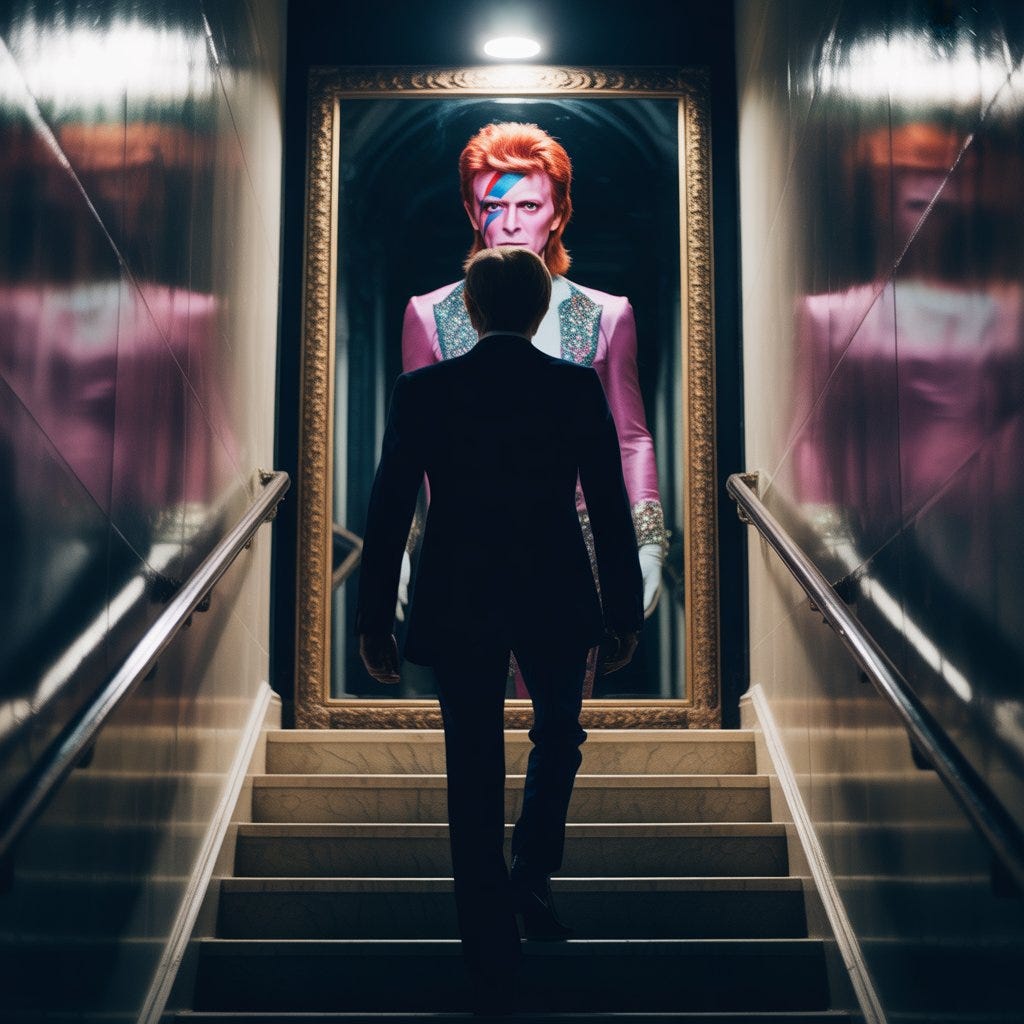
[The man on the staircase. The reflection that looks the other way. Bowie wrote the song in 1970. The free world is still climbing those stairs.]
David Bowie wrote a song in 1970 about a man who meets himself coming the other way.
Not a ghost. Not a dream. Just a man, on a staircase, looking at a version of himself that got somewhere he doesn’t remember going. The other one looks fine. Comfortable, even. The other one made a deal somewhere back along the corridor and has lived well on the proceeds.
“You’re face to face”, Bowie wrote, “with the man who sold the world.”
The song sits there quietly for fifty-six years. And then 2026 arrives.
And the free world — the thing that was supposed to be the point of everything, the reason for the alliances and the institutions and the speeches and the flags — walks past itself on a staircase. Looks at what it’s become. Doesn’t quite recognise the face. Democracy. Autocracy. The slow transfer of one into the other while everyone was watching something else.
The deal was made. Nobody remembers signing.
Let me tell you how that happened.
Here’s the trick. It’s not complicated. It’s so straightforward, in fact, that once you see it, you’ll find yourself wondering how you didn’t see it before. And then you’ll stop wondering, because you’ll already know why.
Pick a threat. Make sure it’s real enough to feel genuine — because if it isn’t real at all, people notice eventually. Make it visible. Make it culturally distinct. Make it the kind of thing that activates the oldest part of the human brain — the part that runs on belonging and fear and us and them before a single rational thought has had time to form.
Then point at it.
Point at it hard, and long, and with the full weight of governments and newspapers and television studios and think tanks and a seemingly endless supply of commentators who are always, somehow, available at short notice. (Never once needing to be asked twice. Funny, that.)
And while everyone is looking over there —
do whatever you like over here.
The mosque didn’t dismantle the free world. The ballot box did.
The numbers are worth sitting with for a moment, because they have the decency to be honest even when everyone else isn’t.
Freedom House tracks political rights and civil liberties across 195 countries. They’ve been doing it since 1973. In 2006, 46% of the world’s people lived in countries they rated as Free. In 2026, that figure is 21%. The V-Dem Institute — whose democracy dataset runs from 1789 to the present, built by more than 4,200 scholars — found that global democracy is now back at 1978 levels.
Twenty consecutive years. Nearly half the world’s free population. Gone.
None of it taken by the threat everyone was told to watch.
Six of the ten countries newly identified as autocratising in 2026 are in Europe and North America. The United States — the country whose president has carried the title “leader of the free world” since Eisenhower — was this year stripped of its liberal democracy classification for the first time in over fifty years.
Not by jihadists. By its own executive branch.
Hungary slid into democratic capture while the West was busy checking flight manifests. Poland wobbled. Italy backslid. The UK’s own rule of law indicators are deteriorating. The institutions built after 1945 to make another 1939 structurally impossible are being quietly, methodically, cheerfully dismantled — and the people doing the dismantling are on the news every night, tie straight, flag pin in place, talking about freedom. (The flag pin is a nice touch. Very reassuring. I always feel better about a man’s intentions when he’s remembered to wear the flag.)
There’s a word for this. It arrived, as the best words do, without being sent for.
Transmorphing.
The attacks were real, the dead were real, Iran is real — and none of that is in dispute. What gets transmorphed is the scale: a genuine threat inflated into an existential one, while the actual dismantling happened somewhere else entirely.
What gets transmorphed is the destination. The emotion stays genuine. The target gets quietly promoted beyond its actual size. And by the time anyone notices, the new target feels like it always was. Of course it was. Look at them. Look at what they believe. Look at what they’re doing to our —
Our what, exactly?
Our freedoms? The ones currently scoring their lowest marks in twenty years? Our democratic institutions? The ones being hollowed out by people with six-figure salaries and security details? Our way of life? The one being restructured, as you read this, by a government in Beijing that has quietly become the preferred development partner for more than half the planet — not because anyone particularly loves what Beijing offers, but because what Washington used to offer has been withdrawn, and the gap needed filling, and China was standing there with a chequebook and no questions about your human rights record?
They handed China the vacancy and called it patriotism.
This is how it actually works in 2026. Not the story told on the news.
The free world — such as it is, and it is less than it was — has no leader. The United States abdicated. The space that left is being filled, methodically and without apology, by a country that has never pretended freedom is part of the offer — whatever its domestic record on lifting populations out of poverty, and that record is real. China’s strategy isn’t complicated either. It watched Washington spend twenty-five years burning its own soft power, alienating its allies, and torching the institutions it built — and it waited. It removed tariffs on African imports while Washington raised them. It expanded infrastructure projects while the US slashed foreign aid. It showed up to multilateral forums while the US walked out of them.
For country after country across Africa, Latin America, and Asia, the question is no longer ideological. It’s practical. Who turns up? Who brings the money? Who doesn’t lecture us?
China turns up. (On time, as well. With the paperwork already done.)
If you want a single image that captures where we actually are in 2026, try this one. In January of this year, the British government approved the construction of the largest Chinese embassy in Europe. Twenty thousand square metres. Former Royal Mint Court. Right in the heart of London. Approved over the objections of the US government, the Joint Committee on National Security Strategy, MI5’s own public warnings about Chinese espionage, and hundreds of protesters in the street. (The protests were very well attended. Nobody changed their mind.)
Why London and not Paris, Berlin, or Amsterdam? Because London is where the money moves. Beneath that site run the fibre optic cables carrying the financial transactions of the Western economy. Paris has the politics. Berlin has the manufacturing. London has the cables. China didn’t buy a building. It bought a position — 200 metres from the Tower of London, next to the data infrastructure of the Western financial system — from a government that needed the trade relationship more than it feared the proximity. British exports to China fell 23% in the same period. They approved it anyway.
They handed China the vacancy. Then they handed it the postcode.
Meanwhile, the culture war runs. The “great replacement” runs. The mosque stays visible — not as a source of the damage, but as the designated address for the anger. The immigrant stays visible. The otherness of the other stays carefully, consistently, professionally visible — because visible otherness is the most reliable mechanism ever devised for keeping people from looking at what’s in their own pocket.
What’s in the pocket? The living standards. The housing. The public services. The pension. (The pension that keeps getting further away, like a bus stop that moves every time you get close to it.) The things that were quietly redistributed upward while everyone was busy being furious in the right direction.
Look over there.
And here’s the part that keeps you up.
There’s something almost elegant about it, in the way that a con is sometimes almost elegant, if you can bear to admire the craft while knowing the damage it did. (My mother would have called it brass neck. She’d have meant it as criticism. I’m not entirely sure it is.) The people running the look-over-there operation didn’t need everyone to believe it fully. They just needed enough people to believe it enough of the time to fill the space where scrutiny would otherwise be.
And it worked.
Twenty-five years of declining freedom, declining institutions, declining democratic norms — and the dominant cultural narrative remained: the threat is over there, it wears a different face, it prays differently.
It came from somewhere else.
It didn’t come from somewhere else.
It grew up here. It went to school here. It learned the language of freedom fluently and used that language to take freedom apart, piece by piece, while pointing at the horizon and saying — look. Look at that.
And enough people looked.
That’s not stupidity. That’s a brain stem doing exactly what it evolved to do — identify the visible threat, mobilise the tribe, protect the border. It’s a two-hundred-thousand-year-old system running in a twenty-first-century world it was never built for. (It was designed for savannahs and predators, not think tanks and rolling news. In fairness, nobody told it.) It doesn’t make people foolish. It makes them human.
The people who knew that, and used it — that’s a different conversation.
You were played. Professionally. By experts. And they’ll do it again tomorrow.
In 1993, Kurt Cobain sat on a stool at MTV Unplugged and sang David Bowie’s song.
No band. No distortion. Just a voice and an acoustic guitar and a room full of people who didn’t yet know they were watching a farewell.
He didn’t write The Man Who Sold the World. That was Bowie’s — a man, a staircase, a version of himself he didn’t recognise. A deal half-remembered. A world half-gone.
Cobain sang it like he understood the ending.
Stripped of everything, quiet as a confession, he sat there and delivered someone else’s words about a man who sold the world — and somehow made it sound like the most honest thing that had been said in years. No flag pin. No think tank. No commentator available at short notice. Just the song, and the voice, and the thing the song was actually about.
Five months later he was gone.
The free world is real. Smaller than it was, leaderless, underfunded, and under pressure from inside as well as out — but real. Not perfect. Not the only model anyone has ever proposed. But the best working arrangement for human freedom currently available — and it is shrinking. What’s replacing it isn’t Islam. It’s a transactional authoritarianism that doesn’t need you to believe anything, just to comply — one handed its best recruiting tool not by any external enemy, but by the democratic world’s own decision to spend a generation staring at the wrong horizon.
Twenty-five years. One trick.
The world watched where it was told to watch.
The deal was made. Most of us signed without knowing.
Sometimes the cover version is the honest one.
The article that follows this one begins with a plastic kettle. It ends somewhere considerably less comfortable.
And the free world quietly left through the back door, while everyone was busy watching the front.
Now, if you enjoy playing join the dots, help yourself. You’re welcome.
Sources.
Freedom House — Freedom in the World 2026: The Growing Shadow of Autocracy 👉 https://freedomhouse.org/report/freedom-world/2026/growing-shadow-autocracy
V-Dem Institute — Democracy Report 2026: Unraveling the Democratic Era? 👉 https://v-dem.net/documents/75/V-Dem_Institute_Democracy_Report_2026_lowres.pdf
Council on Foreign Relations — Freedom House’s Annual Report Shows the Dire State of Democracy Worldwide 👉 https://cfr.org/articles/freedom-houses-annual-report-shows-the-dire-state-of-democracy-worldwide
HuffPost UK — Controversy Around China’s New Mega-Embassy in London, Explained 👉 https://huffingtonpost.co.uk/entry/controversy-around-chinas-new-super-embassy-in-london-explained_uk_696f6412e4b02f48956d2fcc
The Almighty Gob is a Bristol-based publication covering politics, power, and the gap between what institutions say and what they actually do — from City Hall to the White House, from the corner shop to the Moon. Publishing since 2020, with over 500 pieces including 88+ Bristol FOI-based investigations, The Almighty Gob operates across nine social media platforms, Substack, and thealmightygob.com — reaching readers who prefer their politics without the packaging.