
Dubai. I-ran. Home.
British celebrities and tax exiles fled to Dubai to escape Britain. Iran just reminded them where home actually is.

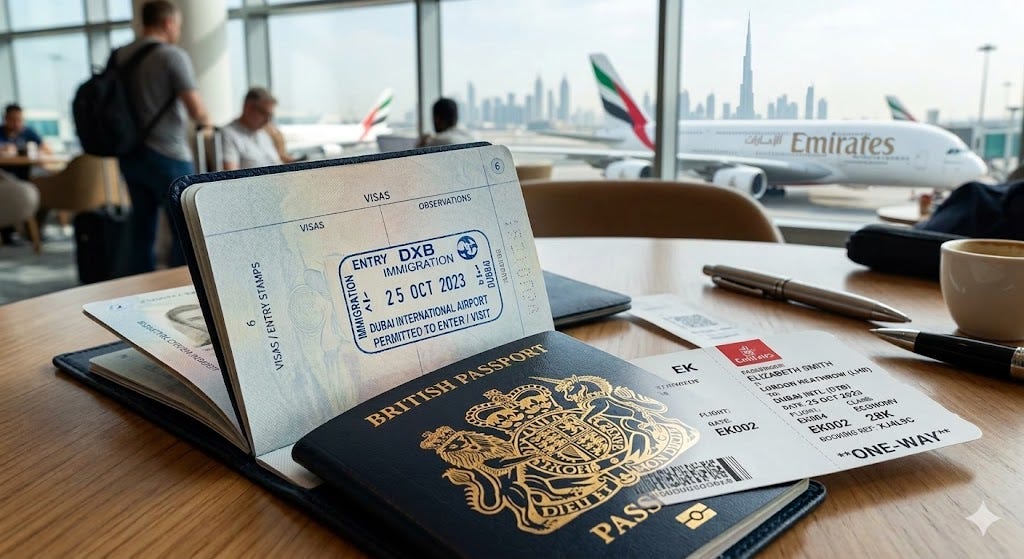
Picture the announcement.
Not the departure itself. The announcement. The carefully lit selfie at the airport. The caption about finally making the decision that needed making. The comments — hundreds of them — from people saying good for you and you deserve this and honestly, who could blame you?
Nobody films the basement.
On the night of the 28th of February 2026, Rio Ferdinand — former Manchester United and England defender, proud Dubai resident, a man who had cited lifestyle, safety, and weather as his reasons for relocating his family — was in one. A basement, beneath his Dubai home, while missiles and drones crossed the airspace overhead. The children had a sleepover down there.
That is the basement. Not a concept. A place. The place you end up when the life you announced meets the life you are actually living, and the gap between them becomes, briefly, impossible to ignore.
Every leaver has one. The ones who went quietly always knew it was coming. The ones who went loudly tend to discover it later — and in considerably less comfortable circumstances.
And here we are. Exactly where this was always going.
They came in waves. Footballers first, then the media class, then the influencer tier, then the commentariat, and finally — because there’s always a finally — the people who built entire careers explaining why Britain was broken while accepting British salaries, British audiences, and British platforms to do it from.
Dubai had a pitch. And the pitch was good.
Zero income tax. Year-round sunshine. Safety. Stability. A golden visa. An emirate that had understood something the British political class apparently hadn’t: that if you make a place worth living in, people will pay to be there. And if you make a place worth being seen in, they’ll pay considerably more than that.
This was never accidental, of course. Governments that want something tend to arrange for it to happen. The UAE government built a Creators HQ programme aimed at entrepreneurs, introduced a renewable ten-year Golden Visa, and by 2025 had an estimated 50,000 content creators installed and producing. Every perfectly lit Instagram post an unpaid advertisement. Every relocated British celebrity a proof of concept. It is quite an efficient system. The product was not Dubai. The product was the idea of Dubai. And the idea was selling rather well.
So they went.
And for a while, the content was impeccable.
How long did you think that particular arrangement would hold?
“We came to Dubai to feel safe.” — Petra Ecclestone, two months after relocating her family.
On the 28th of February 2026, the United States and Israel launched coordinated strikes on Iran.
Iran responded.
One missile. One hotel fire. One Arabic emergency alert landing on one phone at two in the morning.
It is remarkable, really, how much can unravel from so little. An entire personal mythology built post by post, caption by caption. And then one night in a region that was never asking permission — and the whole arrangement began, quite calmly, to show itself for what it was.
By the time the first wave of missiles crossed into UAE airspace, the Fairmont hotel on Palm Jumeirah was on fire, debris had struck the Burj Al Arab, and Dubai International Airport had been hit. One person was killed at Abu Dhabi’s Zayed International Airport. Seven more were injured.
The phones of British Dubai went off simultaneously. Every notification a small, private verdict.
Kate Ferdinand — wife of Rio, mother of several — told her 1.4 million Instagram followers that the family was safe. It had been, she said, “a very scary night.” Rio described it as “a bit of a different week.”
A different week. You wonder what an ordinary week looks like, by that measure.
Apprentice contestant, vocal critic of British weather and British crime, December transplant — was posting selfies requesting updates. One notes that the weather, at least, had improved considerably.
Laura Anderson, Love Island alumni, who had landed in Dubai with her two-year-old daughter just hours before the strikes, updated her followers: “I just witnessed what appeared to be a missile flying over my house. It’s surreal this is actually happening.”
Joey Essex, who relocated after his UK home was broken into and was formally welcomed to his new life by Dubai officials at the Burj Al Arab, was suddenly very keen to leave. His assessment on arrival, recorded for posterity: “First ever day in Dubai, get me out of Dubai immediately.”
And Graeme Souness — stranded at Abu Dhabi airport in his capacity as a Liverpool club ambassador, posting videos from the departure gate while “pretty loud bangs” went off overhead — offered the evening’s finest line. His mother, he told his followers, used to say: wherever you are, son, there’s never a dull moment.
She was right.
Richard Keys — the former Sky Sports presenter who reinvented himself at beIN Sports and has been anchored to the Gulf region ever since — told his followers it had been “a bit lively earlier.” No show today.
And then there’s Isabel Oakeshott.
Oakeshott relocated to Dubai in 2024. Her stated reason: Labour’s VAT on private school fees. Britain, she concluded, with its tax burden and its Labour government, was simply no longer compatible with her requirements.
From Dubai, she continued her commentary. The country she had left behind remained a reliable subject. Contempt, it turns out, is considerably more portable than tax liability.
Then the missiles started flying, and she began posting emergency alerts from her luxury flat. In Arabic first. Then English.
A bilingual emergency alert. Received by a woman who built a sizeable public profile around concerns about migrants not integrating, not learning the language, not embracing the culture of their adopted country.
One notes, without particular emphasis, that she had not learned Arabic. One notes also that the contradiction had been sitting there, patient and unhurried, waiting for precisely this kind of evening.
She was now, technically, that migrant.
The internet reached its conclusion almost immediately. It filed it under: as expected.
Ed Davey rose in the House of Commons. “We rightly expect our brave armed forces to protect British citizens around the world in crises like this,” he said. “But that includes tax exiles like Isabel Oakeshott and washed-up old footballers who mock ordinary people who stay in the UK and pay our taxes here.”
Oakeshott called him a talking potato. Said it was a badge of honour. There is a particular kind of confidence that comes from never having had to consider the consequences of your own position. She has it in abundance.
Susanna Reid asked, on live television, whether Brits who had moved specifically to avoid British tax — and who now needed British protection — should fund their own evacuation.
It is a question that deserves a straight answer.
Does it not?
“They declined to fill in British government evacuation forms just in case it somehow turned into a tax form instead.”
— Emirati analyst Amjad Taha, speaking to the Financial Times, March 2026
Because the mockery is deserved. The irony is real. The sight of people who made content out of leaving Britain — who turned their departure into a revenue stream — now tagging the British Prime Minister on Instagram asking for help is not irony. It is the bill arriving.
But it is not the whole story. Not even close.
Not everyone who left made a production of it.
A record 110,000 Britons aged 16 to 34 left the UK in a single year. They did not post about it. They did the mathematics — housing costs, student debt averaging £53,000, stagnant wages, crumbling services, the quiet and persistent sense that the contract between citizen and state had been quietly voided — and the mathematics did not work out in Britain’s favour.
Nurses. Engineers. Teachers. Junior doctors. Software developers. Graduates who did everything they were supposed to do, accumulated everything they were told to accumulate, and then looked at what was available on the other side of it and concluded: not here.
The country did not lose them. It priced them out and watched them go.
A handful of people making rather a lot of noise had, it turns out, been obscuring a considerably larger and quieter story running underneath. Nobody thought to ask why the quiet ones were leaving.
None of this was difficult to see, for anyone who was looking at the right thing.
Back in November 2025, I examined something that nobody in the mainstream press wanted to sit with for very long: the peculiar spectacle of people who had spent years voicing concerns about Muslim immigration to Britain, quietly relocating to a country that is 75% Muslim, where Islam is the official religion, where Arabic is the official language, and where 88% of residents are expatriates. That piece is here.
It was never about culture. It was never about values. It was never about the erosion of anything. It was about economic anxiety — specifically, the anxiety of people who had enjoyed a particular position in the British social hierarchy and watched that position become less affordable, less secure, less exclusive. Dubai offered them what Britain used to: tax-free earnings, status, a servant class safely positioned lower down the economic order, and a lifestyle that photographed well.
Patrice Evra settled there and calls it home sweet home. Dwight Yorke has lived there for years. Wayne Lineker built a business empire on the Palm. There are others you may well know of.
None of them are hiding from Muslims. They are living amongst them. Perfectly happily. Because it was never the issue.
The issue, for a very specific type of British leaver, was always economic equality at home. Dubai resolved that. For a price.
“It’s not immigration they oppose. It’s equality.”
“This is Dubai’s ultimate nightmare,” wrote Cinzia Bianco, an expert on the Persian Gulf at the European Council on Foreign Relations, as the missiles flew, “as its very essence depended on being a safe oasis in a troubled region. There might be a way to be resilient. But there is no going back.”
The five-star Fairmont on Palm Jumeirah. The Burj Al Arab. The airport. The port of Jebel Ali.
The landmarks they posed in front of. The backdrop they sold the dream against.
On fire, or very close to it.
The pitch was the place. The place was burning. That is the something else.
What the UAE constructed with such precision was always sensitive to exactly this sort of interruption. A single cascade of decisions — none of them made in Dubai, none of them particularly concerned with the feelings of fifty thousand content creators — produced consequences that no amount of golden visas or beach club memberships was designed to absorb. The product was safety. It is a slightly awkward thing to discover that the one feature you are unable to manufacture is the one your customers came for.
They are coming home now. Some quietly, some noisily, some insisting they are not coming home at all — merely passing through, briefly, for logistics, for reasons entirely unrelated to the missiles.
Petra Ecclestone flew home business class a few days after the worst of it. She was not escaping, she said. She needed to get her daughter to a horse show in Europe.
The internet politely disagreed.
The ones who left without fanfare will not make an announcement about returning. They will simply look at the numbers, and make the calculation again. And if Britain has built the houses and made the mathematics work — some of them may come back.
If it has not, they will not.
The tax exile problem is embarrassing. The evacuation form problem is funny. The Oakeshott problem has a very long shelf life. But the brain drain does not repatriate on a charter flight. The 28-year-old who left for Toronto, Berlin, Sydney, or yes, Dubai — quietly, without a selfie, without a brand deal — that person needs a reason to reconsider.
Not a speech about patriotism. Not a lecture about contribution.
A calculation that works.
There is, as it happens, an alternative.
Cornwall has been making its case for independence for decades. Quietly, stubbornly, in the way that only a peninsula separated from the rest of England by the River Tamar and several centuries of distinct identity tends to do. The Cornish flag flies from pubs. The word Kernow appears on bumper stickers. The pasty is protected by law.
Does Cornwall offer zero income tax? Not yet. Does Cornwall offer guaranteed sunshine twelve months of the year? It does not. Does Cornwall offer the kind of influencer backdrop that sells a luxury lifestyle to millions of followers?
Well. Have you seen the sea at St Ives on a clear morning in June?
The point is this: everything that Dubai sold as a pitch — the blue water, the sense of somewhere separate, the feeling of a life lived slightly outside the rules that apply to everyone else — Cornwall has been sitting on for centuries. Without the missiles. Without the autocracy. Without the emergency alerts.
And crucially: when Cornwall eventually does secure its independence, and when the phones light up with people suddenly remembering where they actually come from — perhaps the British government ought to have a consulate ready. Given that the dispute between Cornwall and the rest of Britain has been running considerably longer than the dispute between the West and Iran, it seems the kind of thing worth planning for.
The basement, as it happens, travels with you. It always did. That was rather the point.
Nobody films the basement.
They film the announcement. The departure. The palm tree and the cocktail and the caption that says this is the life and the comments from people who stayed, tapping the little heart — because what else are you going to do.
The basement comes later. It is where you work out whether the place you left to get away from is, in fact, the place that still has to come and get you.
For some of them, it was. For the ones who left without ceremony, and will return without ceremony — or will not return at all — the question is different. It always was. And the answer? That one belongs to the people who valued Britain as their home.
CITATIONS & SOURCES:
UAE Golden Visa / Creators HQ programme — Creators HQ
50,000 content creators based in Dubai — Stratrich
Ed Davey parliamentary statement on tax exiles — Liberal Democrats
110,000 UK emigration figure — Migration Observatory, University of Oxford
£53,000 average student debt — House of Commons Library
Cinzia Bianco / ECFR on Dubai’s shattered safe haven image — NewsNation / AP
Amjad Taha on influencers declining evacuation forms — Financial Times / The Independent
Previous investigation: Bristol City Council housing failures — The Almighty Gob
thealmightygob.com — built on FOI requests, primary source analysis, and a consistent refusal to pretend that things are fine when they are not.