
East Bristol, Bath, Croydon and the LTN Resistance That Won't Go Away.
The story of a cigar and a council whose plans continually go up in smoke.

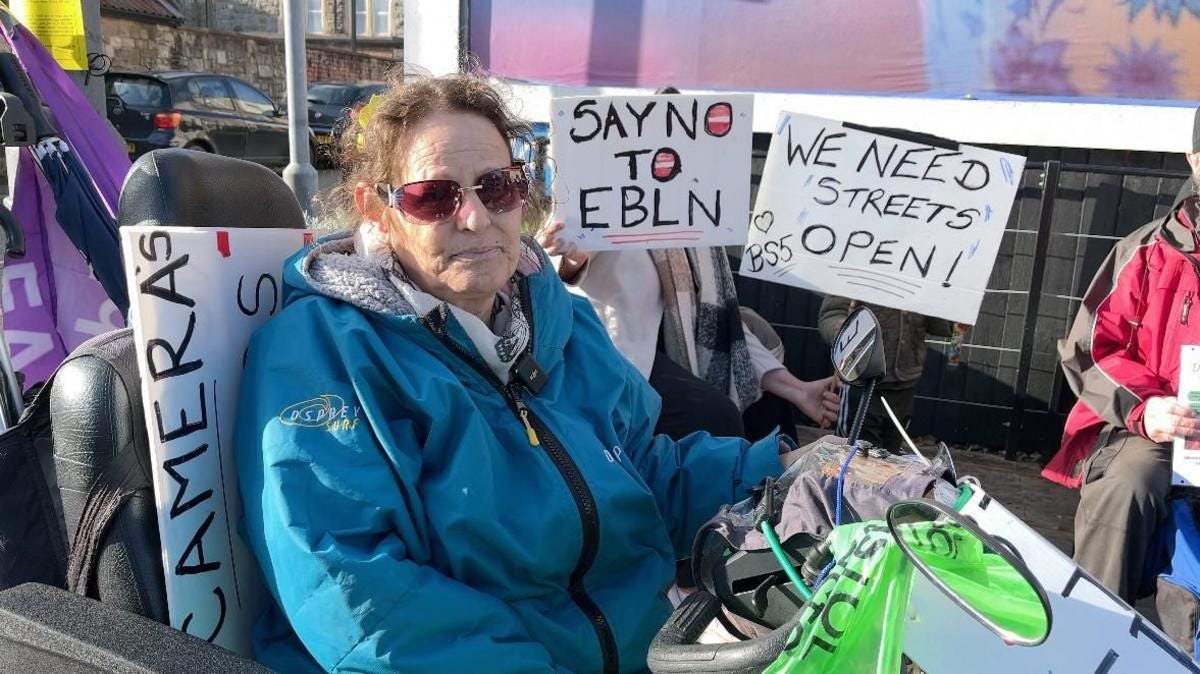
[The lived experience. Not the news cycle experience. East Bristol, Bristol — TheAlmightyGob.com]
In East Bristol, Bath and Croydon, residents are fighting Low Traffic Neighbourhood — LTN — schemes through physical blockades, High Court challenges, and fines that nobody can collect.
So. Here I am, again. Another Saturday morning in Bristol.
The sun is blazing. People out shopping, just getting on with their lives. To my right, a man at an adjacent table — Panama hat, big fat Cuban cigar, burning away slowly. Because smoking a Cuban cigar isn’t something you rush. It’s time burning away very deliberately, very slowly, and he’s doing exactly that — watching the world go by, taking everything in, settled in his own meditative state. It’s not a cigarette. It’s not anything else. It’s a cigar. And there’s a difference.
It reminds me of the days when I used to sit and enjoy a cigar myself. I think of those Cuban ladies, legendarily rolling them between their thighs. It brings back the memory of a Montecristo No. 1 — which by all accounts, compared to back then, would probably cost a week’s wages nowadays. Walking into a real tobacconist in those days was something else entirely. An emporium. Cigars in tubes displayed at the front counter. And behind — the humidor. Dark oak cabinets, stacked, each one carefully maintained. Like a bonsai tree, except without the pruning. Every cigar at exactly the right temperature. Exactly the right humidity. Waiting.
I had my own personalised cigar cutter. And there was a ritual to it. A glass of vintage port or a robust brandy — either would do. You’d clip the end, dip it briefly, and then you’d smoke it. Slowly. As it was always meant to be done. Back then.
That was a life. A somewhat lovely life. In some respects anyway.
That’s my case for the defence. Now. The real story of the day has no nostalgia to it. None whatsoever.
I’ll be honest with you. I’ve had a brain-numbing few days. Heavy research, heavy writing — the kind where every sentence has to be load-bearing, every fact checked twice, every claim able to stand up and not be argued with. Well, it can be argued with. But it would be rather futile to do so.
So this feels different. Because this isn’t one of those pieces. This isn’t a story requiring painstaking hours of research and re-editing until every fact is airtight. The evidence doesn’t need constructing. The research is no further than a scroll. The story is right here, laid out plainly, in front of anyone willing to look at it.
It just needs reporting.
In East Bristol, Bath and Croydon, residents opposed to Low Traffic Neighbourhood schemes — LTNs — have been fighting Bristol City Council, Bath and North East Somerset Council, and the courts themselves. Protests at bus gates, a High Court judicial review, and fines nobody can collect. The resistance, it turns out, is not a passing mood.
The Lived Experience vs The News Cycle Experience.
And what it’s about isn’t some imported cause. Nobody here is waving flags about something happening three thousand miles away. Nobody’s marching through a city centre with borrowed outrage about a conflict they’ll never be directly affected by.
There is a difference — and it matters — between the lived experience and what might be called the news cycle experience. The lived experience is your road, your business, your school run, your driveway. The news cycle experience is a cause you’ve adopted, a position you’ve taken, a march you’ve attended. One has consequences. The other has a hashtag.
This is something altogether more honest, more human, and — if we’re applying the question of what actually matters — considerably more important.
This is people standing in their own road.
A Cuban cigar burns at over a thousand degrees at its core. You wouldn’t know it to look at it. The frustration of the people of East Bristol is exactly that. Contained. Sustained. And still burning.
And like that cigar burning slowly to my right — they’re not going anywhere. Patience, it turns out, is not a weakness. It’s a thousand degrees, contained. And somewhere there is virtue in both. Not a trace of signalling.
Three Roads. Three Fights. One LTN Resistance.
In Barton Hill, Bristol, on the morning of 17 April 2026, residents physically blocked ETM contractors from installing a relocated bus gate on Avonvale Road. Not a petition. Not a strongly-worded letter to their MP. They stood in the road. The truck stopped. The work stopped.
This was not the first time. Not the second time. Not the third time. In all weathers, this community has turned out — and every time, Bristol City Council has chosen to come back. A different hour. A different approach. Once, notoriously, in the early hours, with contractors, police, drones and a helicopter. Bristol City Council chose to bypass democratic consent while most people were asleep.
There is no violence here. No aggression. No hostility. Just people, standing in their road. The simplest form of protest. The most meaningful form of protest. The most sensible and logical form of protest that doesn’t wear anyone else’s badge — only its own.
Around 240 people had already formally objected to the relocation plan. Cllr Ed Plowden — Green councillor, chair of the Transport and Connectivity Policy Committee — described the blockade as the work of “a small group of protesters” causing disruption and increasing costs.
Small group. Noted. They’ve been a small group every single time. And every single time, they’ve shown up anyway.
The new bus gate location was right outside Hamblins fish and chip shop, owned by Armin Amadi, who has argued consistently that the original blockade had already devastated his trade. The council’s answer to that problem was to move the problem directly to his front door.
One protester reported being told by a police officer that thirty officers would return to force the works through. The council said this was “not something we’re aware of.”
You can assess that for yourself.
“The council continues to install barriers. The residents continue to show up. One side is being paid to be there. The other one isn’t.”
Bristol City Council’s Documented Form.
Regular readers of The Almighty Gob will recall this is the same council with well-documented, extensively reported form for saying things that subsequent events then contradict with some enthusiasm. What the Acronym LTN Really Means: Lies To Neighbourhoods? examined the consultation failures and the legal precedent set by the West Dulwich judicial review. The Road Tax They Forgot To Mention connected Mr Justice Pepperall’s ruling on 4 March 2026 — quashing six Croydon LTN schemes found to have been operated primarily as revenue generators — directly to Bristol’s own enforcement model. Both are available at thealmightygob.com.
Supporters of LTN schemes will point to air quality data, reduced rat-running, and safer streets for cyclists. Those arguments deserve the Three Questions Framework in return. Is it practical — when traffic doubles past a school on a road with blind bends? Is it logical — when 74 per cent of directly affected residents say no and councils proceed regardless? What is the likely outcome — when the High Court has already answered that question in Croydon?
The argument has not changed. If anything, like a Montecristo left unattended, it has only got stronger.
Bath: The High Court LTN Challenge.
Now. Twelve miles down the road, residents aren’t blocking contractors. They’ve gone straight to the High Court.
The Heart of Lansdown Conservation Group has filed a statutory challenge against Bath and North East Somerset Council, with lawyers submitting a 40-page statement of claim alleging seven legal failings relating to the Lower Lansdown and The Circus LTN. The challenge is live. No ruling has yet been delivered. However, the documented evidence the claimants are working with is not ambiguous.
The council’s own monitoring data showed one road experienced a 115 per cent surge in traffic — more than 1,100 extra vehicles per day. Locals called it bedlam. The council called it progress and made the scheme permanent anyway.
Traffic on the lower part of Sion Road — a road with blind bends — roughly doubled. Sion Road passes Kingswood Prep School.
Read that again slowly. Traffic past a school, on a road with blind bends, doubled. The council acknowledged this. Then made the scheme permanent anyway.
“74 per cent of residents said no. The council heard them clearly. Then proceeded regardless.”
Is it practical? No. Traffic doubles elsewhere. Is it logical? Not when 74 per cent of the people you serve are telling you it isn’t. What is the likely outcome? There’s a 40-page legal document with some specific thoughts on that.
The council says it will “vigorously contest” the challenge. Councils always vigorously contest things — right up until the point a judge tells them they don’t have that option. Mr Justice Pepperall was available for comment in Croydon, 4 March 2026. Ask Bristol City Council how that one landed.
Croydon: The Ghost in the Honda.
Meanwhile. Somewhere in London, a Honda driver has been passing through LTN cameras long enough to accumulate a reported £254,683 in penalty charge notices. Islington Council has failed to identify the owner. The motorist has paid £80.
No placard. No legal team. No early-hours confrontation with a contractor’s truck. Just a car, a camera, and a quarter of a million pounds sitting on a spreadsheet that nobody can collect.
This is what happens when an enforcement model built entirely on the assumption of compliance meets people who simply decline to comply.
Mr Justice Pepperall’s ruling on 4 March 2026 established that LTN schemes do not operate lawfully as revenue generators. What the ghost Honda driver demonstrated — quietly, anonymously, from behind a windscreen — is that even before the law catches up, the model has a fragility built into its foundations.
Islington Council does not know who the driver is. The driver knows exactly what they’re doing.
“You do not fine someone you have failed to find.”
What This Is Really About.
None of these people — not the residents of Barton Hill standing in the road for the third time in all weathers, not the Heart of Lansdown Conservation Group with their 40-page legal submission, not the Honda driver somewhere in London — are fighting about something three thousand miles away. There is no borrowed cause here. No fashionable outrage. No imported conflict dressed up as principle.
They are fighting for their road. Their corner. Their school run. Their fish and chip shop. Their ability to get out of their own driveway.
That is the lived experience. And it has a temperature. Over a thousand degrees of it, contained, patient, sustained — burning slowly, going nowhere.
Happiness Is a Cigar.
There was a television advertisement once. Happiness is a cigar, it said. Whatever situation the actor found himself in, however badly the world was crashing down around him — it didn’t matter. He was having his moment. Enjoying it. Fully present. Undisturbed. Bach’s Air on the G String playing softly underneath. Everything wrong. Everything, somehow, fine.
The man with the Panama hat understood that entirely.
So, it turns out, do the residents of Barton Hill.
Wouldn’t it be wonderful if somewhere, conversely, there was a hamlet called Cigar? There isn’t. But then, some things are better as an idea than a place.
That man with the Panama hat and the Cuban cigar was still there an hour later. Still burning slowly. Still watching the world go by. Unhurried. Unbothered. Going nowhere.
The residents of East Bristol are exactly that. They have been here before. They will be here again. Burning slowly. Steady. Patient. Immovable.
You do not put out a cigar by ignoring it.
And as for the man with the Panama hat — an hour later, he was still there.
Havana nice day.
The Almighty Gob has covered the East Bristol Liveable Neighbourhood extensively. Previous investigations include What the Acronym LTN Really Means: Lies To Neighbourhoods? and The Road Tax They Forgot To Mention, both available at thealmightygob.com and on Substack.
About the Author. Like, you need to know. Still.
John Langley is the founder and sole voice of The Almighty Gob — Bristol’s independent publication covering politics, power and institutional accountability since 2020. Former independent Bristol mayoral candidate (2016, 2021). Author of The Sexual Philanthropist. No party allegiance. No press accreditation. No tribal capture.
thealmightygob.com | Substack | X | Bluesky | Facebook | Instagram | LinkedIn | Threads | Muckrack
© 2026 John Langley / The Almighty Gob. All rights reserved.
Amazing as always John, you've hit the nail on the head perfectly. Thank you. We will keep going, not because it's our job, but because it's our lives they are playing with, our community they are breaking up in 'cells', and our access, independence and rights they are stripping away without a care. Even guinea pigs are treated better than we have been. Over 18 months we've been under constant attack from those elected to serve us, not once has any of them even bothered to say, we're really sorry this is harming your lives so badly, is there anything we can do to make that better for you. They just keep coming. . And we'll keep coming out of our houses, cos we are stuck here in this quagmire mess. They aren't.