
Employment Rights Bill Could Ban Christmas Songs at Work: Free Speech Union Warns of 'Offense' Liability Crisis.
When 'offensive conduct' becomes employer liability, Christmas carols become tribunal risks.

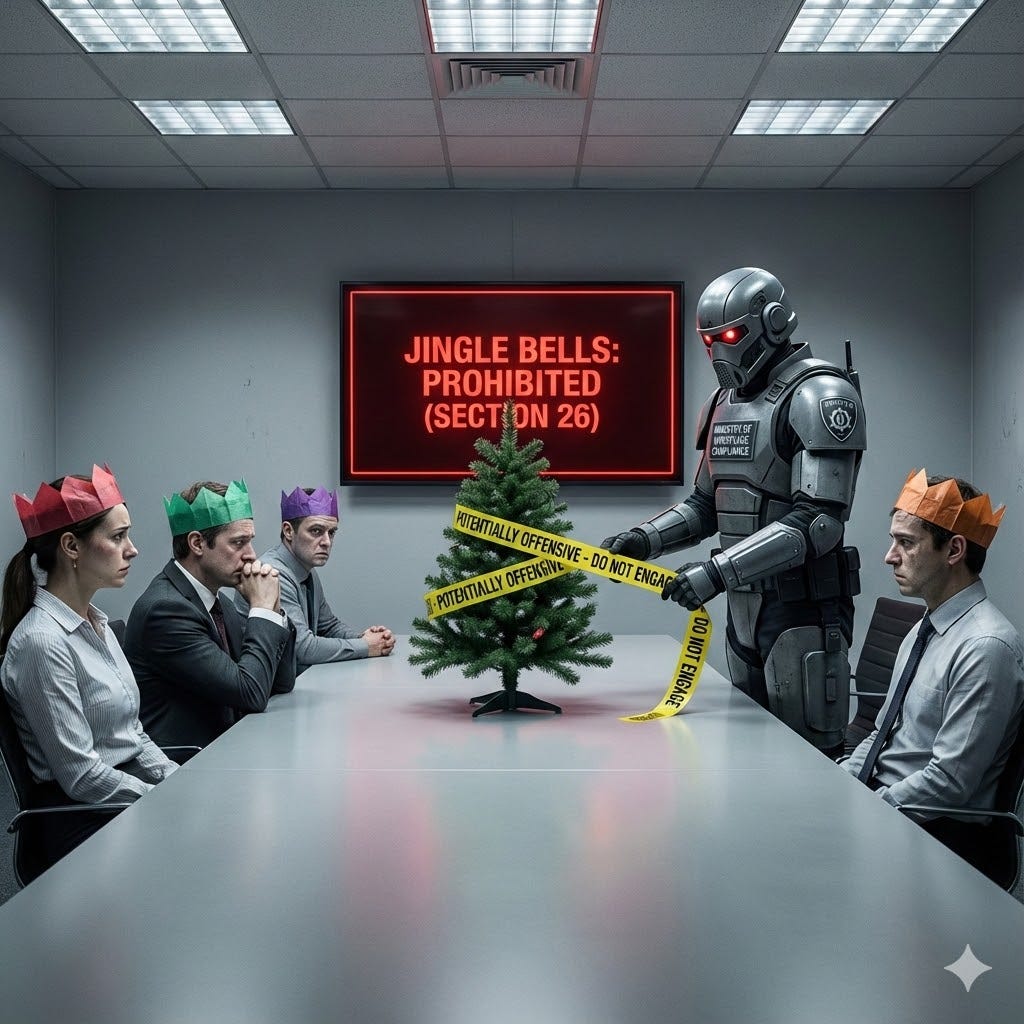
The Free Speech Union has identified a peculiar problem with Britain’s new Employment Rights Bill: your office Christmas party might need to ban “Jingle Bells.” Not because anyone objects to sleigh rides, but because James Lord Pierpont first performed the song in blackface at minstrel shows in the 1850s. Under the Bill’s harassment provisions, that historical association could constitute tribunal grounds if any employee finds it offensive.
This isn’t hyperbole. It’s the logical outcome of legislation defining harassment as conduct creating an “intimidating, hostile, degrading, humiliating or offensive environment.” That final word does considerable work. It’s subjective, unlimited in scope, and places liability on employers for anything happening “in the course of employment”—including work social events.
The Free Speech Union’s concern centres on a structural problem: when harassment threshold drops to mere “offense” and employers face tribunal liability, the rational response isn’t evaluating genuine harm. It’s banning anything that could conceivably offend anyone. And in diverse societies, that’s everything.
When Everything Offends Someone
Consider the expanding catalogue: “Do They Know It’s Christmas” perpetuates African stereotypes. “Fairytale of New York” contains slurs Radio 1 previously censored. “Baby It’s Cold Outside” allegedly depicts coercion. Even “Jingle Bells” carries minstrel associations. Traditional carols reference religious content offending secular colleagues. Modern pop Christmas songs offend religious colleagues finding them trivialising.
This isn’t performative bullshit about a handful of songs. Follow the logic to its conclusion: Spotify hosts over 100 million tracks. Conservatively, perhaps 500,000 songs workplaces might play at social events. Under a standard where “offensive conduct” creates liability, how many survive?
Religious songs offend atheists. Secular songs offend religious colleagues. Love songs might offend aromantic people. Breakup songs might trigger divorced colleagues. Party anthems offend teetotallers. Literally any lyric could conceivably offend someone somewhere.
The endpoint isn’t a banned songs list. It’s half a million prohibited tracks because the threshold is subjective offense, not objective harm. Which means the only safe option is silence. No music. Nothing. Because in diverse workplaces, everything offends someone.
The Adult Alternative Nobody’s Considering
Here’s what adults do when encountering content they find offensive but not directed at them personally: they ignore it. They move on. They exercise the fundamental human capacity for emotional self-regulation, distinguishing functional grown-ups from toddlers.
At a pub, if someone sings a song you dislike, you can leave, start a different conversation, internally roll your eyes and continue your pint. What you don’t do—or didn’t, until now—is demand legal intervention because your sensibilities were disturbed.
This isn’t callousness. It’s the social contract making diverse societies possible. People believe different things, value different touchstones, and find different content objectionable. The solution cannot be everyone constantly policing behaviour against the most sensitive possible interpretation by any possible observer.
Yet that’s precisely what the Employment Rights Bill’s harassment provisions demand. By creating employer liability for “offensive environments,” the legislation doesn’t protect workers from genuine harassment. It infantilises them, replacing adult responsibility for managing personal reactions with institutional control over every possible trigger.
Bristol’s already been here. The Colston statue stood in the city centre for 125 years. Millions walked past it daily—shopping, commuting, school runs, social activities. Most people just ignored it. Those who found it offensive (legitimately—Colston was a slave trader) could choose not to look at it, could campaign through the democratic process for its removal.
They exercised adult emotional self-regulation. They walked past. They ignored it. They got on with their lives whilst pursuing legitimate channels for change.
June 2020: the statue came down. Not through the democratic process, but direct action, Bristol City Council later declined to prosecute. Once someone declared offense loudly enough, the statue couldn’t exist. Adult responsibility—ignore what offends you whilst pursuing legitimate change—was replaced by institutional capitulation to the loudest voice claiming harm.
That’s the Employment Rights Bill in miniature. If it offends someone, it must go. No consideration of whether adults can simply ignore it.
Labour’s 40-Year Pattern
This isn’t new territory for Labour. In the 1980s, a Labour councillor called Bernie Grant in Haringey, North London, became a national symbol when his council allegedly banned “Baa Baa Black Sheep” from nurseries because “black sheep” was deemed racist. Whether the ban actually happened remains disputed, but the damage was done.
Grant became the poster child for what Conservatives dubbed “loony left” councils—well-intentioned progressives implementing absurd prohibitions, achieving nothing except national ridicule. Conservatives weaponised the controversy for a decade. Every Labour policy became suspect. Real anti-racist initiatives became politically toxic because voters associated them with banning nursery rhymes.
The pattern was identical to today: identify a genuine problem, draft vague legislation with subjective standards, fail to consider practical implementation, create perverse outcomes, and achieve the opposite of the intended effect.
Forty years later, Starmer’s government repeats the exact mistakes with different songs. Ban Christmas carols. Create elaborate compliance systems. Demonstrate progressive credentials. Don’t actually address workplace harassment—that’s hard. Just prohibit anything potentially offensive and call it protection.
Labour learns nothing, forgets nothing, repeats the same mistakes with depressing regularity.
Welcome to Demolition Man Britain
Remember Demolition Man? Stallone gets fined credits every time he swears because the sanitised future eliminated all “offensive” behaviour. Everyone’s safe, controlled, monitored. No bad language. No physical contact. No cultural friction. Every pub’s a Wetherspoons because anything with actual character might offend someone.
When actual violence erupts—when Simon Phoenix escapes killing people—the sanitised society is completely helpless. They’ve spent decades eliminating minor friction instead of addressing real problems.
That’s Britain under the Employment Rights Bill. Ban the Christmas carols. Prohibit pub sing-alongs. Create elaborate monitoring for “Jingle Bells” compliance. Train HR departments investigating historical associations of songs about sleigh rides.
And when actual workplace harassment occurs—the kind involving real power imbalances, systematic discrimination, material harm—institutions will be too busy monitoring carol compliance to notice.
Because institutions excel at performative prohibition, whilst actual problems continue unaddressed. It’s easier to ban “Fairytale of New York” than handle discrimination cases. Simpler to eliminate Christmas parties than address genuine workplace toxicity.
Welcome to Demolition Man Britain, where everything’s prohibited, and nothing’s protected. Where you can’t sing “Baby It’s Cold Outside” at office parties, but systematic workplace harassment continues because institutions spent budgets on carol compliance monitoring.
Feelings Over Facts Made Law
This is the same pattern everywhere. LTN schemes get implemented despite 54% opposition—because caring about the environment feels right even when evidence shows schemes don’t work. The Colston statue came down without a democratic process—because someone’s feelings of offense override 125 years of adults simply ignoring it.
Common Sentiment has replaced Common Sense. Emotional comfort now trumps basic competence. And the Employment Rights Bill codifies it: your feelings of offense create legal liability, regardless of whether actual harm occurred.
Performance replaces substance. Prohibition replaces protection. And adults get treated like fragile children, whilst real problems continue unaddressed.
The Choice
Britain could trust adults to behave like adults—to distinguish between actual harassment and content they simply don’t prefer, to exercise personal responsibility for emotional responses, to handle minor social friction without legal intervention.
Or Britain could continue expanding institutional control, criminalising ordinary behaviour, treating workers like fragile children needing protection from historical associations with songs about sleigh rides.
The Employment Rights Bill chooses the second option. When everything potentially offends someone and “offensive conduct” creates legal liability, the only safe option is nothing. No music. No jokes. No cultural references. No ordinary human interaction not pre-approved by HR.
That’s not workers’ rights. That’s a fucking dystopia.
And the real kicker? Whilst employers agonise over whether “Fairytale of New York” creates tribunal risk, actual workplace harassment—involving real power imbalances, genuine discrimination, material harm—continues largely unaddressed.
The Employment Rights Bill doesn’t protect workers from offense. It protects institutions from liability whilst teaching adults they’re too fragile to hear a Christmas carol without legal intervention.
John Spartan, you are fined one credit for a violation of the Verbal Morality Statute.
“Opinions don’t affect facts. But facts should affect opinions, and do, if you’re rational.” — Ricky Gervais
Reality doesn’t care about your feelings. The Employment Rights Bill does. And that’s the problem.
Grow up.
END CREDITS:
Employment Rights Bill 2024 harassment provisions | Free Speech Union analysis on workplace liability | James Lord Pierpont “Jingle Bells” minstrel show history (Kyna Hamill, Theatre Survey 2017) | “Do They Know It’s Christmas” stereotype critiques | BBC Radio 1 “Fairytale of New York” editorial decisions | Edward Colston statue removal Bristol 2020 | Bernie Grant Haringey controversy 1980s | Demolition Man (1993) Verbal Morality Statute | “Common Sentiment has replaced Common Sense” - Bristol City Council governance analysis, November 2025, www.thealmightygob.com | Ricky Gervais on facts and opinions.