
Equality for Everyone — Except the Women Who Believe In It.
She joined the Green Party because she believed in things.

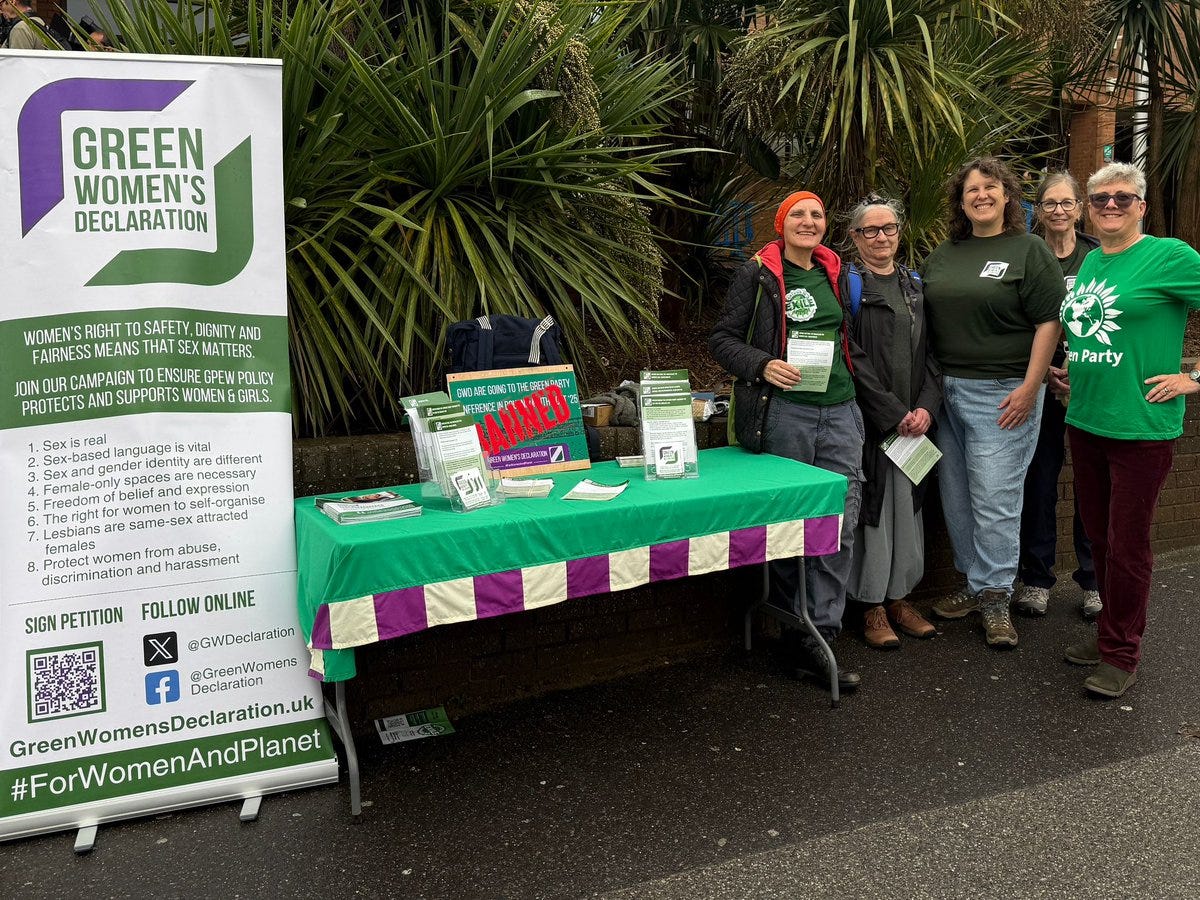
Clean air. A fairer society. The radical notion that the planet was worth saving.
She went to meetings. She knocked on doors. She stood at stalls in the rain handing out leaflets to people who mostly didn’t want them, because that’s what you do when you believe in something enough to get wet for it, isn’t it? Okay, well this and my former career then. However, that’s an entirely different story, and one best to let settle where it is.
Then she said that women are female.
And the party expelled her.
Then she said it again.
And they expelled her again.
Then — and this is the part where you might want to put your tea down — she said it a third time.
You already know what happened next.
Have you ever watched an institution do the same thing three times and genuinely believe it would end differently?
This is the story of the Green Party of England and Wales in 2026.
Not the version they’d like you to read — the one about Zack Polanski’s soaring membership numbers and his barnstorming conference speeches about banning landlords and freeing the NHS.
The other version.
The one happening in the legal correspondence.
The Green Women’s Declaration — a group of female Green Party members who made the mistake of believing that equality applied to them — has formally launched legal proceedings against the party under the Equality Act 2010.
Under. The Equality Act. 2010.
Remember this.
Not because it’s a legal footnote.
Because it’s the whole story in five words. The party that built its entire modern identity on that law — that waves it like a flag at every press conference, every conference speech, every indignant tweet — is now on the receiving end of it.
Filed against them.
By the women they claim to represent.
Remember this, because the people who did it are betting you won’t.
The party that exists to champion that law is now being sued under it. By its own women. Having, as the GWD put it with admirable restraint, exhausted all internal channels.
You have to admire the restraint, really. After everything they’ve been through, “exhausted all internal channels” is doing the work of a much longer sentence.
The specific incident that tipped this into court is almost too on-the-nose to be believed, which is perhaps why it’s true.
The Green Women’s Declaration had a confirmed stall booking at the Green Party conference in Bournemouth.
Paid for. Arranged. Legitimate.
The kind of thing political groups do at political party conferences in functioning democracies.
Two days before the event, the booking was cancelled.
Not because of any rule violation. Not because of any complaint about their conduct. No.
Because they were women.
And, get this — because the party actually said this out loud, in public, with apparent sincerity — GWD’s presence at the conference “would risk undermining” it as a safe and welcoming space.
A safe and welcoming space.
For everyone except the women who believe they’re women.
A safe and welcoming space.
For the avoidance of doubt: the people making the conference unsafe, in this framing, were the women.
You know, those with vaginas.
When did “keeping people safe” start meaning keeping women out?
The Green Women’s Declaration noted, with a patience that frankly defies belief, that the Labour Party and the Liberal Democrats had faced similar situations with gender-critical groups and had been vindicated in court every time.
They described the Green Party’s failure to learn from those precedents as “astonishing.”
That was before they filed the lawsuit.
Now it is evidence.
Here is what makes this particular story different from a simple tale of institutional bad behaviour.
The Green Party knew.
They knew because their own legal counsel told them — in a document that subsequently leaked, as these documents tend to do — that their internal rules around “transphobia” and “queerphobia” risked unlawfully discriminating against members holding gender-critical views.
A protected philosophical belief, as it happens, under the Equality Act 2010 since 2021.
Like, who knew? Who knew that a ‘phobia’ is a genuine fear of something. You know, like spiders, or dark places, for instance, and nothing more?
Apparently not the Green Party lawyers.
They knew because Dr Shahrar Ali, their former deputy leader, took them to court for removing him from his spokesperson role after he expressed the view that biology is real.
Guess what? He won!
It was the first ever protected-belief discrimination case brought against a UK political party.
The party paid £9,100 in damages, then a further £90,000 in costs — £99,100 in total, for a case their own legal team estimated they spent around £400,000 defending.
Then they suspended him again.
He is now preparing a second lawsuit.
They knew because Emma Bateman — former co-chair of Green Party Women, a woman with years of dedicated service to the party — was expelled.
Then the expulsion was overturned.
Then she was expelled again.
Then that was overturned.
Then she was expelled a third time.
Three expulsions. One woman. One set of beliefs that a tribunal confirmed she is legally entitled to hold.
They knew because Dawn Furness, also a former co-chair of Green Party Women, describes in her own legal claim a disciplinary system that has been, in her words, “weaponised to systematically purge gender-critical women from the party.”
She has been expelled three times too.
Her case is in the courts.
A Green Party AGM apparently spent a significant portion of its time discussing the mounting suspensions, expulsions, and litigation — while the Disciplinary Committee and the Regional Council blamed each other for the losses they’d already incurred.
They knew because Jude English — former Green councillor for Ashley ward in Bristol, a lesbian who says she is “too gay” for the party — was expelled for five years.
Her offence?
Attending a Green Women’s Declaration webinar.
The complaint against her called GWD a “transphobic organisation.”
She is now threatening legal action naming Green co-leader Carla Denyer personally.
They knew because Paula O’Rourke — one of Bristol’s longest-serving Green councillors, former leader of the Green group, first elected in 2016 — resigned the party whip in November 2025.
Not because she was expelled.
Because she watched her own colleagues walk out of Bristol City Council meetings and hold up pro-trans placards while women with gender-critical views were speaking from the public gallery.
She called it a refusal of democratic duty.
She said the chilling effect on women coming forward to speak to their elected representatives was real, and corrosive.
Her departure cost the Bristol Greens their council majority.
The party’s response was to say that councillors have the right to feel safe in their place of work.
Safe. Again. That word.
And then, apparently refreshed by this productive exchange, continued doing the same thing.
What do you call an organisation that loses in court, pays the damages, and then does it again? Principled? Or something else entirely? More than likely “green” — if you use the other dictionary version of the term. You know what I mean, don’t you?
Anyway, I’ll leave you to fill in the blanks. Take your time.
You know. The blanks that conveniently draw your attention away from. Though you could equally be forgiven for thinking it’s something more grassroots, and fundamental to the Green Party — like hugging trees, for instance, and not about trans rights.
Now, here’s a number that deserves its own paragraph.
£190,000.
That is what the Green Party has already spent on legal battles arising from discrimination claims brought by its own members.
A further £350,000 has been allocated across its 2025 and 2026 budgets to defend against more of the same.
The party’s own leaked dossier described these sums as a substantial proportion of its actual and projected income — money that is therefore not being spent on staffing, on local parties, on the environmental campaigns that are supposed to be the reason the Green Party exists.
Just pause for a moment to consider how many new trees could be planted for £190,000.
But, you know, when you can no longer see the wood for the trees, etc.
So, is it practical to keep expelling the same people for the same legally protected beliefs while haemorrhaging money you haven’t got? No.
Is it logical for a party whose entire identity rests on equality law to treat that law as an inconvenience when women try to use it? No.
What is the likely outcome of a party that has lost in court, is being sued again by the same claimant, and has now attracted a formal Equality Act claim from an entire women’s group, while its leader dismisses Supreme Court rulings and its membership numbers do not pay its legal bills?
You can work that out yourself.
The trajectory only goes one way — that even two of the shortest planks would recognise from afar.
When the bill for being wrong keeps growing and the answer is always to budget more — what exactly is being protected, and who is paying for it?
Most likely not the tree in the party’s logo.
Now, in April 2025, the UK Supreme Court ruled unanimously.
Lord Hodge delivered the judgment.
The words “women” and “sex” in the Equality Act 2010 refer to biological women and biological sex.
You know what they are, don’t you?
Unanimous. The highest court in the land. No ambiguity. No wiggle room. Rubber stamped it.
Zack Polanski called it “thinly veiled transphobia.”
So, let’s get one thing settled from the get-go.
I speak from direct experience, having worked with a significant number of men who have transitioned — who have endured the physical and mental pain of it.
The hormone injections. The therapy. The surgery.
You know, the real trans people.
Not guys who wake up first thing, check their facial stubble in the mirror, and then go through the decision-making process of what skirt to wear that day.
So, to be clear. Am I transphobic? No.
Am I trans’faux’bic? A brand new word I’m introducing to the language from this moment — perhaps, arguable. Nonetheless, it’ll become viral by this time next week, month, possibly. Mark my words.
The finite wisdom of the Supreme Court is, however, apparently, a vehicle for “bigotry” — according to the Green Party leader’s framework.
Note how this generically fashionable word, like many others, just trips off the tongue nowadays, when an argument is lost.
Therefore, even the women in his own party who agree with the Supreme Court are clearly a threat to the safe conference environment.
And the Equality Act — the law the party claims as a founding principle — is apparently only valid when it protects the people Polanski has decided deserve protecting.
The Green Women’s Declaration, meanwhile, pointed at the Supreme Court ruling and said: the law is now clear.
They wrote to the party.
They sought dialogue.
They asked for their stall booking to be honoured.
They are now in court.
If the Supreme Court is wrong, the science is wrong, the law is wrong, and the women are wrong — who exactly is left to be right?
Hands up if you say, not Polanski.
As, presumably, his knowledge of the law far outweighs that of the brightest legal minds in the country.
Don’t you think?
So, to continue, there is something almost Kafkaesque about where this ends up — except Kafka’s protagonists never quite understood what they’d done wrong, and the women of the Green Women’s Declaration understand perfectly.
They haven’t done anything wrong.
That’s precisely the point.
That woman from the beginning — the one standing in the rain handing out leaflets to people who mostly didn’t want them — she is every one of them.
Dr Shahrar Ali included, who understands better than most what it costs to hold a legally protected belief in that party.
Emma Bateman. Dawn Furness. Jude English. Paula O’Rourke.
Different names, different wards, different roles.
The same belief. The same party. The same response.
They joined a party that told them it stood for the marginalised, the overlooked, the systematically ignored.
They believed it.
They worked for it.
They stood in the rain for it.
Quite probably little realising, at that time, that the “marginalised” would not necessarily mean them — that rather than being lifted up, they would be pushed off the political cliff and replaced by the badge wearers of identity politics instead.
I’ll leave that to settle while you take your next sip of whatever you’re enjoying.
Because here is what those women actually did, after being pushed off that cliff.
They didn’t walk away.
They didn’t quietly resign their beliefs along with their memberships.
Or swim across the Channel to seek asylum in France.
They kept going.
Through the letters, the hearings, the reinstatements, the re-expulsions, the AGMs that turned into blame sessions, the conference they turned up to anyway after their stall was cancelled.
And when they needed that party to stand for them — when they asked it to honour a stall booking, to acknowledge a Supreme Court ruling, to apply its own stated principles to its own female members — the party cancelled their booking, ignored the ruling, and is now paying lawyers to argue in court that it was right to do so.
The Green Party has spent years positioning itself as the institution that holds other institutions to account.
It is now the institution being held to account.
By its own women.
Under its own cherished law.
And somewhere in there — in that gap between what the Green Party says it is and what the Green Women’s Declaration has been forced to prove it isn’t — is the clearest possible answer to the question of what the modern Green Party actually stands for.
They told her.
Three times.
And here she is — still believing in clean air, a liveable planet, and the kind of basic decency that shouldn’t need a manifesto to spell out, regardless of the language you speak, or the dialect that shapes how you speak it.
Still believing in equality.
The party she’s suing says it believed in equality too. Once.
The difference, it turns out, is that she still means it.
Meanwhile, those at the top of the Green Party are still, well, you know, just green.
The Green Women’s Declaration formally launched legal proceedings against the Green Party of England and Wales on 4 March 2026, citing discrimination under the Equality Act 2010. The case was reported in The Times on 4 March 2026. Dr Shahrar Ali’s first discrimination case against the party resulted in £9,100 damages plus £90,000 costs — £99,100 in total — the first ever protected-belief case brought against a UK political party. He is preparing a second claim. Emma Bateman and Dawn Furness are each pursuing separate legal actions. The party has spent approximately £190,000 on discrimination-related legal fees, with a further £350,000 allocated across 2025-26 budgets. Disclaimer: all references to trees in this article are made in good faith.