
The Magic Roundabout: Bristol's Honest Application for the European Green Capital Award 2028.
The only UK city ever to win it. Barred from entering. Here is what the submission would actually say.

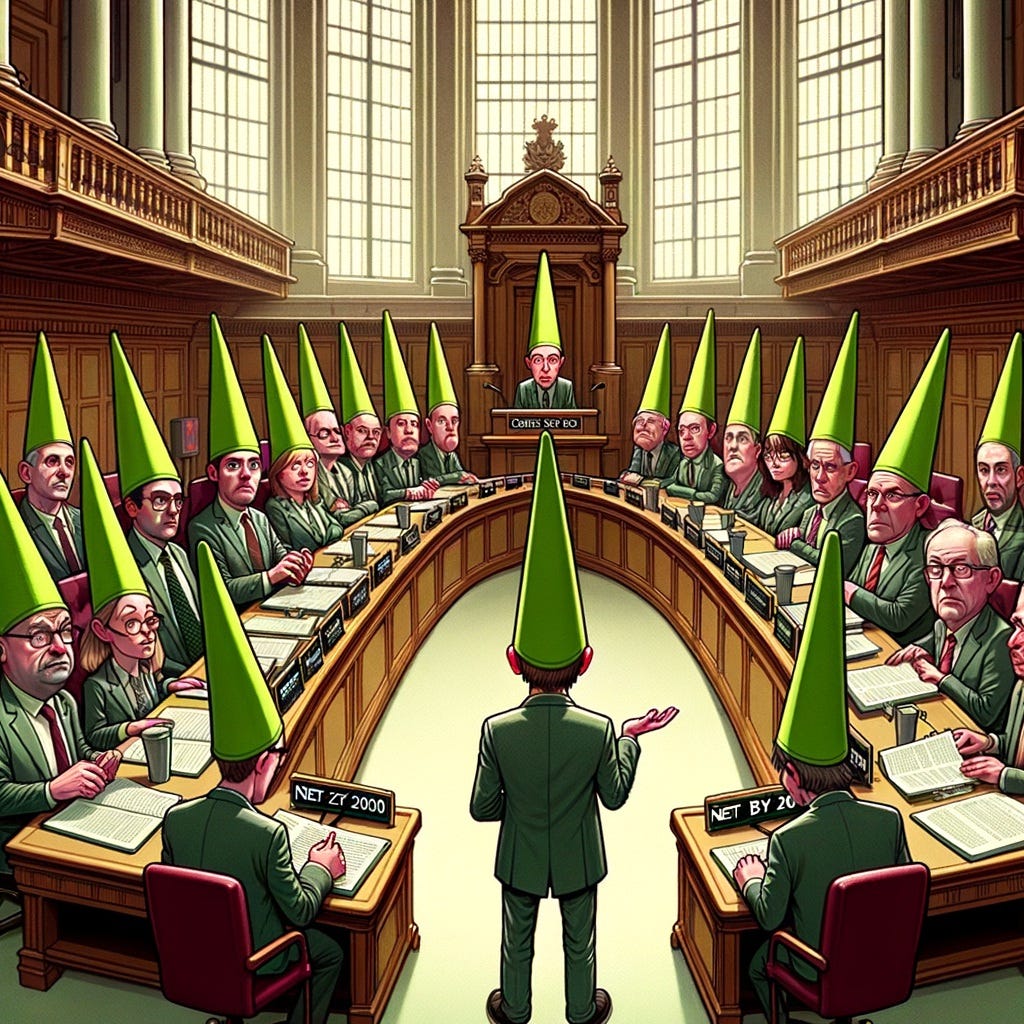
[bristol-city-council-green-dunces-hats-european-green-capital-2028.jpg]
I was reading Tristan Cork’s piece this morning.
Bristol has failed to make the longlist for UK City of Culture 2029.
Swindon made it.
Sit with that for a moment. Not in anger. Not even in surprise — because that, in itself, is the story. When ‘@bristol_citizen’ commented on Twitter/X, the response wasn’t outrage. It was a shrug. Two words. No surprise. A city from which its own residents have stopped expecting anything.
If there were an award for civic failure — for reaching beyond your capabilities whilst focusing on everything except the thing you were supposed to be doing — Bristol would not merely win it. Bristol would be asked to host the ceremony.
I sat with it for a while — and found myself thinking about something else entirely. Something with a deadline in a fortnight that nobody in Bristol appears to be discussing.
The European Green Capital Award 2028. Open for applications until 1 April 2026. €600,000 to the winner. The most prestigious urban sustainability title in Europe.
Bristol won it in 2015. The only UK city ever to do so.
Bristol is barred from entering again. Past winners are barred. The rules are clear and final. Bristol’s trophy is on the shelf, keeping the dust company. It has been there for eleven years. The city that built an entire political identity around that title — the city now governed by the Green Party itself — sits on the outside of the competition it once defined, watching the deadline pass.
I found myself asking: what if it could enter? What would that submission actually say?
Not the version they’d write. The honest one.
What follows is that document.
Every claim within it is drawn from the public record.
EUROPEAN GREEN CAPITAL AWARD 2028 FORMAL APPLICATION — CITY OF BRISTOL, UNITED KINGDOM
Applicant Authority: Bristol City Council Political Leadership: Cllr Tony Dyer, Council Leader Submission Date: March 2026 Application Reference: [not applicable — see administrative note above]
Note for assessors: Past winners of the European Green Capital Award are not eligible to reapply. That’s us.
Bristol won in 2015.
However, we would like to draw the assessors’ attention to this administrative detail at the earliest opportunity, so that no one’s time is unnecessarily wasted.
We are, though, deeply committed to the spirit of the process. Although not a formal application in itself, this document is offered as a guide to how future submissions might be presented — drawing on the direct experience of a former winner, and submitted in the hope that other cities may benefit from Bristol’s considerable expertise in this area.
INDICATOR ONE: CLIMATE CHANGE AND ENERGY.
We are proud to report that Bristol City Council declared a climate emergency in 2018 — the first local authority in the United Kingdom to do so. For clarity, an emergency is defined here as a situation requiring urgent action. We have produced several documents to this effect. On reflection, it was less an emergency and more a series of panic stations over something that has not, as yet, happened. A call to man the lifeboats.
In a paddling pool.
Yet, on this, we remain vigilant.
Still. The first local authority. In the country. That is what we said, and we said it with considerable conviction.
The documents are thorough. The language is urgent. The formatting is, frankly, outstanding.
Bristol’s carbon emissions have continued on their own trajectory. The climate strategy describes the changes needed as dramatic. The word is accurate. The drama, at present, is confined to the documents.
The city once called itself a laboratory for change. Most laboratories require test subjects. Ours preferred monkeys. The monkeys are still in the laboratory at City Hall. The experiments continue. Monkey see, monkey do. We consider this a continuity of commitment.
We are committed to net zero by 2030. It is currently 2026. We are still processing, as we were in 2024.
INDICATOR TWO: URBAN MOBILITY AND TRANSPORT.
Bristol’s transport record is the jewel in this application’s crown, in the sense that a crown made entirely of organically sourced, vegan paste jewellery, in the jewel colours of the pro-Palestinian flag, is still, technically, a crown.
MetroBus launched. The routes run. Infrequently, and not always to schedule. There is, nonetheless, a certain poetry to it — passengers know exactly what to expect: the same wait, delivered with the precision of a system that has perfected the art of almost arriving.
Car dependency remains structurally embedded, and we are as committed to this as ever.
Traffic calming schemes have been introduced across residential areas. They have done nothing to calm the residents. Opposed by 54% of residents in formal consultation. The council noted this opposition carefully and proceeded. Emergency services subsequently reported access difficulties. The council noted these concerns with equal care, and moved on.
Then there is the matter of the high streets.
A major study ranked Bristol’s high street health 37th out of 55 UK cities. Below Slough. Below Hull. Below Doncaster.
Below Swindon.
Swindon also made the UK City of Culture 2029 longlist this week.
We offer this information without comment, as a point of local geography.
INDICATOR THREE: GREEN URBAN AREAS AND BIODIVERSITY.
Bristol is green. Authentically, verifiably, and — we have the documentation to confirm it — documentably green. The parks are real. The trees are real. The Avon Gorge is real and magnificent.
In March 2026, more than 70 volunteers spent a Saturday planting almost 30,000 flower bulbs in St George Park — bulbs they had spent months fundraising for. Days later, the council’s mowing team destroyed most of them. Green credentials moving forward as planned.
Eagle House, Knowle West. A former youth club, standing near the spot where two teenagers, Max Dixon and Mason Rist, were stabbed to death. During the 2024 local elections, Green Party candidates promised the community this building would reopen as a youth centre.
The council is proceeding with demolition. The leader noted that empty buildings attract antisocial behaviour. Antisocial behaviour requires additional police funding. Additional police funding is something the council chooses not to provide.
There is a garden where the youth club was meant to be. There is a promise where the garden was meant to be. There is a policy document where the promise was meant to be.
In effect, Bristol has its own Magic Roundabout. It is called City Hall.
The Downs remain lovely, whilst having quietly acquired an additional and wholly unintentional community of resident dwellers — a village within a city, self-organised, unplanned, going round its own quiet circuit, and entirely consistent with our commitment to inclusive green spaces.
For the assessors’ reference, the greenest things currently visible in Bristol are the green placards that appear in the chamber, held aloft with considerable conviction, on matters of trans rights. And, of course, the trees. We are satisfied this meets the spirit of the indicator.
INDICATOR FOUR: AIR QUALITY.
On a still morning, standing at the top of Park Street, you can taste it. Bristol has some of the worst air quality in the United Kingdom.
We note that in 2015, the European Commission’s expert panel ranked Bristol first in the United Kingdom for air quality performance. That distinction is now the preserve of the council chamber, where the air quality remains, we are pleased to report, robust.
The council’s Keep Bristol Cool mapping tool maps the problem with great precision. It does nothing to cool the protests that appear on the streets most weekends.
We recommend the Commission’s independent panel bring a cardigan and perhaps not linger on the A4 corridor longer than is strictly necessary.
INDICATOR FIVE: NOISE.
The council chambers have, in the past year, hosted the Adhan — the Islamic Call to Prayer — performed by Councillor Abdul Malik at Full Council on 10th March 2026, unannounced, unagendaed, unminuted, and broadcast to the city without debate or consent, as documented here. The chamber has additionally hosted: a walkout over gender-critical statements from the public gallery; a casting-vote power seizure following a Labour defection that gave the Greens effective control of all eight policy committees; and an extraordinary meeting that descended, in the words of contemporary reporting, into chaos.
We acknowledge this indicator concerns environmental noise rather than political noise.
We are, however, struggling to separate the two.
INDICATOR SIX: WASTE AND CIRCULAR ECONOMY.
Bristol City Council has experienced well-documented difficulties with waste collection in recent years. Missed collections, route changes, and the matter of the bin lorry procurement — a process that generated considerable controversy regarding who, precisely, authorised what and when.
The circular economy, in Bristol, is more circular than perhaps intended.
Policies are proposed. Policies are consulted on. Policies are amended. Policies are approved. Policies are implemented. Problems arise. A review is commissioned. A report is produced. Recommendations are noted. Policies are proposed.
Somewhere in this cycle, a resident wrote a letter. The letter was noted. The letter is in the file. The file is in the system. The system is processing the letter.
Nobody crashes. Nobody gets anywhere.
The roundabout is, by any objective measure, the most efficient part of the operation.
INDICATOR SEVEN: WATER MANAGEMENT.
Bristol’s waterfront is beautiful.
The harbour that held a hydrogen ferry in 2015 — the first of its kind in the country, announced as the beginning of a fleet, a symbol of a city at the frontier of the hydrogen economy — is still there. Still catching the light on a late afternoon. Still making everything look like a promise.
There is one ferry.
There has always been one ferry.
We are proud of our water management.
CLOSING STATEMENT.
The European Commission will note, having read this application in full, that Bristol is not eligible to enter the 2028 competition. Past winners are barred. The rules are clear. No exceptions are made.
We would like to state, for the record, that we believe this is just.
Bristol formally proposes that the Commission urgently consider expanding the qualifying criteria.
Identity politics. Civic protest management. Chamber diversity programming. The equitable distribution of placard colours across all recognised causes.
On these measures, Bristol’s record since 2015 is, we submit, exemplary.
We are available to assist in drafting the revised framework at the Commission’s earliest convenience.
The document closes. The harbour remains. The trophy on the shelf catches the light, the way the ferry catches the light, the way everything in this city catches the light and looks, for a moment, like a promise. Like a New Year’s resolution. Forgotten by the end of February.
It was a long time ago. We believe the title may still appear on some council correspondence. If so, we would gently suggest it has passed its use-by date — though we note that expiry dates, like net zero targets, are more advisory than binding in Bristol. The laboratory is still open. The experiments continue. The monkeys are still at their stations, seeing what they have always seen, doing what they have always done.
This morning, Bristol learned it did not make the longlist for UK City of Culture 2029. Nobody has resigned. Yet. They probably won’t. They will, however, be offered a higher paid position in a different department.
The harbour is still beautiful. The ferry is still there. On a late afternoon, the light still falls across the water the way it did in 2015, the way it did when the banners were up and the city felt, for a moment, like something was beginning.
That moment keeps going back to the beginning.
The documentation enters the process. It passes the first meeting. The second. The third. The fourth. Then it files itself quietly back where it started — next to the trophy, in the dust, alongside the fundamentals of what it actually means to be green. Air quality. Transport. Biodiversity. Water. The seven indicators. The things Bristol was measured on. The things that won the award. All of them filed. All of them gathering dust. All of them keeping the trophy company.
The debates continue. The impasse holds. Little gets resolved.
On a desk at City Hall, a Newton’s Cradle swings. One ball pulls back. Strikes. The last ball swings out. Returns. Strikes again. Same force. Same arc. Same desk. Same result. Nothing lost. Nothing gained. Nothing resolved. Back where it started. Every single time.
Two words from the Bristol Citizen. No surprise.
Newton’s Cradle keeps swinging.
Bristol, March 2026.
Submitted in the spirit of full transparency.
The Almighty Gob is a Bristol-based publication covering UK institutional dysfunction and political accountability. Over 500 pieces published, including more than 88 Bristol investigations built from FOI requests and primary sources. Not a journalist. Something the city occasionally needs more.
SOURCES AND REFERENCES
European Commission — Bristol Green Capital Award 2015 and European Green Capital Awards 2028. Application period open 8 December 2025 to 1 April 2026. environment.ec.europa.eu
European Commission — Bristol 2015 European Green Capital winning city. environment.ec.europa.eu
UK City of Culture 2029 longlist — Bristol not included. Swindon, Blackpool, Inverness-Highland, Ipswich, Middlesbrough, Milton Keynes, Portsmouth, Sheffield and Wrexham longlisted. Announced 18 March 2026. Department for Culture, Media and Sport. gov.uk Also reported by Tristan Cork, Bristol Post, March 2026. [LINK-CITY-OF-CULTURE-ARTICLE]
Excite OOH / Centre for Cities / ONS data — Bristol ranked 37th out of 55 UK cities for high street health. Reported Bristol Post: City centre slammed as ‘soulless’ as Bristol ranks behind Swindon for high streets.
Bristol City Council climate emergency declaration, 2018 — first UK local authority to do so. Bristol One City Climate Change timeline. bristolonecity.com
East Bristol Liveable Neighbourhood — 54% of residents opposed in formal consultation. Bristol City Council monitoring data and engagement report, December 2025.
St George Park flower bulbs destroyed by council mowing team, March 2026. Reported by Tristan Cork, Bristol Post. [LINK-ST-GEORGE-PARK-ARTICLE]
Eagle House, Knowle West — demolition plans despite 2024 election pledge. Bristol Post / Bristol 24/7, 2025.
Adhan performed at Bristol City Council Full Council, 10th March 2026. The Almighty Gob — The Uninvited Heckler. [LINK-UNINVITED-HECKLER]
Magic Roundabout, Swindon — constructed 1972, five mini-roundabouts, consistent operation for fifty years. Wikipedia / Roads.org.uk.