
Facebook and Other Antisocial Media.
A verdict, a word, and the brain stem — the part of you that reacts before you think.

So there I was. Two in the morning, phone on silent — always on silent — and I’m just sitting there in the stillness with nothing but the hum of the fridge for company, thinking about nothing in particular. And this word arrives. Just lands. Transmorphing. I’d never seen it. I’d never heard it. I hadn’t gone looking for it. It was just suddenly there the way things sometimes are when you’ve finally stopped making enough noise to drown them out.
So naturally I went and looked it up.
Wiktionary had it. The Oxford English Dictionary traced it all the way back to 1888. Barely used in all that time — a word sitting quietly in the dictionary like something that knew its moment hadn’t arrived yet. The meaning: to change shape or form. Simple enough. Except the shape I had in mind was something the dictionary had never quite got around to describing.
It had now. Because transmorphing — as I was about to use it — describes something far more specific. The deliberate reshaping of identity, at any age, by an architecture engineered to reach the oldest part of the human brain before the reasoning part has had a chance to say anything about it.
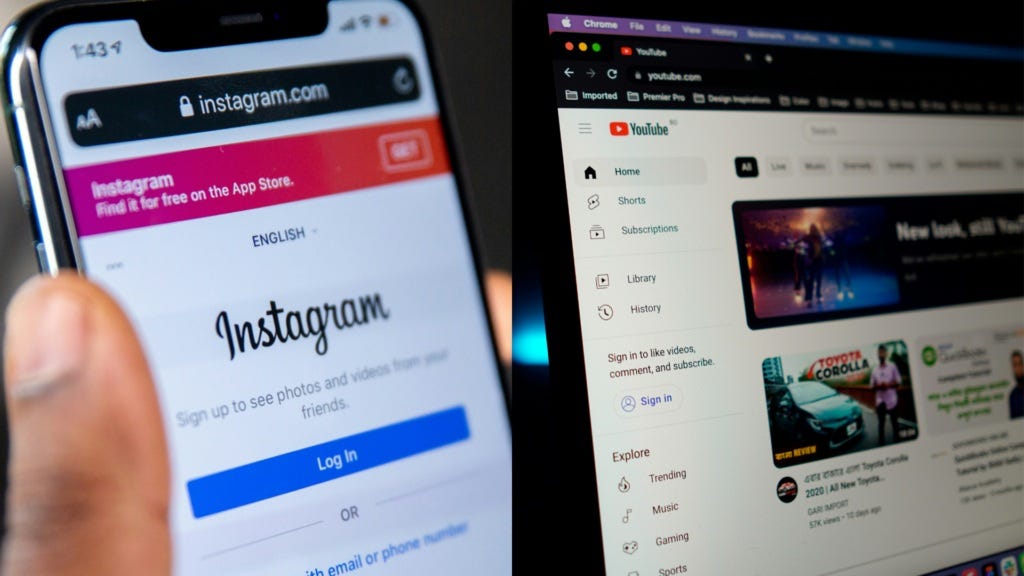
On the 25th of March 2026, a Los Angeles jury found Meta and Google liable on all counts in a case that has already changed the legal relationship between technology platforms and the children they were built to consume. The plaintiff — a twenty-year-old woman the court called Kaley, or KGM — started using YouTube at six years old. Instagram at nine. By her early teens she was on it all day, every day, and somewhere in all of that she developed anxiety, body dysmorphia, depression, and suicidal thoughts.
The jury awarded her six million dollars. Meta pays seventy percent. Google the rest.
Both companies disagree with the verdict. Both are appealing.
The documents, though, are already out there. And documents don’t appeal.
Here’s what those documents said. Meta’s own people — the researchers, the engineers, the executives who are paid to know exactly what their platforms do to human beings — wrote this about their approach to young users: “If we wanna win big with teens, we must bring them in as tweens.” Another internal memo noted that eleven-year-olds were four times more likely to keep coming back to Instagram than to any competing app. The platform’s own minimum age was thirteen. They knew that too.
They knew. They carried on. They called it a priority.
This isn’t a technology story.
It’s a story about the oldest part of the human brain — the brain stem. The bit that was there long before reasoning arrived. Long before language. Together, the brain stem and the structures sitting just above it — the limbic system, the amygdala — form the oldest architecture in the human brain. The part that reacts before the thinking brain has been consulted. The part that runs on fight, flight, hunger, fear, and tribal belonging. The part a six-year-old is almost entirely operating from, because the reasoning brain — the part that says hang on, wait, let me think about this — takes well into adulthood to fully form.
The platforms knew this. Infinite scroll wasn’t a happy accident. Autoplay wasn’t an oversight. Notifications engineered to fire at the exact moment a child’s attention began to wander weren’t there for the child’s benefit. These were decisions. Made by people who understood neuroscience well enough to point it at a target that had no defence against it.
How do you make a child never put down the phone?
Kaley’s lead attorney asked the jury that question. The answer was in the documents all along. You build the phone so the oldest part of the brain physically cannot let it go.
Now. The legal bit — and it matters, so stay with me.
For thirty years, social media platforms have hidden behind something called Section 230 of the 1996 Communications Decency Act. The argument being — we’re just the pipe. We carry the water. Whatever flows through it isn’t our responsibility.
The Los Angeles jury didn’t challenge that. It went underneath it.
The jury was told specifically not to consider the content Kaley saw — the posts, the images, the beauty filters, the influencers, the endless comparisons that quietly dismantled her sense of self over a decade. All of that stays protected. The pipe can carry what it carries.
However the pipe itself was found to be defective. Not what it delivers — how it was built to make delivery impossible to refuse. That’s where the liability lives. A pipeline engineered to be addictive isn’t infrastructure anymore. It’s a product. And products can be defective by design.
TikTok and Snap saw what was coming. Both settled before the trial began. Quietly. Undisclosed amounts. No courtroom. No executives in the witness box. No internal documents read aloud to a jury.
When you settle before discovery — what exactly is it you’re paying not to have read out?
X isn’t named in the litigation. Truth Social isn’t named. One — X, under Elon Musk — operates under the political cover of its billionaire owner’s proximity to power. The other is owned by the sitting President of the United States. The pipe carrying the most inflammatory water is the one nobody is currently looking at.
Selective accountability is still accountability. It just comes with exemptions for the people who can afford them.
And here’s where transmorphing earns its place. Because what happened to Kaley isn’t the only thing it describes.
Tribalism isn’t an ideology. It’s a brain stem function — older than language, older than reasoning, older than anything the prefrontal cortex would eventually learn to do. The need to belong. The need to identify who isn’t us. Social media didn’t create that instinct. It found it, mapped it, and built an engagement model around it. Every like is a tribal signal. Every share is a tribal endorsement. Every pile-on is a tribal expulsion. The algorithm amplifies whatever produces the strongest tribal response — because tribal response is the most reliable thing the oldest part of the brain reliably produces.
The same mechanism doesn’t only operate on tribal belonging. It operates on identity itself. On the developing sense of who a child is, or might be, or has been shown on a screen often enough to start believing they want to become. Same infinite scroll. Same autoplay. Same notification at the moment attention drifts. Underneath all of it, the oldest human behaviour of all — monkey see, monkey do. Not a moral judgement. A neurological reality.
Children are mimics. They copy the observable world around them before the reasoning brain has formed enough to evaluate what’s worth copying and what isn’t. That’s how children learn. The platforms just decided to be what the children observed.
When the observable world is a screen algorithmically curated to show a child a continuous stream of identity content — shaped not by what serves the child’s development but by what generates the most engagement — the mimicry doesn’t discriminate. It copies what it sees. The platform doesn’t care what it’s delivering. It cares only that delivery continues.
The Los Angeles verdict has confirmed, in a court of law, that the delivery system itself was the weapon.
The child didn’t choose to be transmorphed. The architecture chose for them. Before they could read. Before they could reason. Before the part of the brain that might have said wait had been given the time to develop.
Mark Zuckerberg sat in that Los Angeles courtroom and told the jury that keeping young users safe has always been a company priority.
He is worth approximately two hundred and thirty billion dollars.
The jury awarded Kaley six million.
Just sit with those two numbers for a moment. Six million against two hundred and thirty billion isn’t accountability. It’s a rounding error on a rounding error. The punishment doesn’t register on any instrument designed to measure it.
And yet — Kaley woke up the morning after the verdict with six million dollars and the same brain she had the morning before it. The anxiety didn’t settle. The body dysmorphia didn’t lift. The architecture of her thinking — laid down before she was old enough to understand that an architecture was being laid — doesn’t respond to a bank balance.
Money is in this sense just another loop. The dopamine hit of acquisition fading into the need for more acquisition. The house that’s never quite large enough. The account that needs another zero. You’ve seen it. We all have. The same brain stem mechanism the platforms exploited in Kaley, running quietly in the man who built the platforms, running in every institution that now profits from treating the damage the platforms caused.
The therapy industrial complex didn’t create the crisis. However it has no financial incentive to end it. The charities need the suffering to continue funding their response to it. The academic departments need the research grants the crisis generates. The pharmaceutical industry needs the diagnosable conditions the crisis produces. And yet here we are. None of these people are villains. They’re just invested — in the most literal sense of the word — in a problem remaining a problem.
If the punishment doesn’t register — did anything actually change?
Here’s what the verdict actually confirmed. Stripped of the legal language and the compensatory arithmetic.
A child was handed a screen. The screen had been built by people who knew it would rewire her developing brain and did it anyway because the rewiring was profitable. The child grew into a young woman carrying damage that six million dollars cannot reach. A jury of twelve people looked at the documents, heard the evidence, deliberated for forty-three hours across nine days, and said: this was done deliberately, with malice, with knowledge of the harm, and for money.
That finding doesn’t expire on appeal. It lives in the record.
Two and a half thousand cases are waiting behind it.
And somewhere — in files that were settled before they could be subpoenaed, in platforms operating under political protection, in academic departments and charity boardrooms and pharmaceutical research budgets — the same calculation is being made again.
The oldest part of the human brain is still the target.
The architecture is still running.
The cases are still accumulating.
And the children are still six years old when it finds them.
Two in the morning. Phone on silent. The stillness doing what it does when you let it.
A word arrived that I’d never heard, traced back to 1888, sitting in the dictionary barely used for over a century. Transmorphing. The deliberate reshaping of a developing identity by an architecture engineered to exploit the oldest part of the human brain before the newest part has had a chance to form.
The Los Angeles jury didn’t use that word.
However they described exactly what it means — in forty-three hours of deliberation, in a finding of malice, oppression and fraud, in six million dollars that will not cure what it compensates.
The documents are in the public record. The jury’s finding is in the record. The calculation being made in every settled file and every protected platform is in the record. What we choose to do with it is the only question left.
Outside the court, Kaley’s co-lead counsel said the verdict was a referendum — from a jury, to an entire industry — that accountability has arrived.
Because without truth, we have no democracy.
Sources.
Verdict and trial coverage: NPR — PBS NewsHour — CBS News — KPBS — Courthouse News
Case details: K.G.M. v. Meta et al. — Wikipedia
Section 230: 47 U.S.C. § 230 — Cornell Law
Transmorphing etymology: Wiktionary — Oxford English Dictionary
The Almighty Gob is a Bristol-based publication covering UK institutional dysfunction and political accountability.