
"Free Palestine," They Chant To Themselves In Broadmead, Bristol. No One Else Listens.
One, Two, Three, Four, Five, Six, Seven, Eight. As Useful As A Christmas Tree On The Equator.

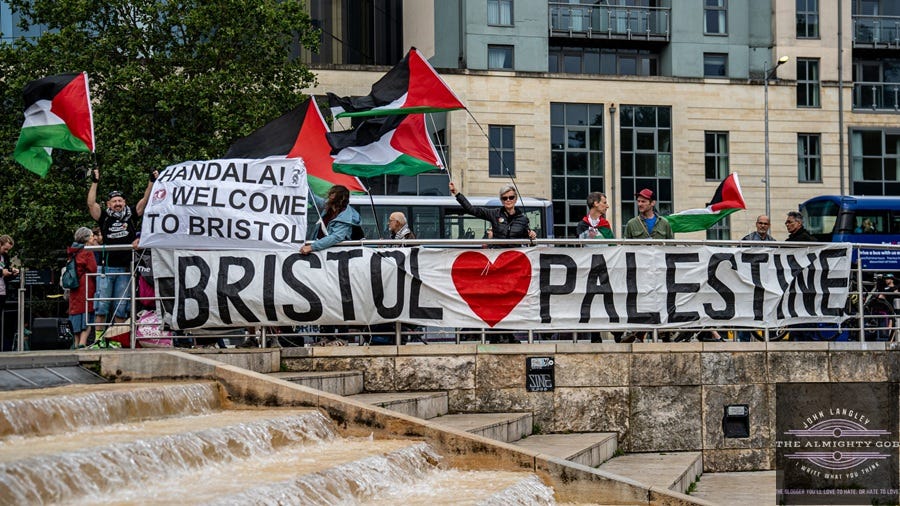
[Pro-Palestinian demonstrators gather in Bristol city centre. Where the megaphone carries further than the argument-www.thealmightygob.com]
Today is Sunday. Peace and quiet.
I suppose even protesters need one day to hand wash their hi-vis outerwear.
Which brings me to yesterday. And a question worth sitting with before we’re done.
There are days when you know, before you’ve even got your coat on, that something is about to happen that you’ll be thinking about later.
Yesterday was one of those days. I just didn’t know it yet.
I went into Bristol yesterday wrapped for the cool spring air. Big coat. Sensible. The kind of decision that feels entirely reasonable at the time and reveals itself, in retrospect, as a catastrophic failure of situational awareness. My Israeli IDF t-shirt — the coveted one — stayed at home, hanging in the wardrobe, entirely unaware of the opportunity it was missing. To be clear: not worn in support of the IDF. Worn for balance. There is a difference, and it matters.
Because outside Barclays Bank on a spring Saturday in Bristol, numerous people were gathered — with nothing better to do than come out and rejoice in the sound of one another’s voices. An audience performing for itself. The co-masturbation of the ego, dressed up as political conscience. And, in their own estimation, making history.
As Useful As A Christmas Tree On The Equator.
These may well have been once intelligent people. However, the prefrontal cortex — that inconvenient seat of reason, judgement, and the ability to connect cause with effect — doesn’t repair itself on demand. And reversing the damage doesn’t come cheap. Not on the NHS. Not anywhere. Some deficits, it turns out, are permanent fixtures.
You know the type. You’ve seen them. You may even, at some point in your life, have been them — and if that’s the case, now is probably a good time to sit with that.
The megaphone was there. The megaphone is always there.
Some piece of equipment — battered, overworked, held together by conviction and cable ties — that takes a human voice and returns it to the world as something approximating a wasp in a jar.
Stand there long enough and you start to notice something.
Whatever the argument was — and there was presumably an argument — it arrived on the street as largely indistinguishable sound. Consonants lost. Syntax dissolved. The wind reorganised the rest into nothing.
What survived?
One. Two. Three. Four. Five. Six. Seven. Eight.
Then the chant. Then back to one.
The only thing the megaphone successfully transmitted was arithmetic.
Not the geopolitical thesis. Not the humanitarian case. Not the carefully considered position on international law, arms sales, or the moral obligations of Western democracies. Those all became noise somewhere between the speaker’s conviction and the listener’s ear.
The numbers made it. One through eight. Every time. Without fail.
They could count. That much was established beyond reasonable doubt.
Barclays, of course, is not a random choice. The BDS movement has campaigned against Barclays for years over alleged investment links to Israeli defence companies. There is a thread there, if you pull it. A thesis. A reason for standing specifically here rather than anywhere else.
The bank was closed.
It was Saturday.
The building offered no response, registered no reaction, and will open again Monday morning entirely unchanged. The glass didn’t even fog. It was the nearest one. Proximity, not conviction, decides more than anyone standing outside a closed bank would care to admit.
Now.
Four thousand miles away, in the place this performance was presumably for, nobody knew it was happening.
That’s not a cruelty. It’s just physics.
Numerous people on a Bristol street. Sound that travels as far as the end of the block before the atmosphere claims it. The solidarity — if that’s the word — doesn’t travel. It doesn’t arrive. It evaporates somewhere over the English Channel and whatever remains isn’t enough to register on any instrument ever built.
The audience this was designed for had no idea it had one.
They were four thousand miles away, dealing with four-thousand-mile problems, entirely innocent of a broken megaphone counting to eight outside a closed bank.
Ask yourself something. When was the last time you saw a megaphone pointed at something close? Something here? Something that requires you to care about people in the same postcode rather than people in a place you will never visit and could not find without a search engine?
Who benefits from the distance? The cause stays clean at 4,000 miles. No complexity. No means-testing your solidarity. No awkward questions about the food bank three streets away. At that range, the moral arithmetic is simple. Closer to home, it never is.
Because here is what the megaphone was not pointed at this week.
120 miles up the road. In this country. In real time.
Late March. Four Jewish community ambulances belonging to Hatzola — volunteer paramedics, people who show up when you call — torched in Golders Green. Four people charged.
Wednesday this week. An attempted firebombing of Finchley Reform Synagogue. Two people in balaclavas. Petrol bottles placed against the windows. A brick to smash them. Arrests made.
Same night. An ignited container thrown into a Persian-language media organisation in Wembley.
Friday night. An arson attempt on a former Jewish charity building in Hendon. Counter-terrorism police leading the investigation.
And running beneath all of it — a line of inquiry the Metropolitan Police is actively pursuing — whether a foreign state is directing criminal proxies to conduct coordinated operations on British streets.
Before we go any further.
Did you share anything about Finchley this week? Post anything about Hatzola? Say anything at all? No judgement. Just the question sitting there, doing what questions do.
Not Gaza. Not 4,000 miles away. Here. This week. This country. 120 miles up the road.
No chant for any of it. No megaphone. No counting. Not even one through eight for the Hatzola volunteers whose ambulances were reduced to ash in Golders Green. Nothing for the Finchley congregation who woke to find someone had tried to burn their synagogue down with petrol and a brick. Silence — complete, unbroken, undisturbed silence — for a north London Jewish community living through a week that looked like somewhere the rule of law was losing the argument.
The cause that gets the megaphone is the one that’s cinematically distant and morally uncomplicated from a Bristol pavement. Caring about Jews in Britain is, apparently, a different and considerably more demanding proposition.
That gap is not a coincidence. It is not an oversight. It is the whole argument. Sitting in plain sight. On a spring Saturday. Outside a closed bank.
And the likely outcome? Monday morning the bank opens. The glass stays unfogged. The megaphone goes back in the bag. Nothing moves. Nothing changes. The people 4,000 miles away remain entirely unaware that numerous people in Bristol showed up for them.
The Almighty Gob has covered a lot of Bristol’s public theatre over the years. The marches with purpose. The ones without. The ones where you can feel, in the first thirty seconds, which kind you’re watching.
This one had numerous people, a broken megaphone, a closed bank, and a counting system that topped out at eight before looping back to one.
Which brings us back to Sunday. Peace and quiet.
I had the wrong coat on. Added to which, I discovered last night that my balls hadn’t dropped. Not the right ones anyway. So no chance of a win on the lottery either.
We were all, in our own way, underprepared.
“Free Palestine” will no doubt return again next Saturday. And still be as free as it was yesterday. The only difference being, that by next weekend, the chanters may have learned to count to ten.
The Almighty Gob is a Bristol-based publication founded by John Langley — independent Bristol mayoral candidate 2016 and 2021, and one of the city’s most forensic observers of institutional power. Publishing since 2020, with over 500 pieces across seven platforms and Substack at thealmightygob.com — no party allegiance, no press accreditation, no interest in acquiring either.