
Free Palestine Won't Fix Your Boiler.
Tower Hamlets residents pay £1,755 a year for a council that can't keep half its repair appointments. The Green Party's answer? Free Palestine. By The Almighty Gob | Tower Hamlets | March 1 2026

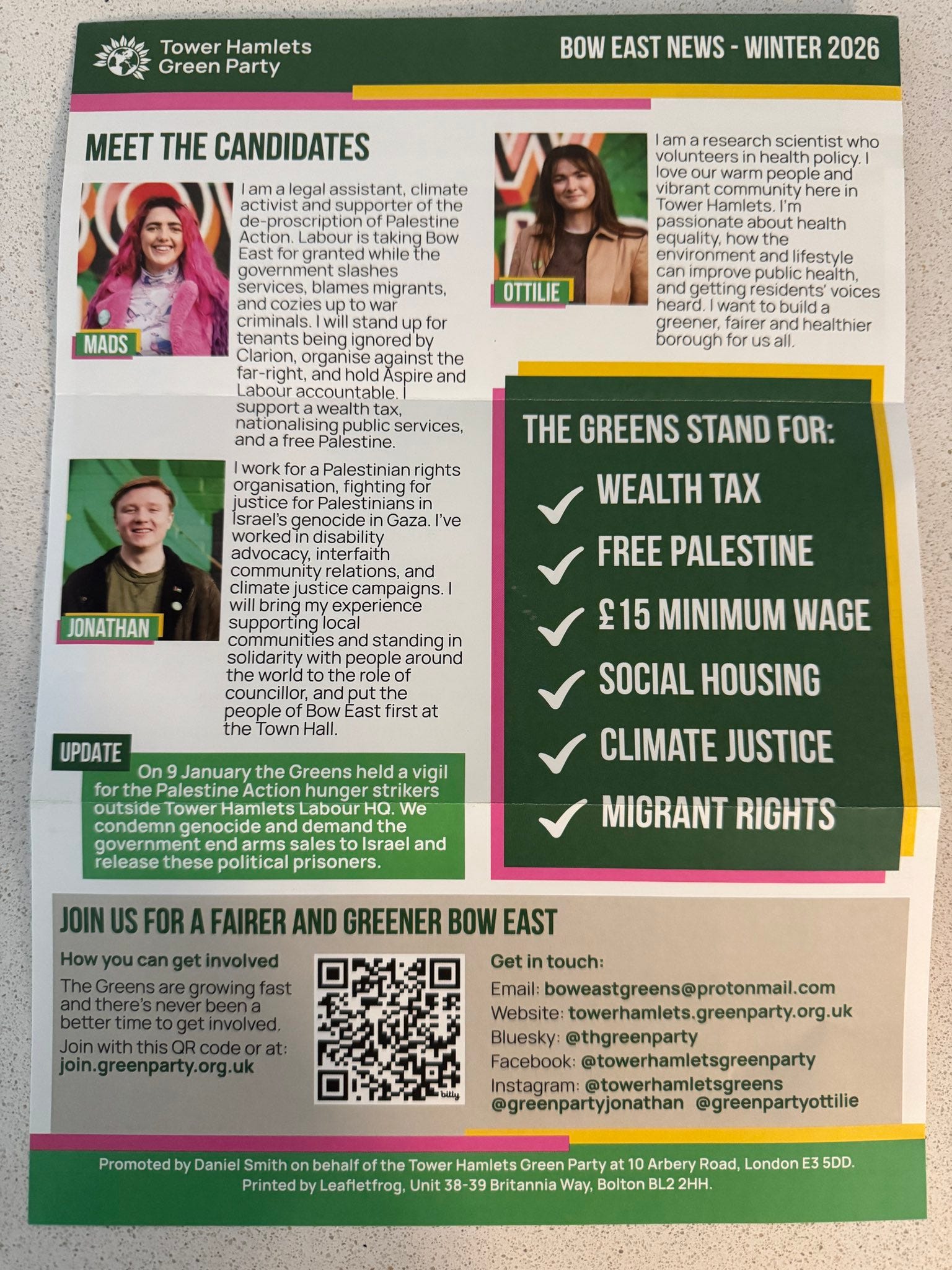
It's 2.30 in the morning. The phones are off. The street outside is empty. No emails, no notifications, no noise. Just the kind of stillness that most people never get because they're too busy filling it with something. This is when I'm most productive. When the world goes quiet and the mind goes clear. Two articles. One sitting. In stillness, silence, and solitude. One leaflet sourced on social media.
Let’s start with a number. £1,755.
That’s what a Band D household in Tower Hamlets pays in council tax every year. Not a fortune by London standards. But it’s real money. Working people’s money. Handed over on the understanding that the council will do what councils are supposed to do — fix things, maintain things, keep people safe in their own homes.
Now let’s look at what that £1,755 is actually buying.
Nearly one in four council homes — 23% — fail the Decent Homes Standard. There are 2,500 overdue fire safety actions, with 1,700 classified as high risk. More than 750 water safety remedials outstanding. Over 1,400 communal electrical safety checks, unresolved. Tenant satisfaction with repairs has collapsed from over 80% to just 65% since 2022.
And that’s before we get to the repairs service itself.
Less than half of all repair appointments — 47.3% — are actually kept. For emergency repairs completed on time, Tower Hamlets manages 76%. Newham manages 99%. Southwark manages 94%. The council paid over £106,000 in compensation to its own tenants last year. Less than 60% of calls to the housing service are even answered.
Sound like a council that’s on top of things?
£106,000 paid in compensation to their own tenants. And the Greens want to talk about Gaza.
The Leaflet.
The leaflet is called ‘Bow East News, Winter 2026.’ It introduces three candidates. And it lays out — with the confidence of people who have never waited three days for someone to answer the phone to report the drug dealers in the flat upstairs — exactly what the Tower Hamlets Green Party stands for.
Here it is, from their own checklist: Wealth Tax. Free Palestine. £15 Minimum Wage. Social Housing. Climate Justice. Migrant Rights.
Six items. Two of them — a Wealth Tax and a £15 Minimum Wage — are national government policy levers that no ward councillor has ever had the power to implement. One of them — Free Palestine — is the foreign policy position of a sovereign state, which a ward councillor in Bow East has precisely the same ability to influence as they have to redirect the orbit of the moon. The remaining three are so vague as to be decorative.
Not one word about repairs. Not one word about fire safety. Not one word about the 23% of council homes below basic standard. Not one word about the Regulator for Social Housing’s C3 judgement — second lowest possible rating — handed to Tower Hamlets for serious failings. Not one word about the government intervention, escalated in January 2026, over material concerns about financial management and governance. Not one word about the boiler that hasn’t worked since October.
They had a leaflet. They had space. They had candidates. And this is what they chose to put in it.
Meet the Candidates.
First is Mads. A legal assistant and climate activist who is a supporter of the de-proscription of Palestine Action. When this leaflet went through doors, Palestine Action was a proscribed organisation under the Terrorism Act 2000. Proscribed. By Parliament. Meaning that supporting it was, at that point, a criminal offence carrying up to fourteen years in prison.
The legal picture shifted weeks later — but the leaflet had already gone out.
On 13 February 2026, the High Court ruled that proscription unlawful and disproportionate — though the government is appealing and the order technically remained in force at the time of publication. The timing is worth noting: the candidate was publicly campaigning for the de-proscription of a then-proscribed organisation, and she chose a ward election leaflet to say so.
Next is Jonathan. Jonathan works for a Palestinian rights organisation and wants to bring — quoted directly from the leaflet — “solidarity with people around the world” to the role of ward councillor. He will, he tells us, put the people of Bow East first at the Town Hall.
The people of Bow East need someone who will put the repairs service first at the Town Hall. Someone who will sit in a scrutiny meeting and demand to know why 2,500 fire safety actions are overdue. Someone who will ask, out loud, with witnesses present, why emergency repairs here complete on time at a rate twenty-three percentage points below Newham. That’s what putting people first looks like from a council seat. Solidarity statements are a different job entirely.
Then there’s Ottilie. A research scientist who volunteers in health policy. She wants to build “a greener, fairer and healthier borough.” Fine. Content-free. Those words, in that order, have been said by roughly four thousand people in British politics. They mean nothing without specifics. And specifics are conspicuously absent.
Notice anything missing from all three of them?
Three candidates. Zero deliverable policies. One campaigning for a proscribed organisation. This is the offer.
The Update Box.
The leaflet contains an ‘Update’ box, rendered in dark green for emphasis. It tells residents that on 9 January, the Greens held a vigil for Palestine Action hunger strikers outside Tower Hamlets Labour HQ.
Palestine Action. Named. In a box. In green. On a ward election leaflet.
Practical? A vigil outside a Labour office does not fix a single overdue fire safety action. It does not unblock a drain, resolve a communal electrical fault, or get a call answered in the 40% of cases where currently nobody picks up. Useless as an act of local governance.
Logical? Only if your primary purpose is not to represent all residents of Bow East, but to perform for a specific activist audience. Bow East is roughly 37% Christian, 25% no religion, 21% Muslim, and 65% English-born. A genuinely mixed community with a shared interest in having a functioning council. Organising vigils for a proscribed organisation — whatever your view of that organisation — is not a cross-community strategy. It is the opposite of one.
Likely outcome? Candidates whose entire political identity is built around performative activism will perform activism. They will not drag officers into scrutiny sessions over fire safety backlogs. They will issue solidarity statements. They will hold vigils. And the residents of Bow East will keep waiting.
The Bigger Picture.
Tower Hamlets is not short of political drama. The current Mayor, Lutfur Rahman, won re-election in 2022 despite having been previously found guilty of electoral fraud and removed from public office. The council has received disclaimed audit opinions for five consecutive years.
The money picture is no better.
General Fund reserves fell by 42% in a single year. The government’s intervention, begun in 2024, was escalated in January 2026 over material concerns about financial management and governance.
This is the borough ward councillors are supposed to help fix. And the Green Party’s contribution to this moment is a candidate whose position on a proscribed organisation made its way into election literature, a checklist of policies no councillor can implement, and a vigil that left the boiler exactly where it was.
The residents paying £1,755 a year deserve candidates who understand what a council seat actually is. It is not a platform for international solidarity campaigns. It is not a microphone for national policy positions. It is a seat at a table where decisions get made about repairs, housing, safety, services, and money. Boring, practical, unglamorous decisions that affect whether people can live safely and decently in their own homes.
If you want to campaign for Palestinian rights, there are organisations built for exactly that purpose. If you want to be a ward councillor in Bow East, your job is to represent the people who live there — all of them — and hold to account a council that currently cannot answer 40% of its own phones.
A council seat is not a stage. It is a job.
And here, the shape of it starts to show. Not just in these three candidates. Not just in this leaflet. In the approach itself — the particular way that local elections become vehicles for causes that local elections cannot touch, in places where the gap between what residents need and what they’re being offered is widest.
It’s a formula. It turns up in specific kinds of places, with specific kinds of materials, aimed at specific kinds of anger. And it works — as electoral strategy. As governance, that’s a different question entirely. But the formula runs, and it runs, and somewhere at the end of every run, there’s a boiler that nobody fixed.
Free Palestine won’t fix your boiler. Not in Manchester, Bow, or anywhere else.
https://x.com/HeidiBachram/status/2028483861978415344?s=20
The more I sat with it, the bigger the picture got. Part 2 is where it led me.
Sources and References.
Tower Hamlets Housing Performance Regulator of Social Housing — Regulatory Judgement: Tower Hamlets Homes (April 2025). C3 rating issued for serious failings in tenant safety and repairs. Tower Hamlets Council — Housing Performance Dashboard (2024/25). Repair appointment completion rates, emergency repairs data, call answer rates, tenant satisfaction figures. Ministry of Housing, Communities and Local Government — Intervention Notice: Tower Hamlets Council (January 2026). Escalation of statutory intervention over financial management and governance.
Council Tax Tower Hamlets Council — Council Tax rates 2025/26. Band D figure: £1,755.
Electoral and Demographic Data Office for National Statistics — Census 2021, Tower Hamlets. Religion, ethnicity and country of birth data for Bow East ward. Electoral Commission — Bow East ward, Tower Hamlets. Candidate and promoter data, 2026 local elections.
Palestine Action — Legal Status Home Office — Proscription of Palestine Action under the Terrorism Act 2000 (July 2025). R (Ammori) v Secretary of State for the Home Department [2026] EWHC 292 (Admin). High Court ruling, 13 February 2026. Proscription found unlawful and disproportionate. Government appeal pending at time of publication.
Tower Hamlets Governance Election Court — Erlam and others v Rahman and another [2015]. Finding of electoral fraud, removal from office. National Audit Office and Mazars — Disclaimed audit opinions, Tower Hamlets Council, 2018/19 through 2022/23.
One Leaflet. One Election. One Formula.
The Greens just won their first northern seat. In the 15th most deprived constituency in England. Here’s how the formula works.
By The Almighty Gob | Greater Manchester | March 1 2026.
Let’s start with a number. 14,980.
That’s how many votes Hannah Spencer received in Gorton and Denton on 6 February 2026. Enough to win. Enough to make history. The first Green MP elected in the north of England. The first Green parliamentary by-election victory. In a constituency Labour had held since 1931.
Nearly a century. Gone. In a Thursday afternoon count in Manchester.
Now let’s look at where those 14,980 votes came from. Because the answer is more interesting than the headline. And the headline was already very interesting.
The Constituency.
Gorton and Denton is the 15th most deprived constituency in England. Thirty-five of its forty Manchester-side neighbourhoods sit in the most deprived quintile nationally. Forty-five per cent of its children — over 12,000 young people — live below the breadline. In Levenshulme and Longsight that rises to 59% and 56% respectively. More than 61% of households are deprived in at least one dimension: employment, education, health, or housing.
The income figures make it concrete.
A third are in fuel poverty. The poorest neighbourhood in Manchester — Longsight East — average household income: £23,000 a year. Less than half the income of the city’s wealthiest neighbourhood.
This is a place that has been let down continuously, for decades. By Labour. By every government of every flavour. By economics that gutted manufacturing and replaced it with nothing. By austerity that stripped services and called it efficiency. By a political class that showed up every five years and left.
Nearly a century of safe seats. The 15th most deprived constituency in England. Draw your own conclusions.
The Candidate.
Hannah Spencer is 34. She left school at 16. Trained as a plumber. Set up her own business. Qualified as a gas engineer, then started a plastering course — still attending most Thursdays during the campaign. Four rescue greyhounds. Politically radicalised by Covid and Partygate. Green councillor in Trafford since 2023.
There is a meaningful difference between a candidate who volunteers in health policy and loves the vibrant community, and a candidate who has spent fifteen years going into people’s homes and fixing what’s broken. Spencer knows what damp looks like from inside a boiler cupboard. She’s been in those houses. In a constituency where a third of households are in fuel poverty, that is quite a lot.
The victory speech was good. Not polished-good. Real-good. Working hard used to get you somewhere — a house, a life, somewhere. Now what does it get you? That is not focus-grouped. That is the real thing.
The candidate is real. The machine that got her elected is worth examining.
The Campaign Materials.
The Green campaign produced materials in Urdu, Bengali, Arabic, and Pashto. Spencer appeared in a keffiyeh outside a mosque in campaign photographs. An Urdu leaflet carried the message: push the falling walls one more time. Labour must be punished for Gaza. The English-language materials led on stopping Islamophobia and stopping Reform.
The digital operation ran alongside it.
Videos were produced in four languages for WhatsApp distribution. A Starmer-Modi handshake clip was circulated in campaign materials. Islam21c — an Islamic media platform — published an article encouraging Muslim voters to overlook their discomfort with Green Party positions on drugs, prostitution, and LGBT rights for what the article called more urgent matters.
The more urgent matter was Gaza.
Spencer told The Times before the vote: Gorton and Denton has a large Muslim population, and that will certainly be an element. An element. Named. In advance. In a national newspaper.
Democracy Volunteers, monitoring the election, recorded the highest family voting levels in ten years of UK observation.
The Formula.
So. Let’s apply the framework.
First: identify a community with concentrated, legitimate grievance. Gorton and Denton’s Muslim population — concentrated in Longsight and Levenshulme — had real, felt anger about Gaza and Labour’s position on it. That anger was not manufactured. It was real.
Second: find the galvanising issue. Not fuel poverty. Not the 45% of children below the breadline. Gaza. The issue that produces the highest emotional activation in the target community. The issue that translates — literally, into four languages — most cleanly.
Third: produce materials calibrated to specific communities, carrying different emotional registers for different audiences. The Urdu leaflet reads differently from the English leaflet. Same campaign. Different messages.
Fourth: neutralise the social policy problem. The Green Party’s positions on drugs, prostitution, and LGBT rights are not compatible with socially conservative religious communities. The Islam21c article did that work: overlook the discomfort for the more urgent matter. Third-party endorsement, doing what the party couldn’t do officially.
Fifth: add the graduate-progressive vote as ballast. Burnage and Levenshulme carry 42% student and graduate populations. Left-economic populism plays there. Different audience. Different activation. Same candidate.
The Muslim bloc vote in Longsight. The graduate-progressive vote in Burnage. Together they overcame the Reform dominance in Denton — 83% white, voting entirely differently. Spencer threaded a needle that shouldn’t have fit.
Practical as electoral strategy? Yes. The arithmetic was correct, the execution competent, the result historic. Logical? Electorally yes — but the coalition that elected her is not a programme. It is two separate expressions of the same anger, pointing in opposite directions. Holding them together across a full parliamentary term is a different problem. Galloway filled the same gap in Bethnal Green and Bow in 2005. He held it for one term. The Greens are not Galloway — but the structural dynamics of a single-issue coalition are the same regardless of the candidate.
37 constituencies with 20%+ Muslim populations. 73 more between 10% and 20%. The formula is not finished.
The Pattern.
You may have read recently about a ward election in Bow East, Tower Hamlets. Three Green candidates. A checklist: Wealth Tax, Free Palestine, £15 Minimum Wage, Social Housing, Climate Justice, Migrant Rights. A vigil for Palestine Action hunger strikers. One candidate publicly supporting the de-proscription of what was, at that point, a proscribed organisation under the Terrorism Act 2000.
A borough where 23% of social homes fail Decent Homes Standard. Where 2,500 fire safety actions are overdue. Where fewer than half of all repair appointments are kept. Where the boiler hasn’t worked since October.
The leaflet mentioned Palestine three times. The repairs service, not once.
Different city. Different election. Different scale. Same formula. Identify the grievance. Find the galvanising issue. Produce the materials. Neutralise the inconvenient positions. Count the votes.
Same product. Different price points. One is the trial run. The other is the rollout.
What This Actually Is.
Step back from the election. Step back from the candidates. Step back from Gaza and fuel poverty and ward leaflets and parliamentary victories.
Look at what you’re actually looking at.
A political party identified an underserved market — communities with real, legitimate grievances, a gap between what they needed and what was on offer. The party developed a product — a brand proposition, a set of materials, a candidate profile — precisely calibrated to that market. It tested the messaging. It translated it. It distributed it through the channels its target audience actually uses. It neutralised the objections. It mobilised the customer base.
This is not a political strategy. This is a marketing strategy. Indistinguishable, in its mechanics, from how any competent business captures an underserved segment.
Look at the language.
The multilingual WhatsApp videos are content. The keffiyeh photograph is brand positioning. The Islam21c endorsement is influencer marketing. The Urdu leaflet and the English leaflet are A/B variants for different audience segments. The candidate is the product face.
The grievances are real. The product and the marketing can both be genuine. But the formula runs on anger, not on need. The residents of Bow East are still waiting for the repairs. The residents of Gorton and Denton are still in fuel poverty. The formula got its result. The work — the boring, unglamorous work of actually fixing things — that comes later. If it comes at all.
You’re not angry at the Green Party for doing this. You recognise it too clearly for anger. You’ve seen it before. In every political party that ever identified a grievance and turned it into a vote. In every brand that ever found your pain point and sold you something to fill it. In every piece of content designed to move you from where you are to where someone else needs you to be.
The Greens just run it cleanly.
It found the frequency of your anger. It broadcast on it. You felt it working. Everyone always does.
The boiler can wait.
By the time I’d finished writing, it had all come together. I hope it does for you too.
Sources and References.
Gorton and Denton — Deprivation Data Ministry of Housing, Communities and Local Government — English Indices of Deprivation 2019. End Child Poverty Coalition — Local Child Poverty Indicators 2024/25. Levenshulme: 59%. Longsight: 56%. Gorton and Denton overall: 45%. Department for Energy Security and Net Zero — Sub-regional Fuel Poverty Data 2024. Office for National Statistics — Annual Survey of Hours and Earnings 2024; Census 2021. Longsight East household income data.
Election Result Electoral Commission — Gorton and Denton Parliamentary By-Election, 6 February 2026. Spencer (Green) 14,980 (40.7%); Reform 10,578 (28.7%); Labour 9,364 (25.4%). Electoral Commission — Historical results, Manchester Gorton. Labour representation from 1931.
Campaign Materials The Times — ‘Green Party targets Muslim vote in Gorton by-election’ (January 2026). Islam21c — article on Muslim vote, encouraging voters to “overlook” Green social policy positions (January 2026). Democracy Volunteers — post-election statement on family voting levels, February 2026.
Historical Comparison Electoral Commission — Bethnal Green and Bow by-election 2005. Galloway (Respect) result and 2010 general election loss. House of Commons Library — Muslim population by constituency, England and Wales (2021 Census). House of Commons Library — 2024 general election results. Labour vote decline in constituencies with 15%+ Muslim population.
Tower Hamlets Reference Regulator of Social Housing — Regulatory Judgement: Tower Hamlets Homes (April 2025). Tower Hamlets Council — Housing Performance Dashboard 2024/25. R (Ammori) v Secretary of State for the Home Department [2026] EWHC 292 (Admin), 13 February 2026.
I am independent blogger and satirical commentator documenting Bristol City Council and the wider landscape of British institutional dysfunction. Three questions. Every time. Is it practical? Is it logical? What’s the likely outcome?
thealmightygob.com
Talking about Boilers, I heard that Carla Denyer has still got a gas boiler. https://www.tiktok.com/@itvpolitics/video/7384389116693089568?lang=en