
From Maslow's Hierarchy To Bristol's Lowerarchy. Explained.
The Chessboard Squares of Bristol Life. Aren't As Black And White As They Appear.

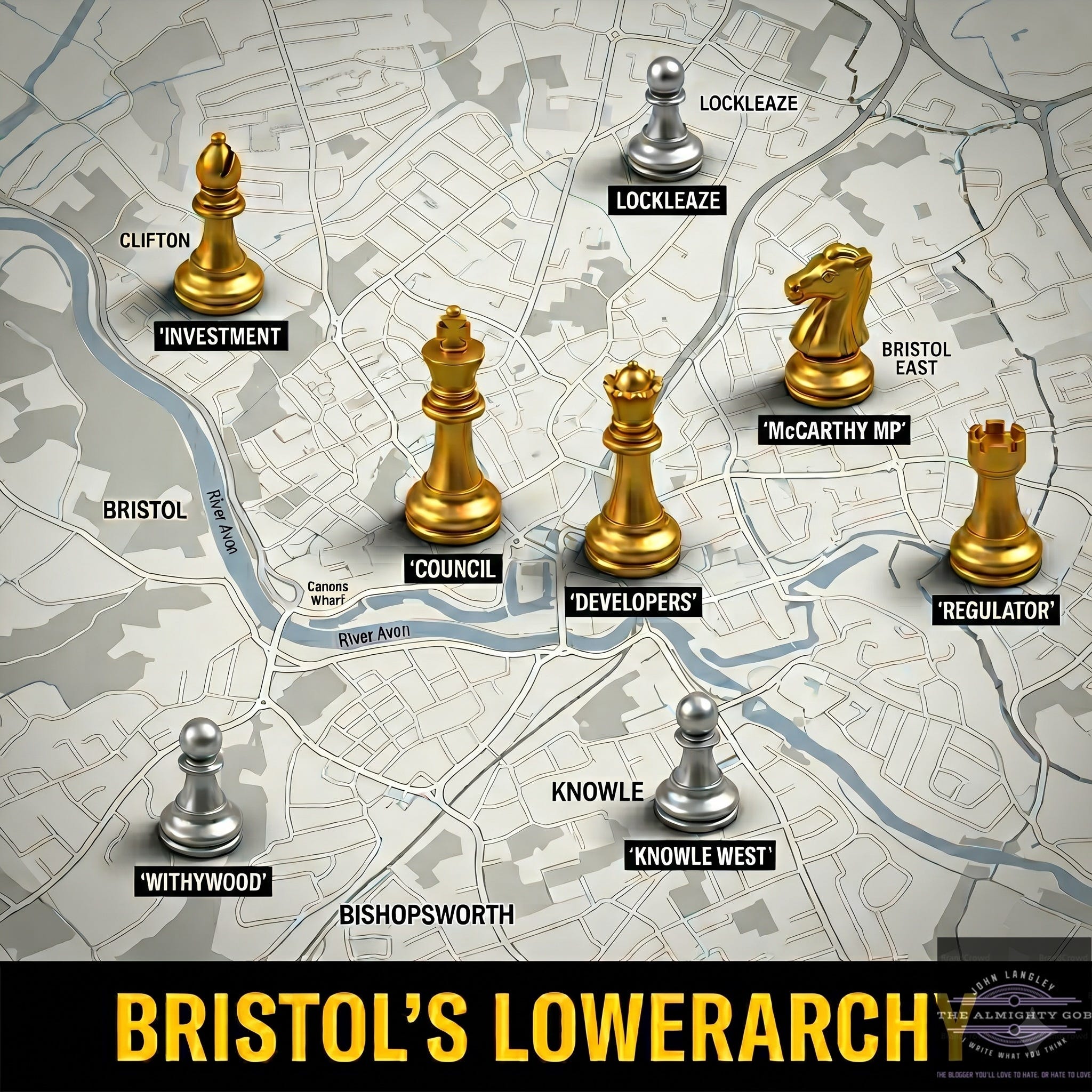
[Who Moves. Who Stays. Who Gets Left Behind. thealmightygob.com]
As of this morning, at 8:02am, on 27 May 2026, one voice was more prominent than the noise that surrounded it.
@LJRyder16 posted this on X:
“I’ve said a version of this for 2 decades- I think E/SBLN are part of delivering this agenda. Pointed out ‘lowerarchy’ to McCarthy MP-reply? Im listening to ‘Conspiracy theories/its just resource management.’ Get this in mainstream media please.”
@LJRyder16’s post came directly in response to The Almighty Gob’s article published earlier — Maslow Is SO Yesterday, Dahling. This Is Bristol’s Lowerarchy: The Investment Hotspot That Forgot Who Lives Here — in which the term lowerarchy was coined and the Bristol housing crisis was set against the city’s property investment credentials. That article is available here https://bit.ly/3PFDQ9g
So. Two decades of observation. One coined term from The Almighty Gob’s Bristol Lowerarchy piece. One sitting MP. Two responses. Result?
Conspiracy theories.
Resource management.
This article is the response to both.
The lowerarchy isn’t a theory.
It is a coined term for a documented reality — evidenced by parliamentary submissions, a Regulator finding serious failings, a council website advising applicants to think about other options, and a waiting list of 18,000 households.
The term didn’t create the reality. The reality created the need for the term.
@LJRyder16 is that voice.
Someone who has been saying a version of this for two decades. Someone who took a coined term from an independent Bristol publication and raised it with a sitting MP before most of Bristol had finished its breakfast.
Not because she had the loudest platform. Because she had the clearest sight.
History has never been moved by the size of the crowd. It has always been moved by the one voice more prominent than the noise that surrounded it.
I’m Not A Chess Player. However.
I do have some understanding. Mind you. I can just about master an article for The Almighty Gob — and that’s still a work in progress. Ah well. I guess there’s still some hope for me after all.
However. The pawns are the most exposed and the first to be sacrificed on the board.
In Bristol’s particular version of the game — the one being played right now, today, in plain sight on the Harbourside and in the housing offices and in the temporary accommodation spreadsheets that haven’t been published — the people of Knowle West, Lockleaze, Withywood, and every other neighbourhood the investment brochure doesn’t photograph, aren’t the pawns.
They are the board itself.
The surface everyone else plays on. The foundation that makes the game possible.
The city that existed before the investment thesis arrived, that will exist long after it moves on, and that is currently being used as a playing surface by pieces that were never elected to represent it, never asked permission to use it, and have no intention of leaving it in better condition than they found it.
It’s a game of Bristol affordable housing versus Bristol unaffordable housing.
And the board has never been fully engaged with the rules. If at all.
Funny, that.
The Pieces. And What They Choose Not To Do.
Stand at the edge of the Harbourside on any given morning.
Watch the cranes moving over Temple Meads. Watch the glass going up where the ordinary is being replaced. Admire this as an example of transparency in Bristol. Watch the city being rearranged, piece by piece, with the unhurried certainty of a game that started long before most of its residents noticed the board had changed.
Then notice, with equal care, what each piece chooses not to move toward.
The king moves slowly. One square at a time.
Bristol City Council is the king.
Managing 26,700 tenanted homes with an £8 million annual shortfall, a botched IT system producing repair figures nobody trusts, and a Decent Homes Standard with no confirmed implementation date.
Technically the most important piece on the board. Practically the most defended while contributing the least forward motion.
The king doesn’t build homes. The king issues asset management strategies. The king removes 4,000 names from a waiting list and files it under progress. The king moves one square. Calls it a consultation. Moves one square back.
Is that practical? For the people on the waiting list, demonstrably not. Is it logical? Only if the goal is the management of lists rather than the provision of homes. What is the likely outcome? The mathematics don’t close. They widen.
The king also approves.
Over 2,800 purpose-built student accommodation beds are currently in the Bristol development pipeline for 2026/27 alone.
530 at Albert Road. 500 at Temple Quarter. 282 in Redcliffe. 1,500-plus at the Propeller Quarter in Brabazon.
Each bed occupied for approximately thirty weeks of the academic year.
Each bed sitting empty for the remaining twenty-two.
The Almighty Gob has written about this before. The arithmetic hasn’t changed.
18,000 households on the waiting list would be grateful for any one of those beds for fifty-two weeks a year.
The king approved the rooftop boardroom instead. Meanwhile.
Somewhere on the waiting list, a family is still counting the days. Hours. Possibly, even minutes. Hope, now being so removed from their world. You know. Where ‘pointless’ becomes a lifestyle by default.
The queen goes where she chooses. Any direction. Any distance. Unconstrained by the squares the board’s residents occupy.
The developers — Kinrise, Mactaggart Family & Partners, and every regeneration vehicle behind every waterfront masterplan in the city — are the queens. You know. Not casting aspersions. In the more literal sense.
The most powerful pieces in the game. They don’t wait. They don’t get removed from the register after two years of inactivity. Who’d have thought. Not me. Clearly.
They get planning permission, a podcast studio, and a rooftop boardroom with panoramic views across the city they’re playing on. The budget stopped at disco lights, and a sound system that would make Glastonbury sickened with envy.
The knight moves in L-shapes. Never straight. Never direct. Always arriving at an unexpected angle that avoids the most obvious squares entirely. Not by accident. By geometry.
Kerry McCarthy MP has represented Bristol East for over twenty years. And, it’s still in one ‘L’ of a state. Some might say.
On the morning of 27 May 2026, @LJRyder16 raised the lowerarchy concept with her. McCarthy’s response, as reported by @LJRyder16: conspiracy theories and resource management.
The knight moved over the board’s actual residents without engaging a single one of them.
The characterisation of McCarthy’s response is @LJRyder16’s own, published publicly on X on 27 May 2026.
This is not a personal attack on Kerry McCarthy. It is an observation about the geometry of institutional response. The knight doesn’t choose its movement pattern. The game does.
Kerry McCarthy is welcome to clarify her position at any time. The Almighty Gob will publish any such clarification in full.
@LJRyder16 went further. She suggested that the East Bristol Liveable Neighbourhood and South Bristol Liveable Neighbourhood schemes are part of delivering the same agenda.
The Almighty Gob has written extensively on both.
McCarthy’s response to that observation was the same two words.
Conspiracy theories. Resource management.
Is that practical? For the people of Knowle West — the board itself — it is the least practical response available. Is it logical? Only if the goal is the avoidance of the question rather than the answering of it. What is the likely outcome? The knight’s geometry doesn’t change the arithmetic. It never has.
The bishops move diagonally. Always on the same colour square.
The investment prospectus, the regeneration brochure, the Business Live headline celebrating Bristol as the top property investment destination in the South West — these are the bishops.
They cover enormous ground while remaining permanently on the squares where the yield figures live. They never land on Knowle West. They never land on Lockleaze. They never land on Withywood. As to why? Well.
The bishops of Bristol property investment are geometrically incapable of reaching the squares where the board’s actual residents are standing. The geometry isn’t an accident. It’s a feature.
The rooks move in straight lines. Powerful when deployed.
The Regulator of Social Housing found serious failings in how Bristol City Council manages its homes.
The rook moved. Once. Issued its finding. Stopped. Bristol? Rooked.
You see. The rook doesn’t initiate. It responds. And then it waits to be picked up again by someone with the authority to place it back in the game.
Notice what none of these pieces ever does. None of them asks the board how it is. None of them sits with the people of Knowle West over a cup of tea and a difficult conversation. None of them stays. None of them ever invited to view the presentation of facilities they will never get to enjoy themselves. You know. Like a postcard from somewhere you may get to dream of. Though never visit. It’s like the middle finger of authority. From a safe distance. The other side of the river.
They move. They play. They leave.
The board remains.
The Board.
There is a number that exists. Not estimated. Not projected. Not modelled.
A precise, documented, operational number sitting in a spreadsheet in a council office in the same city that has just been named the top property investment destination in the South West.
It is the number of Bristol households currently placed outside the local authority area. Moved. Not rehoused. Moved. Out of Bristol entirely.
Away from the neighbour who has the spare key. Away from the school that finally understood the child. Away from the GP who knows the full history without being told it again.
Away from twenty years of ordinary life built in a city that then decided, quietly and administratively, that their square was needed for something else.
Managed, in Kerry McCarthy’s precise and carefully chosen word, out.
Bristol City Council’s own temporary accommodation guide confirms the mechanism plainly.
Placements could be in any area of Bristol or outside. Applicants are not restricted to considering accommodation in Bristol.
The council’s words. The council’s document. Publicly available. Unamended. Unretracted.
Read that slowly. Not restricted to considering accommodation in Bristol. Which is another way of saying: we may move you out of the city you came to us from. The city whose waiting list you joined. The city whose board you are.
Bristol is not unique in this.
Oxford City Council placed over half of its temporary accommodation households outside the city in 2024/25. The mechanism is widespread and entirely consistent with the council’s own published guidance.
A conspiracy theory requires the absence of evidence. This one comes with a footnote.
This is the people chessboard. Pieces moving in every direction simultaneously across every local authority boundary.
Bristol moving households out. Other authorities moving households in. Nobody permanently housed. The board keeps shifting. The game keeps running. Though. Notice the absence of that chess clock. It would never sustain the batteries required.
And the number of pieces currently off the board — Bristol residents, in another city, tonight, in a place that isn’t home and was never supposed to be — is known precisely by the people who chose not to publish it.
Should anyone feel moved to characterise what the council’s own documentation describes as something other than what it plainly is — the managed displacement of Bristol residents from their own city — they will find the temporary accommodation guide waiting patiently for them.
It has not been amended. It has not been withdrawn. It says what it says.
The Almighty Gob has noted it. The public record now reflects it.
Permanently.
The Game.
It stops being a conspiracy theory when you can see it playing out before your very eyes.
The board is Knowle West. The board is Lockleaze. The board is Withywood. The board is the 18,000 households on the Bristol social housing waiting list, the 4,000 removed from it, the 1,786 families in Bristol temporary accommodation averaging 558 days in a place nobody calls home.
The board is Bristol.
And the board has been watching the game being played on top of it for long enough to know exactly who the pieces are, which direction they move, and whose interests they serve when they get there.
Bristol gentrification has a mechanism. It is called trickle-up urbanism. Bristol City Council housing has a shortfall. It is £8 million. Annually. Bristol temporary accommodation has a number. It hasn’t been published. Bristol property investment has a brochure. Bristol affordable housing has a waiting list. The Bristol Post has a headline. Everyone’s happy. Well. Almost.
The Almighty Gob has the board.
You see. Every claim in this piece is sourced from parliamentary submissions, Regulator findings, Bristol City Council’s own published documentation, and independently verified news reporting. All sources are publicly available.
And on that board — on the morning of 27 May 2026 — one voice was more prominent than the noise that surrounded it.
Two decades of observation. One coined term. One MP. Two responses.
Conspiracy theories.
Resource management.
Neither of which, it turns out, is as black and white as they appear.
The board knows.
It was just waiting for someone to write it down.
That person was @LJRyder16. In a post earlier this morning.
© The Almighty Gob 2026. All rights reserved. Unauthorised reproduction prohibited.
The Almighty Gob is an independent Bristol-based publication covering institutional accountability, urban policy, and the gap between what cities say and what cities do.