
From Nursery To The Encampment.
What Happens When You Stop Letting Children Be Children - The Almighty Gob.

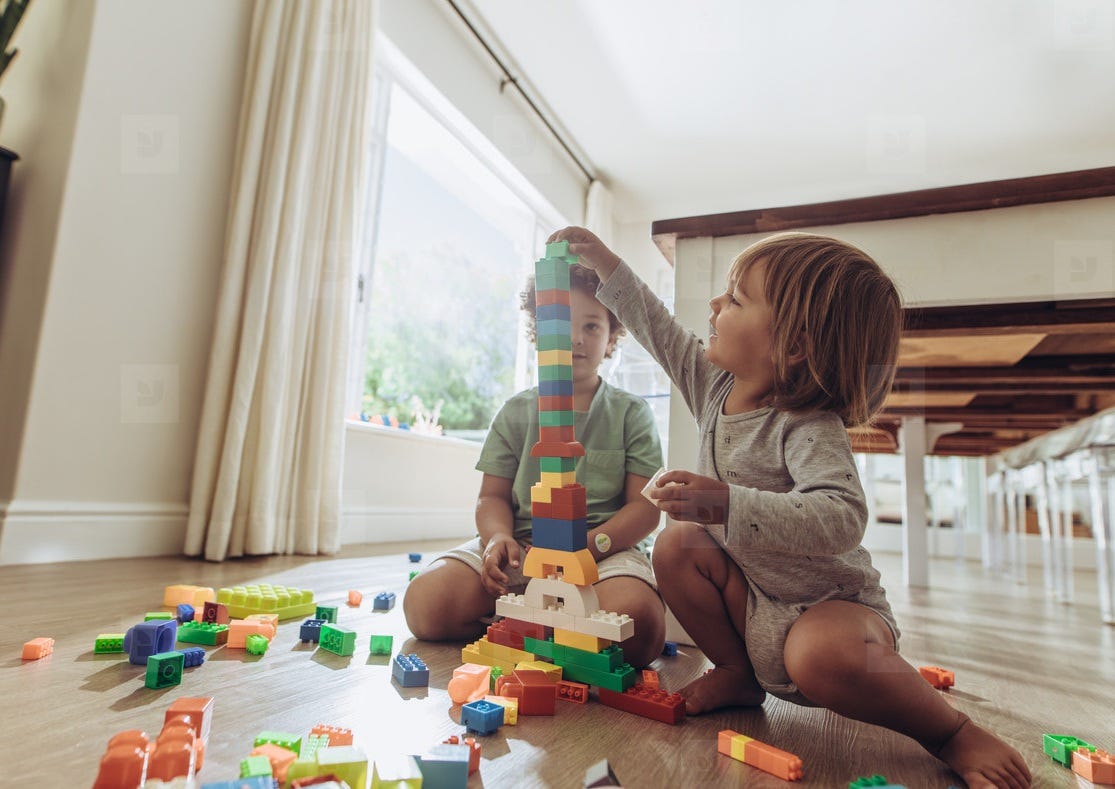
The Child With The Blocks.
Imagine a child playing. Just like the child in the image above. She is four years old. She is doing what four-year-olds are built to do — arranging wooden blocks into a tower that will fall, laughing when it does, building it again. She is learning gravity, consequence, persistence, and joy, all without a single lesson plan. Nobody has told her what to think about the blocks. Nobody has told her what the blocks represent. The blocks are wooden. The room is warm. Nobody has shown her a screen. Nobody has given her a target. She is doing precisely what she is built for at precisely the age she is built to do it. She is, for now, free.
Keep that child in mind. We will come back to her.
Something Changed.
Something changed. It always does, and it always starts somewhere no one was watching. Nobody meant to do it. That is the most damning part. Nobody sat in a room and decided to wreck a generation. They just kept making sensible decisions until the wreckage was complete. Not overnight, not through conspiracy — gradually, with good intentions, through a thousand small decisions that each seemed reasonable at the time. The pipeline from nursery to university that once produced curious, resilient, independently-minded adults now produces something rather different. And by the time you see the finished product, it is far too late to ask where it went wrong.
The question worth asking is: where did it start?
“The bug was never in the machine. It was always in the people running it — and the people, it turns out, were trained not to notice.”
The Clock Is Wrong.
It started earlier than most people think. The pressure to formalise childhood — to turn play into preparation, to replace mud and blocks and stories and songs and the patient turning of seasons with targets and assessments and early literacy frameworks that arrived, year by year, earlier and earlier — began nudging downward through the age groups until it reached the nursery floor itself. What was once understood as the necessary business of being small — the messiness, the repetition, the self-directed exploration — became something to be managed, measured, and moved through as quickly as possible.
The result is visible in the data, though rarely framed honestly. The number of children identified with special educational needs in England has risen every single year since 2016, reaching over 1.67 million in 2024 — nearly one in five of all school pupils. Spending on support has almost doubled in a decade and is forecast to hit £21 billion by 2029. The system calls this progress.
These figures are presented as discoveries — children with needs finally being identified. And some of that is true. But not all of it. Because when you change what you demand of a five-year-old, you change how many five-year-olds appear broken.
One in five children is now officially behind. The system that set the pace has not been questioned. The children have.
The children are not broken. The clock is wrong. Children given time — real time, unhurried time, time measured in seasons rather than assessment windows — catch up completely. The research is unambiguous on this. The system ignores it because the system is not designed around children. It is designed around targets.
From learning difficulties to learned helplessness — the pipeline does not stop at diagnosis. It just changes what it calls the problem.
“Every child arrives ready to learn. The question is whether what we ask them to learn is ready for them.”
A Profession Becomes An Ideology.
Into this system walk the teachers. Most of them entered the profession because they wanted to help children learn. That impulse is genuine. What happens next is structural rather than sinister — which makes it harder to argue with and easier to miss.
A TES poll found that 49% of UK teachers voted Labour at the last general election, with 80% having backed Remain. Teaching leans left. It has for a long time, and there are obvious reasons — public sector employment, graduate culture, union membership, the values that draw people toward caring professions in the first place. None of that is a crime. What comes next is.
Union conformity does the rest. The NEU, with 450,000 members, has called for the full decolonisation of the national curriculum. When the professional body speaks, teachers listen — not because they are told to, but because belonging to a tribe means absorbing its orthodoxies. The teacher who privately disagrees stays quiet. The teacher who agrees enthusiastically shapes what gets taught. Over time, the distribution shifts. Not through instruction. Through selection pressure.
That is how a profession becomes an ideology.
“Nobody orders a profession to think alike. The atmosphere does it quietly, over years, one unasked question at a time.”
What Gets Left Out.
What gets taught matters. What gets left out matters more.
The national curriculum does not prescribe specific historical content in any binding way. Teachers have discretion. And discretion, exercised consistently across a left-leaning profession, produces patterns. The national curriculum is a guarantee of almost nothing. It is a framework so broad that two children in the same country, the same year, the same age, can leave school having been taught entirely different versions of their own history — and every teacher involved will have followed it to the letter. The historian William Dalrymple observed that children move from Henry VIII to the Nazis, skipping what he called the most interesting period in between — the era when Britain administered the largest empire the world had ever seen. That period is not banned. It is simply inconvenient, and inconvenient material has a way of disappearing when nobody is watching.
Nobody banned Churchill. They just stopped teaching him. There is a word for that. Several, actually.
Churchill becomes optional. The British Empire becomes a source of shame rather than complexity. The Transatlantic Slave Trade is taught with appropriate gravity while other forms of slavery — Arab, African, Ottoman — are treated as footnotes, if they appear at all. This is not balance. It is curation. And curated history does not produce thinkers. It produces people who have been handed conclusions and told to feel appropriately about them.
A curriculum built around what a child is actually ready to absorb — emotionally, intellectually, at each stage of their development — looks nothing like this. It would not skip the difficult. It would simply wait until the child had the tools to hold it. That approach exists. It has existed for over a century. Nobody in government has seriously proposed it. That tells you everything about what the curriculum is actually for.
The evidence on what this does to a child is not theoretical. Peer-reviewed research from the LSE found that political indoctrination at school level measurably reduces individual agency and life outcomes — effects still detectable fifty years later. A system that substitutes emotional instruction for critical thinking is not educating children. It is processing them.
Roger Waters wrote the warning in 1979. Another Brick In The Wall. The line that every generation since has sung along to without quite believing it applied to them. We don’t need no thought control. Forty-five years later, here we are.
“Discretion, exercised consistently by a profession that stopped questioning itself, is just censorship with better manners.”
The Erasure Instinct.
The same instinct that filters the curriculum shows up everywhere once you know what you are looking at. It is not confined to classrooms.
Colston Hall in Bristol — a concert venue with no financial connection to Edward Colston — was renamed Bristol Beacon in September 2020 following a £132 million refurbishment. The name change was pursued not because the building had done anything wrong, but because the discomfort of association was considered reason enough. Bristol Beacon. Not an explanation. Not a reckoning. Not a single word about slavery, history, or the city’s relationship with its own past. A beacon. Pointing nowhere. Saying nothing. One hundred and thirty-two million pounds and that is what they came up with. Statues came down across the country under the same logic. Libraries felt the pressure too. An Index on Censorship survey found that 53% of UK school librarians had been asked to remove books, and 56% of those complied. The targets varied — LGBTQ+ content from religious conservatives, historical content from progressives — but the mechanism was identical. Remove the discomfort. Remove the thing.
History does not get processed this way. It gets binned. And children raised in institutions that bin the difficult rather than confront it grow up without the tools to confront difficulty themselves. They learn, instead, that discomfort is a signal that something is wrong and that the correct response is removal. That lesson will follow them.
“You cannot teach a generation to face hard truths by spending their entire education removing them.”
The Chilling Effect Moves Upward.
Those children become students. Some of them become teachers. The academics who train the next generation of educators were themselves shaped by the same pipeline, and they reproduce the same assumptions in the people they produce. The chilling effect migrates upward. The lecturer who knows which opinions carry professional risk stops offering the other ones. The seminar that should produce genuine argument produces nodding instead — enthusiastic, career-preserving, ideologically compliant nodding. They call it discussion. It is anything but. Students learn that the range of acceptable thought has edges, and they learn not to approach them.
A 2021 survey found that over half of conservative-leaning students in UK universities self-censor. Not because they are told to. Because the atmosphere makes the cost of speaking clear without anyone having to say a word. That is a more effective form of control than any policy could achieve. It is not accidental. It is the logical endpoint of a pipeline that began, decades earlier, on a nursery floor — the same floor where a child with wooden blocks was first told that play needed a purpose.
“Self-censorship is what you get when the rules are never written down but everyone already knows them.”
And now, quietly, the system has begun to notice. Not with honesty — with rebranding. The same politicians and educators who spent thirty years telling every child that university was the summit of human achievement, who stripped woodwork and metalwork and practical skills from the curriculum in favour of academic targets, who created a culture in which a trades apprenticeship was somehow a consolation prize — those same voices are now discovering, with the enthusiasm of the recently converted, that the trades are the future. That skilled hands matter. That not every eighteen year old needs a degree and fifty thousand pounds of debt to prove their worth.
Perhaps. A little late. But perhaps.
The people who made these decisions are still in post. Still drawing salaries. Still chairing committees about the future of education. Just so we are clear about who we are talking about.
They say Britain lost its manufacturing industries. That is not entirely true. We never stopped manufacturing. We just changed the product. Less steel. More compliance. Less coal. More conformity.
You might want to screenshot that.
The production line kept running. It just moved into the classroom. And like every production line, it had a finished product. You are about to meet it.
You should read that again before moving on.
The Finished Product.
In May 2024, students at the University of Bristol erected an encampment in Royal Fort Gardens. It stood for twenty-seven days. The students who gathered there were, by most measures, educated. They had passed their GCSEs and their A-levels. They had gained entry to a Russell Group university. They could write essays and cite sources and construct arguments. What they appeared unable to do was tolerate the existence of a position different from their own, interrogate the complexity of a conflict three thousand miles away, or ask whether the certainty they felt was earned or inherited.
They had read the books. Written the essays. Cited the sources. The one thing a university education is supposed to produce — the ability to sit with uncertainty, to hold complexity, to ask whether you might be wrong — was entirely absent. They were certain. Completely, performatively, magnificently certain. About everything. In the rain.
They were not stupid. They were the finished product. What started as blocks ended up as blockages.
The same infection that rewired individual thinking through rolling news, social media, and the collapse of patience for complexity also rewired the institutions charged with building resistance to it. Two delivery mechanisms. One outcome. A generation that feels everything and questions nothing — that mistakes the intensity of a feeling for the quality of an argument, that has been handed a lens and told it is the only one in existence.
The encampment came down. The students went back to their lectures. The pipeline kept running.
“The encampment was not a beginning. It was a result. The question is what produced it — and the answer starts thirty years earlier, in a nursery.”
Back To The Blocks.
So, back to the child in the nursery. She has knocked the tower down again. She is laughing again. She is about to build it again. She does not know yet that the system waiting for her has decided play is a luxury, that curiosity is a resource to be directed, and that history is a story with approved villains and approved heroes. She does not know that by the time she is old enough to choose her own path — university, trade, or anything in between — the chances are good that she will have been taught what to think about the world without ever being taught how. Or that the people who removed her choices are already preparing a speech about giving them back.
She is four. She still has the blocks. For now, they are hers.
The question is not what went wrong. The question is whether we will leave her alone long enough to find out for herself.
I’m The Almighty Gob — independent blogger and satirical commentator, Bristol-based, publishing since May 2024. Over four hundred articles later, and eighty-eight investigations into the gap between what institutions say and what they actually do. If this piece made you think, share it. If you felt uncomfortable reading this article, that is precisely the point.