
Girlguiding Tells Transgender Children To Leave. Here's What The Letter Doesn't Know.
The Child Nobody Asked; When The System Builds The Identity, Not The Child.

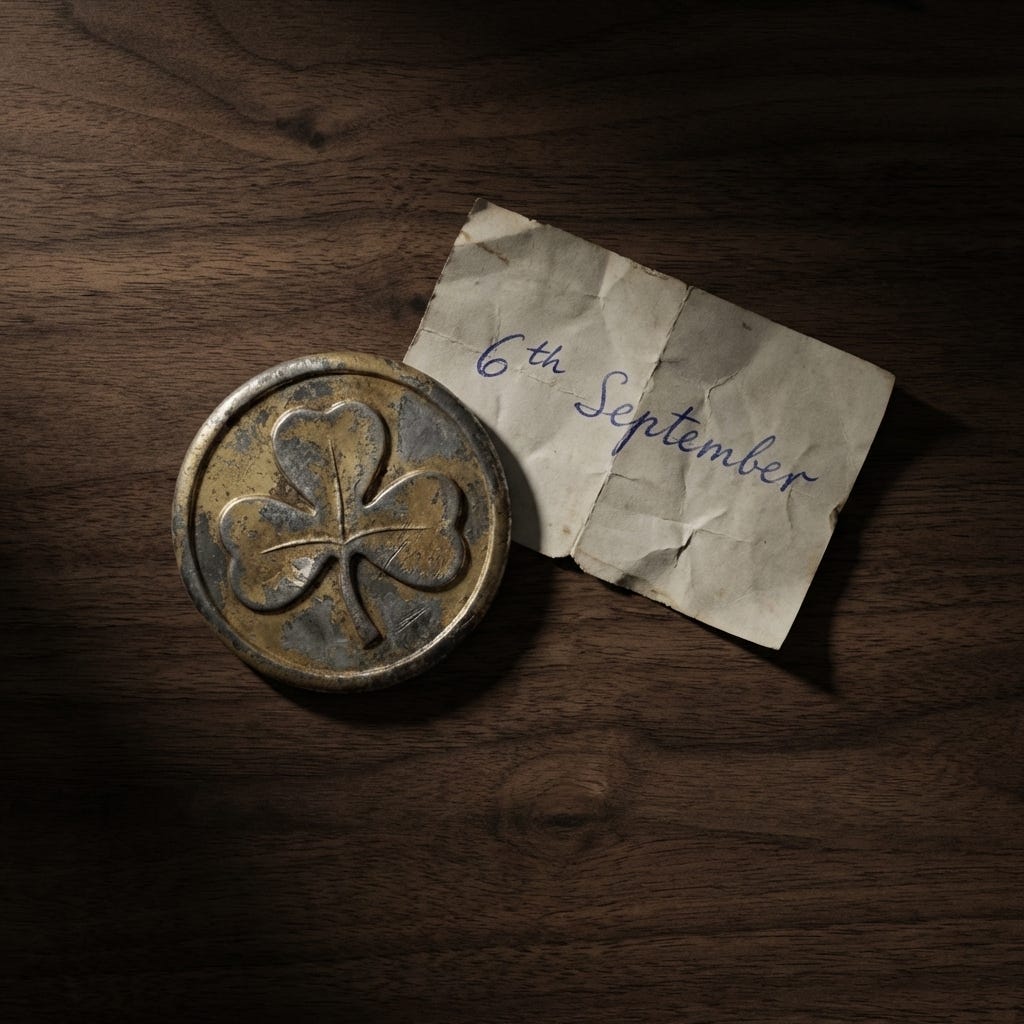
[The badge. The date. The child nobody asked.]
You probably heard about it recently.
Girlguiding. The letter that went out to families. The one that told transgender girls — some of them as young as four years old — that they have until the sixth of September.
After that, the door closes.
It was all over the news. One side outraged at the exclusion. The other side outraged it took this long. Everyone talking. Nobody quite asking the question that sits underneath all of it.
How did we get here?
The legal route is straightforward enough. The Supreme Court ruled in April 2025 that woman and sex, as defined in the Equality Act 2010 — the legislation that governs equality and discrimination law in England, Wales and Scotland — mean biological woman and biological sex. Girlguiding resisted for eight months, then announced in December 2025, with a heavy heart it said, that transgender girls would no longer be admitted as new members. It then set the clock for those already inside.
The sixth of September.
However the legal route isn’t really the question, is it.
The question is how a transgender child as young as four arrives at a leaving date from Girlguiding in the first place. What happened before the Supreme Court. What happened before the ideology. What happened in an ordinary house, on an ordinary Tuesday, that set all of this in motion.
That’s what I want to talk about.
And before we go any further — because if this isn’t said clearly now, this piece will be picked up and used in ways it was never intended to support — let me be precise about something.
This piece is not about trans adults. It is not an argument against trans people. It is not a denial that gender dysphoria is real.
The adult who has carried a persistent, consistent, distressing experience of feeling, at the most fundamental level, that the body they were born into does not match who they are — not since a Tuesday in childhood when a parent saw a sign, however across years, across decades, before any institutional infrastructure existed to receive them, before the community was there, before the validation was available — that person is not who this piece is about. Their experience is real. It was paid for in a currency that cannot be faked. Duration. Depth. Distress. Cost. Private knowledge carried alone at significant personal cost.
That is transformation. Not declaration.
The person inside the shrine is real. Regardless of how the shrine was built. That distinction runs through everything that follows.
Keep it in your pocket. We’ll need it.
There was a time — not ancient history, just a few decades back — when a parent’s job was preparation.
Not happiness. Not affirmation. Preparation.
You loved your child. Fiercely, most of you. However love was not the same as agreement. A parent who disagreed with their child said so. A parent who saw their child heading toward something unwise named it. Not cruelly. However clearly. Because that was the job.
The job has changed.
Somewhere in the late nineties, the self-esteem movement arrived from American psychology carrying a proposition that felt, on the surface, entirely reasonable. A child’s sense of self worth, it largely argued, is the foundation of everything. Sustained challenge to it is, at some level, harmful. Schools adopted it. Therapists promoted it. Parents absorbed it so gradually and so completely that most of them couldn’t have told you when it happened.
Then social media arrived. And parenthood became a performance.
Not for everyone. However for a particular kind of parent — educated, progressive, anxious, metropolitan — the child became visible in a new way. Shareable. A reflection of the parent’s values. Evidence of the parent’s courage. Proof of the parent’s willingness to be seen on the right side of history.
And then came a particular kind of parenting that took hold across a generation. The parent who hovers. Who removes every obstacle before the child reaches it. Who manages outcomes, curates experiences, ensures the child never encounters a reality that hasn’t been pre-approved by someone who loves them. So present, so protective, so devoted to the removal of friction, that the child grows up without ever having learned what friction is for.
They called it helicopter parenting. The name is less important than what it produced.
It’s an excessive devotion to children. Professional parents, overscheduling and overmanaging their children, robbing them of their childhoods. Even the simple act of playing has been taken from them. When does a child ever get to sit in the street with a stick anymore?
By the time the belief system that places gender identity above all other considerations — including biological reality, clinical scrutiny, and the developmental needs of children — arrived in force, the architecture was already in place and waiting.
Here’s something that doesn’t get said enough about love.
It can go too far.
Not through malice. Not through selfishness in any way you’d recognise from the outside. Through excess. Through a completeness of devotion that forgets to leave room for the person it’s devoted to.
The boundary between parent and child is meant to be porous when the child is two years old. The world is large and frightening and the parent is the only fixed point in it. Of course the boundary is thin then.
However the design also requires the boundary to move.
Gradually, across the years, the distance is supposed to grow. Not because love diminishes. Because the child needs space. Needs friction. Needs the experience of making mistakes and carrying consequences and finding, through all of that, something that is genuinely and irreducibly their own.
The parent’s hardest job — the one that never makes it onto a greetings card — is to become progressively less necessary.
Some parents cannot do it. And here’s the thing — you probably know one. You might even be one, in ways you haven’t fully examined. Because this isn’t a character flaw. It isn’t a failure of love. It is, in a very specific and painful sense, too much love. Love that cannot bear the child’s distress. Love that resolves the uncertainty before it can mature. Love that needs, somewhere beneath conscious awareness, the child’s dependence to continue.
And so the boundary that should have moved does not move. It calcifies. Becomes a permanent fixture. What was once appropriate becomes, over years, an architecture the person lives inside without knowing it’s there.
It isn’t always one way.
Sometimes the child holds the parent just as completely as the parent holds the child. The current runs in both directions simultaneously, each feeding the other in a loop that neither can see from inside it. The child learns — not deliberately, not cynically, however through years of call and response — that distress produces movement. That declaration generates attention. That vulnerability brings the parent running.
The parent cannot bear the child’s distress. The child has absorbed that. The loop runs automatically. Neither party experiences it as a pattern.
They experience it as love.
And it is love. That is the precise difficulty.
The child grows. Becomes an adult. Forty, perhaps. Fifty. And still, beneath every significant decision, the original architecture is running. The first mirror ever held up to them is still the mirror they check. The identity built from someone else’s love — constructed before they had the language to participate in its making — is still the identity they inhabit.
The wallpaper they have never seen because they have never known a room without it.
Now. A house in Mississippi.
You may not have heard of Graceland Too. Not the original. A private home, owned by a man named Paul MacLeod, who devoted the entirety of his adult life to the worship of Elvis Presley.
Every surface. Every room. Cutlery. Lampshades. Breakfast cups. The total constructed environment of a single consuming devotion.
Paul MacLeod was not a bad man. By every account he was entirely sincere.
He was also, indisputably, not Elvis.
No depth of conviction closed that distance. No quantity of devotion. No years of complete and absolute identification.
The shrine is not the person it honours.
In almost every other context we understand this immediately. We don’t believe the woman who has covered her walls with images of a film star has become that film star. We understand, instinctively, that identification is not transformation.
And yet.
A parent notices, one ordinary Tuesday, that their four year old son has chosen a dress from his sister’s wardrobe. The child is happy in it. Uncomplicated. The way children are happy when they are simply being without an audience.
The parent — primed by a culture that has spent two decades insisting that a child’s declared reality is sacred, that to question is to harm, that affirmation is the only compassionate response — does not see a boy in a dress on a Tuesday.
They see a sign.
And the shrine begins.
A new name. New pronouns. New clothes. The school is informed. The GP is informed. The ideology arrives fully formed with its own language, its own community, its own institutional infrastructure ready to receive and validate whatever is brought to it. Each step feeling not like a construction however like a revelation.
We always knew, people say. We always knew.
The child didn’t build this shrine.
It was built around them. With love. With complete sincerity. With the best intentions that have ever paved any road to anywhere.
And the person inside that shrine — real, complex, deserving of every care — is not the shrine itself. That distinction matters. It is the most important distinction in this entire piece.
The child, now living inside an identity constructed around them, discovers something.
The world outside the house offers the same thing the house already trained them to need.
Validation. In quantities that never run out.
Every human being needs to be seen. That is not weakness. That is not pathology. It is the most fundamental requirement of being a person. To be recognised. To have your existence acknowledged as real and as mattering.
The question is never whether the need exists. The question is where it gets met. And what happens when the internal architecture for meeting it — built gradually through experience and friction and an imperfect world — was never allowed to develop.
When that architecture is absent, the need looks outward. Permanently. With increasing urgency. Because external validation, unlike the kind built from within, does not hold. It requires constant replenishment. The reassurance that felt sufficient on Monday is insufficient by Wednesday.
The community that formed around this experience provided something real. For many people it provided a lifeline — recognition, belonging, the relief of finally being seen. That is not nothing. That is, in human terms, everything.
However what it could not provide — what it was never designed to provide — was the one thing that genuine care requires.
Scrutiny.
Not hostility. Not contempt. The careful, compassionate, clinically rigorous question: is what you are experiencing what you think it is? And is what we are about to do actually going to help?
An entire ecosystem had been built on the premise that the declaration is sacred, that the identity is beyond question, that the community will receive and reflect and amplify whatever is brought to it. To ask the question was to betray the person asking for help.
To the child living inside it, this felt like finally being understood.
To the parent watching, it looked like their child had found their people.
Then the institutions arrived.
Local government. National government. The NHS. Schools. Youth organisations. The entire infrastructure of public life found itself in the same position simultaneously. Validate or be accused. Affirm or be named. And the naming carried consequences — career consequences, reputational consequences — that concentrated the minds of committees and boards of trustees with remarkable efficiency.
This was not a conspiracy. It was a political groundswell so powerful, so successfully reframed as a human rights imperative, that scrutiny itself had been repositioned as an act of cruelty. Any institution that hesitated became, by definition, a perpetrator of harm.
And so the validation that began in a specific family, in a specific loop, between a specific parent and a specific child — found itself reflected back from every direction by institutions that had been, and this is the right word for it, bullied into compliance.
Political correctness has become one of the newest forms of intolerance — and the most pernicious, because it arrives disguised as tolerance.
Which made it feel, to everyone inside the system, like settled reality.
This has happened before.
Not in the same form. However the architecture — genuine distress, institutional validation, scrutiny reframed as cruelty, a groundswell achieving political normalcy before the evidence arrived — that architecture is not new.
In the 1980s and into the 1990s, a clinical consensus formed around recovered memory. The research of memory scientist Elizabeth Loftus and others would later demonstrate what therapists operating entirely in good faith had not seen — that the therapeutic environment itself could construct memories rather than recover them. At the time, the consensus held that traumatic memories of childhood abuse could be buried so deeply in the unconscious that the patient had no access to them, and that the right therapeutic environment could bring them back.
Patients began producing memories.
Institutions validated them. Courts accepted them. Families were destroyed. The distress was genuine. The therapeutic relationships were genuine. The belief, on all sides, was total.
And then the science arrived.
It found that the memories, in a significant number of cases, had not been recovered. They had been constructed. Not through deliberate deception — through the therapeutic environment itself. Through affirmation so complete, so consistent, so institutionally reinforced, that the mind had built something solid from something that was not there.
The harm was irreversible.
Nobody in that picture had wanted to cause harm.
This comparison is not saying that gender identity is false memory. It is not saying that trans experience is constructed in the same way. It is making one precise observation: that when genuine distress meets institutional validation, when questioning a declared reality is reframed as cruelty, when the groundswell becomes so powerful that scrutiny becomes politically dangerous — the people most harmed are the ones the system claimed to be protecting.
We have been here before. And we did not cover ourselves in glory.
There is a thread running through all of this.
Something real attracts genuine compassion. The compassion attracts resources, language, institutional infrastructure. The infrastructure grows. The definition expands to justify the growth. The expansion becomes normalised. And the normalisation makes questioning it feel like an attack on the original genuine need.
Nobody goes back to ask when the thing stopped being what it started as.
Mental health is the clearest example outside of this debate. And it matters here because the two stories are not separate.
There was a time when mental health meant something specific. Something serious. Depression. Psychosis. Bipolar disorder. Schizophrenia. Conditions that were clinically diagnosable, often biologically rooted, genuinely debilitating. Conditions that required careful assessment, proper clinical process, and sustained intervention.
Then the definition moved.
Gradually, almost imperceptibly, the boundary between clinical condition and ordinary human discomfort shifted outward. Wellbeing arrived. Emotional health arrived. Self-care arrived. And with each expansion the language became softer and broader — and the system became simultaneously more overwhelmed and less equipped to help the people who needed it most.
Because unhappiness is not a condition. It is the weather. It is what happens to people who are alive.
Once you redefine mental health to include it, you have created a demand that cannot be satisfied. The NHS mental health budget has grown year on year. Waiting lists have grown faster. An entire economy has formed around the inexhaustible market of human feeling — apps, coaches, workplace wellbeing champions, therapeutic services public and private, all of it expanding continuously because the thing it claims to treat will never run out.
And somewhere in that queue — behind the person who is struggling, and the person who is having a hard time, and the person who has been told by a system that expanded its own definition until it included everything that their feelings constitute a clinical emergency — is the person with treatment-resistant depression. The person with psychosis. The person with severe and enduring mental illness.
Waiting.
The economy carries the cost. The signed-off work. The expanded services. The institutional apparatus of emotional management that has grown so large, so normalised, so thoroughly embedded in the language of care, that questioning it feels like cruelty.
None of this is an argument against therapy. Properly evidenced, properly boundaried, properly sceptical therapeutic work has helped an enormous number of people navigate genuine suffering. That is not in question.
What is in question is what happened when parts of the therapeutic framework got captured — when affirmation replaced scrutiny as the primary clinical mode, when validation became the product rather than the process, when the goal shifted from equipping a person to manage their own life to managing it for them indefinitely. Many individual therapists were themselves uncomfortable with what was happening. Many raised concerns. The Cass Review found that clinicians who questioned the affirmation-only model were routinely silenced. The problem was not the therapists. The problem was the captured institutional framework they were required to operate within.
Good therapy produces people who eventually do not need it. The model that replaced it in this specific context produced something else entirely.
Same architecture. Different institution.
And into that system — already stretched, already primed toward affirmation rather than scrutiny, already trained to validate feeling rather than examine its source — arrived children in genuine psychological distress.
Not from malice. From drift.
The same drift that moved mental health from the clinical to the emotional. The same drift that moved parenting from preparation to performance. The same drift that moved human rights from protecting people to protecting declarations.
Something real, travelling so far from what it started as that it no longer recognised itself.
There are things we do not allow children to decide.
A child cannot vote. Cannot drive. Cannot marry. Cannot enter a legal contract. Cannot buy alcohol, or cigarettes, or a tattoo. Cannot leave school at eight because they’ve decided they’ve learned enough. Cannot consent, in the eyes of the law, to sexual contact with an adult.
We protect them from these things because we understand, with the clarity that only adult retrospect provides, that the developing mind is not yet equipped to carry the full weight of permanent decisions.
And then we handed some of these children puberty blockers.
Drugs that chemically pause the onset of puberty in a developing child.
On the basis of a declaration. Affirmed by a parent running a loop they couldn’t see. Validated by a community with an inexhaustible supply of certainty. Endorsed by a clinical system that had spent two decades learning to affirm distress rather than examine it.
The Cass Review — the most comprehensive independent review of gender identity services for children ever conducted in this country, led by Dr Hilary Cass and published in 2024 — found the evidence base for medical intervention in children to be remarkably weak. The majority of children referred to the Tavistock — the NHS clinic at the centre of childhood gender identity services in England — had co-occurring mental health conditions, autism, or trauma histories that were never adequately explored. Clinicians who raised concerns were silenced. Outcome data was suppressed because it was poor.
The Tavistock closed.
Not because the children weren’t suffering. They were. However because the institution had confused compassion with compliance. Had applied the one lens it had available — affirmation — to children who needed something the system had largely stopped offering.
A proper diagnosis.
The replacement model now being built — through the Evelina London and regional centres recommended by the Cass Review — places thorough psychological assessment before any medical pathway. That is not a reversal of care. That is what care should have looked like from the beginning.
Consider what that phrase actually means in practice. In 2026.
There is a person in their sixties currently working through a formal ADHD assessment pathway. Not as anecdote. The paperwork exists. Late adult ADHD diagnosis is not an individual anomaly — it is a documented, widespread pattern across the NHS, reflecting decades of a diagnostic framework built too narrowly, that recognised one presentation and missed everything that didn’t fit the template.
The CARE ADHD pathway this person is navigating consists of the following. A welcome assessment. A Patient Health Questionnaire — the PHQ9 — measuring depression. A GAD-7 anxiety scale. A Weiss Functional Impairment Rating Scale measuring how the condition affects daily life across work, relationships, and practical function. A Wender Utah Rating Scale reaching back into childhood to find the evidence of what was always there. An Adult Self-Report Scale. A Childhood Behaviour Scale — completed in adulthood, about a childhood the system never thought to examine at the time. A Physical Health Questionnaire. An Adult Informant’s Questionnaire, requiring someone who knows the person well to provide their own observations. And the DIVA-5 — one of the most detailed structured diagnostic interviews in the battery, covering ADHD symptoms across both childhood and adulthood.
Why is it staggered? Why does it arrive in pieces over months rather than as a single coherent process? Why is a person in their sixties being asked to reconstruct their childhood behaviour through a questionnaire rather than having been seen, assessed, and supported when they were actually a child?
Because the foundations were never sound.
Think of a house. Built in a hurry, on assumptions that were never properly tested. Lived in for decades. The cracks appearing gradually, then faster, then everywhere simultaneously. And then the bill arrives — enormous, unavoidable, and far more expensive than laying the foundations correctly would ever have been.
That is the mental health system. That is the ADHD assessment pathway arriving sixty years late. That is the gender identity services the Cass Review had to forensically excavate. All of it built on frameworks too narrow, then overcorrected to too broad. Clinical rigour traded, incrementally, for ideological convenience. And now the whole structure trying to hold itself up while being repaired from the inside.
The person completing the DIVA-5 at sixty is paying the cost of foundations that were never laid properly.
The cost in human terms — in decades of misdiagnosis, missed support, lives navigated without the map that a timely correct diagnosis provides — is incalculable. It is being paid, questionnaire by questionnaire, appointment by appointment, by people who deserved better fifty years ago.
And the question that follows is not comfortable.
If the system could not see something real, present, and consequential across an entire human lifetime — could look at a person for six decades and not recognise what a battery of standardised questionnaires is now, finally, beginning to confirm — what confidence do we have that the same system correctly identified gender dysphoria in a four year old child?
Puberty blockers, once described as a fully reversible pause button, are now understood to carry consequences for bone density, neurological development, and future fertility that were not adequately communicated to the children or families who consented to them. Studies reviewed by the Cass Review found that approximately ninety percent of children who began puberty blockers during the period under examination went on to cross sex hormones. The pause button, in practice, was a pathway.
And the children on that pathway were the same children we had decided, in every other context, were not yet equipped to make permanent decisions.
A child cannot get a tattoo.
However somehow they could consent to the suppression of their natural puberty on the basis of a declaration made inside a loop built from love, institutional validation, and a community that had never once been designed to say —
Are you sure? Take your time. There’s no rush. You’re allowed to not know yet.
The detransitioners — young people who underwent gender transition and have since stopped, some reversing what could be reversed, some finding they could not — are arriving now. Speaking in courtrooms and testimonies and the quiet devastation of private conversations. Asking whether they were truly equipped to consent. Whether anyone, at any point in the pathway that carried them from declaration to prescription, paused long enough to ask the question that clinical rigour required.
For some, the pathway provided what it promised. However the system that was supposed to identify those cases — and distinguish them carefully from the others — failed to do so with anywhere near the rigour those children deserved. That failure harmed everyone. Including the ones the system genuinely helped.
The detransitioners’ accounts do not invalidate genuine gender dysphoria. They interrogate the system that was supposed to make that distinction — and didn’t.
For those already mid-pathway — children currently on puberty blockers or cross-sex hormones — the questions are live, urgent, and without easy answers. This piece does not pretend otherwise.
The answers are going to arrive in courtrooms over the next decade.
And they will not be comfortable for anyone who confused affirmation with care.
Human rights and being right are not the same thing.
That distinction sounds simple. It isn’t. And it sits at the centre of everything that went wrong.
The trans adult who fought for legal recognition, for protection from discrimination, for the basic dignity of being addressed correctly — that person was invoking human rights in the precise sense the framework was built for. Measurable. Grounded in protection from concrete harm. Legitimate.
However somewhere along the way, the same language — the same moral vocabulary, the same framework, the same weight of historical struggle — got extended into territory it was never designed to cover. The claim that a child’s declaration must be affirmed without scrutiny. That any institution which hesitates is a perpetrator of harm. That questioning is itself a form of violence.
That is not human rights. That is human rights being used to make a question unanswerable.
Rights frameworks exist to protect people from power. When they get used to protect declarations from scrutiny, the framework has been stretched past the point where it can do what it was built to do.
And here is the grey area. Because the child in genuine distress does have rights. Does deserve protection. The framework applies to that child entirely legitimately. However the same language, the same moral weight, is applied simultaneously to the child whose identity was constructed on a Tuesday. And the framework cannot tell the difference between them.
It was never designed to.
Which brings us back to Girlguiding.
An organisation that has been in existence for over a hundred years. Built on a promise. Literally.
“I promise that I will do my best, to be true to myself and develop my beliefs, to serve the King and my community, to help other people and to keep the Guide Law.”
The Guide Promise — made by every Girlguiding member for over a hundred years.
It recently announced it was waiting for the Equality and Human Rights Commission to tell it how to be inclusive.
The EHRC — a government-appointed body with no democratic mandate — is currently drafting guidance on single-sex spaces that remains under government consideration. Girlguiding has said publicly it wants that guidance to be clear and workable. Stonewall, the UK’s largest LGBT rights organisation, has said it hopes the guidance will show organisations how to operate from a principle of inclusion.
Both of them. Waiting for instructions. From a committee. On how to treat people with dignity.
An organisation founded to build moral independence in girls is asking the state to define what its own values mean in practice. That is not a legal problem. That is a confidence problem.
And it raises a question worth sitting with.
At what point did we lose the ability to know, without being told, that a child deserves to be treated with kindness?
There is one final observation worth making. Quietly.
Every system examined in this piece — the parenting culture, the therapeutic services, the gender identity pathway, the mental health economy, the institutional infrastructure that validated it all — grew in direct proportion to the problem it claimed to be solving.
That is not an accusation. It is an observation about how systems work. Demand creates supply. Supply creates dependency. Dependency creates the conditions for more demand.
Nobody designed it this way. Nobody needed to.
The question it leaves behind — the one this piece will not answer, because it is yours to sit with — is a simple one.
What happens to a system built to solve a problem, when solving the problem would end the system?
Don’t just teach your children to read. Teach them to question everything they read. Teach them to question everything.
So. Back to that letter.
The one that told a child — possibly as young as four years old — that they have until the sixth of September.
Here is what that letter does not know about the child it was sent to.
It doesn’t know whether that child’s identity was built from years of persistent, distressing, privately carried experience. Or whether it was built on a Tuesday, in a kitchen, by someone who loved them so completely that they forgot to leave room for the child to find out for themselves.
It doesn’t know whether that child needed time. Whether anyone ever offered them time. Whether there was ever an adult in the room who said quietly, without cruelty, without ideology, without an agenda in either direction —
You’re allowed to not know yet.
The Supreme Court ruling is the law. The sixth of September is the date. The door is closing and that is, legally, where we are.
However the child on the other side of that door — the one who didn’t ask for the identity, didn’t ask for the shrine, didn’t ask for the institutional validation, and didn’t ask for the leaving date —
That child deserved better than to become anyone’s argument.
Including this one.
The Almighty Gob is a Bristol-based publication covering UK institutional dysfunction and political accountability.
It's all built on stereotyping, isn't it. People think they are challenging stereotypes but in fact they are just playing along with them, giving them power over their lives, by rejecting them so strongly they lose sight of reality and end up back where they started. It is so bizarre.
Have you read the council responses to 'gender critical' questions from the last full council meeting? If our councillors are living in such a different reality from so many Bristolians, how can we expect them ever to make any decisions that actually benefit us? They need to go and found a city of their own with just those who agree with their agendas.