
Has Britain Had Its Chips?
Just Eat Says Britain's Lost Its Appetite For Them. The Almighty Gob | thealmightygob.com

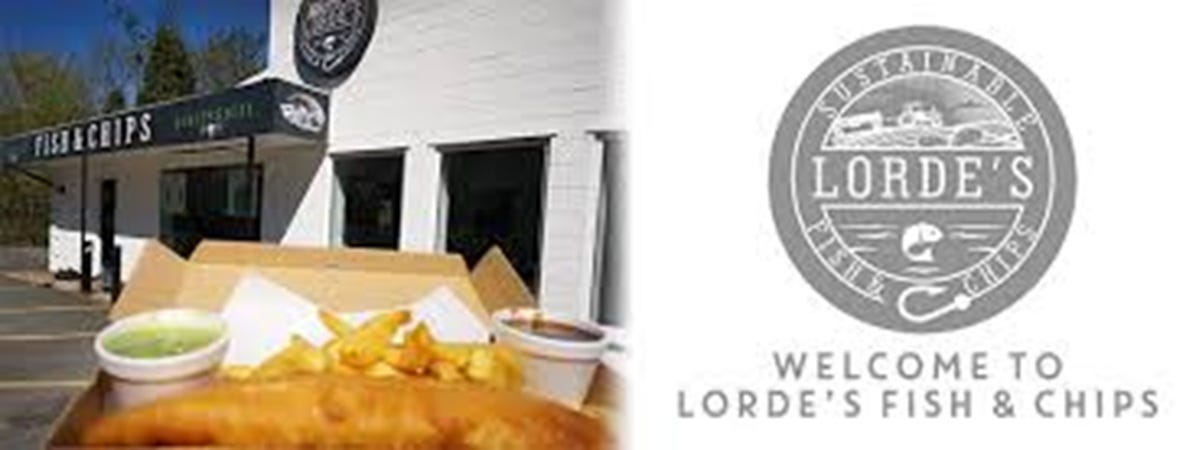
[Lorde's Fish and Chips, Bury. Fresh, crisp, and still standing. Everything a chip shop should be in 2026.]
Picture this A field in England. A pile of potatoes nobody wants.
The farmer has done the maths. Price per tonne down nearly ninety per cent. Input costs up thirty to forty per cent since 2022. He has thought about the food bank. He has thought about animal feed. He has thought about walking away.
Three miles in any direction, a food bank queue. The chief executive of Iceland — the supermarket, not the country — reported as far back as 2022 that food bank users were turning down donated potatoes. They could not afford the energy to boil them. Nothing in the intervening years suggests that calculation has improved.
The appetite is gone before the chip exists. That is where this begins.
Twenty years ago, Just Eat launched in the United Kingdom with seven cuisines: Italian and pizza, Indian, burgers, Chinese, kebabs, fish and chips, chicken. One of seven. No introduction required. It simply was.
To mark its twentieth anniversary, Just Eat has published the list then and the list now.
2006: pepperoni pizza, chicken tikka masala, sweet and sour chicken, margherita pizza, chicken chow mein, chicken korma, fish and chips, beef burger, doner kebab and chips, chicken box.
2026: margherita pizza, chicken chow mein, sweet and sour chicken, Korean fried chicken, chicken tikka masala, pepperoni pizza, loaded fries, Pad Thai, smashburger, veggie burger.
Gone. Not knocked out. Not demoted. Walked past. When did you last order it? Not fish and chips in the abstract — actually order it, on a Friday night, instead of something else?
Korean fried chicken driven by Squid Game and K-pop. Matcha up 120 per cent in a year. Dubai chocolate up 2,684 per cent — which is either a food trend or a collective nervous breakdown, and at this point the distinction may not matter. One hundred cuisines where there were seven. The dish that was one of the founding seven is not on the list.
Britain has had its chips.
Whilst all of that was playing out on the apps, something else was happening in the fields.
Shortages and high prices through 2023 and early 2024 — extreme weather, soaring costs, post-Brexit seed restrictions. Then the market swung. Record harvests across western Europe. Uncontracted crop flooding in from China and India. The benchmark price for English white-packing potatoes: £640 per tonne in 2023. £90 per tonne by mid-2025.
Growers threw potatoes away. Routed them to animal feed. Could not recover the cost of harvest, let alone growing. The appetite had gone. The crop had not. At what point did that become acceptable — and who decided it was acceptable for someone else to deal with?
The potatoes go to animal feed. The animal ends up on a plate. Served, in all likelihood, with potatoes.
Five years ago, the UK grew approximately six million tonnes of potatoes annually. Now around 4.7 million. Industry voices are not optimistic: volume lost to overseas production will not return. More imports. Less domestic crop. The agricultural base that made fish and chips possible, quietly eroding.
The government launched the Tackling Food Surplus at the Farm Gate scheme — £13.6 million to twelve food charities to redistribute an estimated 19,000 tonnes of surplus food directly from farms. An estimated 330,000 tonnes of edible food leaves farm gates as waste or animal feed every year. The gap between what the land produces and what reaches the people who need it had become impossible to ignore. A scheme was announced. The potatoes remained in the field.
The field produces. The appetite does not answer. The circle turns.
The third pressure is less visible. It arrives through a syringe.
Mounjaro — tirzepatide — mimics gut hormones released after eating, signals fullness, slows digestion and suppresses appetite. Not evenly. It targets the craving end — high-calorie, ultra-processed, comfort-driven. The end that chips occupy almost by definition.
Over 1.5 million UK residents already access GLP-1 receptor agonists privately. Usage nearly doubled in a single year — 2.3 per cent of households in March 2024, 4.1 per cent by early 2025. The NHS began its twelve-year phased rollout through primary care from mid-2025. From September 2025, Mounjaro’s list price rose to £133 for the entry dose, £330 for the highest. Patients stockpiled. Some spent over £1,000 at a time — panic-buying appetite suppressants, which is a sentence that says something about the state of the nation that no columnist has yet adequately addressed.
For the average working person in the northwest, £330 a month for an injection is not a calculation that gets made. Mounjaro is, for now, a solution available to those least defined by the problem it solves.
Cornell University research found GLP-1 users cut grocery spend by up to 8.6 per cent within six months. Steepest declines: savoury snacks, sweets, baked goods — the food that built the chip shop economy. The appetite, chemically removed. If the craving is gone, what was it for? Comfort? Habit? Or something that deserved a more honest answer than a chip?
In the UK, Kantar Worldpanel data found that 63 per cent of GLP-1 users were actively trying to reduce their pizza consumption — one measure of a broader pattern the food industry is only beginning to map. Retailers have launched smaller-portion ready meals for GLP-1 users. Greggs has responded. The food industry did not see this coming — or chose not to. It is watching 1.5 million people recalibrate, with more arriving monthly.
Just Eat says Britain has lost its appetite for them. Mounjaro is making sure of it.
The trade has fought — watched costs spiral, cod at historic highs, energy bills far above pre-crisis levels, and oil regulations adding further cost — and held on where it could.
Not always enough. Over a thousand chip shops closed in 2024 alone. The £1.2 billion-a-year industry, 10,500 outlets at its peak, could lose close to half. In Sheffield alone: Tony’s Fish and Chips, Greystones Fish Bar, Papa’s Fish and Chips, Richmonds Fisheries, Poseidon Fish Bar — all gone in recent years. A community fixture becoming a memory.
A fish supper costs £15 or more in some locations. No longer a working-class staple. An occasional indulgence, competing against a hundred things that arrive at the door in thirty minutes.
Then there is Harry Ramsden’s — the whole story, in miniature.
Guiseley, West Yorkshire, 1928. A wooden hut. Guinness World Record — largest fish and chip shop in the world. 250 seats. Nearly a million customers a year. In 1952, 10,000 portions in a single day. The most recognised name in British fish and chips.
What followed: Associated Fisheries. Merryweathers. Granada. Compass. SSP. Boparan Ventures. Deep Blue. The Guiseley restaurant — the birthplace — closed in 2011. Eight UK sites by 2025. The appetite had moved on. The brand had not noticed. When did we stop noticing too?
That ownership list is worth reading twice. It is the corporate history of Britain’s most beloved chip shop — and it reads like the minutes of a meeting nobody wanted to attend. Each successive owner arriving with a plan. Each successive owner eventually leaving. The hut where it all began was demolished in 2012, condemned by asbestos and time.
November 2025: Deep Blue rebranded as Harry Ramsden’s Group. New site in Notting Hill. Franchise deal for Romania — first Bucharest location due 2026. Now served on DFDS Channel ferries to Calais and Dunkirk.
Britain’s most iconic chip shop. Eight domestic sites. Being exported to Romania. Sold to passengers leaving the country on a boat.
Harry Ramsden’s has had its chips in Britain. It is looking for an appetite elsewhere.
Up here in the northwest, it still means something different.
Meat pie. Chips. Gravy. Not a menu option. A position. Held like something ancient — prior to the culture wars, the wellness trends, the TikTok algorithms, the weekly injection. Friday. Any day.
Drive twenty minutes, or more, out of central Manchester in almost any direction and the high street changes entirely. Ramsbottom. Hebden Bridge. The suburban and semi-rural belt where the chippy is still on the corner, still the default, still the thing you plan around. In Hebden Bridge there are chips worth the journey — crisp, done right, the kind that remind you what the argument was always about. Not the ones sitting in the cabinet too long, steaming themselves limp, surrendering to their own warmth while the world orders something else. Those chips have had it. These have not.
On Manchester Road heading south out of Bury, Lorde’s Fish and Chips stands alone. Award-winning. Sustainable. Restaurant and chip shop combined. Reviews that read like declarations of loyalty. Everything a chip shop should be in 2026.
The place survives. It endures.
The circle turns. Something is still wanted. Something does not quite answer.
There is one detail the mourners of fish and chips tend to omit.
The dish is not British. The fish — white fish fried in batter — is widely attributed to Sephardic Jewish refugees from Portugal and Spain, arriving in the East End of London in the sixteenth and seventeenth centuries. The chip came separately from continental Europe — Belgium and France both have a credible claim. They came together in the industrial north of England in the mid-nineteenth century, where railways brought fresh North Sea fish inland and working-class families needed something cheap, filling, fast.
A fusion dish. Immigrant cooking. Continental potato preparation. The economics of industrialisation. Naturalised over a century into something that felt eternal. A very British thing to do with someone else’s idea.
The dish Britain mourns as it scrolls past Korean fried chicken was always, in some sense, someone else’s appetite that Britain borrowed. Britain has eaten the world for as long as it has existed. It simply forgot it did. So if it was never entirely ours — what exactly are we mourning? And is it possible the answer has nothing to do with chips at all?
What Just Eat’s anniversary data shows is not a departure from tradition. It is a continuation of one. Britain has not lost its appetite. It has moved it — as it always has — to the next thing that arrived.
The circle was never broken. It was always turning.
The pile of potatoes is still there.
The farmer did everything right. Planted on time. Irrigated through the dry season at punishing cost. Lifted the crop. The market moved before he could. The demand that once absorbed his harvest — the chip shops, the frozen chip lines, the fish and chip trade — is thinner than it was, and thinning.
Three miles away, the food bank does what it can. Surplus and shortage in the same county, the same moment, the same broken logic. Appetite gone from one end. Need acute at the other.
1.5 million people in Britain have chemically adjusted their appetite away from the food this farmer grows. A hundred cuisines on an app where there were seven. Over a thousand chip shops closed last year that will not reopen. Harry Ramsden’s is on ferries to Calais. The potatoes are in a field.
Somewhere in the northwest, someone is holding a pie and chips and gravy like it is the last of something.
Perhaps it is. Perhaps — given it was never quite what we thought it was — that is not entirely the tragedy it appears.
Has Britain had its chips?
Just Eat says Britain’s lost its appetite for them.
The field is quiet. The potatoes do not keep indefinitely.
The Almighty Gob is a Bristol-based publication covering UK institutional dysfunction, political accountability and the stories the mainstream would rather leave alone.