
Has Jesus Been Trumped?
Easter, the Moon, and the Business of Belief.

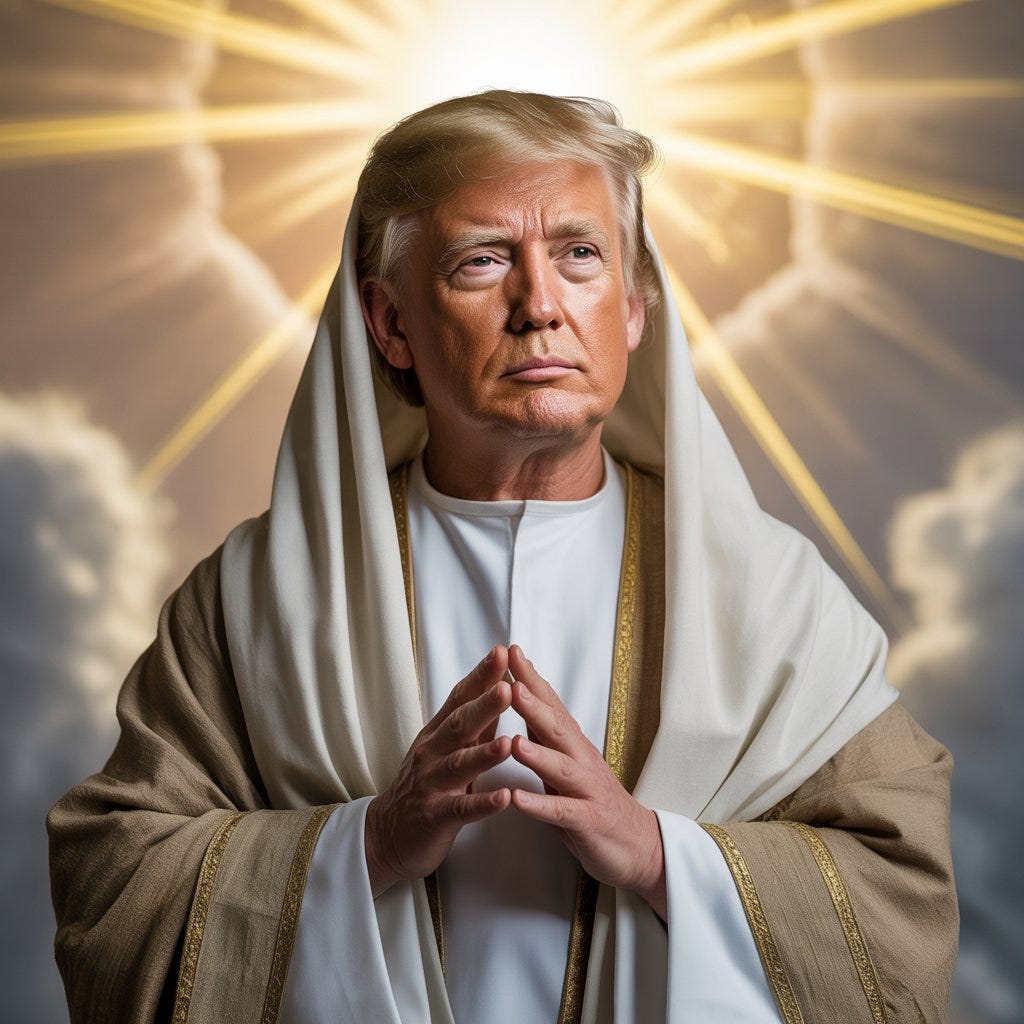
[Paula White said no one has paid the price like he has. He smirked.]
I had an idea for a piece. A bloke gets a cross on the Friday. It’s a bit of a dramatic weekend for him. Then on the Sunday he’s up and about, telling all his mates.
Apparently it’s been done before.
Several billion readers. So I had to cancel that idea.
Though I will say this. He clearly wasn’t a summer or autumn person. Winter for the birth. Spring for the death and the comeback. He had a type, and it wasn’t July or August. Too busy with tourists. Jerusalem in the height of summer was already enough of a nightmare without adding miracles to the schedule.
Here is one version of what happened with the Moon.
Someone at the world’s most powerful telescope noticed that the American flag had gone white. The one Neil Armstrong planted in the lunar regolith on the twentieth of July 1969. The one that was supposed to mean something permanent about who got there first and what that meant. Completely white. Bleached flat by fifty-three years of unfiltered ultraviolet radiation in a vacuum with no atmosphere to apologise for what the Sun was doing to standard nylon.
Word got to Trump.
Donald Trump does not like surrender.
Not in geopolitics. Not in business. Not on an airless rock 240,000 miles away that he has never visited and almost certainly never will. Trump is a man who has spent his entire career putting his name on buildings, golf courses, steaks, a university of questionable standing, and the presidency of the United States — twice. He is not, under any circumstances, putting his name on a surrender.
Also: the Moon is real estate.
Undeveloped, admittedly. No planning permission. Tricky commute. But real estate nonetheless — and the first person to develop it, to put a name above the door, to establish a presence, wins something that no amount of Mar-a-Lago membership fees can buy. The Chinese are going. The Chinese are absolutely going. They have a date. 2030. Donald Trump was not sending Artemis II to the Moon for scientific discovery or the economic benefit of humanity or any of the other things the NASA press release said.
One imagines he was sending it to check on the flag.
And to look at the land.
Four billion dollars. Broken toilet. Ten days. Binoculars.
Artemis II lifted off from Kennedy Space Center on the first of April. The date was not chosen for symbolic effect, which is exactly what makes it perfect. Four astronauts in the Orion spacecraft, departing Earth orbit for the first time since Apollo 17 in December 1972. The first crewed mission to the Moon’s vicinity in over half a century. A flyby. No landing. Close enough to see. Not close enough to do anything about what they saw.
Most people, on a nice day, might take the car out for a Sunday afternoon drive. Americans, being Americans, took it to its logical conclusion. A quick spin around the Moon. Back home for Monday.
Which is interesting timing, given the fuel crisis.
Iran had closed the Strait of Hormuz three weeks earlier — the largest disruption to global oil supply in history, twenty percent of the world’s daily oil gone overnight. Brent crude hit $126 a barrel. American gas prices hit $4 a gallon on 31 March, four days before the launch. People were eyeing the price on the pump before they’d even filled the tank.
Tehran missed a trick. While Iran was shutting down the world’s fuel supply, America was burning four billion dollars worth of it going around the Moon. Not to land. Just to look.
Meanwhile China — which buys around ninety percent of Iran’s oil through shadow fleets and teapot refineries at well below market price — was sitting quietly on 1.2 billion barrels of strategic reserve. Enough for a hundred and nine days. Watching. Saying nothing. Going to the Moon in 2030.
Russia, meanwhile, has plenty of fuel. Their Moon lander just didn’t survive long enough to need any.
The flags are white. All six of them. The science is not contested. Standard nylon degrades under ultraviolet radiation in a vacuum — the process is not gradual, it is inevitable — and it was always going to happen. Nobody planned to go back and check. Going to the Moon turned out to be expensive. The public got bored.
Six white flags. Six locations across the lunar surface. Six universal signals of surrender, planted there by the nation that is least comfortable with the concept.
One imagines Trump heard about this and took it, as he takes most things, personally.
Meanwhile, back on Earth, his spiritual adviser was busy.
This Easter week, at a White House event, Paula White stood behind Trump and compared his arrest, his legal battles, his near-assassination — the whole dramatic arc of the Trump story — directly to the crucifixion. The betrayal. The false accusation. The suffering. She called it a familiar pattern that our Lord and Saviour showed us. Trump stood stone-faced throughout. Then she got to the Jesus parallel. He smirked. The footage was posted to the White House website and quietly deleted. Not quietly enough.
Hold that image.
This is the same Paula White who helped Trump sell a special edition of the King James Bible — bundled with the American founding documents, branded, marketed, monetised. The same Paula White who said the White House was holy ground. To say no to President Trump, she said, would be saying no to God. Trump himself, when asked whether God put him in office, replied: I hope it’s true.
The smirk suggests he more than hopes.
Trump might think he can walk on water. He hasn’t quite perfected the art of miracles yet. But he’s trying.
Because the mechanism operating in the White House this Easter — faith as a lever, theology as a tool, the sanctification of power through proximity to the sacred — is not exclusive to Washington. It has been running in Bristol.
Marvin Rees, Labour Mayor of Bristol until 2024, had a faith adviser. Her name was Rachel Molano. She worked one day a week, paid not by the council but by an unnamed external partner — a detail that, in any other procurement context, would have ended a conversation.
Bethel is unaccredited and condemned as heretical by mainstream Christian denominations. It claims to teach its students to perform miracles, heal the sick, and raise the dead. It also teaches the Seven Mountain Mandate — the explicit belief that Christians must assume control of seven spheres of society, including government, before Jesus can return.
Bethel’s words, not mine. Dominionism. The theological framework that says secular institutions are legitimate targets for faith-based capture.
Rachel Molano was not just any Bethel graduate. She was Bethel’s first UK staff member. Their person in London. Bill Johnson, Bethel’s founder, has described her as a close friend. And she was sitting in Bristol City Hall one day a week, advising the mayor on faith and community matters, while £150,000 of public money flowed toward organisations with connections to the same faith networks.
Perhaps someone trained in raising the dead isn’t such a strange choice for Bristol City Council — given the state of critical thinking in that chamber, resurrection skills might actually prove useful.
But the point is not the theology. The point is the pattern. From the White House to City Hall, the same mechanism. Faith used as access. Sacred language used as cover. Questions not asked because asking them feels somehow impolite — as though scrutinising the theological credentials of a public adviser is a form of persecution rather than basic due diligence.
Paula White compares Trump to Jesus and the footage gets deleted. Rachel Molano advises the mayor and nobody asks who’s paying her.
Same weekend. Same trick. Different postcodes.
The outcome, in both cases, is identical: power insulated from scrutiny by the armour of the sacred.
I was out on the scooter on Good Friday morning. Early. The corner shop already had the hot cross buns out — a cross piped in pale icing on each one, stacked next to the reduced bread and the energy drinks and the scratch cards. Nobody in the queue was thinking about crucifixion. Neither, if we are being honest, was I.
He had the original cross on the Friday. We do ours in dough.
Because this weekend has become the biggest chocolate retail event in the British calendar outside of Christmas. His weekend. The one with the dramatic middle section and the unexpected Sunday finish. Britain will spend an estimated £382 million on Easter eggs this year. The average egg costs £7.69. Aldi starts at 99p. The M&S Extra Thick Pistachio and Milk Chocolate Easter Egg goes up to £20. A kilo of Lindt shaped into a bunny will set you back considerably more, described by one reviewer as impressive, theatrical, faintly absurd.
Impressive. Theatrical. Faintly absurd.
There are rabbit-shaped ones. Oval ones. Mini cake ones. Eggs with sweets inside — Creme Eggs, Maltesers, Smarties, a tube of something vaguely chocolate-adjacent. There is, at the cheaper end, an egg whose listed weight includes a substantial quantity of Skittles — which, as one reviewer noted with admirable precision, are not chocolate, so it is not quite a fair fight.
None of them mention Jesus.
Not once. Not on the packaging, not in the advertising, not in Tesco’s invitation to hop into Easter with our sweetest line-up yet. The man whose weekend this is has been shown the door. He got the cross. The chocolate industry got the eggs. The bunny got the starring role.
The bunny.
But this is not the first time we have done this to him.
We did it at Christmas first. Practised on Christmas. Got very good at it. The stable went. The manger went. The three wise men became a nativity play that half the school doesn’t perform anymore. The star over Bethlehem became a fairy on top of a Norway spruce. The virgin birth became an argument about whether Mariah Carey should be played before December. The Coca-Cola lorry became the symbol of the season. A truck. Driven by a fictional man in a red suit, standardised in his current form by an advertising campaign. That is what we kept. That is what made the cut.
Santa ate the manger. The tree ate the stable. The John Lewis advert ate everything else.
You know this. You’ve watched it happen. Every year, a little more of the original story quietly leaves the room, and every year nobody says anything because the mince pies are good and the film’s about to start, and frankly who wants that argument at Christmas.
And we did it so gradually, so cheerfully, so commercially, that by the time anyone noticed, the children had already grown up thinking Christmas was about presents and quality time and a bird of your choice with all the trimmings. Which is what it became. The sacred got its commercial wrapper and then — slowly, over decades, one Argos catalogue at a time — the wrapper became the thing.
Easter is Christmas with better weather and a shorter run-up. The same mechanism. The same result. The cross becomes a hot cross bun becomes a dietary choice becomes a thing you have with butter if you’re not doing keto. The resurrection becomes an egg becomes a rabbit becomes a promotional event at Cadbury World. The most astonishing claim in human history — that a man died and came back and it meant something permanent and cosmic about the nature of existence — becomes a bank holiday Monday and a mild traffic jam on the M5.
We’ve now done this twice.
Same playbook. Same outcome. Different confectionery.
And what replaced the story, in both cases, was not silence. It was commerce. The same force that smirks when someone mentions Jesus.
We are a nation that keeps the holidays and loses the reasons. We are very good at the eggs. We have completely forgotten the stone.
The Moon and the resurrection are the same story. The same human need to plant something in the dark and say: we were here, this means something, we are coming back. The flag in the regolith. The stone rolled away from the tomb. The gesture made in the direction of the infinite, hoping the infinite is listening.
The infinite, as usual, has not yet replied.
Trump will already be thinking about what to build up there. Jesus overturned the tables in the temple because merchants had taken something sacred and turned it into a transaction. The merchants won that argument in the end — they always do. The temple became a hot cross bun at a corner shop and a £20 pistachio egg at M&S and a Coca-Cola lorry in November and a branded Bible and a smirk when someone mentions Jesus.
The Moon will probably get a golf course.
He’ll put his name on it. In letters you can see from Earth.
And somewhere beneath the sign, in the shadow of whatever gets built up there in the name of American greatness and lunar real estate — six white flags. Still there. Still white. Still doing what white flags do.
He looked up at the Moon from the cross on that Friday and thought it looked interesting.
He had no idea it was already taken.
Several billion readers. The story’s been done before. And it keeps getting done to. Twice, in fact. And counting.
And by Monday it’ll all be over until the back end of the year. When the lorries come back.
The Almighty Gob is Bristol’s most prolific independent blogger — covering politics, power, and the gap between what institutions say and what they actually do, from City Hall to the White House, from the corner shop to the Moon. Publishing since 2020, with over 500 pieces and 88 Bristol FOI-based investigations, The Almighty Gob operates across nine social media platforms, Substack, and thealmightygob.com — reaching readers who prefer their politics without the packaging.
If anybody can be bothered looking further, here are the clues.
The Artemis II mission — NASA.gov. The flag bleaching — widely documented in lunar science literature. Paula White and the White House Easter event — The Daily Beast, Yahoo News, April 2026. Trump’s Bible — documented across multiple outlets from 2024. The Strait of Hormuz crisis — Bloomberg, CNBC, the Dallas Federal Reserve, Congress.gov, March-April 2026. China and Iranian oil — Statista, Kharon, Global Trade Review, Bruegel Institute, 2026. Russia’s Luna 25 — Nature, CBS News, August 2023. Easter egg prices and spend — Which?, Good Housekeeping, Asian Trader, 2026. Rachel Molano, Bethel School of Supernatural Ministry, and Bristol City Council — Joanna Booth’s investigation, The Bristolian. The Seven Mountain Mandate — Bethel’s own published materials.