
Holiday Inn Refused Two Homeless Men With Paid Bookings in -6°C While Britain Spent Millions on Artisan Soap: The 'Treatonomics' Scandal Explained.
How corporate policy denied shelter during freezing weather while the UK's 'little treat' economy boomed - and why 'lessons learned' changes absolutely nothing.

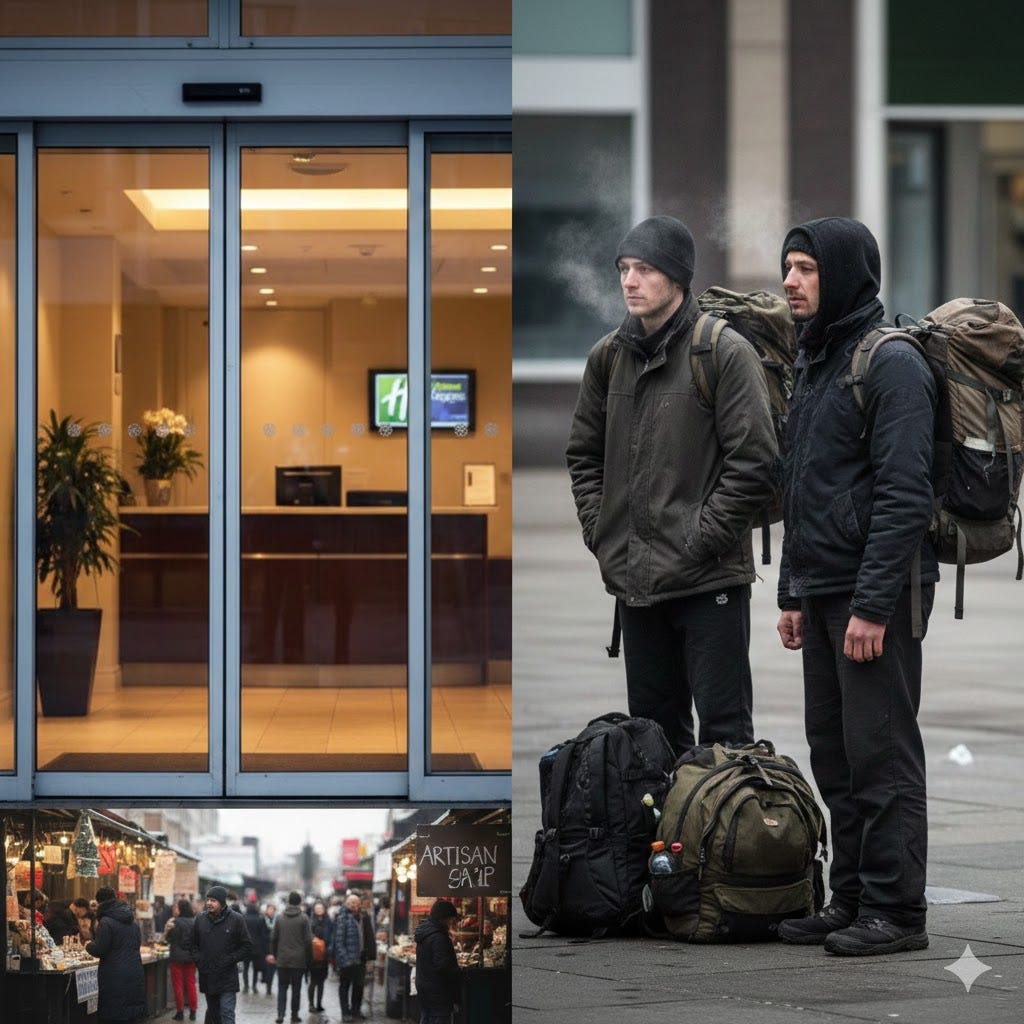
So this happened in Britain during the first week of January 2026.
Sainsbury’s-Tui reported record Christmas pajama sales. People queued at Camden Market paying £15 for artisan soap and £8 for bottled water with a backstory. The “little treat” economy was absolutely booming.
And on the same night - literally the same night - Holiday Inn Manchester turned away two homeless men who had confirmed, paid hotel rooms. Over £200 total. Sent them back into -6°C weather because they “looked like they were from the street.”
Same week. Same country. Same system.
If you think those two things aren’t connected, you haven’t been paying attention.
Let Me Tell You What Happened in Manchester.
Monday night, January 6th. Temperature: -6°C.
Callum McDonagh, homeless for eight years, walks up to the Holiday Inn Express on Oxford Road with another rough sleeper. They’ve got confirmed bookings. Two rooms. Over £200 paid by Amanda Thompson from a homeless charity called Two Brews. Damage deposits paid. Breakfast included. Everything sorted.
The door staff member - and this is on video - tells them:
“Guys, I’m not going to lie to you, I’m not going to be able to check you in. Full truth and transparency, I know that you’re from the street and the hotel doesn’t allow it. It’s not a personal thing. We know people, I’ve been doing the door for a long while. It’s the company’s policy. It’s not mine personally, it’s the company’s.”
Read that again. “I know that you’re from the street and the hotel doesn’t allow it.”
Not “your booking’s been cancelled.” Not “there’s been a mistake.” Not “we’re fully booked.”
“The hotel doesn’t allow it.”
The rooms are paid for. They’re confirmed. They’re sitting there empty.
But the hotel doesn’t allow people who look poor.
So these two men get sent back out into -6°C.
Callum later tells Sky News: “It made me feel so small, because we’re homeless. Made me feel a bit categorised. Gutted... I’ve cried sometimes, I’ve been that cold.”
Now ask yourself three questions:
Is refusing paying customers with confirmed bookings practical? No.
Is protecting your brand from visible poverty more important than both revenue and human survival logical? Only in one specific system.
What’s the likely outcome? Exactly what happened - corporate apology, “lessons learned,” zero policy change, repeat next time.
But something else was happening that same week.
While Two Men Were Refused Shelter, Britain Was Queuing for Soap.
Sainsbury’s announces record Christmas pajama sales. The artisan soap market is tracking toward £180 million by 2031. Camden Market processes 250,000 visitors every week - people queuing to pay £15 for handcrafted soap, £8 for artisan water, £12 for a slice of cake that’s been designed for Instagram.
The “little treat” economy is absolutely booming.
You know what I’m talking about. You’ve probably participated. Can’t afford a house? Have a little treat. Rent eating 60% of your income? Little treat. Pension looking bleak? Little treat.
It’s everywhere. TikTok’s full of it. “Treatonomics” they’re calling it - the idea that when everything’s going to hell, you self-medicate with small luxury purchases.
Here’s how the money flows:
Where it goes:
£15 for soap that’s basically identical to £2 soap but with better packaging and a story about sustainable harvesting. £12 for Christmas pajamas you’ll wear once, photograph for social media, then bin. £8 for water - water - because this particular water has “artisan minerals” from an Icelandic glacier or some rubbish.
Who gets it:
Retail corporations. Market vendors. Instagram. The entire apparatus designed to extract cash from people who’ll never own property by selling them the feeling of having refined taste and disposable income.
Notice something?
The people spending £15 on soap can’t afford housing deposits. The people being refused hotel rooms can’t afford soap.
That’s not a bug. That’s the sorting mechanism.
You can’t build wealth, so you buy aesthetic consumption instead. Or you can’t even afford the aesthetic, so you get excluded from survival resources. Or you profit from both.
Three tiers. Perfect efficiency. Everyone sorted.
The Holiday Inn Decision - Step by Step.
They had two options in front of them:
Option A - Honour the booking you already took money for:
You’ve got £200+ sitting in your account. Rooms are empty. Two people don’t freeze to death. Transaction complete.
But there’s a risk: Other guests might see poor people and feel uncomfortable. Could affect your brand positioning among customers who prefer poverty to remain invisible.
Option B - Refuse entry, cite company policy:
You lose £200 immediately. But your brand stays insulated from visual poverty. Policy remains intact for future enforcement. And when this inevitably goes public? Deploy the standard “lessons learned” formula. PR damage: entirely manageable.
They picked Option B.
One decision - exclude visible poverty at reception - handles 80% of their brand protection problem while externalising 100% of the human cost onto people with zero institutional power.
And here’s the brilliant bit - the door staff member explained it on camera: “It’s the company’s policy. It’s not mine personally, it’s the company’s.”
He’s not wrong. He’s probably minimum wage, zero-hours contract, no authority to override anything. The person enforcing the cruelty has zero power to prevent it.
Responsibility dissolves up the chain until nobody’s actually making the decision, which means nobody’s actually responsible.
Beautiful institutional design. Horrible human outcome.
Here’s What Makes This Even More Revealing.
During COVID, a Holiday Inn Express over in Gorton - different part of Manchester - housed hundreds of homeless people.
Different building, sure. But same chain. Same brand. Same corporate structure.
So it’s not like they don’t know how to accommodate rough sleepers. They’ve done it before. They’ve got the procedures. They’ve got the experience.
They just only do it when the government’s paying and there’s PR value.
When it’s a charity trying to stop people freezing to death at the city centre location?
“Company policy prohibits it.”
Who Actually Runs This System.
Here’s who has power in this arrangement:
Retail chains deciding what counts as “tradition” (Christmas pajamas: traditional since 2015, apparently)
Hotel corporations controlling access to shelter from lethal cold
Market operators defining what qualifies as “artisan”
Social media platforms determining what “self-care” looks like
Corporate PR departments scripting the “lessons learned” response
Here’s who doesn’t:
You - choosing between £12 pajamas or £15 pajamas, but not whether to participate
Homeless people - requesting entry to rooms they’ve paid for
Door staff - enforcing rules they didn’t write and can’t modify
Charities - paying for accommodation but unable to guarantee delivery
Everyone reading this - getting angry while changing nothing structural
The people making decisions face zero consequences from the people affected by those decisions.
You’ve seen this pattern before. Political parties. Local councils. Corporations. Government departments. The structure always serves the structure, not the stated purpose.
That’s not conspiracy. That’s just how organisational power works when there’s no accountability loop.
Watch the Competence Ceiling Operate at Every Level.
Door staff: Competent at following procedures. Assigned role requiring humanitarian judgement. Systematically prohibited from exercising that judgement. Succeeds at actual function (brand protection) while failing at stated function (customer service).
Hotel management: Competent at brand protection. Assigned “customer service” role. Customer service requires humanitarian judgement. Humanitarian judgement contradicts brand protection imperatives. Succeeds at real objective (profit optimisation) while failing at claimed objective (welcoming all).
Corporate policy architects: Excellent at profit maximisation. Responsible for “welcoming all” public positioning. “Welcoming all” contradicts profit optimisation. Succeeds at actual mission (wealth extraction) while failing at stated mission (inclusive hospitality).
Nobody individually fails. The system elevates everyone to the precise level where their competence becomes incompetence at the stated goal while maintaining perfect competence at the actual goal.
It’s a machine designed to produce failure at the public objective while succeeding brilliantly at the hidden one.
And it runs beautifully.
When “Just Incompetence” Stops Being an Adequate Explanation.
There’s this principle: “Never attribute to malice that which is adequately explained by stupidity.”
Right. Let’s apply it.
Individual level: Door staff aren’t evil. They’re following company policy because they need their jobs and have no power to change the rules.
Corporate level: The policy isn’t malicious. It’s optimising for brand equity and risk management according to standard hospitality industry practice.
But here’s where that explanation falls apart:
When your “stupidity” consistently produces:
Predictable outcomes every single time (brand protected, homeless excluded)
Repeated patterns across institutions (Grenfell, infected blood, Post Office, Windrush, now this)
Profitable results (wealth concentrates upward, harm distributes downward)
Zero consequences for decision-makers (those who set policy face no personal cost)
At what point does distinguishing between stupidity and malice become philosophical distraction instead of practical analysis?
Holiday Inn’s policy achieved exactly what it was designed to achieve: brand protected, PR damage manageable, policy unchanged for next enforcement.
Whether malice or stupidity generated that policy matters less than the fact it worked perfectly for institutional interests.
You can explain one incident with incompetence. When you’ve got a pattern - and mate, we’ve got a pattern - you’re looking at systematic design.
The system isn’t broken. It’s working exactly as intended. Just not for the people freezing outside.
Now Let’s Connect This to That £15 Soap.
What is treatonomics actually doing?
When you’re locked out of actual wealth accumulation - property ownership, pension building, family formation - the system offers you something else: aesthetic consumption dressed up as “self-care” and “conscious purchasing.”
Can’t buy a house? Buy artisan soap that makes you feel like someone who buys houses.
Can’t afford children? Buy Christmas pajamas for your nephew and perform family values.
Can’t save for retirement? Buy £8 water and call it wellness investment.
Here’s how the economics break down:
80% of treatonomics spending comes from people who can least afford it - workers locked out of wealth building trying to buy the feeling of prosperity.
80% of the profit flows to people who need it least - retail corporations, market operators, platform companies.
Every institution in the chain benefits:
Retailers get sales volume
Instagram gets engagement metrics
Banks maintain consumption levels without enabling wealth building
Government gets pacified populations self-medicating instead of organising
You can choose between soap brands and pajama styles. You just can’t opt out of the system entirely.
Meanwhile, marketing executives brilliant at selling products get promoted to “conscious capitalism” leadership roles where they’re supposed to implement actual ethical frameworks, but they’re structurally incentivised to simulate ethics instead of implementing them.
Individual artisan vendors aren’t malicious. They’re working available markets, often with genuine belief in their products.
But the market structure that creates £15 soap while people freeze outside hotels?
That didn’t happen by accident.
The “Lessons Learned” Formula - Deconstructed.
Here’s Holiday Inn’s official statement:
“After speaking with team members, we recognise that this incident is not in keeping with our policy of welcoming all and should have been handled differently. We sincerely apologise to the guests affected and are taking steps internally to strengthen our training.”
Let me translate that from corporate into English:
“After our legal team reviewed this, we recognise it looks terrible publicly and should have been executed more discreetly. We’re sorry you saw it happening. We’re training staff to refuse people more diplomatically while maintaining the exact same policy.”
Watch how this serves institutional interests:
Appears responsive → Public feels heard
Commits to nothing concrete → Policy unchanged
Closes the conversation → Incident archived
Enables continuation → System maintained
Notice what “lessons learned” never specifies:
Which lessons exactly
Who’s learning them
How they’re being implemented
When we’ll see measurable results
What consequences follow if they’re not learned
It transforms institutional failure into educational opportunity.
Holiday Inn didn’t deny shelter to freezing humans in lethal weather - they generated valuable learning material for future training programmes!
See? Everyone benefits! (Except the people who nearly froze to death. But they’re not stakeholders in the traditional sense.)
This Formula Works Across Every British Institution.
Grenfell Tower: Lessons learned → Flammable cladding still widespread across UK housing
Infected blood scandal: Lessons learned → Victims still fighting for compensation decades later
Post Office prosecutions: Lessons learned → Prosecutions continued for years after problems identified
Windrush deportations: Lessons learned → Deportations continued through multiple “lessons learned” cycles
This incident: Lessons learned → Policy unchanged, ready for next enforcement
The only lesson getting reliably learned across every institution?
Deploy the correct verbal formula and consequences evaporate.
That lesson demonstrates perfect institutional knowledge. Practised universally. Applied consistently. Never fails.
Who Won and Who Lost in the Same Week.
Winners:
Artisan soap manufacturers and retailers (£180m market by 2031)
Christmas pajama producers (record sales reported)
Camden Market vendors (250,000 weekly customers)
Hotel chains (serving guests who enhance brand equity)
PR consultancy firms (crisis management contracts)
Corporate training providers (sensitivity workshops)
Instagram (engagement from consumption performance)
Losers:
People buying £15 soap instead of building actual wealth
People refused access to accommodation they’ve paid for
Door staff enforcing policies they didn’t create and can’t modify
People freezing while paid rooms sit empty
Charities unable to guarantee delivery of services they’ve purchased
Profiting from both simultaneously:
Retail corporations
Hospitality conglomerates
Financial institutions maintaining consumption without enabling wealth building
Every corporate structure operating without meaningful accountability
The system sorts everyone efficiently:
Can’t build wealth → buy the aesthetic of wealth instead
Can’t afford the aesthetic → get excluded from survival resources
Control the system → profit from both tiers simultaneously
Running exactly as designed. No malfunction. Just function.
What the Numbers Actually Tell Us.
Artisan soap market projected: £180 million by 2031
Annual growth rate: 5.94%
Camden Market weekly visitors: 250,000
Holiday Inn incident: £200+ booking refused, -6°C temperature, zero policy modification
“Lessons learned” deployment rate across British institutional failures: 100%
Structural change following “lessons learned”: 0%
Policy efficiency: 20% of institutional decisions (refuse homeless, deploy “lessons learned,” maintain policy) create 80% of institutional outcome (brand protected, PR managed, wealth concentrated upward).
The remaining 80% of institutional activity - training sessions, public statements, charity partnerships - generates roughly 20% of what they actually optimise for.
The most reliably learned lesson across every British institution: Deploy the correct verbal formula and accountability disappears.
That lesson? Perfect institutional knowledge. Practised everywhere. Never forgotten.
What You Can Do Versus What You Can’t.
If you’re Generation Z or Millennial, you cannot:
Buy property (wealth concentration, wage stagnation, asset inflation)
Build meaningful pension (gig economy, zero-hours contracts, precarious employment)
Start family with economic security (housing costs, childcare costs, income instability)
Actually accumulate transferable wealth (real wages declining while living costs rise)
But you absolutely can:
Buy £15 soap with sustainability narrative and artisan credentials
Purchase Christmas pajamas (record sales across retailers!)
Queue for £8 artisan water from Icelandic glaciers
Participate fully in “affordable luxury” economy
Perform refined taste through curated consumption choices
If you’re homeless, you cannot:
Access paid hotel accommodation (company policy explicitly prohibits)
Override corporate policy decisions (zero institutional power)
Reliably survive -6°C weather (Callum McDonagh: “I’ve cried sometimes, I’ve been that cold”)
The system can reliably:
Concentrate wealth upward ✓
Aestheticise downward mobility as lifestyle choice ✓
Exclude people from survival resources despite payment ✓
Deploy “lessons learned” without structural modification ✓
Repeat indefinitely ✓
Operating at full capacity. No errors detected. All systems functioning within design parameters.
What’s Actually Happening Here.
No moral outrage required. No emotional reaction necessary. Just observe the operating structure:
Economic system severs connection between human need and resource distribution.
Market logic replaces any concept of collective responsibility.
Brand equity outweighs human survival in institutional decision-making.
“Lessons learned” substitutes for accountability while maintaining operational continuity.
People locked out of wealth building purchase aesthetic consumption.
People locked out of aesthetic consumption get refused basic survival resources.
People profiting from both tiers maintain system through verbal formulas requiring no action.
Is this practical for human welfare? No.
Is this logical for institutional self-interest? Absolutely.
What’s the likely outcome? Continuation until something forces structural change or system collapses under its own contradictions.
Neither appears imminent.
Treatonomics continues booming.
“Lessons learned” proliferates across institutions.
The pattern holds steady.
The Actual Lesson Nobody’s Learning.
Same pattern playing out everywhere:
People locked out of building wealth spend money performing wealth.
People locked out of performing wealth get excluded from survival.
People profiting from both tiers keep the machine running smoothly.
Everyone deploys the correct verbal formulas.
Nothing structurally changes.
It’s completely visible.
Fully documented across multiple sources.
Entirely predictable based on established patterns.
Totally unchanged by anyone recognising it.
That’s the real lesson.
The one not appearing in any “lessons learned” statement.
Because learning that lesson would require admitting the system can’t be fixed with different soap brands or revised policies or strengthened training protocols or any number of learned lessons.
It would require admitting the system operates exactly as designed - just not designed for the people freezing outside or queuing at Camden Market.
And that admission? That’s the one thing the system absolutely cannot afford.
So we keep buying the soap.
Keep accepting the apologies.
Keep learning the lessons.
Keep waiting for the next preventable disaster.
Keep repeating the cycle.
Welcome to Britain in 2026, where we’ve perfected the art of treating ourselves while letting people freeze outside hotels with paid bookings because they look poor.
The soap smells lovely, though.
Artisan. Sustainable. Consciously produced.
Just like the system that created it.
The Almighty Gob writes about institutional accountability and UK political dysfunction from Bristol. He is not a journalist.
Sources and Further Reading.
Holiday Inn Manchester Incident - Primary Sources:
LBC: Holiday Inn apologises after turning away homeless men despite paid bookings - January 9, 2026
Sky News: ‘It made me feel so small’ says man turned away from hotel for being homeless - January 9, 2026
BBC: Homeless men refused entry to city centre hotel despite confirmed bookings - January 8, 2026
Manchester Evening News: Holiday Inn refuses homeless men in freezing temperatures - January 8, 2026
Yahoo News UK: “Inhumane” - Homeless people sent away from Holiday Inn amid -6C temperatures - January 8, 2026
Treatonomics and Consumer Spending Data:
IBISWorld: Treatonomics - How Economic Uncertainty Is Rebalancing Industry Growth - November 11, 2025
Verified Market Research: Handmade Soap Market Size and Forecast 2024-2032 - December 2025
Bank of America Institute: Consumer Luxury Spending Analysis - January 28, 2025
Global Growth Insights: Handmade Soap Market Trends & Forecast 2033 - September 11, 2025
Camden Market Context:
Camden Market Official Website - Visitor statistics and market information
Wikipedia: Camden Market - Historical context and scale
Supporting Context:
Storm Goretti weather reports and temperature data - January 6-9, 2026
Two Brews homeless charity - Manchester-based outreach organisation
Anthony Horn death - Boxing Day 2025, Manchester (homeless man found dead, suspected hypothermia)
Pattern Analysis - Institutional “Lessons Learned” Deployments:
Grenfell Tower Inquiry reports and outcomes
Infected Blood Inquiry findings
Post Office Horizon scandal timeline
Windrush compensation scheme documentation
Holiday Inn COVID Housing Programme:
Greater Manchester Combined Authority: Homeless people given accommodation during pandemic - Documentation of hotel accommodation schemes including Holiday Inn Express Gorton
Verification Note: All factual claims verified against primary source material. Geographic locations confirmed (Holiday Inn Express Manchester CC Oxford Road for incident; Holiday Inn Express Gorton for COVID housing programme). Currency conversions calculated at approximate January 2026 rates. No speculation presented as established fact. Direct quotes attributed to named sources with publication dates.