
House of Commons, or House of Cards?
How Keir Starmer picked up a house of cards built from a Tarot deck nobody in Westminster ever learned to read. The collapsing economy continues.

Do you think Britain is in trouble? You see, the reason I ask is this, and it’s not the manageable, weather-the-storm kind of trouble that governments talk their way through at press conferences, either.
No. It’s the kind that shows up in the numbers — welfare spending overtaking income tax for the first time in history, 163,000 jobs forecast lost this year, a jobs market at its worst since the pandemic, an economy flirting with recession while the Strait of Hormuz stays closed and oil prices climb toward levels that make 2022 look like a dress rehearsal. Yes, that kind.
It’s the kind of trouble that has been building, card by careful card, since the day Keir Starmer walked into Downing Street — and before that, across decades of governments who saw it coming, looked the other way, and handed it on.
Let me ask you something.
When was the last time you walked into a room and felt, before anyone had said a word, that something had already gone wrong in there?
You could not name it. The furniture was fine. The lights were on. Everyone was doing what they were supposed to be doing. And yet.
That feeling.
That is the feeling of watching the current British government.
Stop.
Here is the image to read and hold onto. For now, at least.
A man. Standing in the middle of the chamber. Holding a Tarot deck.
Not laying them out. Not reading them.
Building with them.
Tarot cards are not playing cards. Playing cards are materials. Tarot cards are meanings. You do not build with meanings. You read them.
Card by careful card. Leaning them against each other. Stacking them upward. Constructing something that gets taller with every card placed and less stable with each one — and requires, above all else, that the builder never stops. Because the moment the builder stops, the whole thing comes down. Why? Because it’s incongruent to how they are designed to be used.
Concentrating. Tongue slightly out. Hands steady. Reaching — always reaching — for the next one.
And around him, on both sides, the reserved silence of people who have calculated that the most useful thing they can do right now is watch.
As, with all Almighty Gob articles, three questions are applied to everything we look at. Is it practical? Is it logical? What’s the likely outcome?
This morning, all three answers are the same.
Oh, and before you jump ahead at this early stage — this is not a partisan piece. This is not a Conservative brief. Not a Reform brief. Not any brief. The Almighty Gob holds no tribal allegiance and seeks none. What follows is an examination of a systemic failure that belongs to no single party and flatters none of them.
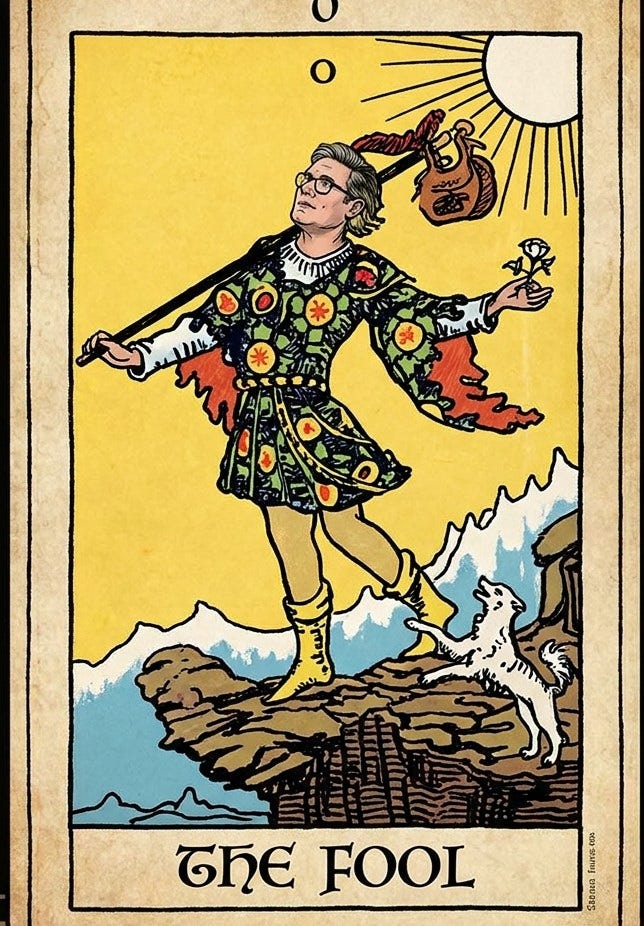
So let’s continue with the headline image of this piece. The Fool.
In Tarot, the Fool is card zero.
Zero. The beginning. The figure who stands at the start of every journey, at the edge of every cliff, full of everything he knows, everything he has learned, and everything he believes himself to be.
And steps forward.
The Fool is not stupid, by any means. Most people misread this, and the argument that follows depends on getting it right.
The Fool is not corrupt. Not malicious. Not lazy. Not incompetent in the ordinary sense of the word.
The Fool is a man of genuine capability who has made one specific error.
He has assumed that what made him exceptional in the place he came from will make him exceptional in the place he is going.
He cannot see the cliff because he is too busy being good at walking. In this instance, from one career to another.
Keir Starmer was Director of Public Prosecutions — head of the Crown Prosecution Service. By the available evidence of some, possibly most, he ran it well. Methodical. Forensic. Process-driven. Evidence in. Decision out. That is a genuine achievement and it deserves to be called one.
You see, and quite rightly so, the CPS does not negotiate with the evidence. It does not ask the evidence how it feels. It does not hold a consultation with the evidence, publish a response document, receive lobbying from the evidence, or discover mid-process that the evidence has changed its mind and now wants something entirely different. The CPS takes the evidence and applies the law.
Mind you. Sixty-seven million people are not evidence.
However.
What is evident is that a government department is a machine.
Whereas, a country is not.
A country is a living system with sixty-seven million people in it, none of whom read the manual, none of whom behave predictably, and all of whom have competing and often irreconcilable interests. It requires — above all other things — the capacity to read what is in front of you rather than manage what is in front of you.
Both entirely different skills. Wouldn’t you say?
You see. One is learned in institutions. The other is learned in the world. Feel free to correct me, if otherwise.
Simply because, a man who is genuinely good at the wrong thing is much harder to argue with than a man who is simply incompetent.
Of course. Some will say this is unfair. That running the CPS is genuinely difficult and that any Prime Minister inherits impossible problems. Both things are true. Neither is the argument being made here. The argument is narrower and more specific: that there is a gap between knowing how to run a department and knowing how to run a country, and that gap — in this case — is the size of a country.
Let’s be clear. Starmer has not risen to incompetence. He has risen to a domain where his specific form of competence does not transfer.
That is more troubling than incompetence.
Incompetence you can identify and replace.
This is neither. And, it leads to The Spread Nobody Wanted To Read.
Now, before we look into the construction, we need to understand the materials.
Because this was not a fresh deck.
Previous governments — Conservative, Coalition, New Labour before them — each drew cards and left them face up. Each deferred the reading that would have told them what the spread meant. Each passed it on, heavier than they found it, to whoever came next.
What could be construed as ‘hidden in plain sight’ — the cards were face up for decades. The meaning was available to anyone who looked. No one did. Maybe, we should let that sit while asking ourselves why.
While doing so, and, before we go further — the failures that follow do not belong solely to Starmer. Some will read this piece as an attack on Labour. It is not. The inherited rot is real, it is documented, and it is its own indictment of the governments that created it. What Starmer chose to do with what he inherited — that is a separate question, and it is the one this piece is asking.
Historically, the Labour Party was founded in 1900. Founded by workers, for workers, in a world where workers meant something specific.
Mills. Mines. Shipyards. Docks. The factory floor.
The trade union as the natural unit of collective life because the workplace was collective life. The Labour market — the actual, literal Labour market — was the constituency.
The party’s name was not a metaphor. It was a job description.
And, that world has now gone.
The pit closures didn’t just close pits. They closed the social architecture that made a man in Sunderland or Barnsley or Merthyr Tydfil know, without ever being told, who he was and who his politics were and why those two things were the same thing.
What followed? A precarious market replaced it. Built on shifts and platforms and zero-hours contracts and gig work that is not employment, and self-employment that is not freedom.
A market designed, in some cases, to make organising impossible.
The people who work in those warehouses have no union. The people on those platforms have no canteen. The people on zero-hours contracts have no colleagues in any meaningful sense — they have shifts.
You do not build a movement on shifts.
And, this, friends, is the card at the bottom of everything. Placed not by Starmer, not by the Conservatives, not by any single government. Placed across fifty years by the economy itself, while every political party looked the other way and left it for the next one.
Nobody sorted it.
Because sorting it would have required admitting that the Labour Party’s central problem is not its policies, not its leader, not its messaging.
It is that the people it was built to represent no longer exist in the numbers, or the form, it was built to serve.
Simply because, identity problems do not have manifestos.
And then, when the Conservatives had finished adding their own cards — and they added plenty — they left the whole thing face up on the table, walked out of office, and handed Keir Starmer a Tarot spread that any competent reader would have recognised immediately.
The NHS four-hour A&E standard has not been met since July 2015. Four Prime Ministers before Starmer. Not once.
The Legal Aid Agency’s cyber risk had been on its own risk register since 2021. They knew. They spent £50 million on security improvements. They passed it on anyway.
The Home Office asylum contracts — described, on the record, by people paid to describe things accurately, as failed, chaotic, and billions over budget — arrived fully broken. That is not rhetoric. That is the parliamentary record.
The digital infrastructure rot is a structural characteristic of UK government IT that transcends party politics entirely. It does not belong to any single government. It belongs to all of them. Every last one.
The spread was pre-loaded. Any Prime Minister who sat down at that table was going to be looking at compromised cards on an unsteady foundation. Regardless of what colour flag they nailed to their political mast.
In this instance, though, it was Keir Starmer who picked them up.
He was shown every card. He was told what each one was.
And he began to build with the cards that follow.
The Deck.
The welfare card.
March 2026. The Office for Budget Responsibility confirmed it.
For the first time in British history, welfare spending has overtaken income tax revenue.
£333 billion spent. £331 billion raised.
The state is now spending more on people who are not working than it collects from people who are.
The country that invented the welfare state is now spending more on it than it earns from the people it was built to support.
The two-child benefit cap, lifted. The triple lock, protected and enhanced. Welfare reform, not attempted.
The OBR projects welfare reaching £407 billion — 11.2% of GDP — by 2030/31.
That is not a projection. That is a destination.
Cards Placed.
The jobs card.
711,000 vacancies. The lowest level since early 2021.
2.5 unemployed people for every available job — the highest ratio since 2015.
The Employers’ National Insurance hike, delivered in Starmer’s first budget, sent a chill through private sector hiring that is still sitting in the bones of the labour market.
Pay growth at 3.8%. Among its softest rates in five years.
More people. Fewer jobs. Less pay.
A market contracting quietly, without drama, the way water drains from a bath.
Nobody announced it. It is just happening, in the background, while Starmer concentrates on the next card.
Card placed.
The NHS card.
7.25 million people on the waiting list.
The four-hour A&E standard — 95% of patients seen within four hours — unmet since July 2015.
Not occasionally. Continuously. Eleven years. Four Prime Ministers. Every announcement, every reorganisation, every promise, every plan.
In the worst months, more than half of all patients at major departments waited longer.
Over one in seven people in the UK is projected to wait longer than six months for treatment by the end of this year.
The NHS card was already leaning when Starmer arrived. He placed his cards on top of one that was already in motion.
It is rather like inheriting a leaking roof and deciding the priority is interior decoration.
Card placed.
The justice card.
May 2025. The Legal Aid Agency was hacked.
Not a minor breach.
One of the most sensitive data breaches in British history — 18 years of records exposed.
Criminal histories. Domestic abuse files. Home addresses.
The addresses of people who had moved to escape the people who now had their addresses.
The Ministry of Justice had known the risk was “extremely high” since 2021.
They spent £50 million on security improvements.
Fifty million pounds. To protect data they then failed to protect. At some point, you have to admire the consistency.
It happened anyway. The system came down. Justice went offline. Literally offline.
Card placed.
The Home Office card.
Asylum accommodation: chaotic, unlawful, billions over budget.
A judicial review found the practice of ending asylum support after 28 days unlawful.
The prisons watchdog identified continued operational failures.
Peers criticised the absence of any coherent plan.
Described, repeatedly, on the record, by people paid to describe things accurately: a department that cuts corners, wastes money, and has no clear long-term strategy.
They have been saying this for years. The department has been listening. It just hasn’t been responding.
Card placed.
The digital infrastructure card.
HMRC. £47 million. A basic phishing attack.
GOV.UK One Login — the government’s own flagship digital identity system — lost its own security certification.
The Foreign Office: hacked by suspected state actors.
Multiple London councils: breached simultaneously.
A Cabinet Office review that found the exact same failures independent analysts had been identifying for years — buried for over a year.
Not fixed. Not published. Buried. The Government reviewed its own failures, confirmed them, and then decided the public didn’t need to know.
Card placed.
The defence card.
Committed to NATO spending levels.
Not funded in any budget.
Rhetoric in one column, arithmetic in another, and nothing connecting the two.
This is the political equivalent of signing up to run a marathon and not buying the trainers. Except the marathon has already started. And someone has closed the road.
In a world where the Strait of Hormuz has been effectively closed since 4 March and oil prices have risen 95% in a single quarter, a defence funding gap is no longer an accounting footnote. It is a structural wound.
Card placed.
The energy card.
This one is different. It arrived from outside the room.
Nobody carried it in. Nobody invited it. The door just opened and there it was.
Saudi Aramco — the world’s largest oil company, state-owned, run by an absolute monarchy, answerable to nobody in the Westminster chamber — reported a 26% year-on-year profit jump this week.
Their East-West Pipeline: seven million barrels a day, rerouted past the Strait that Iran has closed.
Brent crude up 67% year-to-date.
The Aramco CEO said it plainly: even if trade flows resume today, the oil market will not normalise until 2027.
Rising energy costs feed into inflation. Inflation feeds into benefit demands. Benefit demands feed into borrowing. Borrowing feeds into the welfare card. The one that has already fallen.
An absolute monarchy is making extraordinary profits from a geopolitical crisis, and the proceeds are compounding the structural failures of a liberal democracy. That is the world we are currently in.
Nobody in Westminster placed this card. However, it is in the construction now, and it is the heaviest card on the table.
Card placed.
The electoral mandate card.
7 May 2026. Four days ago.
Labour lost 1,496 councillors. Labour lost control of 38 councils.
Some Labour MPs called publicly for Starmer to resign.
Reform UK won 27% of the national vote. Labour won 15%.
For the first time in nearly 50 years, Labour lost Tameside — the council area that contains Angela Rayner’s own constituency.
The party’s former deputy leader. The heartland of the heartland.
The votes did not flow to one opponent. They flowed in four directions at once — to Reform, to the Greens, to the Liberal Democrats, and away.
The electorate did not choose an alternative. It fragmented away from Labour simultaneously in every available direction.
That is not a protest vote. That is a dispersal. People are not going somewhere. They are leaving.
Polling expert John Curtice confirmed what the numbers already showed: none of the political parties now have the support of a substantial section of the public.
This card was not placed by Starmer.
It was placed by 1,496 Labour councillors who lost — and not just by the seat of their pants.
Card placed.
Now. Between us. Let’s count them.
Nine cards. Each one either falling, already fallen, or — in one case — placed four days ago by the electorate.
That done. Now look at the chamber.
The Chamber.
On the Opposition benches: quiet. The particular quiet of people who have done the calculation and found that silence is currently worth more than intervention.
On the Labour benches: held breath — from those who aren’t already briefing journalists.
And in the middle: Starmer. Concentrating. Reaching for the next card.
The House of Commons. More like the House of Commotions.
Eleven ministerial resignations since 2024 — the second highest of any Prime Minister at this point in their first term. With seemingly little evidence of cross-departmental working. The rhetoric about rewiring the state has not translated into outcomes.
Is it practical? You cannot sustain a welfare bill that has overtaken income tax revenue while presiding over a contracting jobs market, a 15% vote share, and a global energy crisis simultaneously.
Is it logical? Each card placed makes the next card more dangerous. That is not opinion. That is physics.
What is the likely outcome? There is a man in the corner of the room who has been running the numbers.
Let’s, for the sake of argument, call him The Card Counter. Shall we?
You see. There is a forecasting group that does not work for any political party.
That group is the EY ITEM Club — the only non-governmental forecasting group in the UK that uses HM Treasury’s own economic model. There’s not a model like it. They have been doing this for 25 years. And. More importantly. They have no political interest in the answer either.
Their verdict. And, you might want to take more than a moment or two with this.
The UK economy will flatline in Q2 and Q3 of 2026.
GDP growth for the year: 0.7%. Down from 1.4% last year.
The jobs market will suffer its biggest hit since the pandemic.
Unemployment will peak at 5.8% by mid-2027. Almost 250,000 more people out of work.
163,000 jobs forecast lost this year alone.
The UK, in the ITEM Club’s own careful language, will flirt with recession.
Their chief economic adviser, Matt Swannell: “Spiralling energy costs and disruption to supply chains will push the UK to the brink of a technical recession in the middle of this year.”
These are HM Treasury’s numbers. Run through HM Treasury’s model. By people with no interest in the political consequences of the answer.
And they were calculated before anyone fully priced in what happens if the Strait of Hormuz stays closed. That said, shall we take a few moments for all of that to fully register, before taking a breath, and the next piece?
So. How long does it last?
Well. The Strait has been effectively closed since 4 March 2026, and it’s now in its third month. When fully operational, it carries approximately one fifth of the world’s seaborne oil and gas.
At three months — already here, or days away — Allianz Research is explicit: the impact becomes recessionary. Not approaching recession. Recessionary.
At six months — if it remains closed through summer — Oxford Economics has run the model.
Global oil at $190 a barrel.
Global inflation at 7.7%.
You see. Unlike 2022, when the world absorbed the energy shock and kept growing, Oxford Economics concludes that a six-month closure tips the global economy into outright contraction.
Ken Griffin, CEO of Citadel — one of the world’s largest hedge funds, a man whose entire professional existence depends on being right about this — was asked directly and answered without decoration: “Let’s assume the strait is shut down for the next six to twelve months — the world’s going to end up in a recession. There’s no way to avoid that.”
You might now want to take a further minute to read that again.
In straight talking language, ‘there is no avoidance!’
Even the National Institute of Economic and Social Research stated, categorically: even if the war ends this year, the Hormuz energy shock will wipe approximately £35 billion from the UK economy over the next two years. That is the optimistic projection.
The Aramco CEO — profiting from every day the strait stays closed — has already told us: even if trade flows resume today, the market will not normalise until 2027.
Yes. 2027.
And, guess what. The welfare card does not sit still while this is happening.
The OBR projected £407 billion by 2030/31. That projection was made before the blockade. Before the energy shock. Before 163,000 jobs lost this year. Before unemployment heading to 5.8%.
More unemployed means more claimants. Higher energy costs mean more in-work support. An economy flirting with recession means lower tax receipts.
Which means the gap between what welfare costs and what income tax raises gets wider — not narrower — with every passing month.
The construction is not a future risk.
Parts of it have already fallen.
The Legal Aid Agency card: fallen. The data is gone.
HMRC: fallen. £47 million. A phishing attack.
The welfare card: fallen — the historic first, confirmed, no longer a projection.
The jobs card: in motion. 163,000 positions forecast lost this year.
The electoral mandate card: placed four days ago by 1,496 Labour councillors who lost — and not just by the seat of their pants.
The energy card is not wobbling.
It is on fire.
And yet the chamber is still building.
Some will ask: what is the solution? Wrong person to ask. You know. I just write this stuff.
Okay. All That Said. What These Cards Actually Are.
So. Let’s continue on the premise that a house of Tarot cards falls and you gather them up.
Then. You lay them back out the way they were meant to be laid. Face up. In sequence. Reading what they say.
The carpet is undamaged. Nobody is hurt. It is, in fact, the only sensible thing to do with a Tarot deck.
However. Nobody in that chamber is reading them.
So. When the welfare card shifts, pensioners cannot heat homes.
When the NHS card moves, people wait in corridors — not as a figure of speech, but in actual corridors, on actual trolleys, in actual pain, wondering why nobody is coming.
When the justice card wobbles, domestic abuse survivors find their home addresses in the hands of the people they moved to escape.
When the jobs card falls, families lose income they do not have reserves to replace.
When the energy card tilts, businesses that have been trading for decades close on a Tuesday with no announcement and no ceremony.
Again, it must be stated. Starmer did not draw this spread.
The spread was pre-loaded before he arrived.
The foundational card — the disappearance of the Labour market that the Labour Party was built to represent — was placed across fifty years by forces no single government created and none can control.
The inherited failures from the governments before him are documented, real, and their own indictment of their own administrations.
Some will say this proves the argument against Starmer is unfair. It does not. Fairness requires acknowledging what he inherited. It does not require pretending he had no choice about what he did next.
However.
Keir Starmer sat down at that table in July 2024.
He was shown the spread.
He was told what each card was.
And the Fool — card zero, the figure of genuine capability at the beginning of the journey — looked at a Tarot spread that was already telling its story, picked the cards up, and began to build.
Not because he is stupid.
Not because he is corrupt.
Because he is a man who learned to manage institutions, and arrived at something that is not an institution, and did not know the difference until the construction was already too tall to stop.
Card by card. Each one presented as necessary.
Each one placed with the particular focus of a man who has decided that the only available option is to keep going.
Tongue slightly out. Hands steady. Reaching for the next one.
In a room where a draught has been building since 4 March from a narrow waterway twenty-one miles wide on the other side of the world that nobody in Westminster controls and nobody in Westminster can close.
The card counter has done the arithmetic.
The ITEM Club is running HM Treasury’s own model.
Oxford Economics has modelled the six-month scenario.
The IMF has issued the largest UK growth downgrade in the G7.
Ken Griffin has said there is no way to avoid it.
The electorate has delivered 1,496 councillors’ worth of verdict in a single night.
Four cards are already on the floor.
Two are in motion right now, today, as you read this.
The three-month recessionary threshold is either here or days away.
The next structural failure is three to five months away.
And if the Strait stays closed through summer, the compounding lands on the welfare card, the jobs card, and the borrowing card simultaneously before the end of 2026.
And the Fool is still reaching for the next card.
The Tarot spread was always going to tell this story.
The cards were always going to fall.
The only question — the one nobody in that chamber is prepared to answer out loud — is this:
How long does the Fool still stand while the cards collapse around him?
He is not standing at the edge of the cliff.
He is already one step off it.
© 2026 John Langley / The Almighty Gob. All rights reserved. Where reproduced, John Langley must be named as source in full.
The Almighty Gob is a Bristol-based publication founded by John Langley — independent Bristol mayoral candidate 2016 and 2021, and one of the city’s most forensic observers of institutional power. Publishing since 2020, with over 500 pieces across seven platforms and Substack at thealmightygob.com — no party allegiance, no press accreditation, no interest in acquiring either.
I usually like your writing, but I don’t like this one. Starmer is not a fool. I accept all your premises. It was clear when he took Office how badly the country was shafted. Everything has been gutted by the Tories for 15 years. We were systemically asset stripped, we were taken through Brexit, and a huge amount of the countries wealth was funnelled into the hands of a few. But this is not unique. It’s happening all over the world. And whilst your description may be more more or less less accurate, what you don’t say is what he should’ve done.
What other choices did he have? You haven’t said anything about the things he has achieved, just like so much of the media today. Everyone spends time saying how he’s failing, no one points of what he’s doing well. For example, the NHS waiting list have got shorter.
So much of what is happening is out of his control. He’s hardly to blame if the world goes into a recession. I think the choice he made today of looking up and out at the EU, and taking the decision to head back that way represents the best chance we actually have of getting through this coming crisis, of saving the economy and kickstarting the jobs market again, especially with the focus on bringing defence production back home out of the US.
I don’t see this piece of writing is helpful. The inherited issues are accurate, and your description of Starmer’s history and character is also reasonable, but casting him as the fool is uncharitable and unhelpful. He’s been dealt a shitty deck. I don’t think any of the current set of politicians wants to step into his role. He’s made a bold choice. It’s about time the bloody media gave him a chance.